

When someone asks me if double-pane is “enough” in North Carolina, I ask which way their worst room faces.
Usually it’s the west side that cooks by 4pm, or an old single-pane where the cold pours straight off the glass in January.
The honest answer is that for most NC homes, a good double-pane already solves the real problem. But “double-pane” alone is not a quality promise. The glass package inside it is.
Why double-pane is the NC standard
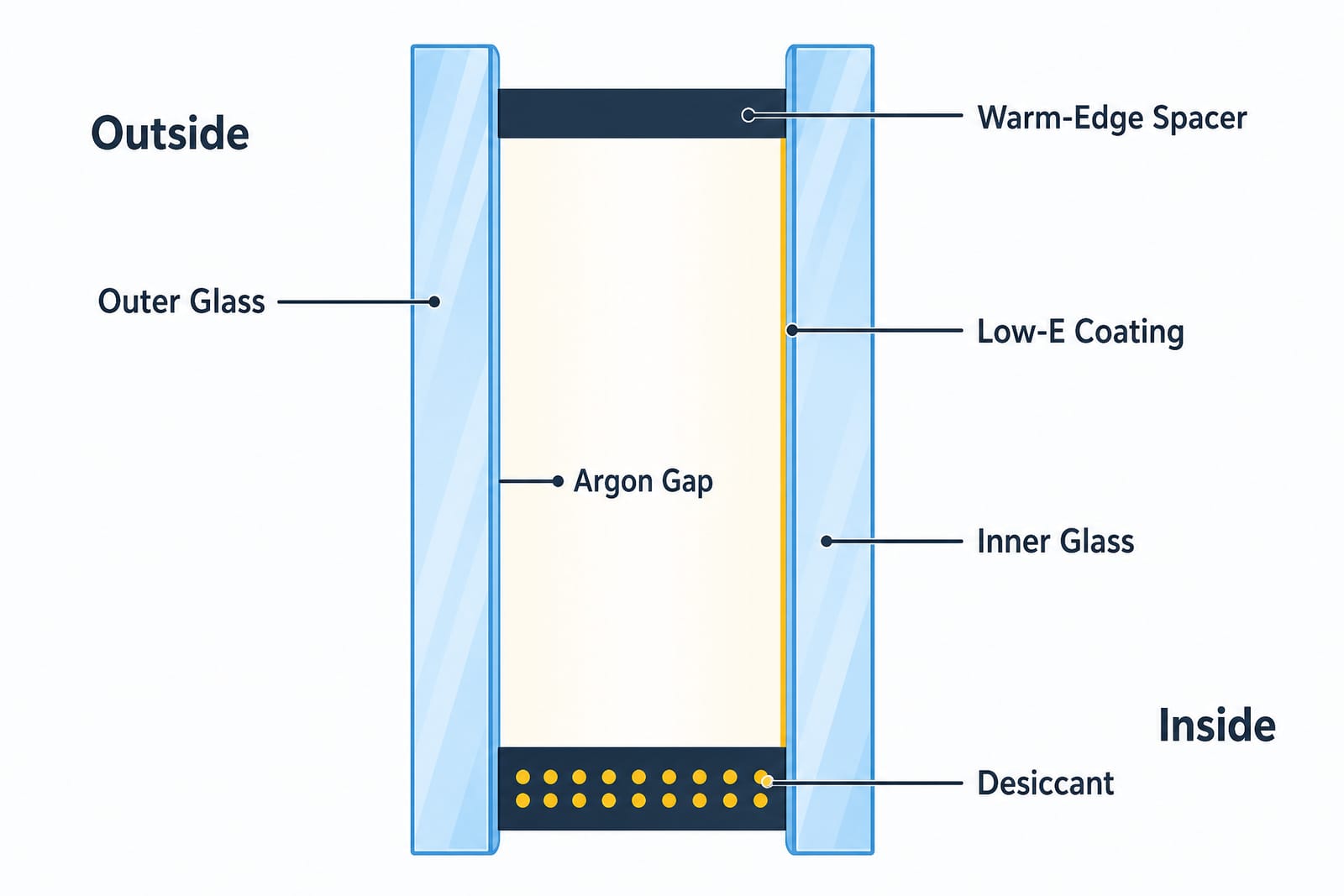
The insulating gas gap plus a Low-E coating handle NC’s summer solar heat, which is the real problem here — not deep-winter cold. A double-pane is an : two panes of glass separated by a sealed, gas-filled gap, held apart by a spacer and closed by an edge seal. Think of it as a sealed thermos — two walls with still gas between them, not one thick pane.
That build-up stops heat three ways at once: the gas gap slows conduction, the still carries less heat than plain air, and the coating reflects radiant heat back where it came from.
In a cooling-dominated state like NC, that’s exactly the work that needs doing.
What makes a good double-pane (vs a bare one)
The panes are the same everywhere — the package is the difference. Two windows can both be “double-pane” and perform nothing alike. Here’s what actually moves the needle:
- Low-E coating — a microscopically thin metallic layer that reflects heat and UV while letting light through. For most of NC, you want a soft-coat Low-E (sputtered, sealed inside the unit). It blocks more solar heat than the hard-coat type.
- Argon fill — the inert gas in the gap. It can improve the unit’s insulating value by up to roughly 16% versus plain air, but only when the fill rate is high (the target is over 90%).
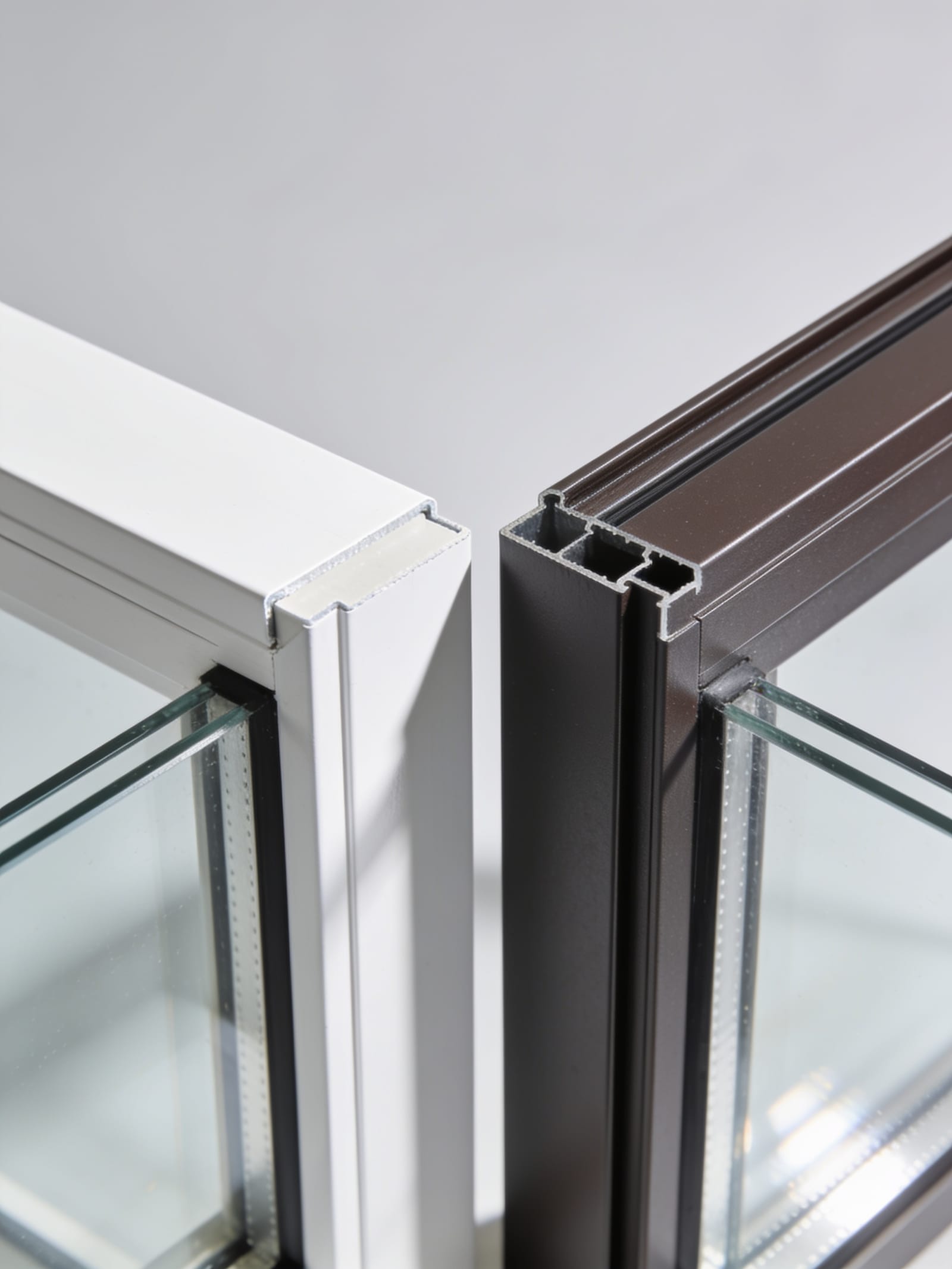
- Warm-edge spacer — the bar around the perimeter that also holds the desiccant, the drying agent that keeps the sealed gap clear. The old aluminum kind is a thermal bridge that makes the glass edge sweat. A warm-edge spacer cuts edge heat loss and reduces that interior condensation.
A bare double-pane with no Low-E is barely an upgrade. When a quote just says “double-pane,” that’s your cue to ask what’s actually in the package.
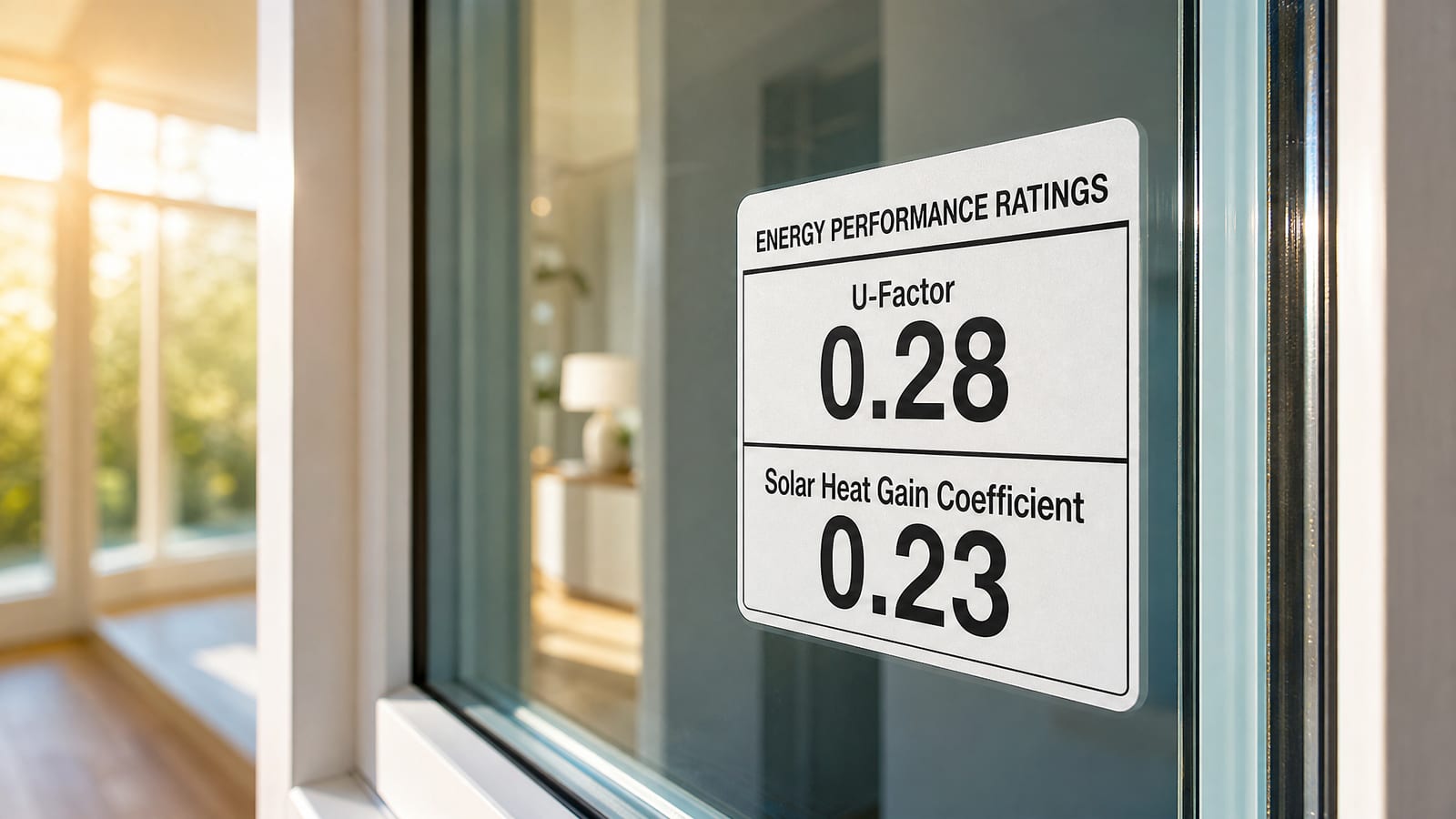
If you want a spec to hand a salesperson, targeting ENERGY STAR’s South-Central numbers — a U-Factor of 0.28 or lower and an SHGC of 0.23 or lower — is a safe, slightly conservative baseline across most of North Carolina. A good Low-E double-pane hits those without a third pane.
For the full walk-through of where NC falls on the ENERGY STAR map, see how to read the NFRC label.
Does double-pane stop NC summer heat?
Yes — with the right Low-E coating that gives you a low SHGC. is the fraction of the sun’s heat that gets through the glass. It’s the number I read first on an NC label, because we spend more of the year fighting heat than cold.
A low SHGC is the difference you actually feel on a west-facing room in July. It’s a comfort question, not a payback-math one.
The companion number is , which rates how well the window insulates (keeps heat in). It still matters in winter, but in NC, SHGC reads first. For the full label walk-through, here’s how to read the NFRC label.
Double-pane and noise
A good double-pane helps with noise some, but noise is where a third pane — or laminated glass — earns its keep. If road or airport noise is your actual complaint, that’s a different conversation, and it usually isn’t a whole-house one. I’d start with the honest version here: what actually cuts window noise.
When isn’t double enough?
When the room is genuinely noise-exposed — a busy road, a flight path — or when someone values maximum quiet and comfort over cost. That’s a triple-pane (or laminated glass) conversation by room, not whole-house.
In NC’s mild winters, the U-Factor gain from a third pane rarely pays for itself. Its real payoff is noise reduction and fewer cold spots.
So it’s a comfort upgrade you choose on the elevations that need it, not a default. The cluster hub lays out the trade-offs: how the IGU is supposed to work.
Why your double-pane fogs up between the panes
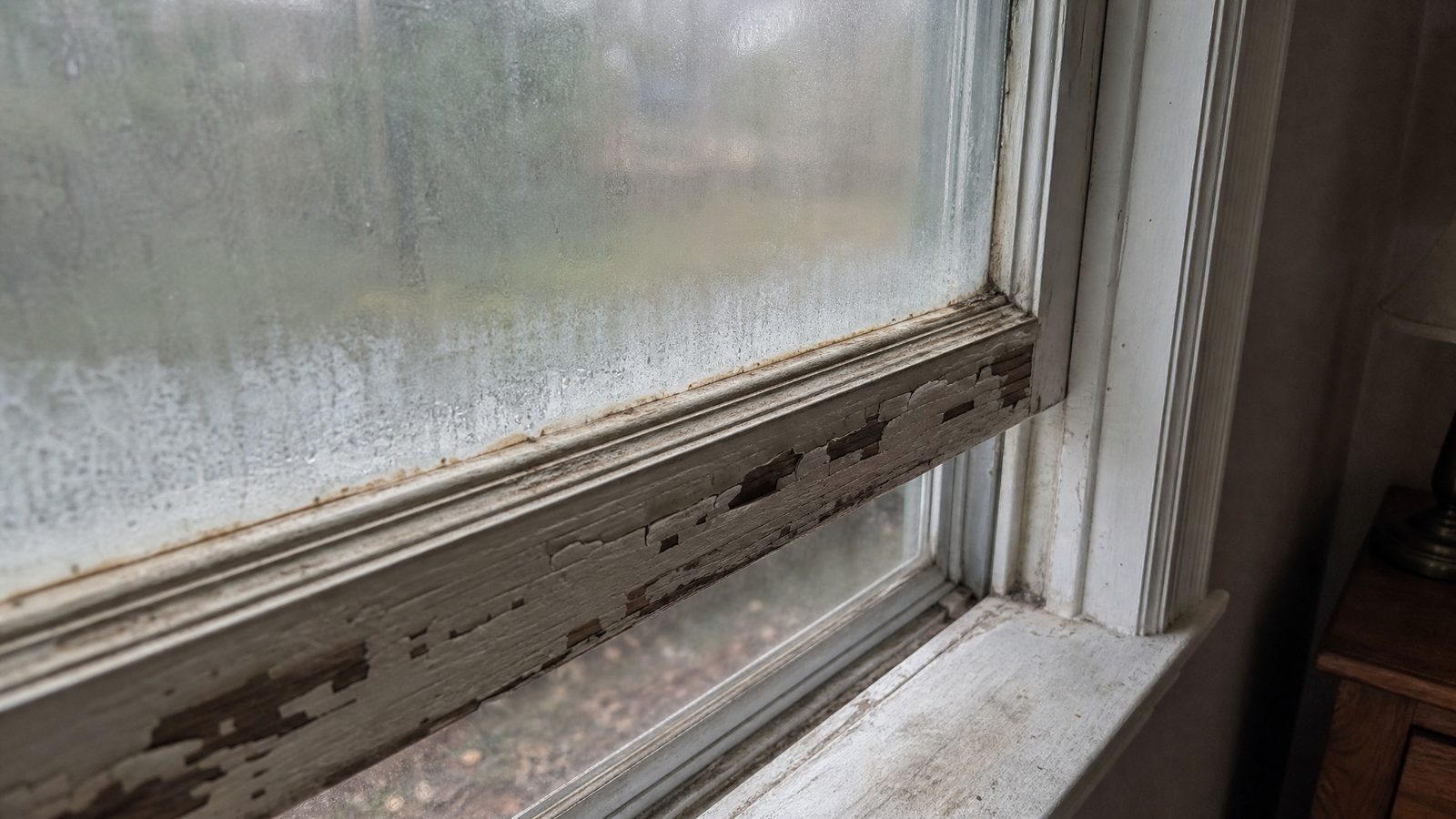
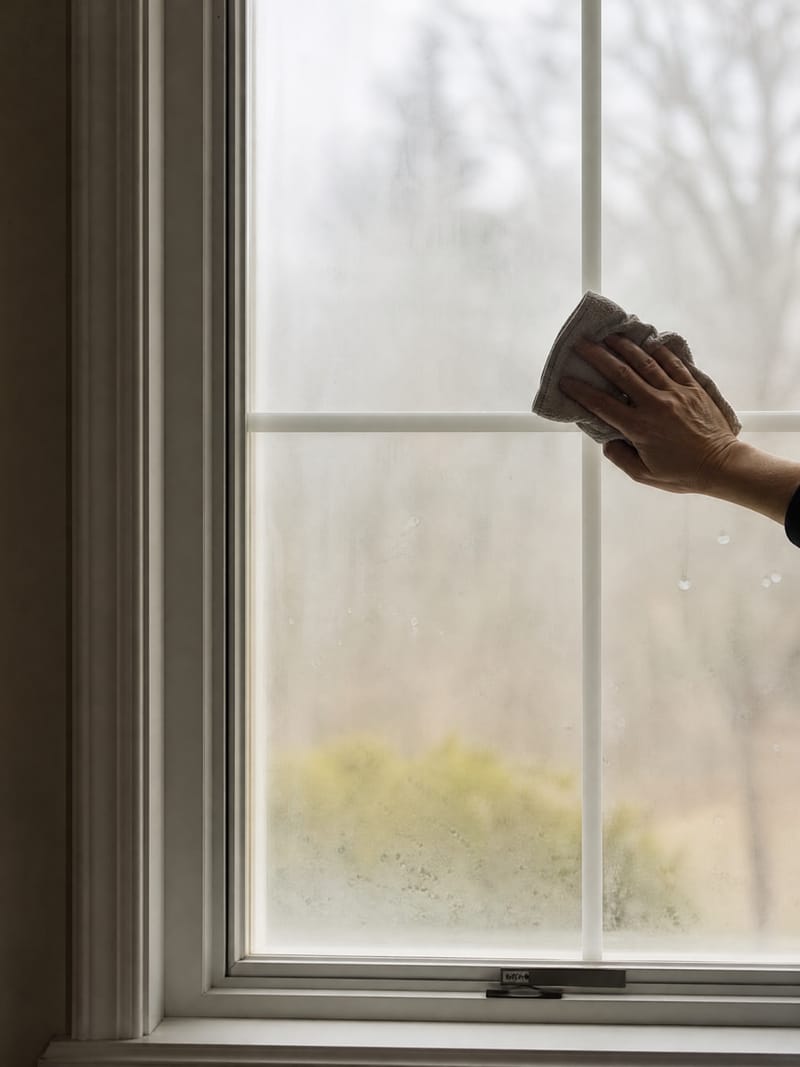
The edge seal failed — the argon escaped, humid air got in, and now moisture condenses between the panes where you can’t wipe it. That fog is the single most common NC window complaint, and it means the sealed unit is dead, not dirty.
Most seals last somewhere in the 10-to-20-year range, and NC’s heat and humidity push thermal cycling and seal breakdown along.
Be careful with “defogging.” Some firms drill the glass, dry it, and reseal the holes — but that’s a cosmetic fix only. It does not restore the seal, the argon, or the U-Factor. The unit stays degraded and moisture can come back.
The real fixes are to replace the glass unit inside a sound frame, or to replace the whole window if the frame itself is failing. Which one makes sense is a repair-or-replace call: maybe you don’t need to replace the whole window.
The glass package is where most of the comfort lives, and it’s the part that’s easiest to get talked past on a quote.
If you want someone to walk you through yours — what Low-E, what spacer, what the label actually says — that’s what a no-pressure consult is for. Get a second opinion on your quote. Your west room will notice by 4pm!
Sources, Verification & Fact-Checking verified July 2026
Every load-bearing fact on this page is sourced and verified against a primary authority.
Verified July 2026 via direct review of the cited authority — the links open the controlling source so you can check it yourself rather than take our word.
- A double-pane is an insulated glass unit (IGU): two panes separated by a sealed, gas-filled gap, held apart by a spacer and closed by an edge seal. The still gap plus a low-emissivity coating cut heat transfer by conduction, convection, and radiation. (view source — U.S. Dept. of Energy, Building Science Education)
- A low-E coating and an argon fill improve a window’s insulating and solar-control performance versus plain uncoated, air-filled glass. Low-E coatings reflect radiant heat; inert gas fills like argon insulate better than air, which is why an insulating double-pane outperforms single-pane glass on U-factor. (view source — U.S. Dept. of Energy, Building Science Education)
- ENERGY STAR window targets for NC’s primary (South-Central) climate zone (Version 7.0, effective Oct 2023): U-factor ≤ 0.28, SHGC ≤ 0.23. A good Low-E double-pane meets these; most of North Carolina falls in South-Central. (view source — ENERGY STAR criteria)
- The NFRC label is the independent, standardized rating that lets you compare U-factor and SHGC across manufacturers apples-to-apples. (view source)
- A foggy double-pane means the edge seal has failed: the argon escapes, humid air enters, and moisture condenses between the panes where it can’t be wiped. The unit has lost its gas and most of its insulating value; “defogging” is cosmetic and does not restore the seal, the argon, or the U-factor. Typical sealed-unit life runs roughly 10–20 years, though the exact figure varies by unit quality, install, and climate. (view source — ENERGY STAR, Is It Time to Replace Your Windows?)