
You’ve got two quotes on the kitchen table and a rep pushing the one he happens to sell. Vinyl on one, fiberglass on the other, and a few thousand dollars between them.
You’re trying to figure out whether the fiberglass upcharge is real value or just margin. Here’s how I’d decide between them if it were my own house. No spreadsheet required.
The short version: this isn’t a “which is better” question. It’s a “how long are you staying, and how much does decades-long seal stability matter to you” question.
Vinyl vs fiberglass: the quick verdict
Pick the frame that fits your stay-length and your house, not the one the rep sells. Here’s the decision in one block:
- Pick fiberglass if: you’re staying long-term, you want a dark exterior that won’t warp, or you’ve got the largest openings where rigidity matters most.
- Pick vinyl if: value comes first, you want genuinely good insulation, and fusion-welded corners and a lower price matter more than squeezing out the last decade of lifespan.
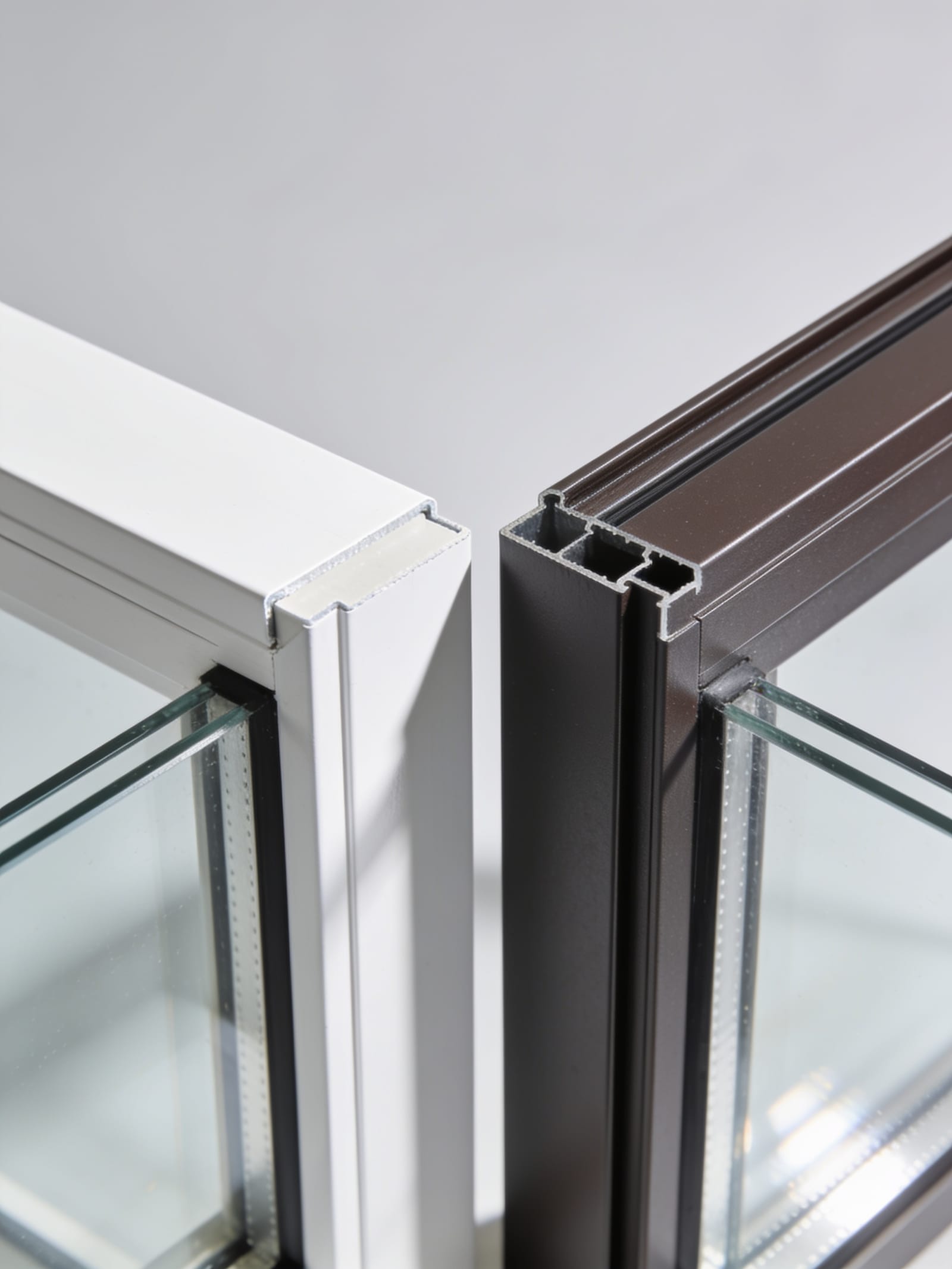
Both are good frames. The difference is thermal movement and how long that keeps the seals tight. That’s exactly the NC-climate-fit question this whole page turns on.
| Factor | Vinyl (PVC) | Fiberglass |
|---|---|---|
| Installed cost | Lower — the value pick | A real premium over vinyl |
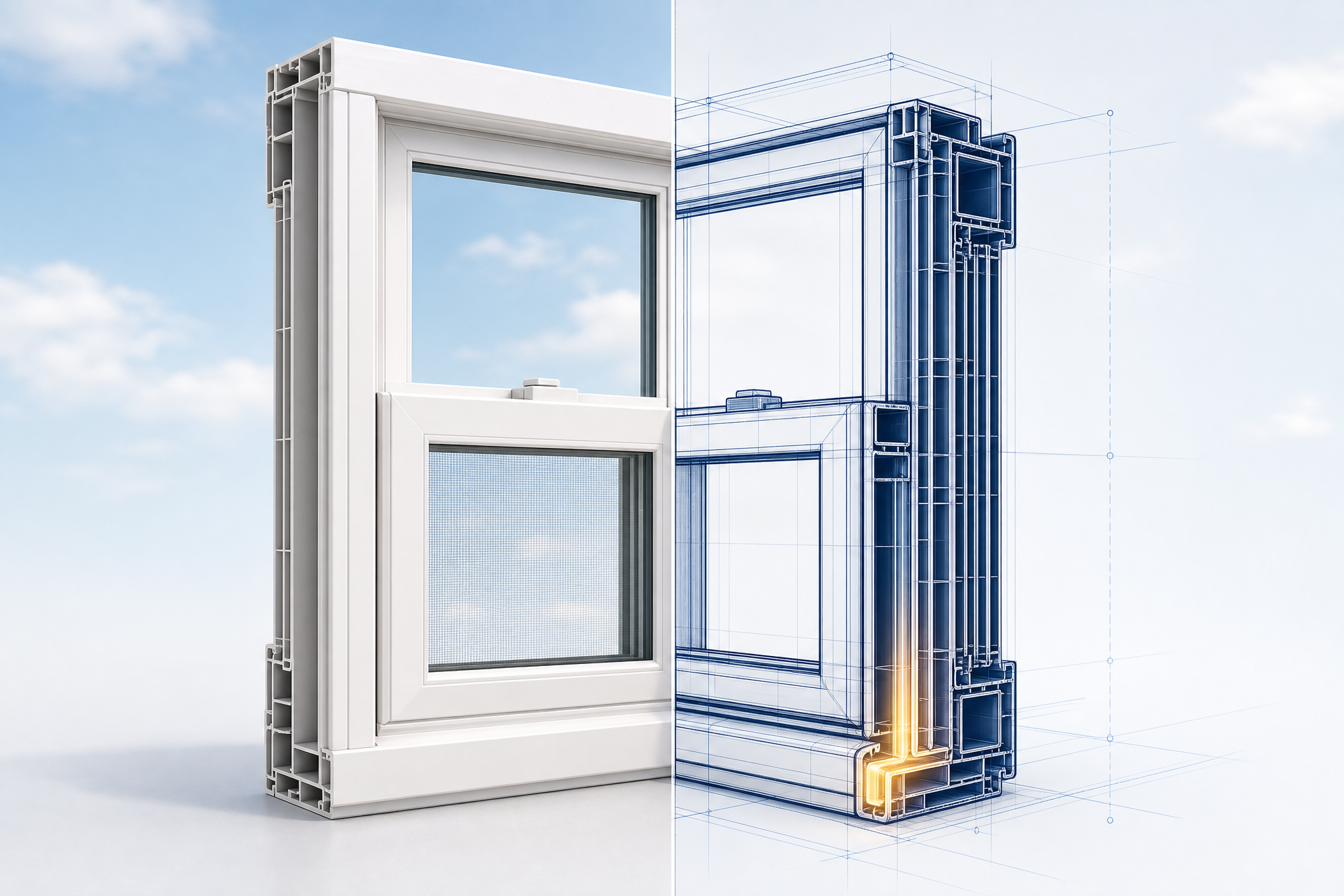
| Insulation | Genuinely good — multi-chamber, often foam-fillable | Good — dimensionally stable with insulated cavities |
| Lifespan | Long — roughly two to four decades | Longest — resists warp, rot, and rust |
| Thermal movement / seal stability | Most movement of the common frames — stresses seals over years | Lowest movement — tracks the glass, so seals stay tight for decades |
| Maintenance | Low — never needs paint | Low — but can be painted if you want a new color |
| Corners | Fusion-welded (heat-fused into one piece) | Mechanically fastened |
| Dark-color tolerance | Color runs through the material, but dark vinyl can warp in full sun | Carries a dark or painted exterior without warping |
| Best for | Value-first buyers who want good insulation | Long stays, big openings, dark exteriors |
Installed cost
- Vinyl (PVC)
- Lower — the value pick
- Fiberglass
- A real premium over vinyl
Insulation
- Vinyl (PVC)
- Genuinely good — multi-chamber, often foam-fillable
- Fiberglass
- Good — dimensionally stable with insulated cavities
Lifespan
- Vinyl (PVC)
- Long — roughly two to four decades
- Fiberglass
- Longest — resists warp, rot, and rust
Thermal movement / seal stability
- Vinyl (PVC)
- Most movement of the common frames — stresses seals over years
- Fiberglass
- Lowest movement — tracks the glass, so seals stay tight for decades
Maintenance
- Vinyl (PVC)
- Low — never needs paint
- Fiberglass
- Low — but can be painted if you want a new color
Corners
- Vinyl (PVC)
- Fusion-welded (heat-fused into one piece)
- Fiberglass
- Mechanically fastened
Dark-color tolerance
- Vinyl (PVC)
- Color runs through the material, but dark vinyl can warp in full sun
- Fiberglass
- Carries a dark or painted exterior without warping
Best for
- Vinyl (PVC)
- Value-first buyers who want good insulation
- Fiberglass
- Long stays, big openings, dark exteriors
What’s the cost difference?
Fiberglass typically runs a real premium over vinyl — but treat that as paying for stability, not as an bet. The honest framing is stay-length: a longer-lived, tighter-sealing frame is worth more to someone staying twenty years than to someone selling in five.
I’m keeping this relative on purpose. Real NC dollars belong on the cost page, not a national average dropped into a sentence. Here’s what each one costs in NC.
How much more? Enough to notice on a whole-house quote, but the gap moves with brand, glass package, and installer. That’s exactly why I won’t pin a percentage to it here.
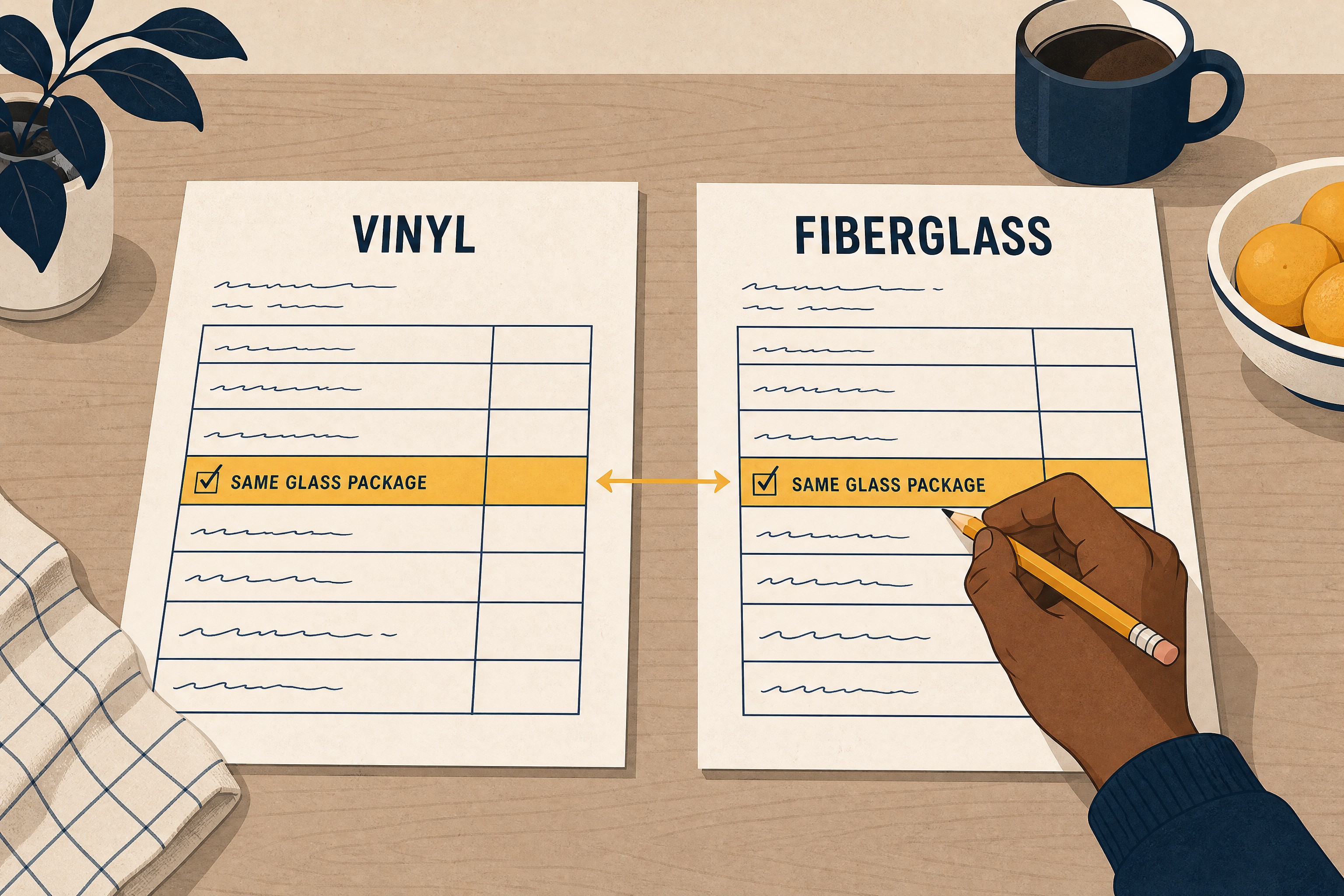
Ask both reps to price the same glass package on each frame, and the real premium for your house shows up on paper — right there on the kitchen table.
Which lasts longer?
Fiberglass lasts longer and shrugs off the things that kill frames — warp, rot, rust. It’s the more durable material by a clear margin, and that’s the honest case for the premium.
Put rough numbers on it: fiberglass generally lasts on the order of 40 to 50-plus years, while vinyl runs closer to 20 to 40. Real ranges, because install and exposure move them more than the material spec does.
Fiberglass is also the stronger, more rigid material by a meaningful margin (I’ll leave the exact multiplier to the labs — the marketing figures float around and I won’t quote one I can’t stand behind).
Vinyl’s honest limit lives here too: it’s less rigid, and under extreme heat — especially in dark colors in full NC sun — it can warp. That doesn’t make vinyl junk. A quality vinyl frame is a long-lived, dependable window. It just means the ceiling is lower than fiberglass’s.
Which holds its seal in NC heat?
Fiberglass — because it barely moves with temperature. This is the technical heart of the comparison.
Fiberglass has the lowest thermal movement of the common frame materials. It expands and contracts at nearly the same rate as the glass it holds, so the glass-to-frame seal stays under far less stress and holds tight for decades.
Vinyl sits at the other end: it has the most thermal movement of the common frame materials. Day after day, summer after summer, that expansion and contraction works on the seals — and in NC’s heat, with dark vinyl in full sun, the frame itself can warp.
The frame moving more than the glass is what stresses a seal over the years.Here’s the whole argument in one picture — how much each material grows and shrinks as the temperature swings, measured against the glass it has to stay bonded to:
Which insulates better?
Both insulate well — don’t let anyone tell you one frame “wins” comfort. Vinyl () is a genuinely good insulator: multi-chamber frames, often foam-fillable. Fiberglass is dimensionally stable with insulated cavities.
They’re close enough that the frame isn’t where the comfort decision gets made.
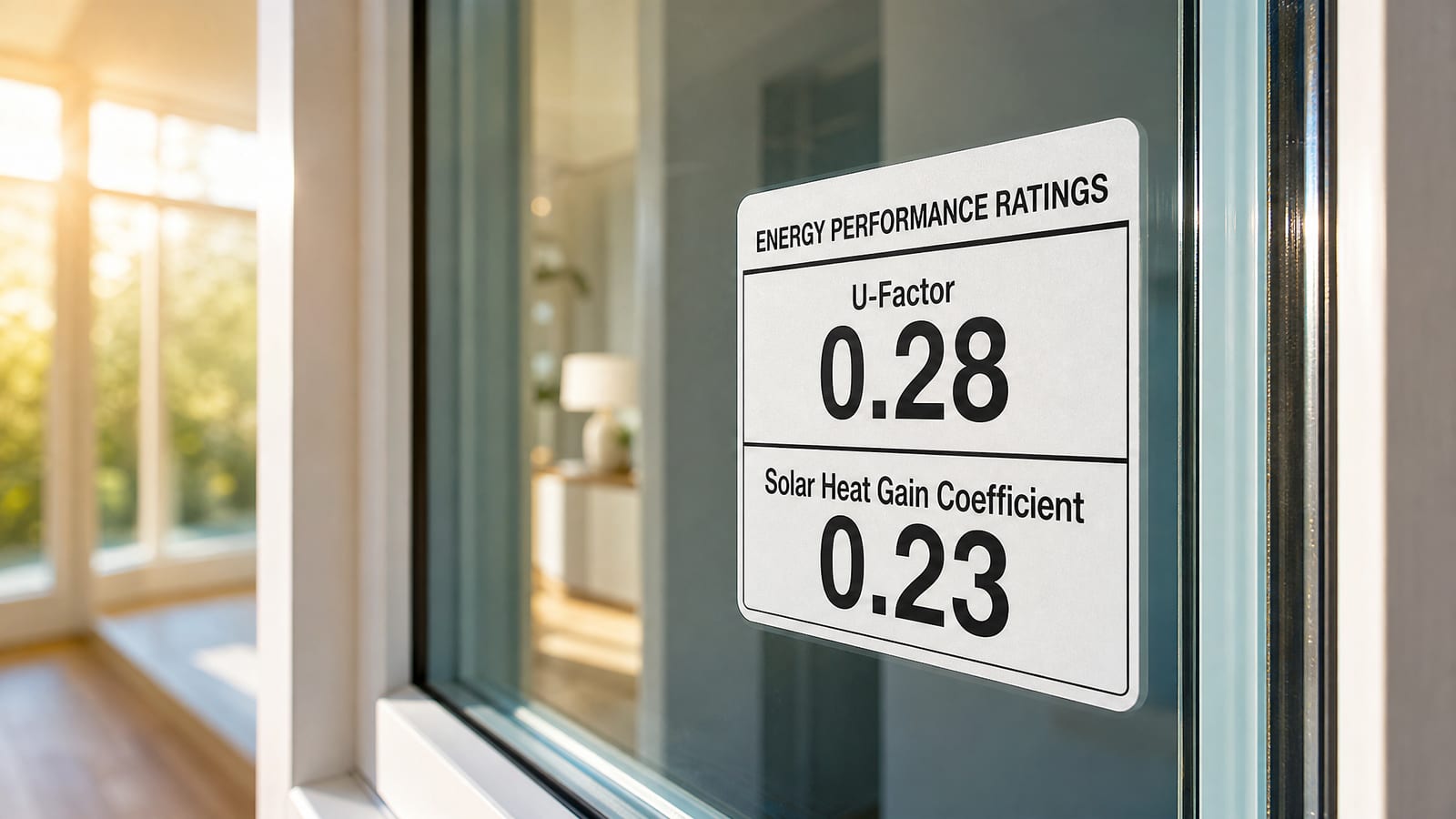
What actually decides the comfort is the glass package — the coating and argon fill — not the frame material. The whole unit’s rating tells the real story. Here’s how to let the energy label break the tie, where the and rate the assembly as a whole.
What about resale and dark colors?
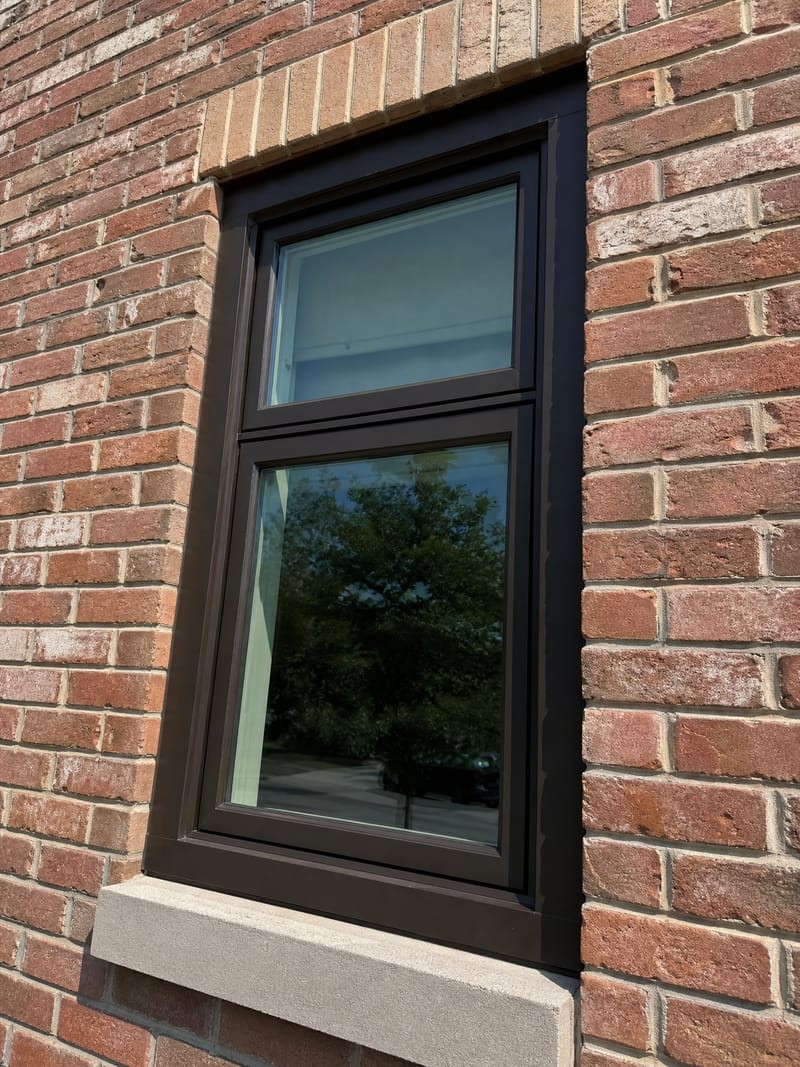
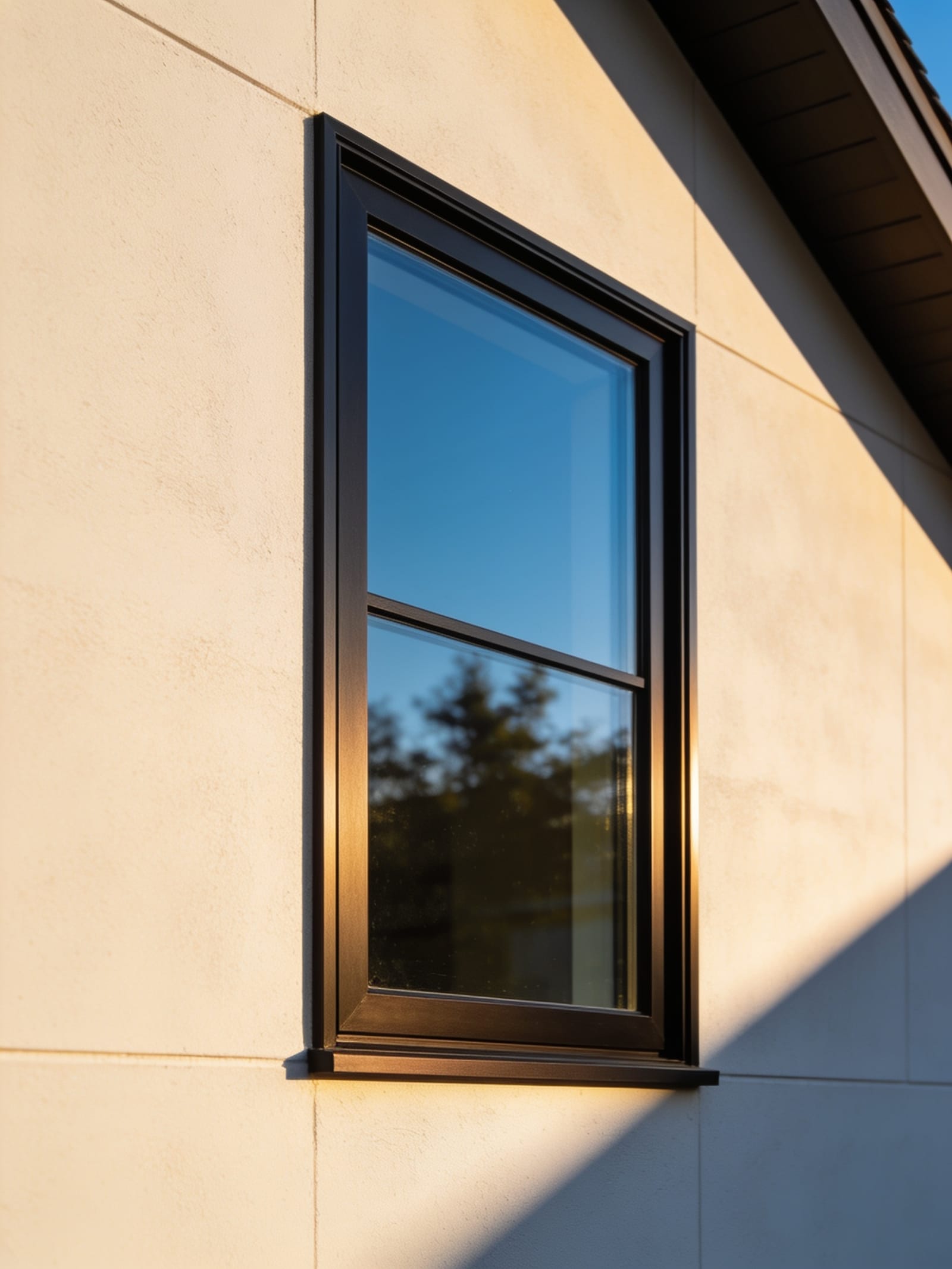
Fiberglass takes a paintable, dark exterior without warping. Vinyl’s color runs through the material, but dark vinyl can warp in full sun. If a deep bronze or black exterior is the look you want and the wall faces the sun, fiberglass is the safer call.
Vinyl’s advantage is that its color is baked all the way through — a scratch doesn’t show a different color underneath — so in lighter shades it’s low-fuss for decades.
On resale, I’d keep expectations modest: clean, efficient, good-looking windows help a sale, but I’m not going to hand you a resale-ROI number I can’t stand behind.
Which is right for your situation?
The pro truth that outranks the material debate: a premium frame installed badly loses to a mid-grade frame installed right. You’re correct to suspect the install matters more than the badge — it does.
Fusion-welded corners, a clean square set, proper flashing and sealing: that’s what decides whether the window holds its dimensional stability and “holds its seal” over the years, more than vinyl-versus-fiberglass ever will.
So validate your own instinct here, then make the frame call on stay-length.
For the wider view, here’s how to think about replacing your windows, and the detail on each frame — why fiberglass seals stay tight and vinyl’s strengths and limits. The one that decides outcomes, though, is why a clean, square install beats the frame.
NC Homeowner Takeaway: The two myths to drop are “always buy fiberglass” and “vinyl is cheap junk.” Neither holds. Fiberglass earns its premium on stay-length and seal stability. A quality vinyl is a genuinely good NC value. The real winner on either one is the install.
Want both shown side by side in your own light, with the frame movement and the glass package explained straight? Get a no-pressure second opinion — book a consult on your quote, no pitch.
Bring both quotes. The kitchen table has done its part!
Sources, Verification & Fact-Checking verified July 2026
Every load-bearing fact on this page is sourced and verified against a primary authority.
Verified July 2026 via direct review of the cited authority — the links open the controlling source so you can check it yourself rather than take our word.
- The window’s whole-unit energy performance ( and ) is rated across the entire assembly — frame, glass, and spacer — not the frame material alone. That’s why a vinyl and a fiberglass window can be compared apples-to-apples on the same label, and why the glass package drives more of the comfort than the frame does. The U.S. Dept. of Energy notes that a quoted U-factor “may refer to just the glass or glazing alone,” while “NFRC U-factor ratings, however, represent the entire window performance, including frame and spacer material.” (view source — U.S. Dept. of Energy, Building Science Education)
- The label is the independent, standardized rating that lets you compare any two windows — regardless of frame material — on the same terms. (view source)
- Vinyl and fiberglass are both recognized frame materials with genuinely good insulating performance; the ENERGY STAR criteria certify units of either material that meet the climate-zone targets. ENERGY STAR specifies U-factor and SHGC requirements by climate zone and does not restrict certification by frame material — certified windows “are available in a variety of framing materials.” (view source — ENERGY STAR criteria)
- Fiberglass frames are dimensionally stable with superior thermal performance; the qualitative thermal-movement ordering (fiberglass lowest — it tracks the glass — and vinyl highest of the common frame materials) drives long-term seal stress and seal integrity. The U.S. Dept. of Energy describes fiberglass frames as “dimensionally stable” with air cavities that give them “superior thermal performance,” and lists vinyl, wood, fiberglass, and composites as the non-conductive frame materials that lower a window’s U-factor. The exact expansion coefficients are directional and kept qualitative here, not stated as a number. (view source — U.S. Dept. of Energy, Building Science Education)
- Fiberglass generally costs more than vinyl and lasts longer; both are kept qualitative here. The cost-premium and lifespan direction (fiberglass the longer-lived, higher-cost material) reflect broad national tendencies, not NC quotes — no specific dollar figure or year count is asserted on this page; NC dollars live on the cost page.