


When someone hands me two window quotes and asks which glass is better, they usually point at the same word on both: double-pane.
Here’s the problem. Two windows can both say “double-pane” and perform nothing alike. The pane count is the label on the box. The glass package inside it is the actual product — and it’s the part you can’t see from the driveway.
So let’s open the box. Not the jargon, the thing itself.
What’s actually inside “the glass”? A modern window pane is a sealed unit — two sheets of glass with an insulating gas sealed between them, plus a coating you can’t see. It stops heat three ways, and three small upgrades decide whether it’s any good. Once you can name those three, the whole quote gets readable.
What’s actually inside the pane?
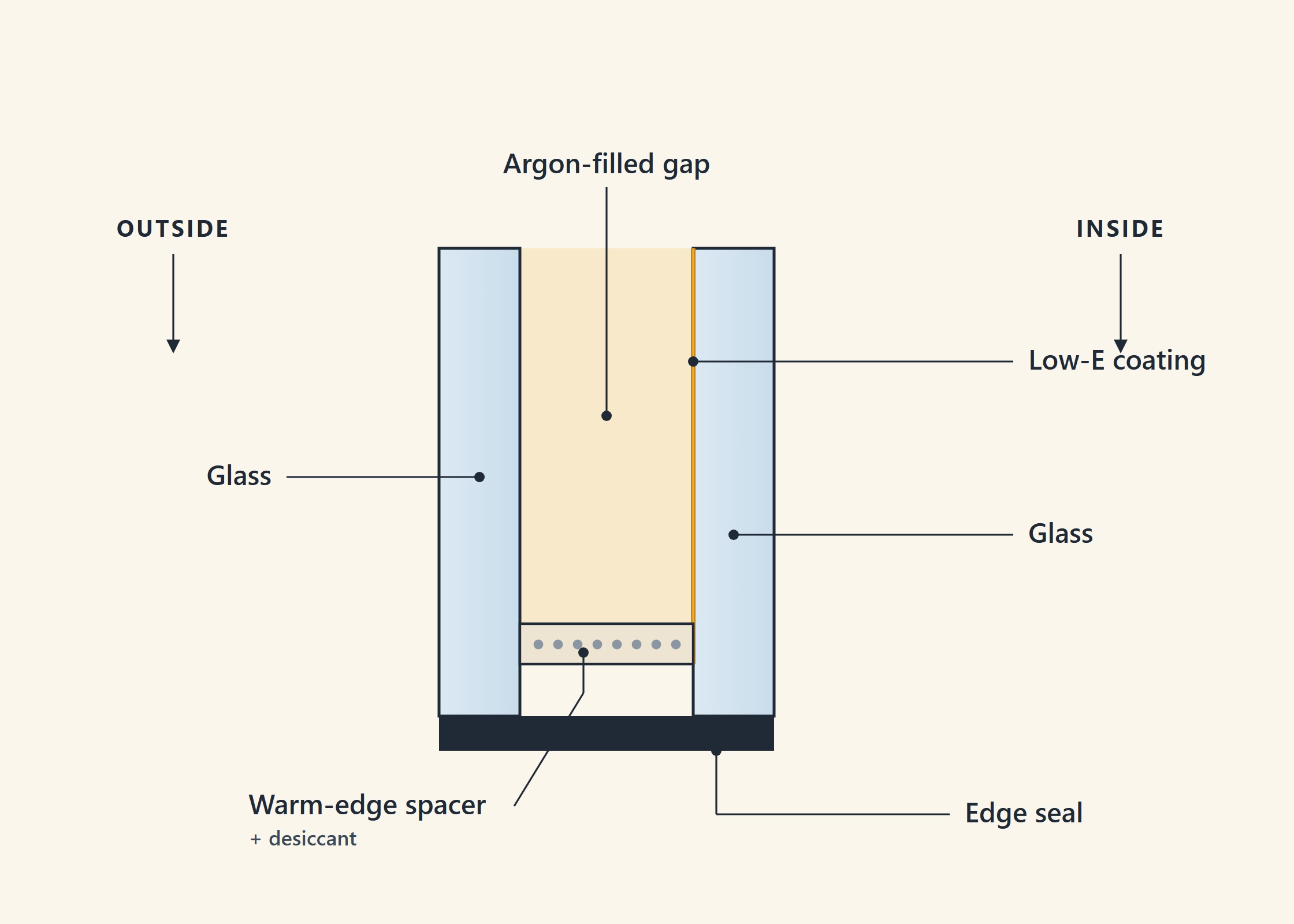
It’s a sealed — two panes of glass with a sealed, gas-filled gap between them. Think sealed thermos, not window pane. A thermos keeps coffee hot with two walls and a still layer between them. Your glass does the same thing with light.
Here’s the build-up, edge to edge:
- Two panes of glass — the parts everyone sees. On their own, they barely insulate. The magic is the space between them.
- The sealed gas gap — the still, insulating layer. Filled with an inert gas (usually argon), it’s the reason a sealed unit beats a single sheet.
- The warm-edge spacer — the bar around the perimeter holding the two panes apart. The old aluminum kind is a thermal bridge that makes the glass edge sweat; a warm-edge spacer cuts that.
- The desiccant — tiny drying beads tucked inside the spacer. They soak up stray moisture so the gap stays clear instead of fogging.
- The edge seal — the closed perimeter that keeps the gas in and humid air out. When it fails, the whole unit fails (more on that below).
- The coating — a microscopically thin metallic layer on one of the inner glass surfaces. Invisible, and it does a surprising amount of the work.
How does a window stop heat?
Heat crosses a window three ways, and each part of the glass owns one lane. This is the mechanism most quotes skip, and it’s the thing that makes the jargon finally make sense.
The sealed gap handles the first two lanes. Still gas can’t circulate the way open air does, so it slows convection. And a dense inert gas like carries heat worse than plain air, so it slows conduction too.
The Low-E coating handles the third lane. It reflects radiant heat — the longwave infrared coming off a hot roof or a warm room — back toward where it started.
| How heat moves | Which layer stops it | What that does for you |
|---|---|---|
| Conduction + convection | The sealed gas gap (argon) | Still, dense gas carries less heat than moving air — the core of the insulation |
| Radiation | The Low-E coating | Reflects radiant heat back to its source — the summer sun out, winter warmth in |
Conduction + convection
- Which layer stops it
- The sealed gas gap (argon)
- What that does for you
- Still, dense gas carries less heat than moving air — the core of the insulation
Radiation
- Which layer stops it
- The Low-E coating
- What that does for you
- Reflects radiant heat back to its source — the summer sun out, winter warmth in
That’s the whole trick. When a salesperson says “Low-E and argon,” they’re really naming the two lanes of heat this glass is built to block. Not a gimmick — a division of labor.
The three words to check on your quote
Low-E coating, gas fill, and warm-edge spacer. Those three decide whether a double-pane is genuinely good or barely an upgrade. You don’t have to memorize the whole vocabulary. You have to check whether these three showed up.
- Low-E coating. The invisible metallic layer that reflects heat and blocks most . For most of North Carolina you want a soft-coat Low-E, which blocks more solar heat. A bare double-pane with no Low-E is barely better than old glass. The full breakdown lives on how Low-E blocks heat.
- Gas fill. The argon (sometimes krypton) in the gap. It’s the invisible insulating blanket — a real, modest improvement, and usually already standard on a quality unit.
- Warm-edge spacer. The perimeter bar that also holds the desiccant. A warm-edge spacer cuts edge heat loss and the interior condensation that old aluminum spacers cause.
”Did they even put the argon in?”
Fair question — and a checkable one. This is the fear I hear most: that the gas is a line item you’re paying for on faith, or that it “leaks out in a year or two so it’s not worth it.” The data tells a calmer story.
A good sealed unit starts mostly full — the benchmark is a fill around 90%. From there the gas escapes slowly. Industry retention figures, from NFRC citing National Renewable Energy Laboratory data, put the loss at roughly half a percent per year — so a window that started properly filled still performs at about 90% of capacity after two decades.
So if you’ve heard the gas is gone by 18 or 24 months, the retention numbers just don’t support that timeline. The honest version: argon is worth having, and it’s usually already in a quality double-pane — so it’s not worth a big separate upcharge.
How do you check it’s real without lab gear? You mostly can’t measure the fill at the sill. What you can do is read the energy numbers on the label — a low U-Factor is the fingerprint of a gap that’s doing its job — and ask the installer to state the fill and spacer in writing on the quote.
Single, double, or triple — what does NC actually need?
For most North Carolina homes, a good Low-E double-pane is the answer. Triple-pane is a comfort-and-quiet upgrade here, not an energy one. More panes mean more sealed gaps and a lower U-Factor, but there’s a point where NC’s mild winters stop rewarding the extra glass.
The number I read first on an NC label isn’t U-Factor anyway. It’s — how much of the sun’s heat gets through — because we spend more of the year fighting heat than cold. That’s coating work, and a good double-pane already does it.
The U-Factors below are hedged ranges, not per-window specs — the DOE puts whole-window U-Factor anywhere from about 0.20 to 1.20, and the ladder shows roughly where each glass type lands within that span.
| Glass | Typical U-Factor (lower = better) | The NC verdict |
|---|---|---|
| Single-pane | Around 1.0 | Old glass. Cold pours off it in January. Upgrade candidate, not a target. |
| Double-pane (Low-E + argon) | Roughly 0.25–0.30 | The NC sweet spot. Hits the ENERGY STAR targets and handles summer solar heat. |
| Triple-pane | Roughly 0.15–0.22 | Lower still — but past the point NC's winters reward. Its real payoff is noise and warmer glass. |
Single-pane
- Typical U-Factor (lower = better)
- Around 1.0
- The NC verdict
- Old glass. Cold pours off it in January. Upgrade candidate, not a target.
Double-pane (Low-E + argon)
- Typical U-Factor (lower = better)
- Roughly 0.25–0.30
- The NC verdict
- The NC sweet spot. Hits the ENERGY STAR targets and handles summer solar heat.
Triple-pane
- Typical U-Factor (lower = better)
- Roughly 0.15–0.22
- The NC verdict
- Lower still — but past the point NC's winters reward. Its real payoff is noise and warmer glass.
For a spec to hand a salesperson, ENERGY STAR‘s South-Central numbers — a U-Factor of 0.28 or lower and an SHGC of 0.23 or lower — are a safe, slightly conservative baseline across most of North Carolina. A good Low-E double-pane hits both without a third pane.
NC homeowner takeaway: if you’ve read online that triple-pane is “always the better window,” that’s true in Minnesota and overkill in most of NC. Keep the instinct, but redirect it — buy the third pane for the rooms that face real noise, not for a whole-house energy payback our climate never quite delivers.
When the glass fogs up between the panes
That haze is a failed edge seal — the gas escaped, humid air got in, and moisture is now condensing in the gap where no towel can reach it. It means the sealed unit is dead, not dirty.
Most seals last somewhere in the 10-to-20-year range, and NC’s heat and humidity push that thermal cycling along. Once the seal goes, the unit has lost its gas and most of its insulating value. So-called “defogging” is cosmetic only — it doesn’t restore the seal, the argon, or the U-Factor.
Whether you replace just the glass unit inside a sound frame or the whole window depends on the frame’s condition. That’s a separate call, and I walk through it here: maybe you don’t need to replace the whole window.
Where to go next
This page is the map; the details live one click away. Here’s how to route yourself by the question you actually have:
- “Is a double-pane enough for me?” → what a good double-pane delivers
- “Double or triple?” → the honest room-by-room verdict
- “What does the coating do, and will it look tinted?” → how Low-E blocks heat (short answer: good Low-E is invisible — you’ll notice the comfort, not a tint)
- “Is the argon worth it?” → what argon does in the gap
- “I need it quieter.” → what actually cuts window noise
- “Storm coast, or security.” → laminated glass and who needs it
- “Is my glass required to be safety glass?” → where NC code requires tempered glass
- “I want privacy in a bathroom.” → obscure and privacy glass options
- “What do these label numbers mean?” → how to read the NFRC label
The glass package is where most of the comfort lives, and it’s the easiest part of a quote to get talked past.
If you want someone to read yours with you — what Low-E, what gas fill, what spacer, what the label actually says — that’s exactly what a no-pressure consult is for. Get a second opinion on your quote. Your west room will thank you by 4pm!
Sources, Verification & Fact-Checking verified July 2026
Every load-bearing fact on this page is sourced and verified against a primary authority.
Verified July 2026 via direct review of the cited authority — the links open the controlling source so you can check it yourself rather than take our word.
- A modern window pane is an insulated glass unit (IGU): two (or three) panes separated by a sealed, gas-filled gap, held apart by a spacer with a desiccant and closed by an edge seal. The still gap plus a low-emissivity coating cut heat transfer by conduction, convection, and radiation. (view source — U.S. Dept. of Energy, Building Science Education)
- Heat crosses a window three ways: the sealed gas gap slows conduction and convection, and the Low-E coating reflects radiant (infrared) heat. An inert gas fill like argon insulates better than air; the Low-E coating is a microscopically thin, virtually invisible metallic layer that reflects radiant heat and UV while passing visible light. (view source — U.S. Dept. of Energy, Building Science Education)
- Argon is an inert gas denser than air that suppresses conduction and convection across the gap; a quality unit starts mostly full (benchmark around 90%), and the gas leaks slowly rather than vanishing — the NFRC consumer guide, citing National Renewable Energy Laboratory data, puts leakage at about 0.5% per year, so a properly filled window still performs at roughly 90% of capacity after 20 years. The improvement over plain-air fills is real but modest (up to roughly 16% on insulating value); figures vary by unit and install. (view source — Efficient Windows Collaborative (NFRC), Gas Fills)
- ENERGY STAR window targets for NC’s primary (South-Central) climate zone (Version 7.0, effective Oct 2023): U-Factor ≤ 0.28, SHGC ≤ 0.23. A good Low-E double-pane meets these without a third pane; most of North Carolina falls in South-Central. (view source — ENERGY STAR criteria)
- The NFRC label is the independent, standardized rating that lets you compare U-Factor, SHGC, and VT across manufacturers apples-to-apples. (view source — National Fenestration Rating Council)
- A foggy pane means the edge seal has failed: the gas escaped, humid air entered, and moisture condenses in the gap where it can’t be wiped. Typical sealed-unit life runs roughly 10–20 years, varying by unit quality, install, and climate; “defogging” is cosmetic and does not restore the seal, the gas, or the U-Factor. (view source — ENERGY STAR, Is It Time to Replace Your Windows?)
- Single vs double vs triple U-Factor ladder (single ≈ 1.0; double ≈ 0.25–0.30; triple ≈ 0.15–0.22): the U.S. Dept. of Energy states whole-window U-Factor “in general … ranges from 0.20 to 1.20” (lower = better-insulating), and that double or triple panes with an inert gas like argon plus low-E coatings “vastly improve” insulating ability — the ladder places each glass type within that span. Presented as hedged ranges, not per-window specs; confirm any specific window against its NFRC label. (view source — U.S. Dept. of Energy, Guide to Energy-Efficient Windows)