
Your slider fogged up between the panes and now it drags every time you open it. Maybe there’s a cold draft off the track in January, or the panel sticks so hard you brace a knee against the jamb to move it.
And somewhere in the back of your mind, you’re already picturing French doors instead.
Before anyone quotes you, here’s the honest version from someone who sells and measures these: most patio-door misery is a seal or a roller, not the whole door. Find out what actually failed first. If it really is a replacement, then — and only then — the slider-vs-French question matters.
Sliding or French, and do I even need to replace it? First, check what failed: fog between the panes is a bad seal, a dragging panel is usually rollers and grit — often a repair, not a whole new door. If it IS a replacement, a slider is the space-saving value pick and a French door gives the widest opening and often the tightest seal. In NC, the glass and the install decide comfort more than the style name. National ranges live on the cost page — verify locally.
This page routes you to the right sub-page. Cost figures are deferred to the cost page; ratings are NC-verified. Last reviewed July 2026.
Sliding or French? The 30-second version
Neither wins outright — they trade space against swing, and price against opening size. Match the door to your room and your priorities, not to which one a salesman calls “premium.”
A slider glides in the plane of the wall. It needs zero swing clearance, gives you the largest uninterrupted pane, and seals with a reach-out lock that draws the moving panel tight to the jamb. It’s the value and tight-room pick.
A French (hinged) door swings open on a pair of panels — an active and a passive leaf — sealing with compression weatherstrip and a multi-point lock that pulls the edges tight at several points. It gives the widest, most open feel, but it needs floor space to swing.
| Style | Swing space | Glass / opening | How it seals | When it's your pick |
|---|---|---|---|---|
| Sliding (slider) | None — glides in the wall plane | Largest single pane; opening is half the width | Reach-out lock draws the panel to the jamb | Tight rooms, best value, big uninterrupted glass |
| French (hinged) | High — needs a clear swing arc to open in | Full opening when both leaves open | Compression weatherstrip + multi-point lock (often tightest) | Widest opening, traditional look, tightest seal |
| Sliding French (hybrid) | None — slides, but styled with wide French stiles | Slider opening, French look | Reach-out lock, like a slider | You want the French look without the swing |
Sliding (slider)
- Swing space
- None — glides in the wall plane
- Glass / opening
- Largest single pane; opening is half the width
- How it seals
- Reach-out lock draws the panel to the jamb
- When it's your pick
- Tight rooms, best value, big uninterrupted glass
French (hinged)
- Swing space
- High — needs a clear swing arc to open in
- Glass / opening
- Full opening when both leaves open
- How it seals
- Compression weatherstrip + multi-point lock (often tightest)
- When it's your pick
- Widest opening, traditional look, tightest seal
Sliding French (hybrid)
- Swing space
- None — slides, but styled with wide French stiles
- Glass / opening
- Slider opening, French look
- How it seals
- Reach-out lock, like a slider
- When it's your pick
- You want the French look without the swing
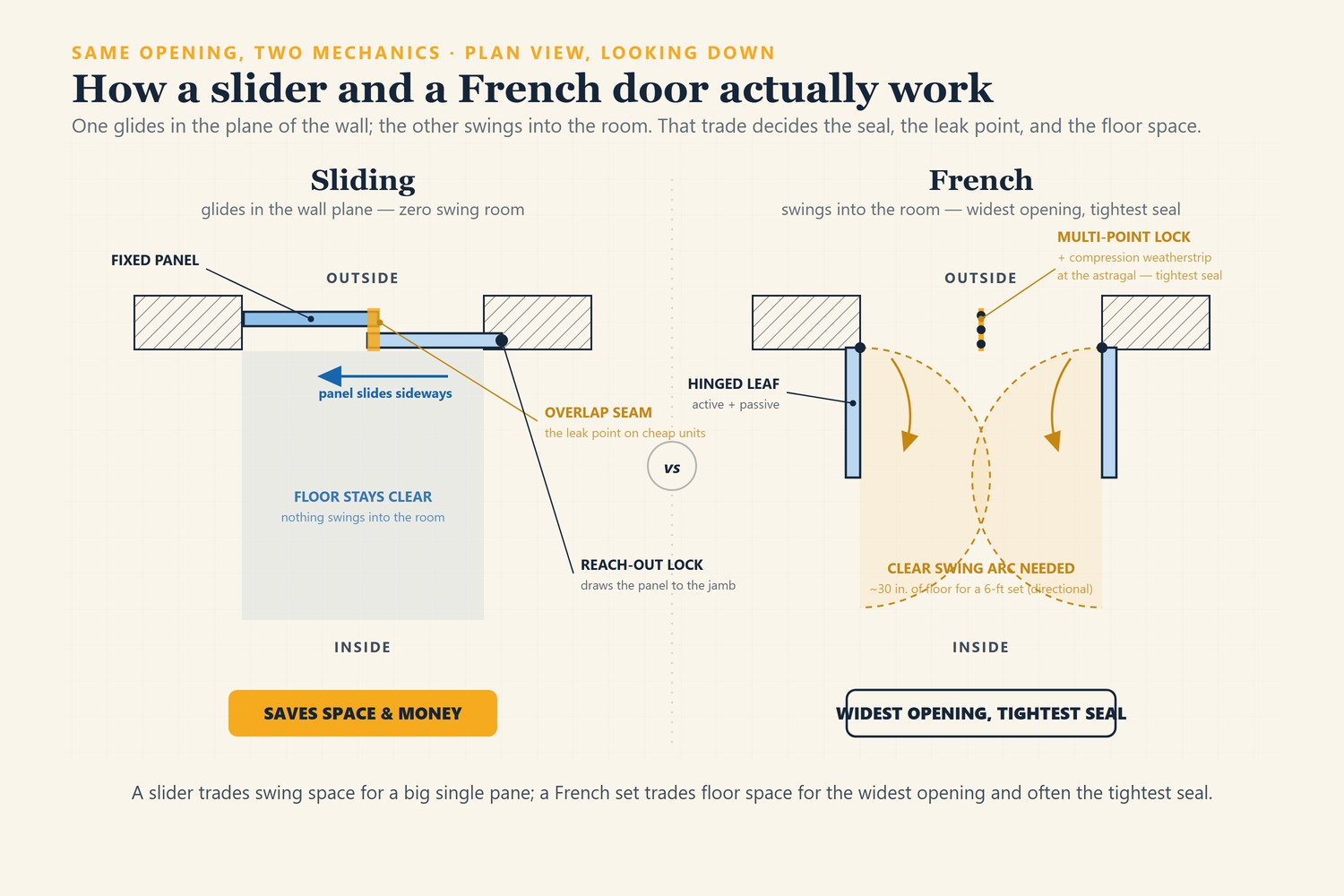
The honest trade, in one line: sliders save space and money; French give the widest opening and often the tightest seal. If you want the whole comparison — cost, energy, security, how long each lasts — read sliding vs French patio doors, then the deep-dives on the sliding door and the French door.
What actually fails on a patio door — and what’s a fix vs a replacement
Most of what sends people shopping for a new patio door is one failed part, not a dead door. Before you price a replacement, find out which of these it is — because two of the three are often a repair.
Here’s the honest crosswalk I’d walk a homeowner through:
| What you notice | What it actually is | Fix, or replace? |
|---|---|---|
| Fog or moisture between the panes you can't wipe off | A failed IGU seal — the insulated glass unit lost its seal, not dirty glass | Often a FIX: reglaze the sealed glass unit if the frame and sill are sound |
| Panel drags, grinds, or takes two hands and a braced knee | Worn rollers plus grit packed in the bottom track | Usually a FIX: new rollers, a scrubbed track, dry-film lube (never oil-based — it attracts dust) |
| A draft you feel with the door shut | Worn weatherstrip, or the perimeter never sealed to the opening | Depends: reseal / re-weatherstrip first; the perimeter is an install fix, not a new door |
| The door won't run true; the frame or sill is soft or rotted | Structural — the opening or sill is gone | REPLACE: full-frame job, because a new door over rot just buys the same failure again |
Fog or moisture between the panes you can't wipe off
- What it actually is
- A failed IGU seal — the insulated glass unit lost its seal, not dirty glass
- Fix, or replace?
- Often a FIX: reglaze the sealed glass unit if the frame and sill are sound
Panel drags, grinds, or takes two hands and a braced knee
- What it actually is
- Worn rollers plus grit packed in the bottom track
- Fix, or replace?
- Usually a FIX: new rollers, a scrubbed track, dry-film lube (never oil-based — it attracts dust)
A draft you feel with the door shut
- What it actually is
- Worn weatherstrip, or the perimeter never sealed to the opening
- Fix, or replace?
- Depends: reseal / re-weatherstrip first; the perimeter is an install fix, not a new door
The door won't run true; the frame or sill is soft or rotted
- What it actually is
- Structural — the opening or sill is gone
- Fix, or replace?
- REPLACE: full-frame job, because a new door over rot just buys the same failure again
Fog between the panes is the clearest one. That cloudiness you can’t wipe off is a failed seal — moisture got between the panes. If the frame and sill are sound and the door still runs, reglazing the glass unit can be the cheaper path. It’s the same failed-seal story your windows have — see what a foggy window really means.
A dragging panel is almost always rollers and grit, not a dead door. The rollers are adjustable, serviceable, and cheap to swap; the fix is often an afternoon.
None of this means “never replace.” When the sill or frame is rotted, or the door won’t run true anymore, it’s a full replacement — and then the cost and style questions are real.
What it means is simpler: find out what failed before you pay for the whole door. That’s the same repair-or-replace call I’d make on a window.
And if a quote jumps straight to a brand-new unit without ever checking whether the seal alone failed, that’s a fair question to put right back to it.
Are patio doors energy efficient in NC?
A quality patio door is as efficient as a good window — because a sliding glass door is rated exactly like one. It carries the same label your windows do, and it’s judged by your NC climate zone, not by a swinging-door glazing table.
That’s the load-bearing distinction. Chase two numbers on the label: the and the . For most of North Carolina, here’s the target.
glass is standard on any door worth buying — it’s the coating that gets you to those numbers. A French door is scored a little differently (as a swinging door, by glazing level), but for a mostly-glass patio door in NC the practical target lands in the same place. If you’ve already read how to read the NFRC label on your windows, the logic carries straight over, and the Low-E glass explainer covers the coating itself.
One NC-specific flag: near the coast, impact-rated glazing is often code-required, and a patio door is a glazed opening like any window. The requirement is real; the exact rating is address-specific — the coastal impact page has the detail.
Does the door or the install decide?
The install decides year five, not the label on the box. This is the part the pitch skips while it sells you a panel, and it’s the thing your own instinct already suspects: install matters more than brand.
Three things you can’t see on a spec sheet decide whether the door actually performs:
- The perimeter seal to the opening. A drafty door is usually a door that was never sealed to the rough opening — worn weatherstrip, unsealed jamb gaps, a sweep that doesn’t compress. A premium door over an unsealed perimeter still drafts.
- Plumb, level, and square. An out-of-square opening racks the panel so it drags and the latch never seats. The door didn’t fail — the install did.
- The sill pan under the threshold. Set on a bead of caulk instead of a back-dammed sill pan, wind-driven NC rain gets under the door and rots the subfloor. The cost page shows that cross-section — it’s the door version of a rotted window sill.
This is why I keep steering the decision back to the install. A mid-grade door set right beats a premium one set badly — the same truth that runs through why the install beats the brand. When you read a quote, that’s what to look for; the window-quote red flags apply almost word-for-word to a patio door.
What will a patio door cost?
Enough that it’s worth pricing carefully, and not so simple that a single number tells you anything. A slider generally runs less than a French door, and the glass package plus any hidden sill rot move the number more than the style name does.
I’m deliberately not throwing a price band at you here, because the real answer — the installed ranges, the line items that should be itemized, and the hidden costs that turn one quote into a wall repair — lives on one page. Start there: what a patio door costs installed in NC.
While you’re mapping the project, a patio door usually belongs in the same trip as your windows or an entry door — same crew, same mobilization. And whatever the range says, it’s a national starting band, not your quote. Verify locally.
Get an honest read before you buy a whole door
A range tells you whether a quote is in the ballpark — it can’t tell you whether you need the door at all. That depends on what actually failed, whether the sill is sound, and, if it’s truly a replacement, which style fits your room.
If you want a no-pressure second opinion, have me look at it. I’ll tell you whether it’s a reglaze, a roller swap, or a real replacement — name the glass package and the NC numbers you actually need — and let you decide.
And your knee comes off the jamb for good!
Sources, Verification & Fact-Checking verified July 2026
Every load-bearing fact on this page is sourced and verified against a primary authority.
Verified July 2026 via direct review of the cited authority — the links open the controlling source so you can check it yourself rather than take our word.
- A sliding glass patio door is rated by climate zone like a window (via the NFRC label), not by the swinging-door glazing table. ENERGY STAR states it directly: “Windows, sliding glass doors, and skylights shall meet the criteria for a given ENERGY STAR Climate Zone” — an important distinction from swinging doors, which meet criteria for a given glazing level. (view source — NFRC; ENERGY STAR key product criteria at view source — energystar.gov.)
- NC ENERGY STAR window/sliding-glass-door criteria: most of NC (South-Central zone) needs U-factor ≤ 0.28 and SHGC ≤ 0.23; NC’s mountains (North-Central zone) need U-factor ≤ 0.25 and SHGC ≤ 0.40. NC has no Southern-zone counties. ENERGY STAR v7.0, effective Oct 23, 2023. (view source — energystar.gov.)
- Patio-door failure modes are the same glass/seal/install story as windows: fog between the panes is a failed insulated glass unit (IGU) seal (reglaze if the frame and sill are sound), a dragging panel is worn rollers plus grit in the track (serviceable/replaceable), and a draft with the door shut is a worn weatherstrip or an unsealed perimeter. A rotted frame or sill, or a door that won’t run true, is a full-frame replacement. (Consistent with the fact-checked sibling patio-door pages and the window repair-or-replace guides on this site.)
- Sliders seal with a reach-out lock and need no swing clearance; French patio doors seal with compression weatherstrip and a multi-point lock and need roughly 30 in. of swing clearance for a six-foot set. The extra frame, hardware, and swing room are why French commonly prices above sliding. (Qualitative door mechanics; the ~30-in. swing figure is directional, tied to the panel width, per DOE Energy Saver, exterior doors.)
- Near the NC coast, impact-protected glazing is code-required in the wind-borne-debris region — glazed openings, patio doors included, must pass the Large Missile Test of ASTM E1886/E1996. The exact design-pressure rating and wind-speed contour are address-specific and must come from the current NC State Building Code and a qualified design pro. (NC Residential Code R301.2.1.2 — view source — codes.iccsafe.org (NCRC2018).)
- Installed patio-door cost bands are deferred to the patio door cost page to keep a single source of truth; this hub introduces no new price figures. (See Patio door cost in NC, itself sourced from national industry cost guides current as of 2026 and hedged “verify locally.”)