


The national company’s rep was at your kitchen table for two hours. The number started high, then dropped four thousand dollars “if you decide tonight.” The next morning a local installer measured the same openings and quoted you roughly half — for what looks like the same white double-hung window.
So now you’re online at 10pm trying to figure out whether the big company is ripping you off, the cheap one is cutting a corner, or you’re just missing something.
Here’s the honest answer: you’re missing one thing, and it isn’t a corner. The two quotes aren’t for the same purchase. Once you see what actually separates them, the price gap stops looking like a scam and starts looking like a choice — one you can make on purpose.
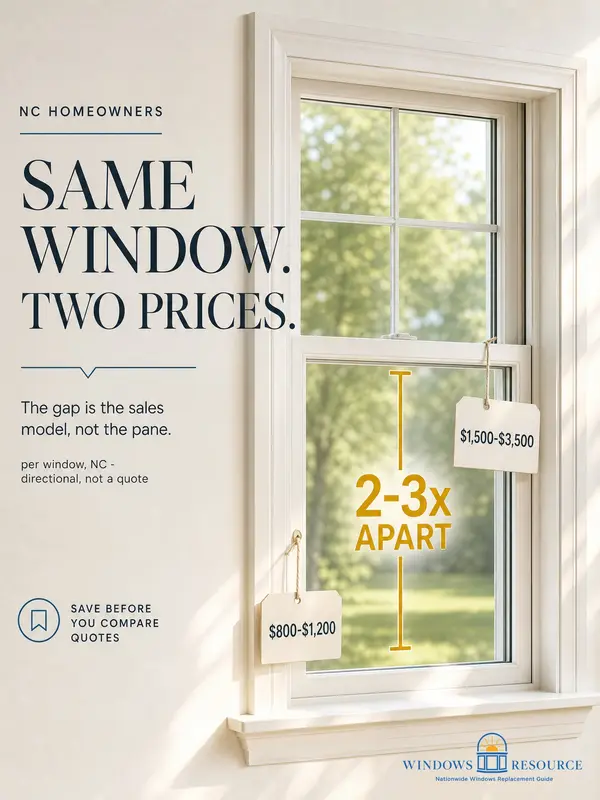
Is a local window company cheaper than a national brand? Usually, yes, for similar glass — because the overhead is leaner, not because the window is worse. The gap you’re staring at is mostly the sales model wrapped around the window: advertising, commissioned in-home sales, showrooms or franchise fees, and one whole-job warranty. That’s a real difference in what you’re buying, and it can push the same class of glass roughly 2–3× apart. This page shows you where each dollar goes so you can decide which model fits your house.
National vs local is the wrong question — here’s the real one
The axis that actually decides your price isn’t national vs local. It’s manufacturer vs full-service in-home. Those two words tell you more than the logo ever will.
A manufacturer makes windows and sells them through a dealer, a lumberyard, or a contractor. You buy the product, and the install is a separate decision you control. Andersen, Pella, Marvin, ProVia, Milgard, and Simonton all work this way. A national name, sold locally — and installed by whoever you hire.
A full-service in-home company does everything under one contract: it sells at your kitchen table, sources or builds the window, installs with its own or managed crews, and warranties the whole job. Renewal by Andersen, Champion, and Window World are built on this model.
Notice what that does to your “national vs local” instinct. A national manufacturer’s window installed by a lean local contractor is a fourth option nobody at the kitchen table names — and it’s often the value play. The brands hub lays out the whole manufacturer-vs-full-service map, and the best-window-brands guide shows why the line on your quote matters more than the name on the ad.
Where does the money actually go?
Into four things the glass doesn’t explain — and each one buys something real. The full-service premium isn’t a markup for its own sake. It’s a bundle of services you’re either paying a company to handle or handling yourself. Here’s the honest breakdown, both sides of each line.
Advertising and lead generation. The TV spots, the mailers, the “buy two get two” promos — that budget is a meaningful slice of a national in-home company’s revenue, and it’s priced into your job. The trade: it’s also why that company is easy to find, still in business, and sending a trained crew instead of a stranger.
Commissioned in-home sales. A rep drove out, measured, and spent the evening walking you through options — and is paid on what you sign. The trade: you got a designed solution and one accountable person, not a parts counter. The long presentation and the same-night discount are the model, not proof the window is bad.
Showroom or franchise overhead. A showroom to walk, or a locally owned franchise paying into a national brand, both cost money that a one-truck installer doesn’t carry. The trade: a place to see the product and a brand standing behind the local operator.
The bundled whole-job warranty. One company covers product and install, so there’s a single number to call. The trade: that single-source accountability is genuinely worth paying for — if the fine print backs it up. Compare the scope, not the word “lifetime.”
None of these four is a number I’ll put a hard figure on. The companies that carry this overhead are mostly private, so an exact advertising-share or commission percentage isn’t something you can verify at a primary source — and a made-up number would be worse than none.
What’s solid is the direction: each line is real spending the leaner route doesn’t carry, and each one buys something back.
Follow the dollar — two business models
Where your window dollar goes
Same pane of glass at the base of both. The gap is everything stacked on top — and each layer buys something real.
Manufacturer + your own installer
You coordinate the pieces — and keep the savings
Full-service in-home company
One contract — each layer is a service they handle
Set the two models side by side and the gap stops being mysterious:
| What you're paying for | Manufacturer + your own installer | Full-service in-home company |
|---|---|---|
| How you buy it | The product through a dealer, lumberyard, or contractor; the install is a separate call you control | One contract — sales, product, install, and warranty from a single company |
| Who installs it | An installer you hire and vet yourself | The company's own or managed crews |
| What's priced in beyond the glass | Leaner overhead — you coordinate the pieces | Advertising, commissioned in-home sales, and showroom or franchise overhead |
| Warranty scope | A product warranty from the maker, a labor warranty from whoever installs — two separate clocks | One whole-job warranty covering product and install together |
| If it leaks in year 5 | You sort out whether it's a product or an install problem | One company to call — single-source accountability |
| Typical installed cost per window (NC, directional) | About $800–$1,200 for premium vinyl | About $1,500–$3,500 for a national premium in-home line |
| What the higher price buys | You keep the savings and the coordinating | Convenience, one point of contact, and a company likely to still exist in year 10 |
How you buy it
- Manufacturer + your own installer
- The product through a dealer, lumberyard, or contractor; the install is a separate call you control
- Full-service in-home company
- One contract — sales, product, install, and warranty from a single company
Who installs it
- Manufacturer + your own installer
- An installer you hire and vet yourself
- Full-service in-home company
- The company's own or managed crews
What's priced in beyond the glass
- Manufacturer + your own installer
- Leaner overhead — you coordinate the pieces
- Full-service in-home company
- Advertising, commissioned in-home sales, and showroom or franchise overhead
Warranty scope
- Manufacturer + your own installer
- A product warranty from the maker, a labor warranty from whoever installs — two separate clocks
- Full-service in-home company
- One whole-job warranty covering product and install together
If it leaks in year 5
- Manufacturer + your own installer
- You sort out whether it's a product or an install problem
- Full-service in-home company
- One company to call — single-source accountability
Typical installed cost per window (NC, directional)
- Manufacturer + your own installer
- About $800–$1,200 for premium vinyl
- Full-service in-home company
- About $1,500–$3,500 for a national premium in-home line
What the higher price buys
- Manufacturer + your own installer
- You keep the savings and the coordinating
- Full-service in-home company
- Convenience, one point of contact, and a company likely to still exist in year 10
That per-window spread is the concrete version of the number that scared you off the national quote:
The why-windows-are-so-expensive breakdown walks the same dollar further, and the best-companies page sorts the NC landscape by exactly this model split.
So is the local quote always the better deal?
No — cheaper isn’t automatically better, and pricier isn’t automatically safer. The lean local route wins on price when the installer is genuinely good. It loses when they’re not, because with a manufacturer’s window the install is entirely on you to get right.
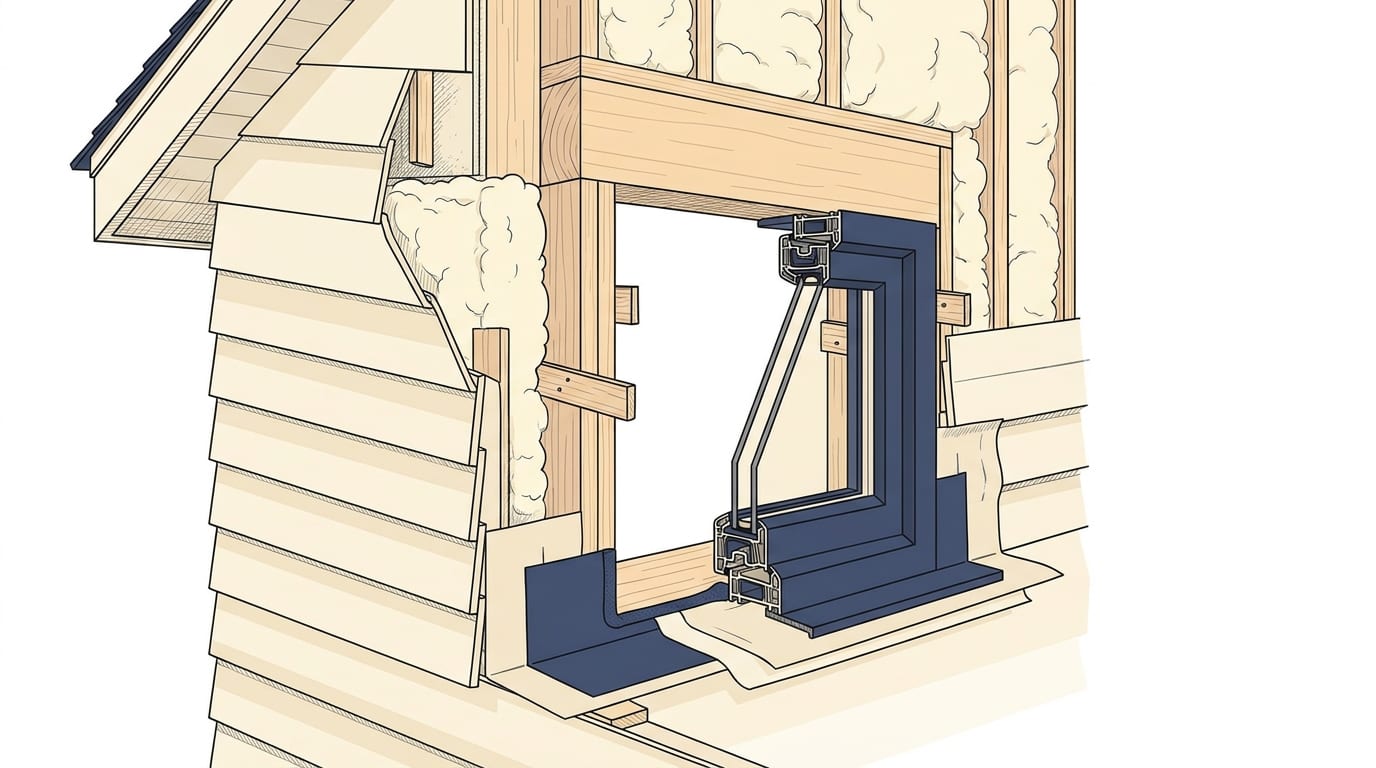
That’s the honest catch in “just go local.” A strong window set in a skipped sill pan, with no flashing and a caulk-only seal, will leak in a way a mid window installed correctly never will. The why-the-install-beats-the-brand guide is the one to read before you sign either quote — it’s the highest-stakes decision on the whole job.
And the warranty math cuts both ways. A whole-job warranty from a company still around in ten years can be worth real money over a two-clock arrangement where the maker points at the installer and the installer points at the maker. Read what each one actually covers — the fine print, not the headline.
Which model should you pick?
Match the model to how much you want to run the project yourself. Neither is the “right” one — they’re two different trades, and the honest answer depends on you, not on the brand.
Lean toward a manufacturer’s window + a vetted local installer when: you’re comfortable getting a few quotes, you’ll check the installer’s references and put the install details on paper, and you’d rather keep the savings than pay for coordination. This is the value play, and it’s where your “go local” instinct is right.
Lean toward a national full-service company when: you want one contract and one point of contact, you value a showroom and a single whole-job warranty, and the convenience is worth the premium to you. Paying more here isn’t getting played — it’s buying a service.
Whichever way you lean, do the one thing that makes the choice safe: get three comparable quotes and compare them line to line — the exact glass line, the install method, the warranty scope — instead of logo to logo. And compare the glass on its NFRC label, not the brochure, so you’re reading the same lab test whoever made the window.
The NC homeowner takeaway
You came in with a good instinct — go local, go straight to a contractor — and mostly, your instinct is right. For similar glass, the leaner local route usually costs less, and the install matters more than the brand on the sticker.
Here’s the one place to hold that instinct loosely: “local and cheaper” only wins if the installer is genuinely good, and “national and pricier” isn’t getting played — it’s buying convenience and single-source accountability that some homeowners rightly want.
So don’t shop the logo, and don’t shop the lowest number either. Shop the model that fits your house and your patience, then compare the actual line items. Do that and you walk into either appointment knowing exactly what your money is buying — which is the whole point!
Sources, Verification & Fact-Checking verified July 2026
Every load-bearing fact on this page is sourced and verified against a primary authority.
Verified July 2026 via direct review of the cited authority — the links open the controlling source so you can check it yourself rather than take our word.
- Manufacturer (dealer channel) vs full-service in-home company — the real axis behind “national vs local”: each company’s own published sales model. Andersen sells through a dealer/“where to buy” channel (Pella likewise); Renewal by Andersen is Andersen’s replacement division, custom-made-and-professionally-installed under one four-step process; Champion says it will “design, build, install, and guarantee” its own products (single-source); Window World describes itself as a franchise, “nationally known, locally owned.” Verified live July 2026 — company self-descriptions, not editorial claims. (Andersen; Renewal by Andersen; Champion; Window World)
- Directional NC installed cost bands — about $800–$1,200/window for premium vinyl (manufacturer + local install) vs about $1,500–$3,500/window for a national premium in-home line: both are hedged market bands, not quotes. The national premium band matches our knowledge-base figure for a Renewal-by-Andersen-class product (most typical configurations, grounded-verified July 2026 against HomeGuide and Modernize cost guides, which put the full range near $1,500–$5,000/window installed); the $800–$1,200 local band sits inside the higher-end vinyl range in the same 2025–2026 cost guides. Stated as ranges with a verify-against-your-own-line-items caveat on the page — cost figures drift, so defer to a live local quote.
- The same class of glass can be quoted roughly 2–3× apart on the sales model: a commonly cited range from our knowledge-base brand-and-market notes (grounded), anchored by the per-window bands above — presented as a range, not a fixed multiplier, and consistent with the ~$1,000 vs ~$2,500 midpoints of those bands.
- Where the full-service premium goes — advertising/lead-gen, commissioned in-home sales, showroom/franchise overhead, bundled whole-job warranty: a qualitative description of the full-service business model, consistent with each company’s published model. We deliberately attach no advertising-share or commission percentage: the companies carrying this overhead are mostly private, no primary source discloses those figures, and the page describes the direction of each cost rather than inventing a number.
- Whole-job (product + install) vs product-only warranty, and single-source accountability as a real value: based on the published warranty structures of full-service companies (one transferable limited warranty covering product and labor) versus the manufacturer/dealer split (maker’s product warranty + installer’s separate labor warranty). Compare the actual coverage document, not the word “lifetime.” Warranty scope detail lives on the warranty fine-print page.
- Install quality decides the outcome more than the brand; a bad install can negate rated performance and void the manufacturer’s warranty: argued and sourced in full on the install-beats-brand page (NFRC; DOE building science) — referenced here without restating the numbers.
- Voice-of-customer themes (the price gap, warranty distrust, the in-home sales experience): reported as recurring homeowner-forum and Reddit themes (“the chain was almost double”; “that ‘big company warranty’ isn’t always the golden ticket”; “‘lifetime warranty’… got vague real fast”), attributed as review-theme reporting — what homeowners say, not an editorial claim about any company or salesperson.
- Story callout (“almost double” threads): a composite of a recurring homeowner-forum pattern reconciling once the sales model is named — told as a representative pattern, no brand attached, both homeowners satisfied by design.