

You got the quote, and it landed like a punch. More than a new roof, you keep thinking — for windows.
You’re not crazy, and you’re not necessarily being taken. Replacement windows genuinely cost real money. But a big chunk of buyers overpay too, and the only way to tell which one you’re looking at is to take the number apart.
I measure and price these for a living. Here’s where every dollar in a window quote actually goes — and which part of it you can do something about.
Why are replacement windows so expensive? Because a real one is real materials plus skilled install — and then, on some quotes, a sales-model premium on top. Break your number into four buckets: the glass package, the frame material, the install labor, and the sales model. Three of the four are genuine costs that barely move. The fourth is the one slice you can shop — and it’s often the biggest single swing in the quote.
Where does the money in a window quote actually go?
Four buckets carry almost the whole number, and they’re not equal. Ranked by how much they swing the price: the sales model, the frame material, the glass package, and the install labor. Size, style, and access add on top.
Here’s the part that surprises people: the window unit itself is often a smaller share of the total than you’d guess. That’s why who you call can move the price more than which window you pick.
Follow the dollar — four buckets
Where a window dollar goes
Ranked by how much each one moves your number. Three of the four barely budge. The fourth is the slice you can actually shop.
Bucket 1: the glass package
This is what you’re actually paying for behind the frame, and most of it is real value. A modern is two or three panes with a sealed gas-filled gap and a microscopic coating — not just “glass.”
The cost movers here are genuine: a coating, argon gas fill, a warm-edge spacer, and double- versus triple-pane. On the coast, impact or laminated glass is often code-required, and it adds real cost for real protection.
In most of North Carolina, the coatings that manage summer heat — the ones that control — usually matter more than chasing the lowest number. This is a bucket where paying up can be worth it, if it’s the right glass for your climate.
Bucket 2: the frame material
The frame sets the floor price before a single option gets added. Cheapest to most: vinyl, then fiberglass and composite, then wood.
Vinyl is the NC value workhorse. Fiberglass typically runs roughly $300–$700+ more per window than a comparable vinyl unit — and that premium buys dimensional stability and longevity, not automatically better energy numbers. Wood costs the most and asks the most maintenance in return.
None of this is markup you can argue away. It’s the material. If you want to know exactly what the fiberglass step-up buys and when it’s worth it, the fiberglass cost breakdown walks through it.
Bucket 3: the install labor
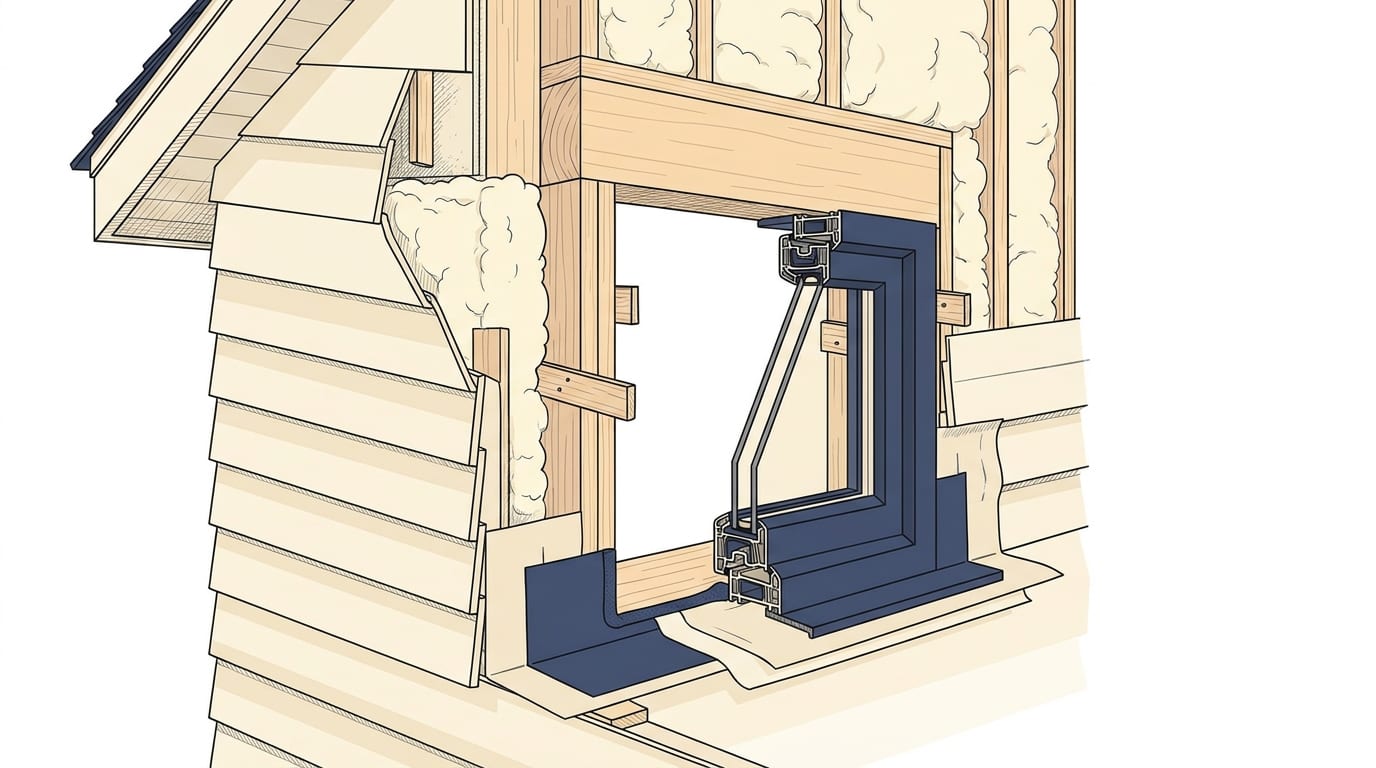
The install is roughly a third of the job, and it’s the third that decides whether the window works. A premium window sealed badly still lets water and air into the wall.
Labor is commonly about 30% of the total job. The method drives it: an insert drops the new window into your sound existing frame; a full-frame replacement tears back to the rough opening, which is the right call over rotted wood and adds roughly 20–30% for the extra labor and material.
This is the bucket buyers are most tempted to shave, and the worst one to cut. A mid-grade window installed right beats a premium window installed wrong, every time — why install beats brand is the whole case.
Bucket 4: the sales model
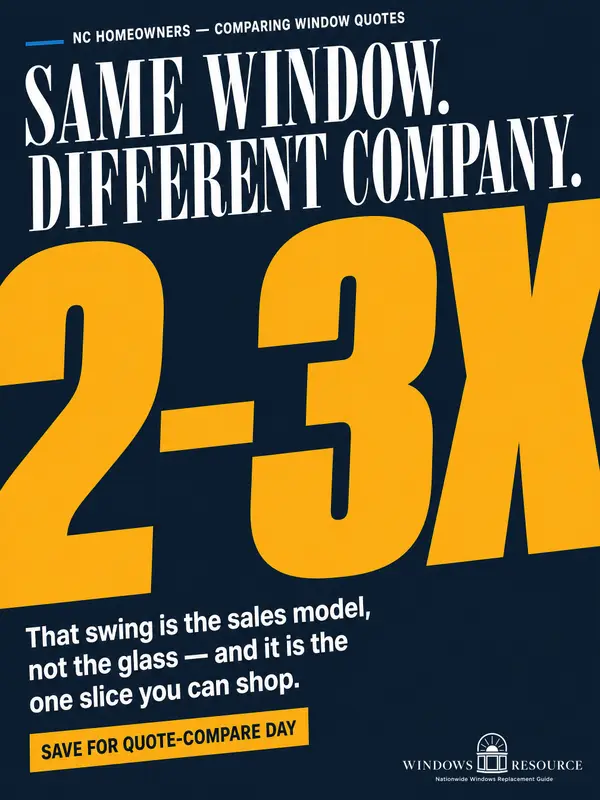
This is the biggest single swing in the quote, and it’s the one slice you can actually shop. The same or similar window can be priced two to three times apart depending on how it’s sold.
A national in-home-sales brand — the long living-room presentation, the showroom, the television ads, the commissioned sales team — carries all of that as overhead, and it’s priced into every job. A local installer fitting a comparable-quality window from a dealer channel usually runs well below it.
Here’s the honest part: that model is legitimate. Some buyers want the showroom, the single point of contact, and the whole-job warranty, and that convenience is a real thing with real overhead behind it. It isn’t a villain. It’s just the one bucket whose size depends entirely on who you call — which is exactly why it’s the slice worth shopping.
The four buckets, side by side
Line the buckets up and the whole number stops being a mystery. Three of them are real costs that barely move between honest quotes. One moves a lot — and that’s your leverage.
| The bucket | What it buys | Can you shop it? |
|---|---|---|
| Glass package | Low-E, argon, panes, impact glass on the coast — real performance | A little — pick the right glass for NC, not the priciest |
| Frame material | Vinyl → fiberglass → wood; longevity and stability going up | A little — match the material to the house and stay-time |
| Install labor | ~30% of the job; the part that makes the window actually work | Barely — and the worst bucket to cut |
| Sales model | Showroom, ads, in-home visit, whole-job warranty — real overhead | Yes — this is the 2–3× swing you control by who you call |
Glass package
- What it buys
- Low-E, argon, panes, impact glass on the coast — real performance
- Can you shop it?
- A little — pick the right glass for NC, not the priciest
Frame material
- What it buys
- Vinyl → fiberglass → wood; longevity and stability going up
- Can you shop it?
- A little — match the material to the house and stay-time
Install labor
- What it buys
- ~30% of the job; the part that makes the window actually work
- Can you shop it?
- Barely — and the worst bucket to cut
Sales model
- What it buys
- Showroom, ads, in-home visit, whole-job warranty — real overhead
- Can you shop it?
- Yes — this is the 2–3× swing you control by who you call
So what should THIS window cost?
Once you know the buckets, you check your number against the tiers — per window, installed. As general 2026 NC bands: recycled-content vinyl ~$450–$1,600, first-generation vinyl ~$800–$2,400, composite/fiberglass ~$2,400–$4,400. A typical 10-window home lands somewhere around $10,000–$35,000 — a wide spread, because which tier you’re sold and the sales-model bucket both swing it.
Those are starting bands, not your quote. The full picture, with the whole-house numbers and how to normalize a total down to a per-window price, lives on what replacement windows really cost in NC. Then run your own number through is this quote reasonable?.
One last honest note, because it belongs on any page about price: windows are worth it for comfort, quiet, and no more drafts — not as a dollars-back investment. The payback math is the part that gets oversold.
And the federal 25C window tax credit expired December 31, 2025, so it’s not available for 2026 installs; anyone dangling a current-year credit is reading from last year’s script.
If you’d like an unbiased read on a quote you already have — which bucket is doing the damage — that’s exactly what a no-pressure second opinion is for. Bring the number; I’ll show you where it’s really going!
Sources, Verification & Fact-Checking verified July 2026
Every load-bearing fact on this page is sourced and verified against a primary authority.
Verified July 2026 via direct review of the cited authority — the links open the controlling source so you can check it yourself rather than take our word.
- Cost tiers (per-window recycled vinyl ~$450–$1,600, virgin vinyl ~$800–$2,400, composite/fiberglass ~$2,400–$4,400; 10-window home ~$10,000–$35,000; full-frame adds ~20–30% over insert): the same tiers carried on the NC cost page and knowledge base. The entry band is grounded in 2026 national cost guides; the upper tiers come from first-hand NC quotes (2025), which aggregators run below. General NC market bands — verify for your project. (view source — HomeAdvisor; view source — Fixr)
- Labor is commonly about 30% of the job: national window-installation cost guides (labor ~$100–$300/window for inserts, ~$150–$800 for full-frame). (view source — HomeAdvisor)
- Fiberglass runs roughly $300–$700+ more per window than comparable vinyl: the matched-grade premium and market-average nuance are detailed on the fiberglass cost page. (view source — This Old House, fiberglass vs. vinyl)
- The sales-model premium (national in-home brands can charge 2–3× a local installer for a comparable window; the markup pays for advertising and the sales operation, not better glass): aggregated from 2026 industry cost guides and consistent with the NC cost page. Presented as a comment on business models, not a claim about any named company.
- Install beats frame (a mid-grade window installed right beats a premium window installed wrong): U.S. Department of Energy building-science guidance — improper installation admits water and air and can void the warranty. (view source — U.S. Dept. of Energy, correct window installation)
- The $44k→$35k same-evening drop is a homeowner-shared forum figure — illustrative of the anchor-and-discount structure and attributed to homeowners, not a verified list price or a claim about any named company.
- Federal 25C window tax credit expired 12/31/2025: P.L. 119-21 (One Big Beautiful Bill Act) accelerated termination of the IRC §25C credit; the IRS confirms windows placed in service after 12/31/2025 are no longer eligible. (view source — IRS, Energy Efficient Home Improvement Credit)