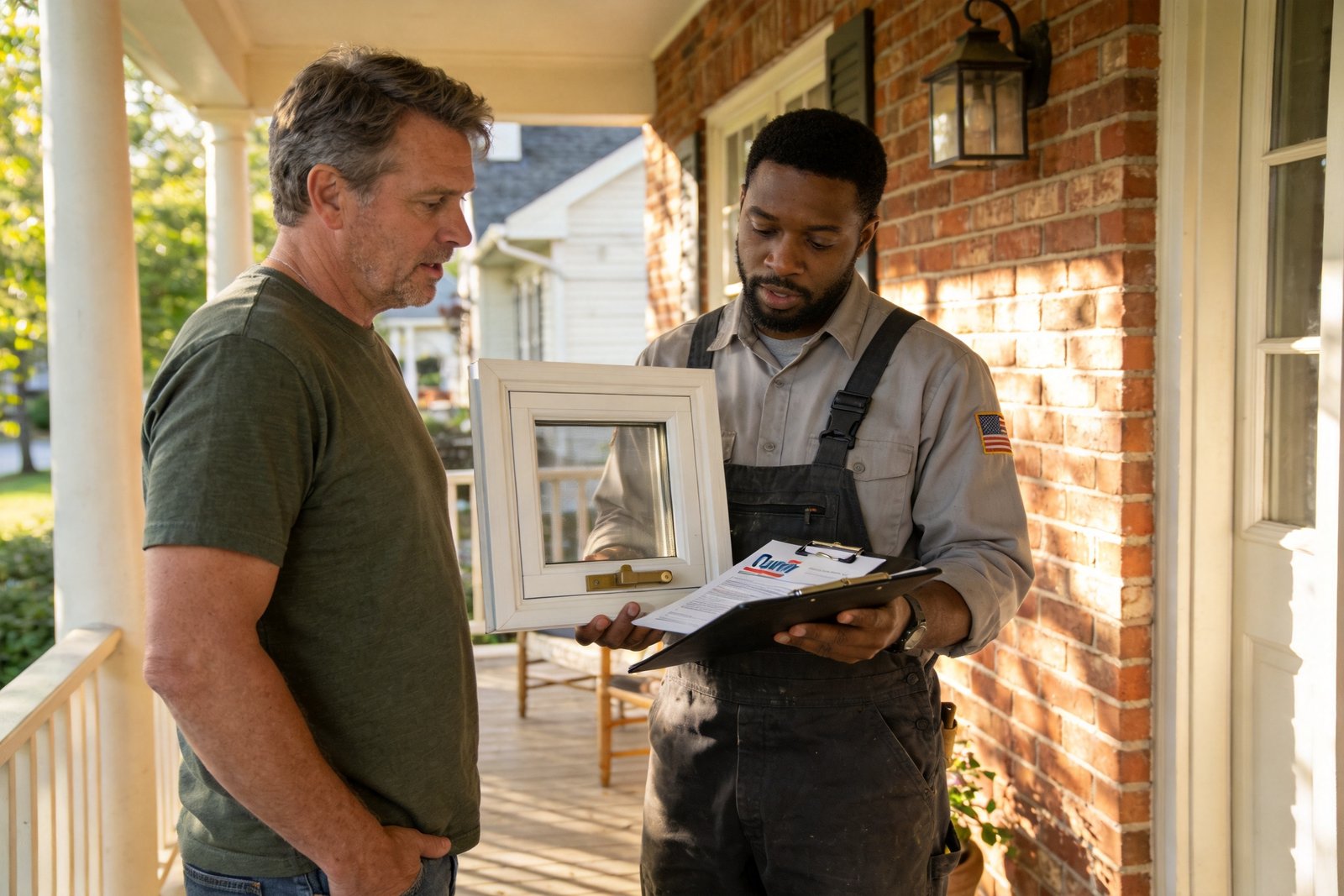


Two quotes, same twelve openings. The vinyl bid read like a sensible sedan. The fiberglass bid read like the same sedan with every option box ticked.
The premium is real. Fiberglass genuinely costs more to make and more to buy. But whether your premium is real — whether that gap is built in the frame or built in the quote — is a separate question, and it’s the one this page answers.
Same rule as everywhere else in this cost cluster: the only number that means anything is per window, installed, with the spec written next to it. Divide first, compare second.
How much do fiberglass windows cost in NC? More than vinyl — but how much more depends on where you buy it. In North Carolina’s in-home-sales channel, fiberglass runs about $2,400–$4,400 per window installed — a clear tier above vinyl. National big-box and local-installer guides run lower (roughly $1,100–$2,200), which is why a survey pegs the average premium at only ~$93 per window while matched-grade guides put it at 50–100% more. All true at once — the gap is grade and sales channel. The premium is earned by dark colors, big openings, and long stays, and skippable most everywhere else.
What drives a fiberglass window’s price?
The same five levers that move a vinyl quote move a fiberglass one — plus one that’s unique to the material. If you’ve read the vinyl cost page, the levers are old friends: grade, glass package, insert vs full-frame install, size and operation, and the seller’s business model.
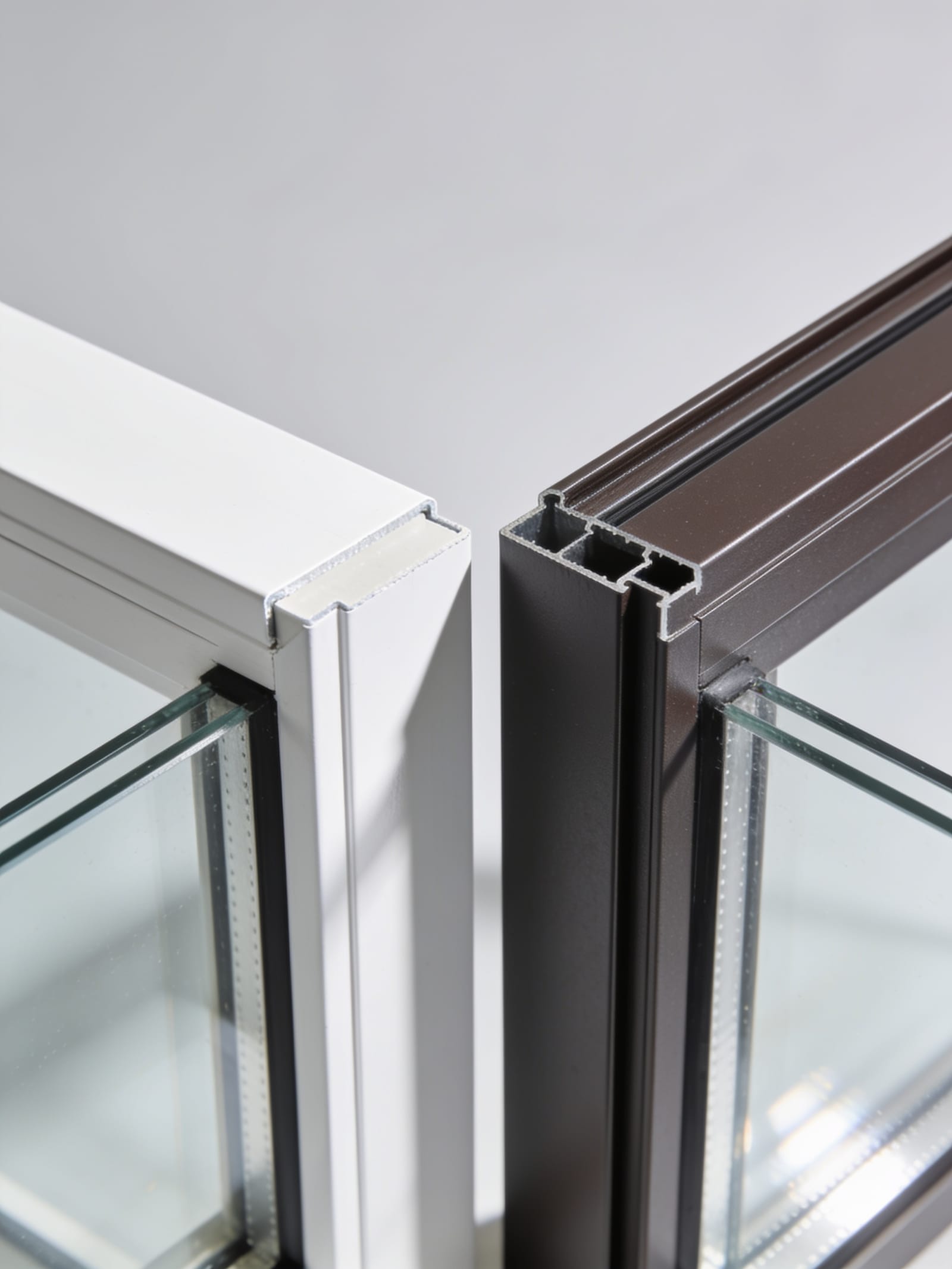
The fiberglass-specific lever is how the frame is made. Fiberglass is pultruded — glass strands pulled through resin into a rigid profile — and that process costs more than extruding vinyl, at every grade. So the floor is higher before a single option gets added.
What you’re buying for that floor is the material’s whole case: the lowest thermal movement of any common frame, which is why the seals stay tight for decades. (The full stability story lives on the fiberglass material page.)
Two things fiberglass pricing does that vinyl pricing doesn’t, worth knowing before quotes arrive:
- Dark colors don’t cost you durability. On vinyl, a dark frame on a full-sun wall is a warp risk you manage. On fiberglass it’s just a color. You may still pay a finish upcharge — but not a lifespan tax.
- Big openings don’t force a compromise. Fiberglass is rigid enough to span large openings with slim profiles where vinyl needs reinforcement or thicker sightlines. Large units still cost more — they just don’t cost more and perform worse.
The honest ranges (per window, installed)
Fiberglass bands run wider than vinyl bands, and they start higher — that’s the material’s floor doing its work. These are national-aggregate figures, not an NC price sheet:
- Unit only, before labor: national cost guides put fiberglass at roughly $500–$1,500 per window, against roughly $100–$900 for vinyl units in the same guides.
- Installed — two channels, two prices. Through a big-box store or a local installer, national cost references put typical installed fiberglass at roughly $1,100–$2,200 per window (inserts lower, full-frame higher). Through the in-home-sales brands where most NC homeowners actually get quoted, it runs the composite/fiberglass tier — about $2,400–$4,400 per window (first-hand NC quotes, 2025). The distance between the two is the sales-model premium, not a better window.
- The vinyl anchor: the fact-checked vinyl cost page carries vinyl in two tiers — recycled-content roughly $450–$1,600 and first-generation (virgin) about $800–$2,400 per window installed.
- The labor line under either material is the same trade: roughly $100–$300 per window for inserts, $150–$800 for full-frame — labor is commonly about 30% of the job.
Per-window installed is the comparable unit. Two whole-house totals aren’t equal until you know the window count inside each one — and with fiberglass the totals get big enough that the divide-first rule stops being a nicety and starts being self-defense.
How much more than vinyl — really?
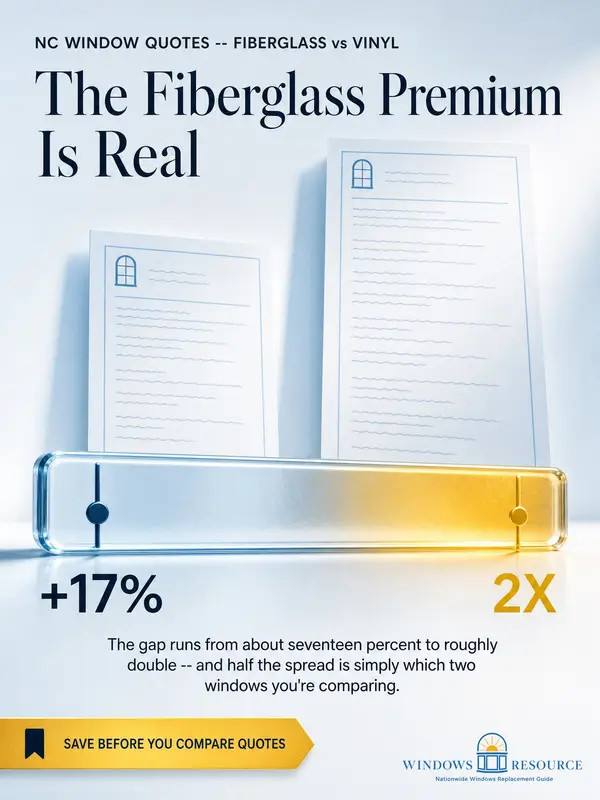
Somewhere between “a modest step” and “double,” and the spread itself is the story. Here’s the same data told two honest ways:
That survey number looks tame because it’s an average of everything — budget fiberglass blended against premium vinyl and vice versa. When cost guides line up matched, comparable-grade units, fiberglass runs 50–100% more than the same vinyl window.
So both sentences are true at once:
- “Fiberglass only averages about 17% more” — true, across the whole messy market.
- “Fiberglass costs half again to double a comparable vinyl unit” — also true, spec to spec.
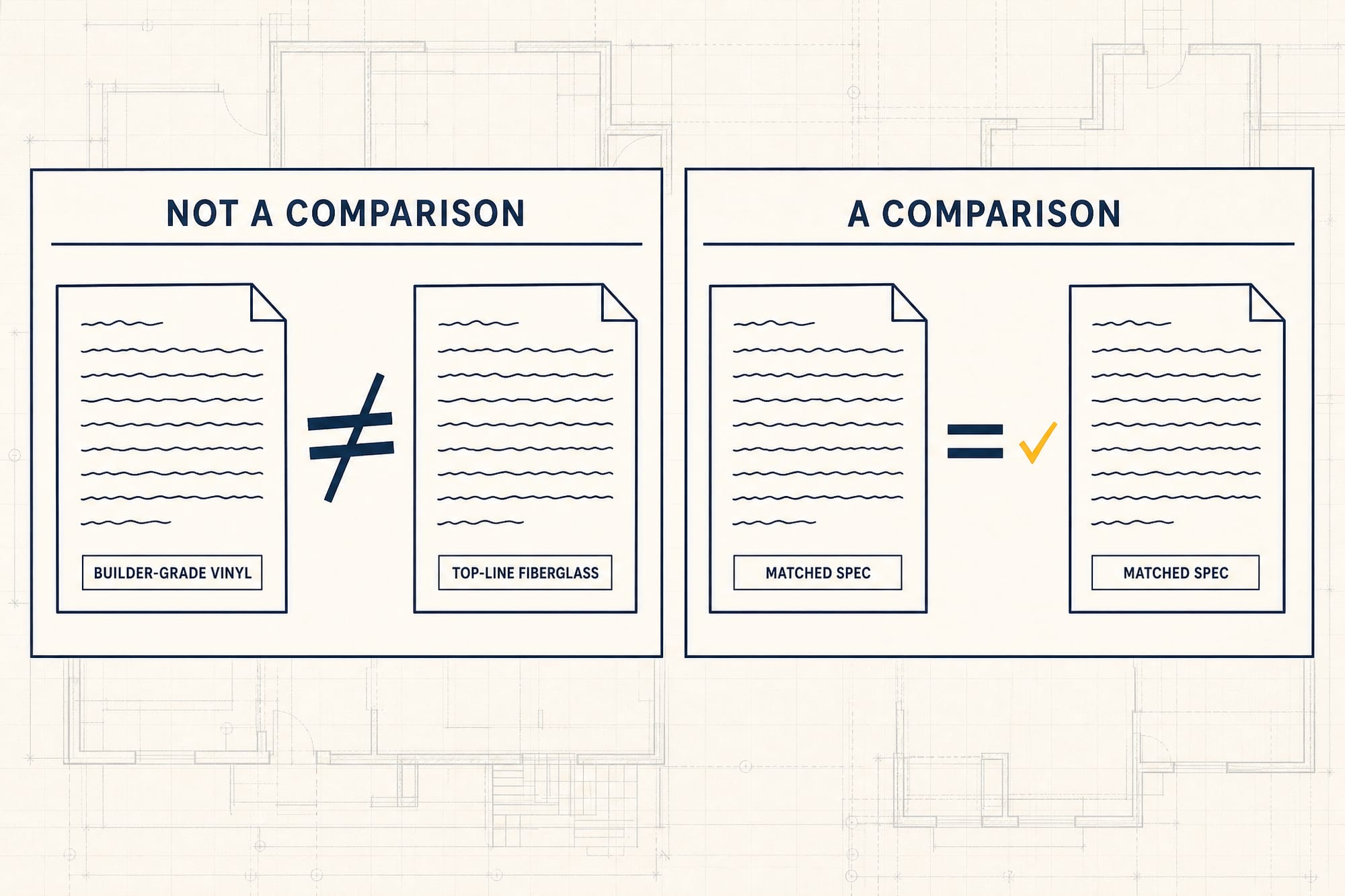
The word doing all the heavy lifting is comparable. A premium vinyl window and a builder-grade fiberglass window nearly meet in the middle of the band — which is exactly how two quotes on the same twelve openings can tell you two completely different stories about the “fiberglass premium.”
Fiberglass vs vinyl: where the money goes
Line the cost factors up side by side and the premium stops being a vibe and becomes a list. The full performance head-to-head lives at vinyl vs fiberglass — this table is just the cost anatomy:
| Cost factor | Quality vinyl | Fiberglass |
|---|---|---|
| The frame's floor price | Extruded PVC — the cheapest quality frame to make | Pultruded glass fiber — costs more at every grade |
| Dark colors on full-sun walls | A warp risk to manage; many makers steer you lighter | Just a color choice — often a finish upcharge, never a lifespan tax |
| Large / structural openings | Needs reinforcement or thicker profiles | Spans big openings with slim, stable sightlines |
| Seal life over decades | Most thermal movement of the common frames — seals get worked | Moves with the glass — seals stay at rest; 40–50-year horizon |
| Where the premium lands | In the glass package and install | In the frame itself — before options begin |
| Who it fits | Most NC homeowners staying put | Dark colors, big openings, longest stays |
The frame's floor price
- Quality vinyl
- Extruded PVC — the cheapest quality frame to make
- Fiberglass
- Pultruded glass fiber — costs more at every grade
Dark colors on full-sun walls
- Quality vinyl
- A warp risk to manage; many makers steer you lighter
- Fiberglass
- Just a color choice — often a finish upcharge, never a lifespan tax
Large / structural openings
- Quality vinyl
- Needs reinforcement or thicker profiles
- Fiberglass
- Spans big openings with slim, stable sightlines
Seal life over decades
- Quality vinyl
- Most thermal movement of the common frames — seals get worked
- Fiberglass
- Moves with the glass — seals stay at rest; 40–50-year horizon
Where the premium lands
- Quality vinyl
- In the glass package and install
- Fiberglass
- In the frame itself — before options begin
Who it fits
- Quality vinyl
- Most NC homeowners staying put
- Fiberglass
- Dark colors, big openings, longest stays
When is the premium actually earned?
Three houses earn it. Most don’t — and knowing which kind you own is worth more than any discount.
Pay for fiberglass when:
- You want a dark exterior on a sun-hammered wall. South- and west-facing NC elevations in a dark color are the clearest single case — vinyl manages that risk, fiberglass removes it.
- Your openings are large or structural. Where vinyl flexes, fiberglass holds a slim line. If your project includes a big picture window or a wide mulled unit, the premium is doing visible work.
- You’re staying for decades. The frame barely moves, so the glass seals barely get worked — fewer fogged panes fifteen years out, on a 40–50-year frame. Buy-it-once is a real strategy; this is its window.
Keep your money in vinyl when:
- Openings are standard and the color is light. A quality vinyl window does the job, and the difference goes into the glass package and installer — which move your comfort more.
- The horizon is short. The fiberglass payoff is measured in decades you have to be there to collect.
- The premium would squeeze the install budget. A mid-grade window installed right beats a premium window installed wrong — every time, in either material.
How to read a fiberglass quote
Same discipline as the vinyl page, one extra demand: make both bids name a matched spec. Per-window line items, brand and series, the and off the label, install method, and both warranties in writing.
Copy this and send it to both bidders
“Can you quote this per window, naming the line (brand/series), U-factor, SHGC, install method, and both warranties — and if I’m comparing fiberglass against vinyl, quote them at the same glass package so I’m comparing frames, not bundles?”
The second half is the fiberglass-specific move. It’s the one question that turns two incomparable quotes into one readable premium.
Once the numbers come back in that shape, sanity-check them against the bands — and the wider context for every number on this page lives at the full NC cost picture.
If you’d rather walk your actual quotes with someone before committing either direction — the vinyl, the fiberglass, or the matched respec of both — that’s exactly what a no-pressure second opinion is for.
Sources, Verification & Fact-Checking verified July 2026
Every load-bearing fact on this page is sourced and verified against a primary authority.
Verified July 2026 via direct review of the cited authority — the links open the controlling source so you can check it yourself rather than take our word.
- Fiberglass premium over vinyl (~$93/window market average vs 50–100% matched-grade): This Old House’s 2025 homeowner survey found fiberglass averaging about $651/window against $558 for vinyl (~17% premium) across many grades and configurations; unit-cost guides comparing matched, comparable-grade windows put fiberglass at 50–100% more. The spread is wide because “comparable” varies — a premium vinyl and a builder-grade fiberglass nearly meet. (view source — This Old House, fiberglass vs. vinyl windows; view source — HomeGuide, fiberglass window costs)
- Unit-price bands (fiberglass roughly $500–$1,500/window vs vinyl roughly $100–$900 before labor): national cost-guide aggregates (Angi/HomeAdvisor-class sources), re-checked July 2026 — national figures, not NC quotes. (view source — HomeAdvisor; view source — HomeGuide, fiberglass window costs)
- Installed fiberglass — by channel. The big-box/local-installer band (~$1,100–$2,200/window) is from national cost guides — Pella carries $1,100–$2,200; HomeGuide runs ~$400–$2,000. The NC in-home-sales tier (~$2,400–$4,400/window) comes from quotes collected first-hand in the North Carolina market in 2025, carried in the knowledge base (
cost-and-warranty.md§2). National aggregators run below it because they survey mostly big-box and local-installer work — neither is wrong; the gap is the channel. National figures are not an NC quote — verify locally. (view source — Pella, replacement window cost; view source — HomeGuide) - Vinyl anchor tiers (recycled-content ~$450–$1,600/window, first-generation/virgin ~$800–$2,400 installed) and labor portion (~$100–$300/window insert, ~$150–$800 full-frame, labor ~30% of job): the tiers carried on the vinyl cost page and the knowledge base; national aggregators show a lower big-box floor. (view source — HomeAdvisor; view source — Fixr)
- Material mechanics (pultrusion; lowest thermal movement of common frames; dimensionally stable and paintable so dark exteriors don’t carry vinyl’s full-sun warp risk; 40–50-year directional lifespan): U.S. Department of Energy building-science references describe fiberglass frames as dimensionally stable with superior thermal behavior; the lifespan figure is a broad industry range, directional not certified. (view source — U.S. Dept. of Energy, Building Science Education)
- Install beats frame (a mid-grade window installed right beats a premium window installed wrong): DOE building-science guidance — improper installation admits water and air and can void the warranty. (view source — U.S. Dept. of Energy, correct window installation methods)