



Two quotes on the table. One leads with a brand you’ve heard of. The other names the flashing.
If nobody has told you which of those two sentences matters more, this page exists to say it plainly: a mid-range window installed right will outlast and outperform a premium window installed wrong. Not occasionally. Reliably — because the physics of a window happen where it meets your wall, and that meeting is the installation.
The uncomfortable part is that everything deciding it — the sill pan, the flashing sequence, the shims, the foam — disappears behind the trim by dinner on install day.
You’re buying something you’ll never see.
So this page does two jobs: shows you what “right” looks like while it’s still visible, and then shows you how to buy it — on paper, in advance, in writing.
Does the brand or the install matter more? The install. A window’s ratings are lab numbers that assume it’s sealed, flashed, and square — a bad install negates them and can void the manufacturer’s warranty, no matter whose name is on the glass. Buy the install: scope on paper, sill pan and flashing named, labor warranty in writing. The how is below.
Why does a mid-range window installed right beat a premium one installed wrong?
Because the ratings live or die at the wall. The numbers on any certified window — U-factor, , air leakage — come from lab testing of the unit itself. The label assumes the window meets the wall correctly. It has no opinion about your opening.
The U.S. Department of Energy puts it in one sentence: windows are only as good as their installation. Gaps around the frame, a missing sill pan, flashing out of sequence, a racked frame — each one bypasses what the label measured. The premium window and the budget window fail the same way, through the same gap.
And the failure compounds. Most manufacturer warranties require installation per the manufacturer’s written instructions. A bad install can void the warranty — so the leak isn’t covered, and neither is the window. You paid for the badge twice and lost both.
Flip it around and the good news is just as strong: a mid-range window, set on a sill pan, flashed in the right order, shimmed square, and sealed without being strangled, delivers everything its label promised. In a real home, that beats the premium unit over the caulk-only shortcut every time.
That’s the whole thesis. The rest of this page is what “right” looks like — and how to make sure it’s what you’re buying.
What does “installed right” actually look like?
Five things, in order. This is the skeleton of every correct install, whatever the brand in the crate:
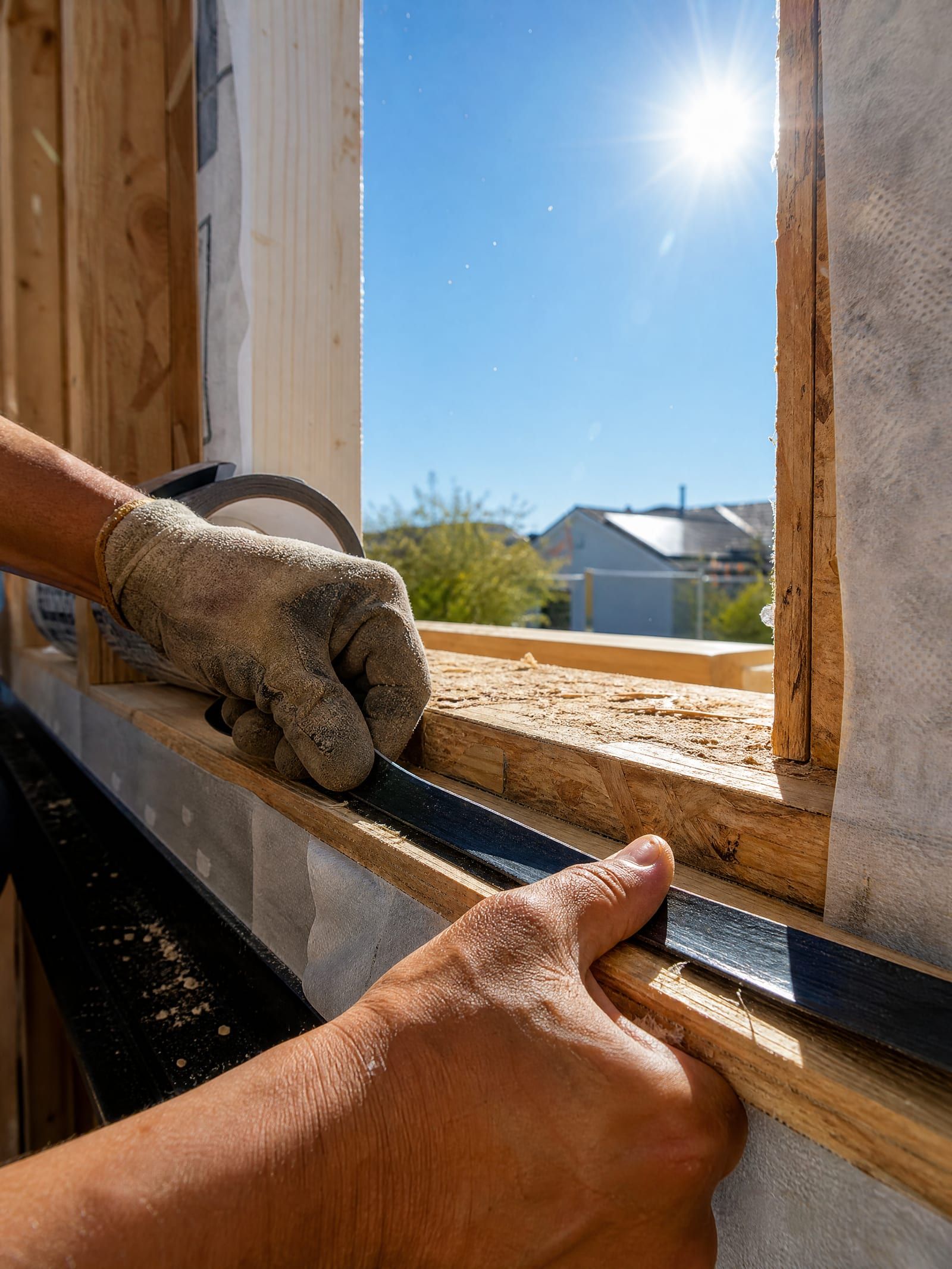
- A sill pan under the window. A waterproof tray that catches any water that gets past the unit and drains it back outside. Water will eventually get past — the pan is the plan for when it does.
- Flashing in shingle order — bottom, then sides, then head — tied into the wall’s so every layer laps over the one below and water always sheds down and out, never in.
- Square, level, plumb — proven, not eyeballed. Shims set in pairs at the sill and jambs, and the diagonals measured to match. A racked window binds, sticks, and wears out early no matter what it cost.
- Low-expansion foam, filled about 40 to 50 percent — not stuffed. Over-filled or high-expansion foam bows the frame and the sash stops operating. Weep holes stay clear.
- Verification before it disappears. The one step that costs nothing: eyes on the flashing and pan before the trim goes on. After that, the evidence is sealed.
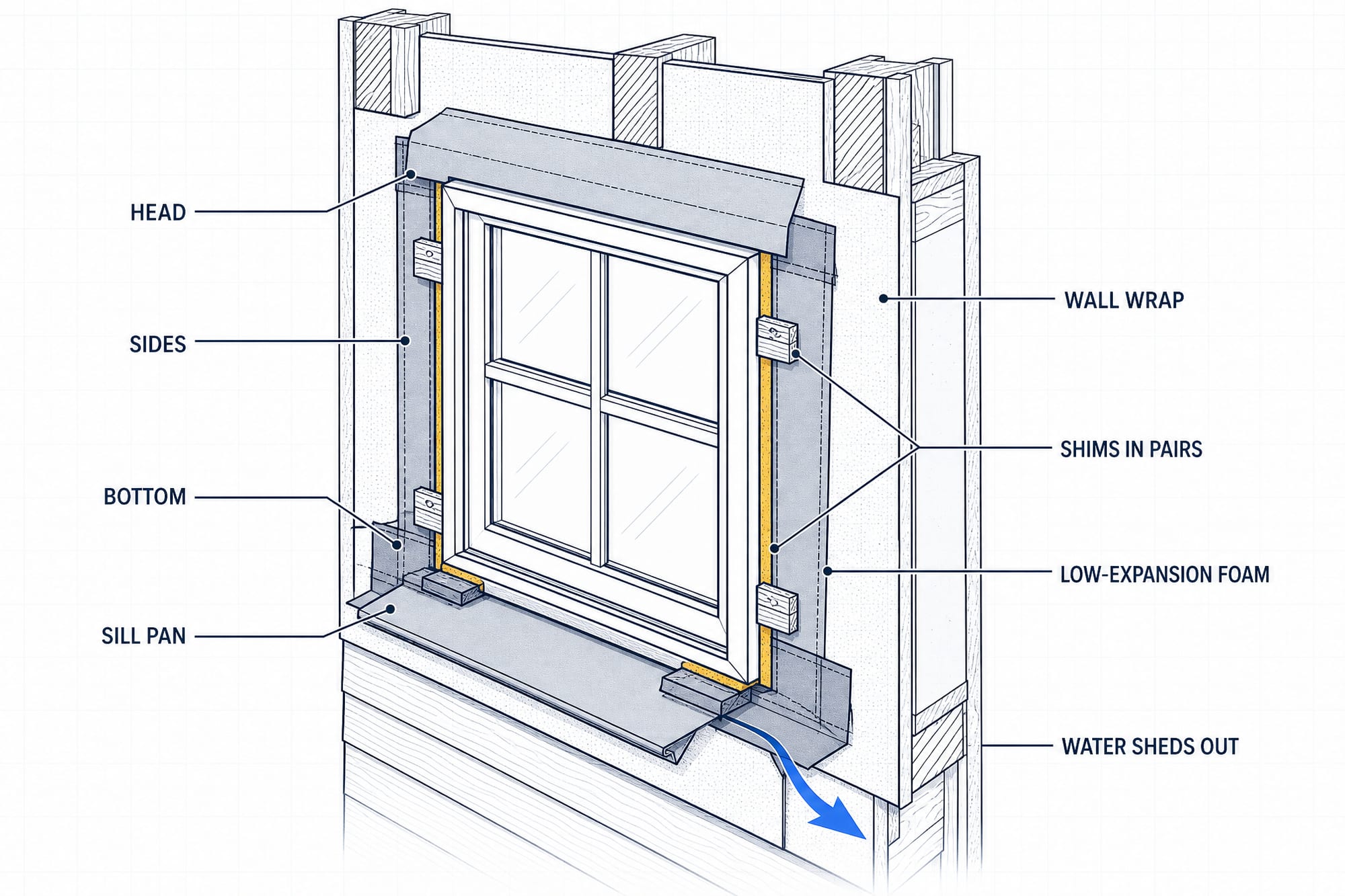
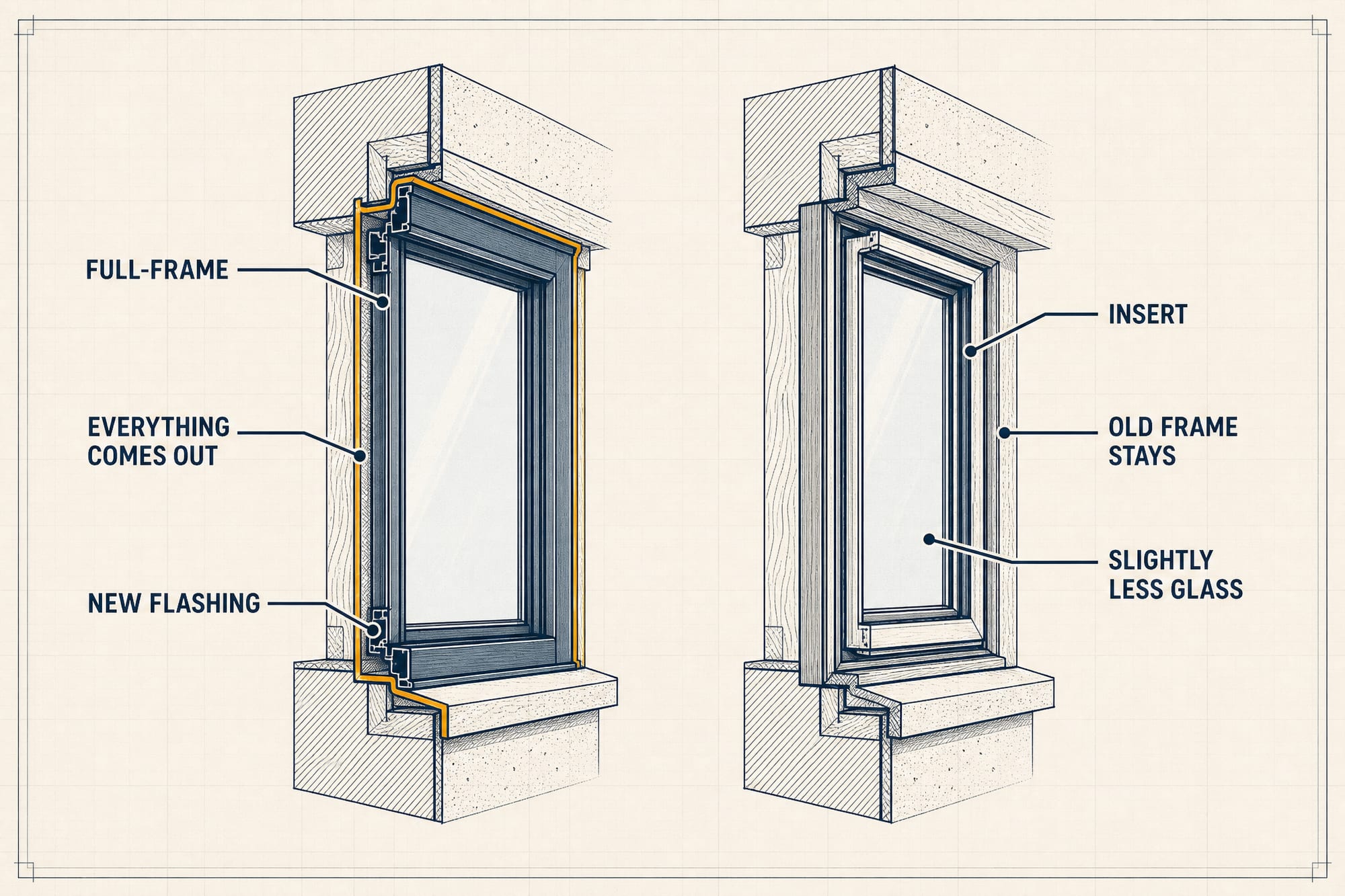
If you want the full job sequence — measuring, tear-out, insert vs full-frame, trim — the complete NC installation guide walks all eight steps, and full-frame vs insert covers the method decision that comes first. This page stays on the thesis: those five items are where a quote earns its money.
Here’s the same list as consequences — what each step buys you, and what the shortcut costs:
| Done right | The shortcut — and what it costs | |
|---|---|---|
| Under the window | Sill pan catches stray water, drains it out | No pan — the first water past the unit lands on bare framing |
| Water management | Flashing lapped bottom → sides → head into the wall wrap | Caulk-only — caulk shrinks and cracks, then the wall drinks |
| Frame geometry | Shimmed in pairs, diagonals equal — sash glides and locks | Racked or unsupported — sticking sash, early wear, air gaps |
| The gap | Low-expansion foam, partial fill — insulated and straight | Stuffed or high-expansion — bowed frame, binding sash |
| Proof | You see the pan and flashing before trim covers them | “Trust me” — the evidence is sealed by dinner |
Under the window
- Done right
- Sill pan catches stray water, drains it out
- The shortcut — and what it costs
- No pan — the first water past the unit lands on bare framing
Water management
- Done right
- Flashing lapped bottom → sides → head into the wall wrap
- The shortcut — and what it costs
- Caulk-only — caulk shrinks and cracks, then the wall drinks
Frame geometry
- Done right
- Shimmed in pairs, diagonals equal — sash glides and locks
- The shortcut — and what it costs
- Racked or unsupported — sticking sash, early wear, air gaps
The gap
- Done right
- Low-expansion foam, partial fill — insulated and straight
- The shortcut — and what it costs
- Stuffed or high-expansion — bowed frame, binding sash
Proof
- Done right
- You see the pan and flashing before trim covers them
- The shortcut — and what it costs
- “Trust me” — the evidence is sealed by dinner
Notice what’s not in the table: the brand. Every row applies identically to the cheapest vinyl unit and the most expensive wood-clad one. Nobody’s ratings survive a caulk-only install.
How does a premium window fail when the install is wrong?
Quietly, and on a delay. Day one looks perfect — premium windows are genuinely nice objects, and a rushed install and a careful one are indistinguishable once the trim is on. The difference files its report later.
A draft you can feel with the sash locked — that’s the air seal that was never made. A stain that blooms after hard rain — that’s water past the unit with no pan to catch it. A sash that sticks every summer — that’s the frame that never got shimmed square.
None of that is the window failing. It’s the install failing around a healthy window.
And this is where the warranty turn makes it worse. When the homeowner finally calls in the leak, an install that departed from the manufacturer’s instructions can put the claim outside coverage. The premium price bought a premium product and then the install threw away its protection.
I want to be fair about how this happens, because it’s usually not a villain story. Most bad installs aren’t sabotage — they’re speed. A method chosen off the clock instead of off the wall: the flashing sequence compressed, the pan skipped because the opening “looked dry,” the foam gun run generous because stuffed feels thorough.
Every one of those choices is invisible by the end of the day. Which is exactly why the fix is buying the install explicitly — the subject of the next section.
How do I buy the install instead of the badge?
You make the invisible parts show up on paper before anyone touches your wall. A good installer has nothing to hide here — the ones who do this right are usually glad someone finally asked.
The Five Answers — get each one in writing
- “Full-frame or insert — and why?” The method should come from your opening’s condition, not the price sheet. Here’s how the window decides.
- “What goes under and around the window?” You want to hear sill pan and flashing — and see them on the quote as scope, not as an assumption.
- “Who actually installs — your crew or subs?” Either can be excellent. But the answer tells you whose workmanship standard applies and who answers the phone if something’s wrong.
- “How long is the labor warranty, separate from the product warranty?” The product warranty covers the window. The labor warranty covers everything this page is about. Get its length and terms in writing.
- “Can I see the flashing before the trim goes on?” The cheapest inspection you’ll ever conduct. A confident installer says yes without blinking.
Notice that not one of the five requires you to know a brand from a bargain bin. That’s the point. You don’t need to hold the drill. You need five answers in writing.
This also reframes the budget conversation. If you’re choosing between stepping up to a pricier brand and stepping up to a fuller install scope — the pan, the flashing, full-frame where the opening needs it, a real labor warranty — spend the upgrade money on the opening, not the logo.
The best-companies page covers how the different company models package that install, and the brand-vs-line breakdown covers how to compare the glass itself once the install question is settled.

What should I check on install day?
Four looks, no tools. You bought the install on paper; this is where you watch it get delivered:
- The pan and flashing, before trim. You asked in advance — now take the look. Bottom, sides, head, each layer lapping the one below.
- The foam. Partial fill, low-expansion. A gap stuffed to bursting is a frame being bent in slow motion.
- The operation test. Every sash opened, closed, locked. A window that fights you on day one loses the fight by year three.
- The walk before final payment. Drafts at the frame, visible gaps, crooked reveals — the full red-flag list is the deep version, and what to expect on install day walks the whole day hour by hour.
None of this is adversarial. A crew doing it right has a job site that invites the look — and the look is what keeps everyone’s story straight after the trim goes on.
The window on your quote will spend one day being installed and a few decades living with the result. Buy the day carefully. The badge on the glass never once got up in the night to stop a leak — the flashing does that, every time it rains, for as long as you own the house.
Sources, Verification & Fact-Checking verified July 2026
Every load-bearing fact on this page is sourced and verified against a primary authority.
Verified July 2026 via direct review of the cited authority — the links open the controlling source so you can check it yourself rather than take our word.
- NFRC ratings are lab-determined for the product unit and assume correct installation — they don’t account for how the window is installed. The National Fenestration Rating Council determines U-factor, SHGC, and VT by simulation and physical testing of the unit; a window won’t perform as rated if it isn’t installed well. (view source — NFRC)
- “Windows are only as good as their installation.” U.S. Department of Energy Building Science guidance: proper installation — flashing, air-sealing the rough opening, following the manufacturer’s instructions (per ASTM E2112) — is what protects against water damage and air leakage, and departing from the manufacturer’s instructions can void the warranty. (view source — DOE Building Science, Correct Window Installation Methods)
- Correct water management: sill pan first, then flashing in shingle order (bottom, then sides, then head), integrated with the wall’s water-resistive barrier so water sheds down and out. DOE Building Science flashing details and standard installer training material. (view source — DOE Building Science)
- Most manufacturer warranties require installation per the manufacturer’s written instructions; a departing install can limit or void coverage. Terms vary by brand — Pella, for example, publishes terms under which failure to follow installation instructions can limit or void coverage. Cited as an example of the structure, not a knock on any brand. (view source — Pella warranty terms)
- Shims in pairs with equal diagonals; low-expansion (window-and-door rated) foam filled roughly 40–50%, not stuffed; over-filled or high-expansion foam bows the frame. Widely published installer guidance and manufacturer install manuals. Stated as craft standards, hedged where ranges vary.
- No prices on this page by design. Install labor ranges and what moves them live on the installation guide and cost page; restating them here would duplicate maintained numbers.
- Story callout (“how it reads on the forums”): composite of the recurring building-forum pattern — premium windows, first-winter drafts, trim pulled, no pan or flashing found, resolved by reinstalling the same units correctly. Told as a representative pattern, not a single sourced thread; no company or crew identified because the pattern isn’t about one.