



Every “best window brands” list you’ve read ranks the same names in a different order. That’s not because the writers are careless. It’s because the question can’t be scored the way the lists pretend.
Here’s why: a window brand isn’t a quality level. Every major manufacturer builds a ladder — a budget line, a mid line, a premium line — under one name. So “is Andersen good?” and “is Pella good?” have the same true answer: which line? Two honest owners can review the same brand and describe completely different windows, and both be right.
This page still gives you the names — the roster below is real, and the full reviews are linked. But its actual job is to hand you something better than a ranking: the unit of comparison that works across every brand — the specific line on your quote, read spec-to-spec on its NFRC label.
What’s the best window brand? No single one — every major manufacturer (Andersen, Pella, Marvin, ProVia, Milgard, Simonton) ladders from budget to premium under one name, and the full-service companies wrap their own lines in a whole-job package — so the brand tells you the ladder, not the rung. Compare the exact line on your quote — NFRC numbers, same material and size — then the warranty scope, then who installs. The name on the ad decides the least of it. Here’s how.
What are the best window brands?
Here’s the honest roster — organized by how each company sells, because that’s the split that actually changes your purchase. No ranking, on purpose: every name below makes windows that can serve an NC home well, and nearly every name below has a budget rung someone was disappointed by after expecting the premium one.
Manufacturers (dealer channel). You buy the product through a dealer, lumberyard, or contractor; installation is a separate decision you control:
- Andersen — one of the widest ladders in the business, from the budget all-Fibrex 100 Series to the fully custom A-Series. Full review.
- Pella — vinyl through fiberglass to premium wood: Encompass and 250 Series, Impervia, Lifestyle and Reserve. Full review.
- Marvin — premium fiberglass and wood-clad; craftsmanship and customization at the top of the market.
- ProVia — high-quality vinyl with strong warranty terms; a quiet favorite among installers.
- Milgard — solid mid-range value with in-house components; strongest presence in the West. Full review.
- Simonton — dependable budget-to-mid vinyl, widely available through dealers and big-box channels.
Full-service in-home companies. One company sells, manufactures or sources, installs, and warranties the whole job in a single contract:
- Renewal by Andersen — Andersen’s premium full-service arm, built around its Fibrex composite. Full review.
- Champion — factory-direct manufacturer-installer: designs, builds, installs, and warranties as one company.
- Window World — the budget, high-volume franchise model; quality runs store by store. Full review.
Local and regional fabricators round out the market — small shops that can be excellent value, vetted individually rather than by name recognition.
That manufacturer-vs-full-service split matters more than most rankings admit. The same or similar glass can be quoted far apart depending on the sales model wrapped around it — a business-model difference, not a scam.
The best window companies page walks that whole landscape — including the column that isn’t a company at all.
So the roster is real. But notice what it can’t tell you: whether your quote is good. For that, you need the ladder.
Why does the line matter more than the brand name?
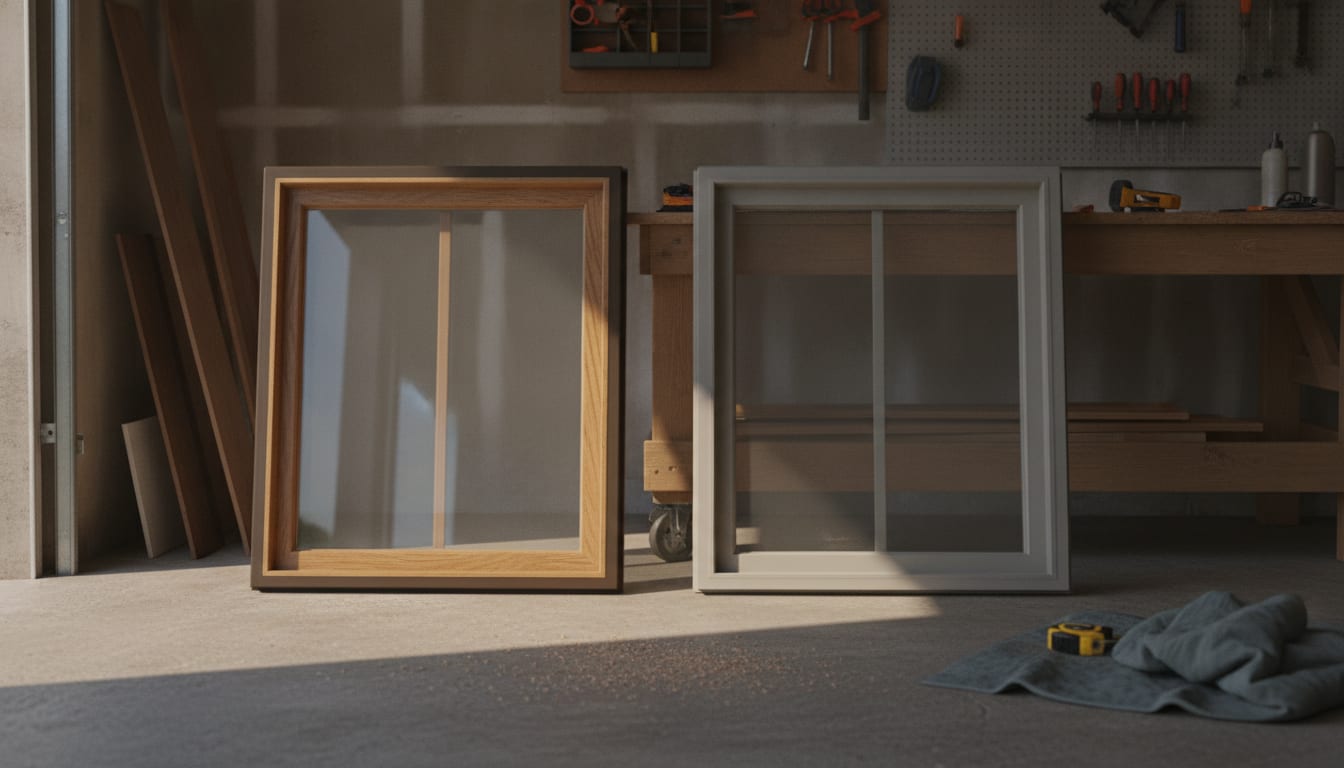
Because the ladder is the product, and the brand is just the ladder’s name. Under every major logo sits the same retail structure: an entry line built to hit a price, a mid line where most buyers land, and a premium line built to win the showroom.
That structure is normal and honest — a base car and an optioned car work the same way. The trap isn’t a bad brand. It’s comparing two different rungs and thinking you’re comparing brands: a budget rung from a premium name against a premium rung from a value name, with the logos pointing you exactly backwards.
Here’s the generic shape of the ladder — deliberately brand-free, because it’s roughly everyone’s shape:
| Budget rung | Mid rung | Premium rung | |
|---|---|---|---|
| Frame material | Builder-grade vinyl | Reinforced vinyl, composite, or fiberglass | Fiberglass, wood, and wood-clad |
| Glass package | Standard double-pane, basic Low-E | Better Low-E stacks, argon fill, warm-edge spacers | Premium coatings, triple-pane and specialty options |
| Sizes and options | Stock sizes, few finishes | More sizes, colors, grid patterns | Full custom sizes, shapes, and finishes |
| Warranty posture | Shorter, more limited | Longer limited coverage | Longest terms, often transferable |
| Price posture | Entry | Middle | Top of the sheet |
| What every rung still needs | A correct install | A correct install | A correct install |
Frame material
- Budget rung
- Builder-grade vinyl
- Mid rung
- Reinforced vinyl, composite, or fiberglass
- Premium rung
- Fiberglass, wood, and wood-clad
Glass package
- Budget rung
- Standard double-pane, basic Low-E
- Mid rung
- Better Low-E stacks, argon fill, warm-edge spacers
- Premium rung
- Premium coatings, triple-pane and specialty options
Sizes and options
- Budget rung
- Stock sizes, few finishes
- Mid rung
- More sizes, colors, grid patterns
- Premium rung
- Full custom sizes, shapes, and finishes
Warranty posture
- Budget rung
- Shorter, more limited
- Mid rung
- Longer limited coverage
- Premium rung
- Longest terms, often transferable
Price posture
- Budget rung
- Entry
- Mid rung
- Middle
- Premium rung
- Top of the sheet
What every rung still needs
- Budget rung
- A correct install
- Mid rung
- A correct install
- Premium rung
- A correct install
One brand name
One brand, three rungs
Under every major logo sits the same retail structure — an entry line built to hit a price, a mid line where most buyers land, and a premium line built to win the showroom.
Wood-clad custom
Fiberglass, wood, and wood-clad — full custom sizes, shapes, and finishes, with premium coatings and triple-pane on the options list.
Premium rung · top of the sheet
Better glass, more options
Reinforced vinyl, composite, or fiberglass — better Low-E stacks, argon fill, warm-edge spacers, and more sizes, colors, and grid patterns.
Mid rung
Builder vinyl
Builder-grade vinyl, standard double-pane, basic Low-E — stock sizes and few finishes, built to hit a price.
Budget rung · entry
This is also why two quotes carrying the same brand name can land thousands apart with nobody lying. Different rung, sometimes a different sales channel entirely — the Andersen vs Renewal by Andersen split is the textbook case, and the Pella vs Andersen comparison shows how two whole ladders line up against each other rung by rung.
How do I compare two window lines spec to spec?
With the label that doesn’t care who made the window — the NFRC label. Every certified window carries a sticker from the reporting the same lab-tested ratings, whoever built it. It’s the only apples-to-apples instrument in this market, and it makes brand loyalty optional.
Five steps:
- Get the exact line on every quote. “Andersen” is not a spec; “Andersen 100 Series, double-hung” is. If a quote won’t name the series, that’s your first question — the red-flags page covers why.
- Pull the NFRC ratings for that line and configuration — from the label itself, the manufacturer’s spec sheet, or NFRC’s public certified-products directory.
- Compare like against like. Same material, same size, same operation type (a casement and a double-hung rate differently by design — that’s a type question, not a quality gap).
- Read the two NC numbers. and . For most of NC — Piedmont, coast, Sandhills — the ENERGY STAR targets are U-factor at or under 0.28 and SHGC at or under 0.23. Mountain counties sit in the colder zone: U at or under 0.25, with SHGC relaxed to 0.40. One spec clears the whole state: U ≤ 0.25 with SHGC ≤ 0.23. The full NC energy-ratings guide unpacks all five numbers.
- Then compare the wrapper: warranty scope (product-only vs whole-job, transferable or not) and who installs — which is the next section, and the biggest one.
Two lines, two labels, side by side — and suddenly the question “which brand is better” becomes the question it should have been all along: which of these two specific windows is better for this house, at these prices? That one has an answer.
If a draft complaint or a condensation problem is what sent you window shopping in the first place, two of the label’s optional ratings speak directly to it — air leakage for drafts, condensation resistance for the fog — and the energy-ratings guide maps each number to the complaint it answers.
What decides the outcome more than the brand?
The installation — by a wide margin. Every rating in the previous section is a lab number. It assumes the window is sealed, flashed, and square in the wall. The bottom row of the ladder table wasn’t a joke: a premium rung over a skipped sill pan loses to a mid rung installed correctly.
That argument gets its own page — why installation quality beats the brand on the glass — including the five questions that put the install on paper before you sign anything.
So here’s the whole method, in the order that protects you:
- Line first. Name it, label it, compare it spec to spec.
- Wrapper second. Warranty scope, and which kind of company is selling it to you.
- Install always. Buy it explicitly — it decides whether everything above performs.
The brand name on the ad is the least load-bearing word on your quote. Not because brands don’t matter — the good ones earn their reputations — but because the reputation belongs to the ladder, and your house only gets one rung of it. Pick the rung on purpose.
Sources, Verification & Fact-Checking verified July 2026
Every load-bearing fact on this page is sourced and verified against a primary authority.
Verified July 2026 via direct review of the cited authority — the links open the controlling source so you can check it yourself rather than take our word.
- Manufacturer (dealer channel) vs full-service in-home company — the two ways window brands sell: each company’s own published model: Andersen and Pella sell through dealer/retail channels; Renewal by Andersen describes itself as Andersen’s full-service replacement division; Champion describes itself as a factory-direct manufacturer-installer with single-source responsibility; Window World describes itself as a franchise system, “nationally known, locally owned.” Company self-descriptions, not editorial claims. (Andersen; Renewal by Andersen; Champion; Window World)
- Andersen’s ladder — 100 Series (all-Fibrex budget) through 200, 400, and the custom A/E-Series: all lines confirmed current as of July 2026 against andersenwindows.com product pages (same verification as the live Andersen review). Lineups shift over time — the manufacturer’s current catalog is always the final word.
- Pella’s ladder — Encompass and 250 Series vinyl, Impervia fiberglass, Lifestyle Series and Reserve wood/wood-clad: all lines confirmed current as of July 2026 against pella.com (same verification as the live Pella review); Pella also sells a 150 Series vinyl line not named above. Same catalog caveat.
- Roster one-liners (Marvin premium fiberglass/wood-clad; ProVia quality vinyl and warranties; Milgard mid-range value, Western presence; Simonton budget-to-mid vinyl): each maker’s published line positioning, checked July 2026 — positioning descriptions only; no prices or rankings stated on this page by design.
- The NFRC label as the apples-to-apples comparison — same lab-tested ratings on every certified window, independent of manufacturer: NFRC’s published rating and certification program. (view source — NFRC)
- NC ENERGY STAR targets — most of NC in the South-Central zone (U ≤ 0.28, SHGC ≤ 0.23); mountain counties in North-Central (U ≤ 0.25, SHGC ≤ 0.40); U ≤ 0.25 + SHGC ≤ 0.23 clears both zones: ENERGY STAR Version 7.0 residential window criteria, verified county-by-county against the live ENERGY STAR Climate Zone Finder (Guilford and New Hanover = South-Central; Watauga and Buncombe = North-Central), 2026-07-06, per county placements verified against the published zone finder, July 2026. (view source — ENERGY STAR Climate Zone Finder)
- Similar glass can be quoted far apart depending on the sales model wrapped around it (overhead, in-home sales, whole-job warranty vs product-only): checked against each company’s published sales model, July 2026. Stated directionally, with no multiplier printed on this page; the full breakdown lives on the best-companies page.
- A bad install negates rated performance and can void the manufacturer’s warranty: argued and sourced in full on the install-beats-brand page (NFRC FAQ; DOE Building Science); referenced here without restating numbers.
- Generic ladder table (materials, glass, options, warranty posture by rung): qualitative composite of the verified Andersen and Pella ladders and the KB brand map — deliberately brand-free, presented as typical retail structure with an explicit read-the-actual-warranty caveat in the caption.
- Story callout (“which brand is best” threads): composite of a recurring homeowner-forum pattern — same-brand praise and complaints reconciling once series and installer are named. Told as a representative pattern, not a single sourced thread; no brand attached to the anecdote by design.