


Here’s an odd thing about one of the most-searched window brands in America: most of what you’ll read about it is describing products that are no longer on the company’s own website.
Milgard is a Western brand — five factories, all west of the Rockies — and the review industry mostly isn’t. So the internet’s Milgard coverage leans heavily on old press kits: a fiberglass line the site no longer lists, and a “lifetime warranty” story that the current documents flat-out invert.
This review works from Milgard’s own live pages and its warranty PDFs dated January 1, 2026. Three things came out of that reading that you won’t find in the usual roundups — and all three are things to check on a quote, not marks against anyone.
Which Milgard is on your quote? Read the code
Milgard’s naming system does most of the work for you, once you know it: the letter is the material, the number is the tier. V = vinyl, C = fiberglass, A = aluminum. Higher number, higher position in the range.
That matters because the model code is what’s printed on your quote — the marketing name usually isn’t. A quote that says “V250” and a quote that says “C700” are different purchases and shouldn’t carry the same price.
The six current series, with Milgard’s own positioning:
| Series | Material | What it is | The tell on a quote |
|---|---|---|---|
| V250 Style Line® | Vinyl | The value line — slim profile, fewer colors and styles | No double-hung offered |
| V300 Trinsic™ | Vinyl | The modern line — narrowest vinyl frame, maximum glass, black-on-black option | Narrow frame + dark finishes |
| V400 Tuscany® | Vinyl | The flagship vinyl — widest style range of any series | The ONLY line with double-hung, bay/bow, and swinging patio doors |
| V450 | Vinyl | A separate vinyl line with a narrower option set | Three exterior colors only (white, adobe, black) |
| C700 Fiberglass | Fiberglass | The premium line — six matched interior/exterior colors | Colors like Steel Gray and Bark = C700 |
| A250 Thermally Improved | Aluminum | Thin sightlines for contemporary and mid-century homes | Only two anodized finishes |
V250 Style Line®
- Material
- Vinyl
- What it is
- The value line — slim profile, fewer colors and styles
- The tell on a quote
- No double-hung offered
V300 Trinsic™
- Material
- Vinyl
- What it is
- The modern line — narrowest vinyl frame, maximum glass, black-on-black option
- The tell on a quote
- Narrow frame + dark finishes
V400 Tuscany®
- Material
- Vinyl
- What it is
- The flagship vinyl — widest style range of any series
- The tell on a quote
- The ONLY line with double-hung, bay/bow, and swinging patio doors
V450
- Material
- Vinyl
- What it is
- A separate vinyl line with a narrower option set
- The tell on a quote
- Three exterior colors only (white, adobe, black)
C700 Fiberglass
- Material
- Fiberglass
- What it is
- The premium line — six matched interior/exterior colors
- The tell on a quote
- Colors like Steel Gray and Bark = C700
A250 Thermally Improved
- Material
- Aluminum
- What it is
- Thin sightlines for contemporary and mid-century homes
- The tell on a quote
- Only two anodized finishes
The two field tests
You can usually identify the line from the quote without asking anyone, using two facts from Milgard’s own series pages:
Style availability. If your quote includes a double-hung, a bay or bow, or a swinging patio door, you’re looking at a V400 Tuscany — none of the other five series offers those styles.
Color availability. A quote promising Steel Gray or Bark is a C700 quote — those matched fiberglass colors don’t exist elsewhere in the range. Three exterior colors only points at V450; anodized-only points at A250.
Small thing, worth knowing: Milgard’s color swatches are labeled by plant. Each of its five factories serves its own region, so the color menu you’re offered depends on which plant serves you. If a color you saw online isn’t on your dealer’s sheet, that’s the reason — ask what your plant runs.
”My quote says Ultra or C650 — is that still a thing?”
If you’ve been researching Milgard fiberglass, you’ve probably hit the name Ultra. Here’s the current state of it.
The fiberglass line on Milgard’s site today is the C700 Fiberglass Series. The windows page and the main navigation list six series, and Ultra isn’t among them.
The old name hasn’t fully left the building, though — Milgard’s own dealer locator still offers “C650 Ultra Series” as a product filter, and a 2017 comparison post on its blog still mentions the Ultra name. That’s a normal product transition with normal lag, and it’s exactly why buyers get confused googling it.
Can you get Milgard on the East Coast?
No — and the cleanest proof is that Milgard answers this question itself. Its own site asks “Can I get Milgard® windows on the East Coast?” and answers:
MI — Milgard’s sibling under the MITER Brands umbrella, which Milgard joined in 2019 — runs plants in Pennsylvania and Texas to serve the East and South. So the East-Coast answer isn’t “you’re out of luck,” it’s “different badge, different company, ask there.”
The footprint behind that answer: Milgard operates five factories, all Western — Tacoma (the original site, founded 1958), Portland, Sacramento, Temecula, and Prescott Valley, Arizona — each serving its own region. And a count of the dealer profiles published in Milgard’s own sitemap in July 2026 found 655 dealers across 14 states, none east of Texas — with roughly three-quarters of the network in California, Washington, and Oregon alone. (That’s a count of its published directory on one date, not a company statistic — but it draws the map clearly enough.)
If you’re reading this from the East: your closest equivalents in spirit are the national manufacturer-through-dealer brands — Simonton on the vinyl side, Andersen if you want a bigger materials range.
The warranty, read from the actual documents
Everything in this section comes from Milgard’s three current consumer warranty PDFs, all effective January 1, 2026, and they’re genuinely worth understanding before you sign — because the structure is more interesting than the word “lifetime” suggests.
The standard warranty is two warranties in one. Frame and panel coverage runs for as long as the original purchaser owns and occupies the home — that’s the “lifetime” — and drops to a 10-year term for “All Other Owners.” That second category is broad: it includes anyone you sell to, rental properties, commercial use, HOAs, and builders.
The practical translation: rent the house out and “lifetime” becomes 10 years. Sell it, and the next owner gets 10 years from the manufacture date — not from their purchase.
The component terms worth knowing, from the Replacement-product document:
Beyond the seal: hardware and finishes run 10 years, screens and weatherstripping 1 year, stress cracks 1 year. And one exclusion to know: glass breakage is not covered by the standard warranty at all.
The Full Lifetime Warranty — a paid upgrade, and the inversion
Here’s the finding that most Milgard coverage gets backwards, and it’s the most useful thing on this page.
Milgard offers a Full Lifetime Warranty — and it is an optional, paid upgrade, not the standard coverage. The document’s first paragraph says it must be purchased at the time of the original sale and reflected in the order documents, and Milgard’s warranty page lists it as available on three lines only: V400 Tuscany, V300 Trinsic, and C700.
What the upgrade buys is real: lifetime coverage on frame, glass unit, and hardware with labor and shipping paid, plus the only glass-breakage coverage Milgard offers (non-specialty glass, reasonable use).
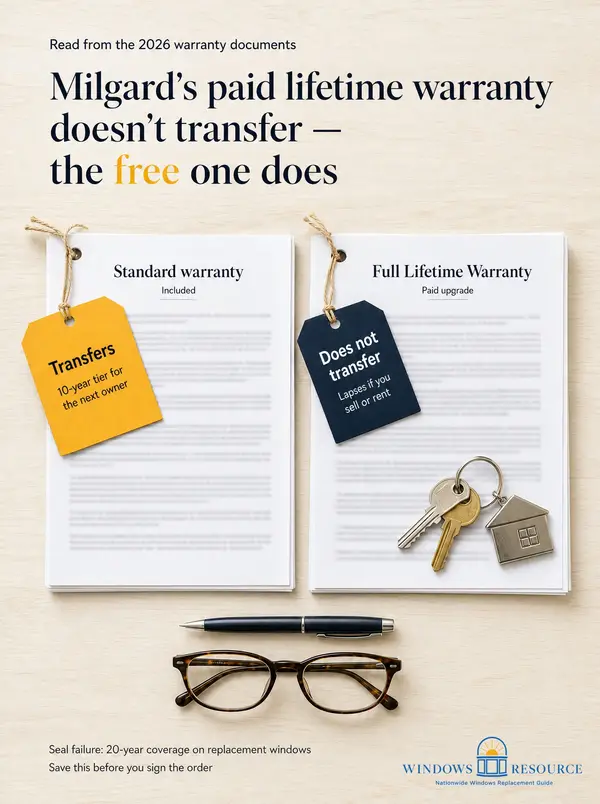
But here’s the inversion. The standard warranty document says plainly that it is transferable — each owner passes it to the next, at the 10-year “All Other Owners” tier. The paid Full Lifetime Warranty says the opposite:
So on Milgard, “transferable” is a property of the free warranty — and “lifetime” is a property of you staying in the house. If you’re buying with a five-year move on the horizon, the upgrade’s value shrinks accordingly, and that’s worth doing the math on before you pay for it. Not a gotcha — it’s in the document, dated and published. Just read before you buy, or ask the dealer to walk you through which warranty is on your order.
| Standard warranty (included) | Full Lifetime Warranty (paid upgrade) | |
|---|---|---|
| Availability | Every line, automatically | V400, V300, C700 only — must be on the original order |
| Frame & panel | Lifetime (original owner-occupier) / 10 yr all other owners | Lifetime, labor & shipping paid |
| IGU seal failure | 20 yr (replacement) / 10 yr (new construction) | Lifetime |
| Glass breakage | Not covered | Covered (non-specialty glass) |
| Transfers to the next owner? | Yes — at the 10-year tier | No — lapses on sale or rental |
Availability
- Standard warranty (included)
- Every line, automatically
- Full Lifetime Warranty (paid upgrade)
- V400, V300, C700 only — must be on the original order
Frame & panel
- Standard warranty (included)
- Lifetime (original owner-occupier) / 10 yr all other owners
- Full Lifetime Warranty (paid upgrade)
- Lifetime, labor & shipping paid
IGU seal failure
- Standard warranty (included)
- 20 yr (replacement) / 10 yr (new construction)
- Full Lifetime Warranty (paid upgrade)
- Lifetime
Glass breakage
- Standard warranty (included)
- Not covered
- Full Lifetime Warranty (paid upgrade)
- Covered (non-specialty glass)
Transfers to the next owner?
- Standard warranty (included)
- Yes — at the 10-year tier
- Full Lifetime Warranty (paid upgrade)
- No — lapses on sale or rental
The service-territory catch
One more clause that matters if you move — or buy remote property. Both standard warranties cover the product anywhere in the United States, but labor and shipping only follow it inside Milgard’s Service Territory, and only for the first 10 years. Outside the territory, inspection, labor, and shipping are the owner’s cost.
The territory is drawn as a map (redrawn effective January 1, 2026 — older articles describe the old one), so don’t trust a state list from any review, including this one: check the live map on Milgard’s warranty page against your address.
And a definition worth noticing: covered “Skilled Labor” is work requiring skills an owner doesn’t have — the documents say plainly that other labor, like swapping hardware, isn’t covered even inside the territory.
What do Milgard windows cost?
Milgard publishes no prices — its site shows a relative $-to-$$$$$ indicator per series and nothing more. So any review quoting you a “Milgard price” is quoting you someone’s price, somewhere, once.
What can be said honestly is the shape: Milgard is a mid-market brand whose price span runs narrower than the wood-carrying nationals — because there’s no wood line, there’s no wood-line ceiling. The spread between its value vinyl and its fiberglass flagship is real but modest compared to a range that tops out in custom wood.
Your actual number lives on a local quote from a certified dealer — and when you have one, run it through the quote sanity-check before you compare anything.
What owners praise — and what they complain about
Reading across aggregated owner reviews and forum discussion (reported themes, not company claims):
The praise clusters are consistent: rooms that hold temperature after replacement, noise reduction people didn’t expect, the narrow-frame looks — the V300’s black-on-black draws specific compliments — and the one-motion locking hardware. The Pacific Northwest, where the brand has operated since 1958, carries a genuine multi-decade goodwill cluster.
The complaints cluster in three places. The largest is service coordination — and the shape matters: it’s mostly about claim handling, response times, and repeat visits, not about coverage being denied. Process friction, not bad faith. The second is seal failure — fogged units showing up earlier than expected. Worth pairing with the fact above: on replacement product, that exact failure carries a 20-year term, so a fogged unit is a claim to file, not a loss to absorb. The third theme is the “it changed after they got bought” narrative — the verifiable core is simply that Milgard joined MITER Brands in 2019; the quality perception is a reported owner perception, and I have no evidence to adjudicate it either way.
One more pattern in the complaint data, and it’s the one I’d weight most: a large share of “the window is bad” reports are actually delivery-and-install reports — out-of-square openings, misaligned hardware, poorly fitting screens. Which brings us to the section that matters more than the brand.
The dealer is the whole experience
Milgard is a manufacturer. It doesn’t install anything. Its certified dealers sell the window and — in Milgard’s own words — “connect you with experienced installers.” That’s the same structure as Andersen’s dealer channel, and it means the same thing: the window on the sticker and the window in your wall are separated by an installation decision that belongs to you.
Milgard’s own warranty documents make this point better than I can:
That’s not a loophole — it’s the company being honest that a lab-tested sample and a field install are different things. The numbers survive only if the install is right, and the install is a separate decision from the window.
Practical version: Milgard’s dealer locator filters by real capability flags — public showroom, offers installation, replacement vs new construction, financing. “Offers installation” being a filter tells you some dealers don’t. And each dealer profile carries its own reviews — read those, not just the brand’s. You’re not just buying a Milgard; you’re hiring whoever puts it in.
So — are Milgard windows good?
Unanswerable until you name the series — and that’s not a dodge, it’s the structure of the company. A V250 and a C700 are different products at different prices with, potentially, different warranties on the order.
The honest summary: a Western-only, all-non-wood manufacturer (vinyl, fiberglass, and one of the few remaining residential aluminum lines) with a strong regional reputation, sold through dealers whose quality — like every dealer-channel brand — varies by the dealer. The product draws real praise on comfort and looks; the paperwork rewards the ten minutes it takes to read it.
Before you sign anything: read the model code off the quote, ask which warranty is on the order, and check whether “Ultra” means C700. Those three questions cost nothing and answer almost everything.
Sources, Verification & Fact-Checking verified July 2026
Every load-bearing fact on this page is sourced and verified against a primary authority.
Verified July 2026 via direct review of the cited authority — the links open the controlling source so you can check it yourself rather than take our word.
- Milgard’s current window lineup is six series — V250 Style Line, V300 Trinsic, V400 Tuscany, V450, C700 Fiberglass, and A250 Thermally Improved Aluminum — with no “Ultra” series listed. The V400 Tuscany is the only series offering double-hung, bay/bow, and swinging patio doors; the legacy “C650 Ultra Series” name still appears in the dealer-locator product filter. (view source — milgard.com/windows · view source — Milgard dealer locator)
- Milgard states it is a Western brand and routes East-Coast buyers to MI Windows and Doors, its sibling under MITER Brands (joined 2019), which operates plants in Pennsylvania and Texas. (view source — Milgard, “Shop for quality vinyl windows nationwide” · view source — milgard.com/about)
- Milgard operates five manufacturing facilities, all in the West — Tacoma/Fife WA (the original site; company founded 1958 in Tacoma), Tualatin OR, Sacramento CA, Temecula CA, and Prescott Valley AZ — each serving its own region. (view source — milgard.com/our-locations)
- A count of Milgard’s published sitemap on 2026-07-28 found 655 dealer-profile pages across 14 states, none east of Texas, with ~73% in California, Washington, and Oregon. Method: count of dealer-profile URLs in milgard.com/sitemap.xml on that date — a directory snapshot, not a company statistic. (view source — milgard.com/sitemap.xml)
- Milgard’s standard warranty is two-tier: lifetime coverage for the original owner-occupier, limited to 10 years for “All Other Owners” (defined to include subsequent owners, rentals, commercial use, HOAs, and builders) — and it is transferable at that 10-year tier. IGU seal failure is covered 20 years on replacement product and 10 years on new construction; glass breakage is excluded. Documents effective January 1, 2026. (view source — Milgard Replacement Product Warranty PDF · view source — Milgard New Construction Warranty PDF)
- The Full Lifetime Warranty is an optional upgrade purchased with the original order, available on V400 Tuscany, V300 Trinsic, and C700 only; it adds glass-breakage coverage and lifetime labor/shipping — and it “cannot be assigned or transferred,” lapsing if the owner sells, rents out, or ceases to occupy the dwelling. (view source — Milgard Full Lifetime Warranty PDF · view source — milgard.com/warranty)
- Labor and shipping coverage applies only within Milgard’s Service Territory (redrawn effective January 1, 2026); outside it, inspection, labor, and shipping are the owner’s responsibility. Covered “Skilled Labor” excludes work an owner could do, such as replacing hardware. (view source — Milgard Service Territory map)
- Milgard states it does not warrant its test results or certifications, because installation and field conditions affect them. (view source — Milgard Replacement Product Warranty PDF)
- Owner-sentiment themes are reported from aggregated homeowner reviews and forum discussion (July 2026) — praise clustering on comfort, noise reduction, narrow-frame aesthetics, and locking hardware; complaints clustering on service coordination, seal failure, and install-adjacent issues. Reported as themes, not verified individual claims. (Aggregated review sweep, 2026-07-28.)