

You typed “Simonton windows review,” and you’re probably holding a quote — maybe a Home Depot install estimate, maybe a local dealer’s bid. You want one thing settled: does “value vinyl” mean good enough for my house, or the cheap stuff I’ll feel every winter?
Here’s the honest version from someone who reads window quotes for a living. Simonton is a legitimate value-tier vinyl window.
The catch isn’t the vinyl. It’s that the Simonton at the big-box base price isn’t the best window that name makes — and the real risk on the job is the dealer, not the frame.
Are Simonton windows any good? Yes — as a value-tier vinyl brand. Simonton makes dependable, ENERGY STAR vinyl windows across a ladder of numbered collections, from a budget line up to a premium impact-rated one. The honest catch: the base big-box window isn’t the best window Simonton makes, and the finished quality rides on the dealer who installs it. Spec it up with Low-E and argon for NC heat, name the collection on your quote, and vet the dealer — that’s the whole game.
Who makes Simonton, and where you actually buy it
Simonton is a manufacturer — founded in 1946, owned by Ply Gem under Cornerstone Building Brands — sold through independent dealers and, at the big-box end, exclusively at Home Depot.
That’s a different kind of company than a full-service in-home brand that sells, builds, and installs in one visit. With Simonton you’re buying the product; the install is a separate line you can shop, and the dealer you pick is a decision all its own.
Ply Gem acquired Simonton in 2014, and its Cornerstone parent bills itself as North America’s largest manufacturer of vinyl windows and doors. So the manufacturer backing is real and stable — the frame isn’t coming from a shop that might vanish before your warranty does.
One practical note that trips people up: Simonton’s big-box channel is Home Depot, not Lowe’s. If you’re comparing a big-box quote to a dealer quote, you’re comparing two doors into the same manufacturer — and, often, two different windows. More on that next. For the wider field, see how it sits among the other window brands.
Which Simonton line is on your quote?
This is the question that decides everything — because “Simonton” is a ladder of numbered collections, and the legacy names you’ll still see in older reviews (Reflections, ProFinish, Impressions) have been retired.
Simonton’s current site organizes the lineup as numbered collections plus a few named ones. Roughly, by tier:
- Value: 5050, HarborLight, Pro, and the new-construction Contractor / Brickmould lines.
- Mid: 5500, 6100 / 6200, DaylightMax (a slim-frame line), and the narrow-frame ComfortSmart.
- Premium: 6500, Madeira and Premium (wood-look vinyl), and the MaxView 7600 / 7800.
- Coastal / impact: StormBreaker Plus — the hurricane-rated line that only matters in a wind-borne-debris zone.
Treat any single line name as a “confirm on the quote” item, not gospel — the naming has changed before and the retail-channel budget lines carry their own names. The tier shape is what stays stable, and it’s what you need to compare two quotes.
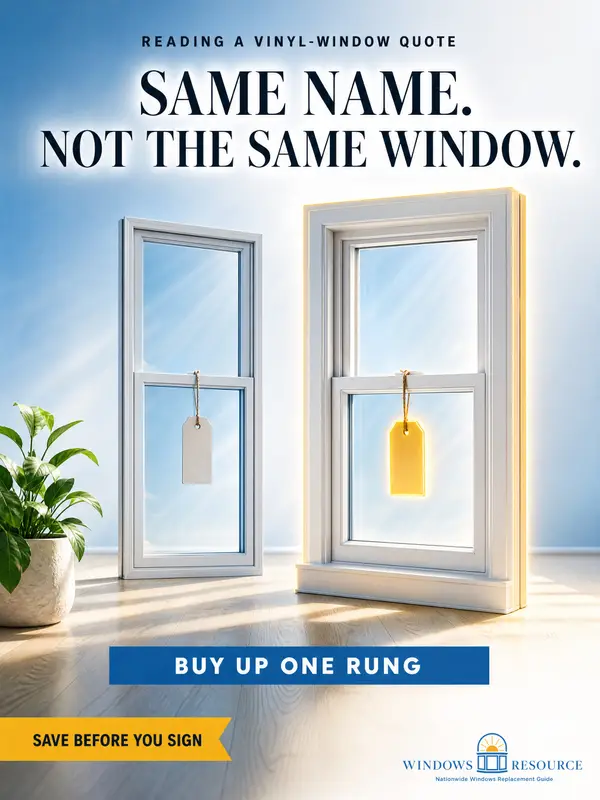
Here’s the move that matters most for a value buyer: don’t judge Simonton by the Home Depot base window. Buy up one rung to a dealer’s mid-tier collection speced with glass and argon fill, and you get a meaningfully better window — often for a surprisingly small step in price.
Buy up one rung
The whole value play, in one step
Don’t judge the brand by the big-box base window — the dealer’s next collection up is a meaningfully better window, often for a surprisingly small step in price.
Dealer mid-tier
Better Low-E plus argon, a thicker frame, an upgraded warm-edge spacer — and a crew you vetted yourself.
Buy up one rung
Big-box base line
Base Low-E with often a single upgrade path, a thinner frame and basic spacer, and a store-arranged crew or subcontractor.
Lowest sticker
| What you're comparing | Big-box base line | Dealer mid-tier (e.g. 5500 / 6500) |
|---|---|---|
| Glass package | Base Low-E, often single upgrade path | Better Low-E + argon; triple-pane available on upper lines |
| Frame & spacer | Thinner frame, basic spacer | Thicker frame, upgraded warm-edge spacer |
| Warranty tier | Budget lines carry less coverage | Upper lines carry the fuller coverage — read the per-line document |
| Who installs | Store-arranged crew or subcontractor | The dealer's crew you actually vetted |
| What to vet | Confirm the exact line and glass spec before you sign | Vet the dealer and the written order as hard as the window |
Glass package
- Big-box base line
- Base Low-E, often single upgrade path
- Dealer mid-tier (e.g. 5500 / 6500)
- Better Low-E + argon; triple-pane available on upper lines
Frame & spacer
- Big-box base line
- Thinner frame, basic spacer
- Dealer mid-tier (e.g. 5500 / 6500)
- Thicker frame, upgraded warm-edge spacer
Warranty tier
- Big-box base line
- Budget lines carry less coverage
- Dealer mid-tier (e.g. 5500 / 6500)
- Upper lines carry the fuller coverage — read the per-line document
Who installs
- Big-box base line
- Store-arranged crew or subcontractor
- Dealer mid-tier (e.g. 5500 / 6500)
- The dealer's crew you actually vetted
What to vet
- Big-box base line
- Confirm the exact line and glass spec before you sign
- Dealer mid-tier (e.g. 5500 / 6500)
- Vet the dealer and the written order as hard as the window
Are Simonton windows good quality?
Yes, with an honest asterisk: dependable mid-range vinyl by the spec sheet — but the finished quality of your job rides on the install and the dealer more than on the frame itself.
An installer-perspective reviewer (thewindowdog) grades Simonton a B (84) — “a dependable mid-range window for homeowners on a budget,” not a premium one. The praise and the gripes both ring true:
- What’s good: wide availability (Home Depot plus contractors), ENERGY STAR ProSolar Low-E glass, competitive install pricing, and a stable manufacturer behind the warranty.
- What’s not: an older frame-design philosophy (air-infiltration trails the newest frames), thicker frames that trade away a little glass area, occasional cosmetic weld marks, and quality that leans hard on who installs it.
On paper the certifications are there — ENERGY STAR, Gold Label, and a Good Housekeeping Seal. Read those as “the product clears the bar,” not as a verdict on your specific job.
Here’s the part the star ratings bury. In the reviews, the recurring pain usually isn’t the window failing — it’s fulfillment and service. One homeowner on a roughly $22k job described the dealer sending the wrong product again and again — wrong size, wrong color, wrong grids — and coming out eight times without getting it right.
That’s a hard story, and it’s one dealer, reported by one buyer — not a verdict on the brand.
But it points at exactly where your attention belongs: get the order in writing, confirm every size and color and grid before it’s placed, and vet the dealer’s service reputation the way you’d vet any installer. The vinyl rarely fails you. The service department is where jobs go sideways.
The “double lifetime warranty,” decoded
“Double-Lifetime” is Simonton’s own term — but it lives in the per-line warranty documents, not the sales pitch, and it means something narrower than it sounds.
On its own warranty pages, Simonton describes “a robust warranty covering our vinyl, hardware, screens, and glass units” and says its warranties transfer to the next homeowner.
The per-line documents name that transfer directly: the 5500/5050 warranty calls the vinyl, hardware, and screen coverage a “Double-Lifetime Components Limited Warranty” — transferable one time to a subsequent homeowner. So “double lifetime” is a real feature, and it’s Simonton’s own word for it. It just means the transfer — not two lifetimes of everything.
You know how “lifetime” tends to go in window warranties, and this is no exception. Read the fine print for three things:
- Labor isn’t Simonton’s. The warranty document says it flatly: labor costs “are not included,” and “neither Simonton nor its distributors will be responsible for any costs incurred in the removal, replacement, installation, reinstallation or repair” of the product. That side of the coverage rides on your dealer — if the dealer closes up shop, it can go with them.
- Glass breakage is limited and conditional. On the lines that offer it, breakage is covered for a set term (three years on the 5500) and only if you bought double-strength glass — and some lines carry no glass-breakage coverage at all. Confirm it before you assume it’s included.
- Terms vary by line and by purchase date. Coverage lives in separate per-collection PDFs with their own date cutoffs, and the budget lines carry less than the upper ones. Read the document for your collection.
So the honest read: the warranty is a genuine plus, especially the transfer. Just don’t let “double lifetime” on a sales sheet stand in for reading the actual document for your collection, purchased on your date — and asking, in writing, who honors the labor side in year three.
What do Simonton windows cost in NC?
Nationally, installed Simonton windows commonly land in roughly the $550–$950 per window range, with a wider $200–$1,200 span across the whole ladder — but that’s a national estimate, not a North Carolina quote.
Treat those as relative positioning, not a price sheet. What actually moves your number: which collection, the glass package, whether the install is a pocket or full-frame job, and the dealer’s overhead. The same window can be quoted noticeably apart depending on the sales model, not the vinyl.
For a value buyer in NC, the play is the one this whole page keeps circling: buy up from the base line to a dealer mid-tier with Low-E and argon for our heat and humidity, and skip StormBreaker Plus unless you’re in a coastal wind-borne-debris county.
Then run the number itself through the same math as any bid — the broader levers on what vinyl windows should cost usually move your total more than the brand name does.
Whatever the sticker says, price your configuration itemized in writing, and defer to a live NC quote before you trust any single figure.
Who Simonton fits — and who should look elsewhere
My take, labeled as opinion: Simonton fits a budget-conscious NC buyer who specs it up, names the collection, and vets the dealer — and it’s a weaker fit where premium materials or hard-sun dark exteriors are the point. By scenario:
- You want a solid value vinyl window and you’ll buy up one rung → this is Simonton’s lane, and it’s a legitimately good one. Spec Low-E + argon, name the mid-tier collection, vet the dealer. That buyer is being served, not settling. (opinion)
- You’re on the NC coast → the impact question comes first. StormBreaker Plus is the line to ask about in a wind-borne-debris zone; that’s a code-and-safety matter separate from the energy glass. (opinion)
- You want fiberglass, composite, or a dark exterior that won’t warp in full sun → this is where vinyl’s real limits show, and it’s worth looking past a budget line — what vinyl does well and where it doesn’t covers the trade-off honestly.
- You want single-source, whole-job accountability from one company → that’s a different model than a manufacturer-plus-dealer buy, and it prices differently. Neither is a trick; they’re just different columns.
So — is it worth a quote?
Getting a Simonton quote costs you nothing and anchors the value end of your comparison — just name the collection, hold every bidder to the same spec, and vet the dealer as hard as the window.
Hand each bidder the same window count and configuration, insist on per-window itemization with the collection, material, , and named, and let the differences sort themselves out.
That’s the same standard this site holds every brand to — the premium ones included.
And if you’ve got a Simonton quote in hand and want it read next to your other bids — which collection it really is, whether the glass is right for NC, whether the dealer is the risk — that’s exactly what a no-pressure second opinion is for.
Sources, Verification & Fact-Checking verified July 2026
Every load-bearing fact on this page is sourced and verified against a primary authority.
Verified July 2026 via direct review of the cited authority — the links open the controlling source so you can check it yourself rather than take our word.
- Company & ownership (founded 1946; acquired by Ply Gem from Fortune Brands in 2014; Ply Gem is part of Cornerstone Building Brands, described on Simonton’s site as “part of North America’s largest manufacturer of vinyl windows and doors”; sold via independent contractors, distributors, and retail — and exclusively at Home Depot among big-box retailers, not Lowe’s; certifications: ENERGY STAR, AAMA Gold, Good Housekeeping Seal): Simonton’s official site (ownership footer, Good Housekeeping Seal, sales channels), corroborated for the 1946 founding, the 2014 Ply Gem acquisition, AAMA Gold, and the Home Depot-exclusive big-box channel by This Old House — both fetched July 2026. (view source — Simonton, official site; view source — This Old House, Simonton review)
- Current product lineup — numbered collections, legacy names retired (value: 5050, HarborLight, Pro, Contractor / Brickmould; mid: 5500, 6100/6200, DaylightMax, ComfortSmart; premium: 6500, Madeira, Premium, MaxView 7600/7800; coastal/impact: StormBreaker Plus): every line named here was confirmed live on Simonton’s product page, fetched July 2026. The legacy Reflections / ProFinish / Impressions names do not appear as current product lines and are not presented as current (nuance: “Reflections” survives only inside the filename of the 5500/5050 warranty PDF, not as a consumer-facing line). Retail-channel budget names (e.g. ClearValue) were not shown on the live lineup; treat any single line name as a “confirm on the quote” item. (view source — Simonton windows lineup)
- Warranty (CORRECTION: “Double-Lifetime” IS Simonton’s own term — the per-line 5500/5050 warranty PDF names the transferable vinyl/hardware/screen coverage a “Double-Lifetime Components Limited Warranty,” transferable one time to a subsequent residential owner; the phrase is NOT on Simonton’s own web pages, only in the per-line PDFs. Simonton’s own web language: “a robust warranty covering our vinyl, hardware, screens, and glass units,” transferable to the next homeowner. From the per-line PDF, verbatim: labor costs “are not included,” and “neither Simonton nor its distributors will be responsible for any costs incurred in the removal, replacement, installation, reinstallation or repair”; glass breakage = 3 years and only with double-strength glass on the 5500, with no glass-breakage coverage on the 5050; terms vary by line and purchase date via separate per-collection PDFs with dated cutoffs, e.g. 5/5/2025, 3/31/2025, 7/29/2024): Simonton warranty pages plus the per-line “Replacement Products” (5500/5050/Asure/Inovo) warranty PDF, all fetched and text-extracted July 2026. (view source — Simonton warranty information; view source — Simonton’s own warranty language; view source — Simonton 5500/5050 warranty PDF)
- Quality verdict & pros/cons (installer-perspective grade of B (84) / “a dependable mid-range window for homeowners on a budget”; pros: wide availability, ENERGY STAR ProSolar Low-E glass, competitive install pricing, stable manufacturer; cons: older frame-design philosophy / air-infiltration trails newest frames, thicker frames = less glass area, occasional cosmetic weld marks, install-dependent quality): thewindowdog installer review, fetched July 2026 — reviewer opinion, attributed, not stated as fact. Corroborating price range, warranty caveats (labor excluded; glass breakage only if double-strength), and mixed customer-service reports: This Old House Simonton review, fetched July 2026. (view source — thewindowdog, Simonton review; view source — This Old House, Simonton review)
- Homeowner voice-of-customer (a dealer’s higher-end Simonton 6500 beat a Home Depot base-line quote on both spec and price, even with an extra window added — poster “-Brent-”; a window salesman chose the Simonton 6500 for his own home — poster “Scott H in Wheaton”; a separate buyer on an about-$22k job reported repeated wrong-product deliveries and eight service visits — poster “Bigsdad”): a GarageJournal forum thread, fetched July 2026, all three quotes verified verbatim — reported homeowner experience, attributed, never editorialized into a claim about the brand or any single dealer. (view source — GarageJournal, Simonton thread)
- Cost context (installed Simonton windows commonly around $550–$950 per window; wider $200–$1,200 span across the ladder): national estimates from the reviews above (thewindowdog gives $550–$950 installed; This Old House gives $200–$1,200), fetched July 2026, never presented as an NC quote — routed to the cost page for real numbers. Defer to a live local quote.
- NC energy targets (the NFRC label is the one apples-to-apples comparison across every certified window — U-factor, SHGC, VT, air leakage, condensation resistance; for most of North Carolina — the South-Central ENERGY STAR zone — the benchmark is U-factor ≤ 0.28 and SHGC ≤ 0.23; coastal wind-borne-debris zones require impact-rated glazing as a separate code/safety matter): NFRC label definition and the ENERGY STAR residential-window criteria page both confirmed live and fetched July 2026; the specific 0.28 / 0.23 thresholds are the established South-Central zone targets for most of North Carolina. (view source — NFRC; view source — ENERGY STAR criteria)