


The salesperson said “lifetime warranty, fully transferable,” and it sounded like the end of the conversation. It’s actually the start of one.
I read these documents for a living, and here’s the honest version: a window warranty is a promise written by the people who’d have to keep it. That doesn’t make it a trick — most of these terms are standard and legitimate. It just means the words are doing specific, quiet work, and four of them decide almost everything.
This page is how to read that page. What’s actually covered, what quietly voids it, and what “lifetime,” “limited,” “prorated,” and “transferable” really mean — so the paper protects you on the day you finally need it.
What should I check in a window warranty? Four things. What “lifetime” is defined as (usually the product’s expected lifespan, not yours). Whether it’s the product warranty, the labor warranty, or both — they’re two separate promises on two clocks. What voids or limits it (bad or unauthorized install, no registration, missed transfer notice). And whether it’s prorated (coverage that shrinks with age) and transferable (survives a home sale, often with a filing deadline). Read those four before you read anything else.
What does a “lifetime” window warranty actually mean?
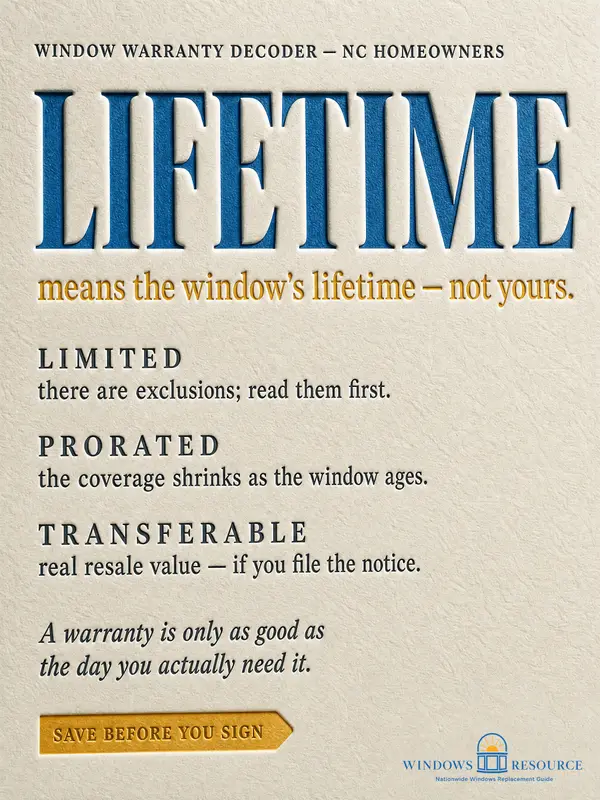
It rarely means your lifetime. In warranty language, “lifetime” almost always means the manufacturer’s expected product lifespan — a figure the fine print usually defines, often as a set span of years rather than “forever.”
The Federal Trade Commission’s guidance on this is straightforward: a “lifetime” claim is supposed to spell out whose life, or what period, it actually covers. That’s why you’ll almost always see it written as “limited lifetime” — and “limited” is the word that carries the exclusions.
Here’s what a real definition looks like. Champion — a national manufacturer whose limited lifetime warranty is one of the stronger ones I read — spells “lifetime” out plainly: coverage applies as long as the original purchaser owns the home. And it’s a genuinely good warranty behind that line. It’s non-prorated, and it covers broken glass, seal failure, parts, labor, screens, and waste removal — even accidental breakage (their own example is a baseball through the pane). But read the definition again. “Lifetime” is pinned to your ownership of the home — which is precisely why the transferable question further down decides what the word is worth the day you sell.
So the first move on any warranty isn’t to feel reassured by the word. It’s to find where the document defines the word, and read that — the way Champion does, in one plain sentence.
Product warranty vs labor warranty — what’s the difference?
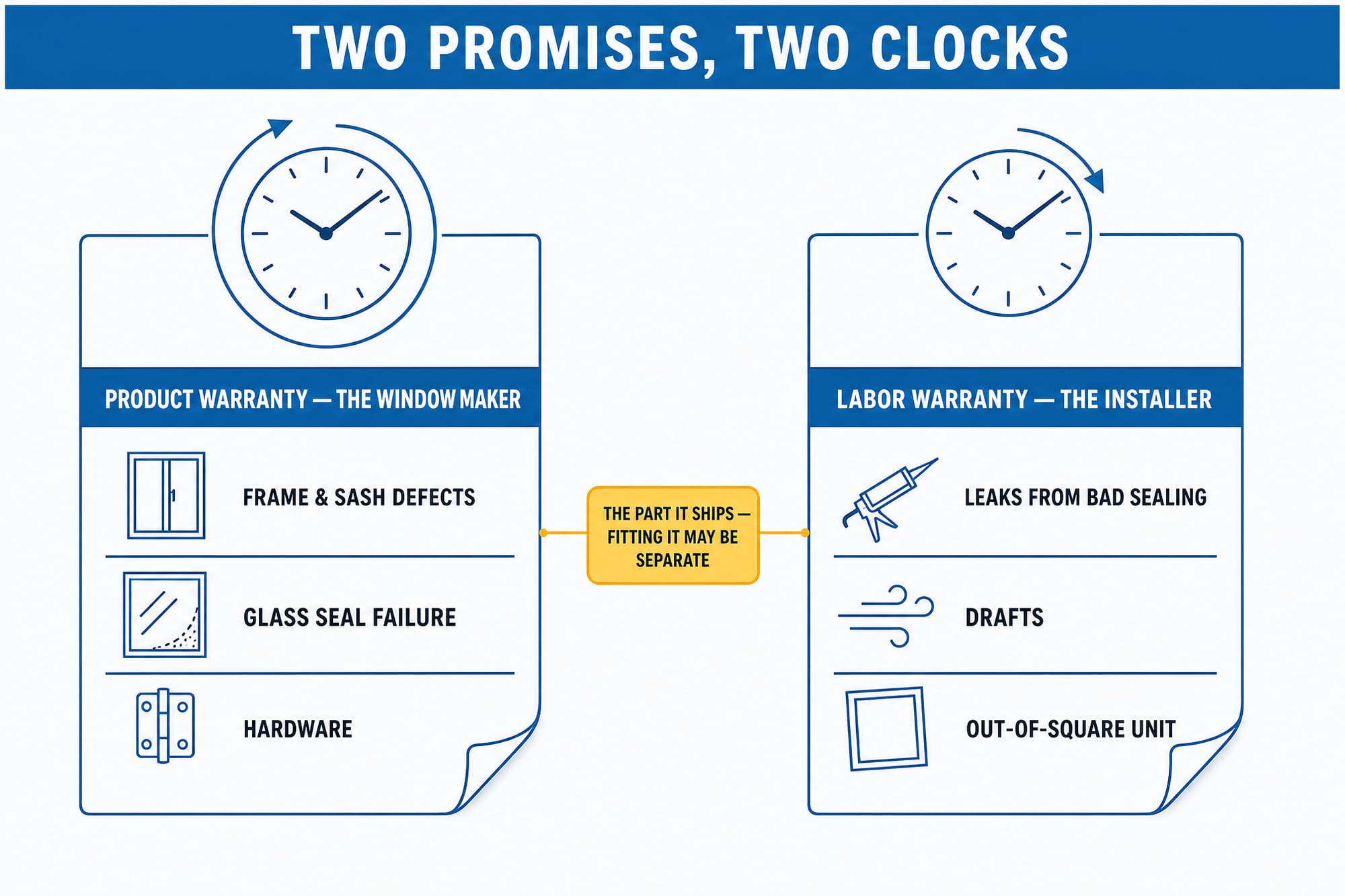
They’re two different promises, from two different people, on two different clocks. Conflating them is where homeowners get hurt.
The product (manufacturer) warranty comes from the company that made the window. It covers defects — a frame or sash flaw, a failed glass seal, faulty hardware. It’s the long one, often measured in decades for some parts.
The labor (workmanship) warranty comes from the contractor who installed it. It covers install faults — leaks, drafts from poor sealing, a unit set out of square. And here’s the catch: install problems are the more common early failure, and the labor warranty is usually the shorter document, sometimes just a year or a few.
ENERGY STAR’s own buying guidance actually splits the coverage three ways — a product warranty, a glass warranty (breakage and seal failure), and an installation warranty. Same idea, finer print: know which document covers which failure, and how long each one runs.
There’s a second gap hiding here. Many product warranties send you the part but not the labor to fit it. The new sash ships free; getting it back into the wall is a separate line — and often a separate bill.
What actually voids a window warranty?
Most “voids” aren’t the manufacturer being cruel. They’re conditions written into the paper that nobody walked you through. The good news: almost all of them are things you can control if you know them going in.
Here’s the honest split — what these warranties typically cover, and what typically voids or limits that coverage.
| What we're talking about | Typically covered | Typically voids or limits coverage |
|---|---|---|
| Frame, sash, hardware | Manufacturing defects in the frame, sash, and moving parts | An install that departs from the maker's written instructions, or an unapproved installer where the brand requires one |
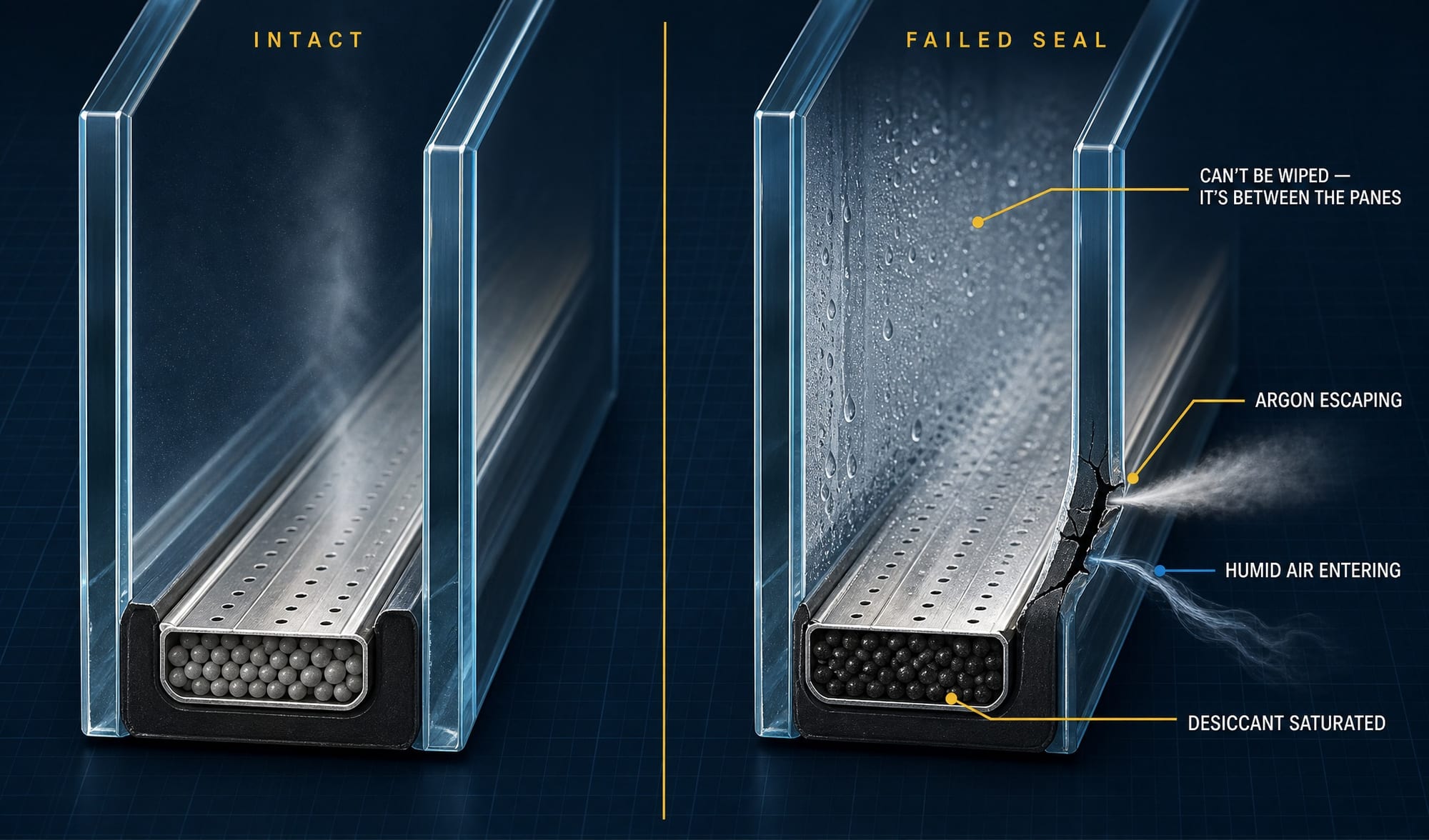
| The glass seal | Seal failure — the fog between the panes — for a stated term | Accidental breakage, or interior condensation from household humidity (not a seal failure) |
| Factory finish | Peeling or blistering of the factory finish, within terms | Normal weathering and fading, or damage from harsh cleaners and pressure washing |
| Labor to fit the fix | Only if a separate labor warranty says so | Often not covered — many product warranties send the part, not the person to install it |
| Keeping coverage alive | Coverage while you follow the terms — registered, installed right, maintained | Skipping required registration, missing the transfer-notice window, or DIY changes to the unit |
Frame, sash, hardware
- Typically covered
- Manufacturing defects in the frame, sash, and moving parts
- Typically voids or limits coverage
- An install that departs from the maker's written instructions, or an unapproved installer where the brand requires one
The glass seal
- Typically covered
- Seal failure — the fog between the panes — for a stated term
- Typically voids or limits coverage
- Accidental breakage, or interior condensation from household humidity (not a seal failure)
Factory finish
- Typically covered
- Peeling or blistering of the factory finish, within terms
- Typically voids or limits coverage
- Normal weathering and fading, or damage from harsh cleaners and pressure washing
Labor to fit the fix
- Typically covered
- Only if a separate labor warranty says so
- Typically voids or limits coverage
- Often not covered — many product warranties send the part, not the person to install it
Keeping coverage alive
- Typically covered
- Coverage while you follow the terms — registered, installed right, maintained
- Typically voids or limits coverage
- Skipping required registration, missing the transfer-notice window, or DIY changes to the unit
The single most common real-world claim is that highlighted row — the fog between the panes, a failed glass seal. It’s usually covered. What surprises people is the row under it: the sealed-glass unit may ship free while the labor to swap it doesn’t. That’s not a scam. It’s the two-warranty split doing exactly what the fine print said it would.
What do “limited,” “prorated,” and “transferable” mean?
These three words quietly set how much coverage you actually have — and for how long. Here’s the decoder.
Limited means split coverage and exclusions. The same window might carry the frame “as long as you own the home,” the glass for a set span, and the hardware for a shorter one — three different clocks on three different parts. “Limited lifetime” is the norm, not the fine-print exception.
Prorated means the coverage shrinks over time. Early on, the manufacturer covers most or all of a covered failure. As the window ages, they pay a smaller share and you pay the rest — right up to the year you finally need it. A non-prorated (or “full”) term holds its value the whole way; a prorated one is worth watching the fade on.
Transferable means the coverage survives a home sale — real resale value, and worth having. But it usually comes with strings: written notice to the manufacturer within a set window after the sale, sometimes a transfer fee, and coverage that may drop or prorate after the handoff. Transferable is genuine money at closing if you file the notice in time.
What should I check before I sign?
You don’t need a law degree. You need to read four things and ask about them out loud. A good rep can answer every one without flinching — these are the questions of an informed buyer, not a difficult one.
The four-line warranty read — do this before you sign
- “Where does this document define ‘lifetime,’ and what does it say?” Read the definition, not the headline.
- “Is this the product warranty, the labor warranty, or both — and how long does each run?” Two clocks. Get both in writing.
- “What would void or limit it?” Registration, approved installer, transfer notice, cleaning rules — know the list.
- “Is any part prorated, and is it transferable if I sell?” Find the fade, and the filing deadline.
Then do the small chore most people skip: register the product if registration is required, keep the paperwork, and note any transfer deadline the day you’d ever need it. Under the FTC’s warranty rules you’re also entitled to read the full written warranty before you buy — so ask for it up front, not after the deposit.
And remember why the labor side matters so much: a bad install can void the manufacturer’s warranty entirely, because most product warranties require the window to be installed to the maker’s instructions. If the glass seal ever fails, foggy panes are the classic covered claim — worth knowing before it happens.
The warranty is one line item among several worth reading closely. For the rest of the appointment — the pricing, the pressure, the missing line items — the window quote red flags page is the companion to this one, and the buyer’s playbook ties it all together.
If you’d like a second set of eyes on the warranty before you commit — someone who reads these daily — that’s exactly what a no-pressure warranty decode is for. Send the page; I’ll tell you what’s covered, what’s prorated, and what would quietly void it.
Sources, Verification & Fact-Checking verified July 2026
Every load-bearing fact on this page is sourced and verified against a primary authority.
Verified July 2026 via direct review of the cited authority — the links open the controlling source so you can check it yourself rather than take our word.
- ”Lifetime” typically means the manufacturer’s expected product lifespan, commonly defined in the fine print, and the term must be defined: Federal Trade Commission consumer guidance on warranties (a “lifetime” claim should state whose life or what period it covers). Cited as the reason to read the definition, not as a claim about any brand. (view source — FTC, Businessperson’s Guide to Federal Warranty Law (advertising a “lifetime” warranty))
- Worked example of a real “lifetime” definition — Champion’s Limited Lifetime Warranty is non-prorated and covers necessary repairs, broken glass (including accidental breakage), seal failure, parts, labor, screen repair, materials, and waste removal, with the term defined as coverage “as long as the original purchaser owns the home”: Champion Windows’ public warranty and guarantee pages (both live-verified July 2026; the “as long as the original purchaser owns the home” language and the accidental-glass example are Champion’s own). Used as one concrete, strong example of how a lifetime warranty defines its own coverage and period — not an endorsement and not a knock. Specific transfer terms are directed to a Champion representative on the same pages, so confirm transfer conditions in writing against your own contract. (view source — Champion Windows warranty · Champion guarantee)
- You’re entitled to read the full written warranty before you buy: the FTC Pre-Sale Availability Rule under the Magnuson-Moss Warranty Act requires warrantors/sellers to make written warranty terms available to consumers before purchase. (view source — FTC, Businessperson’s Guide to Federal Warranty Law)
- Warranty coverage splits three ways — product (defects), glass (breakage + seal failure), and installation (labor) — and estimates should name brand, model, U-factor and SHGC with labor and materials broken out: ENERGY STAR replacement-window buying guidance. Same source used across the buying cluster. (view source — ENERGY STAR buying tips)
- Manufacturer warranties commonly condition coverage on installation per the maker’s written instructions; a departing or unauthorized install can limit or void coverage: a widely published warranty structure. Pella, for example, publishes its limited-warranty terms publicly, including conditions tied to following installation instructions. Cited as an example of the standard structure, not a knock on any brand. (view source — Pella warranty terms)
- Warranty vocabulary — “limited” (split coverage + exclusions), “prorated” (coverage shrinks with age; the maker pays a smaller share over time), “transferable” (survives a home sale, often requiring written notice within a set window and sometimes a fee, with coverage that may prorate after transfer), and “labor usually not included in the product warranty”: aggregated from 2025–2026 industry warranty guidance and consistent with the ENERGY STAR framing above. Specific term lengths, proration schedules, and transfer-notice windows vary by manufacturer and product line — confirm them against the actual warranty document for the brand on your quote before relying on any specific number.
- Two separate warranties (product vs labor), the manufacturer covering defects and the installer covering workmanship, with labor typically the shorter term: consistent with the ENERGY STAR three-way split above. The KeyStat “2” refers to this product-vs-labor structure.
- Foggy glass = failed insulated-glass seal (a covered defect under most glass warranties), distinct from interior surface condensation caused by household humidity (not a seal failure): covered in depth on the site’s foggy windows page; not restated in numbers here.
- Story callout (foggy pane; glass unit shipped free under the product warranty; labor to fit it not covered; installer’s workmanship warranty expired): a homeowner-shared forum pattern, retold as reported — illustrative of the product-covers-part / labor-is-separate structure, not a verified claim about any named manufacturer or installer.