

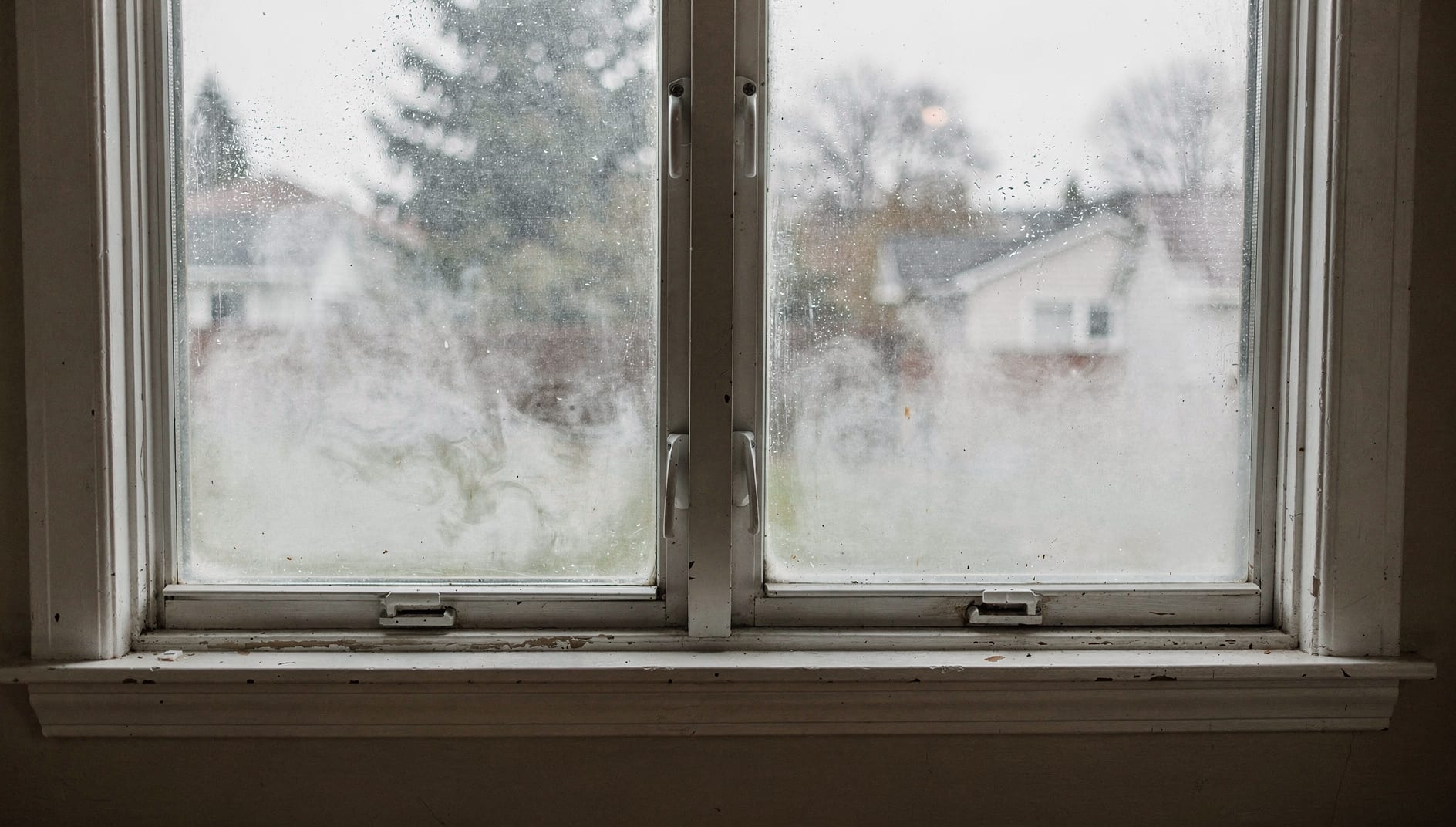
You’ve cleaned that window six times. Inside, outside, vinegar, the good microfiber cloth.
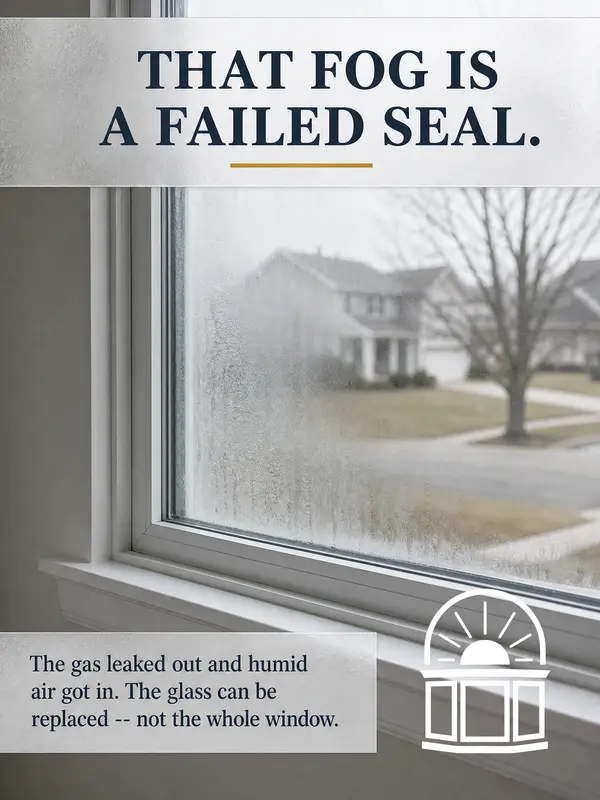
The haze is still there, because it isn’t on either side you can reach. It’s between the panes, in a sealed space no towel has ever entered.

Here’s the bad news and the good news in one sentence: the glass unit is dead, and it’s often the only thing that’s dead. Which means the fix you’re dreading — new windows, whole house, five figures — is very often not the fix you need.
Can a foggy window be fixed? Yes — but not by wiping or “defogging.” The sealed unit has failed. If the frame is sound, a new fixes it for a fraction of a full window. If the frame is rotted or failing too, replace the window.
Why is there fog you can’t wipe?
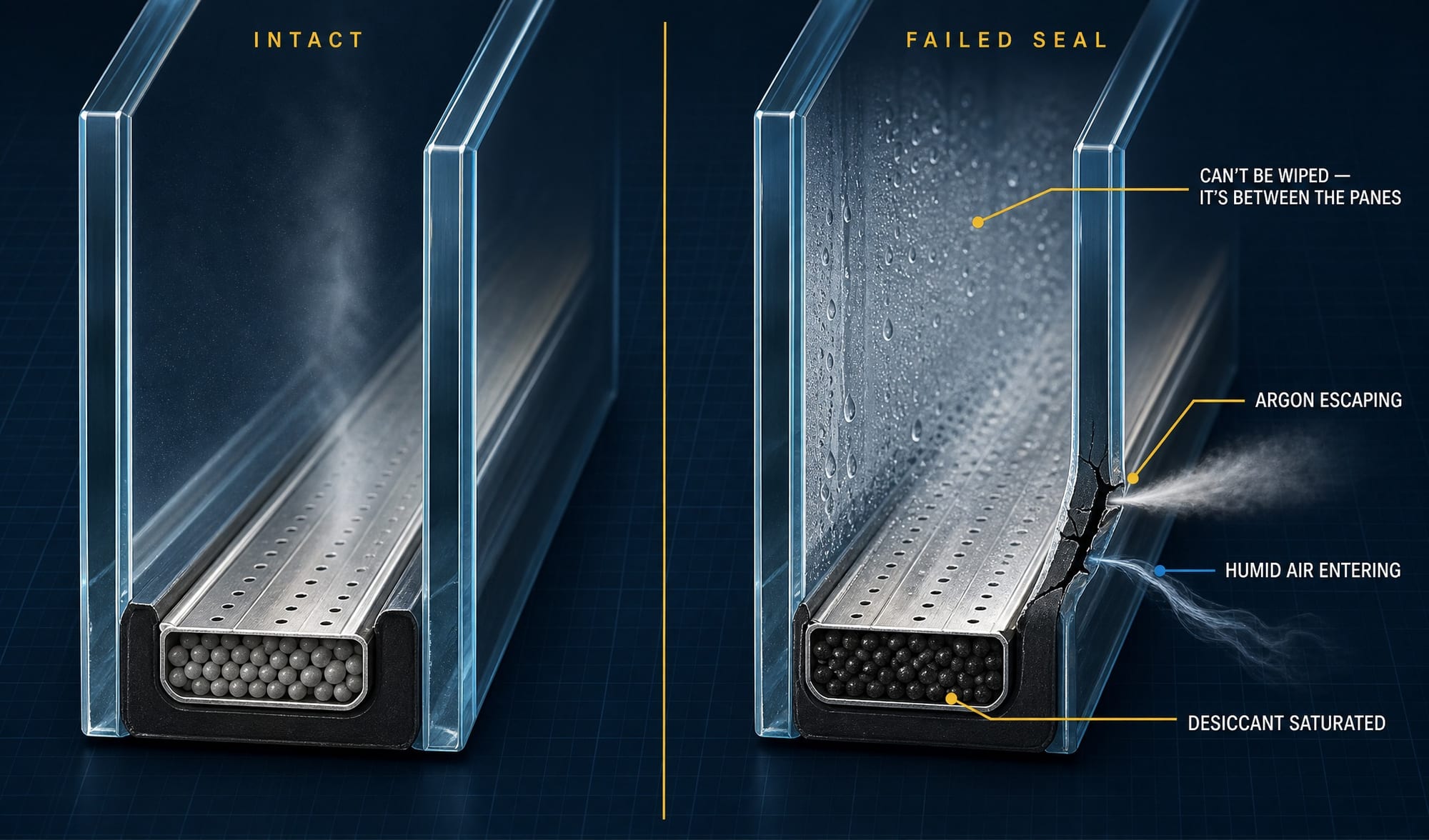
The edge seal failed, and everything after that is just physics running its course. A double-pane window is a sealed unit — two panes, an argon fill, a spacer bar holding a drying agent called desiccant, all closed by an edge seal.
Think of it as a thermos: two walls, a sealed gap, and the seal is the whole trick.
When that seal gives out, the chain runs one way:
- The argon escapes. The insulating gas leaks out through the breach.
- Humid air leaks in. NC air rarely arrives dry.
- The desiccant saturates. The drying agent in the spacer absorbs moisture until it can’t anymore.
- The fog moves in. Water vapor condenses on the inside faces of the glass — the two surfaces you will never reach.
That’s why the haze survives every cleaning. It isn’t dirt. It’s a broken thermos.
How the unit is supposed to work, in full, is here: the sealed unit explained.
Why do seals fail? (especially in NC)
Mostly age — and North Carolina’s climate leans on that clock harder than most. Sealed units typically last somewhere in the 10-to-20-year range. What wears them out:
- Age. Flexible sealants stiffen and let go. Ten to twenty years is the honest expectation.
- Thermal cycling. Glass expands every hot afternoon and contracts every night, flexing the seal daily. NC summers make that a workout.
- UV. Sunlight breaks down the sealant itself — the sunny side of the house often fogs first.
- Humidity. Our damp air accelerates seal breakdown, and once a seal is compromised, it feeds the moisture straight in.
- Install stress. A unit set out of square carries edge stress from day one. Manufacturing defects and house settling do the same work slower.
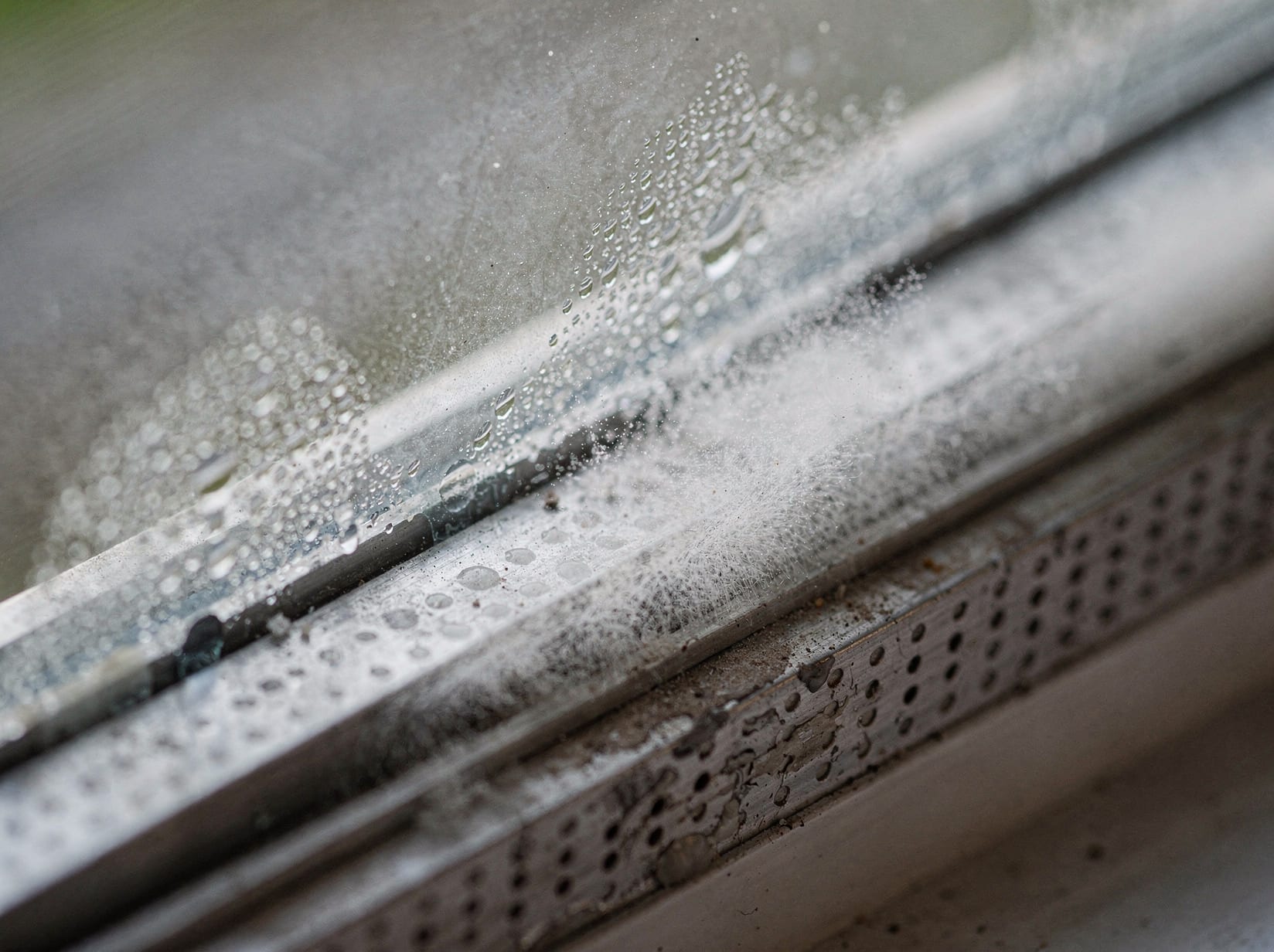
So if your foggy window faces southwest and went in around 2010, nothing went wrong, exactly. The seal did its tour.
Is “defogging” worth it?
Defogging is a cosmetic service — it clears the view and restores nothing else. The method is real: a technician drills a small hole in the glass, dries the cavity, sometimes adds an anti-fog agent, and seals the holes. The haze goes away, and on the day it’s done, it looks like a repaired window.
It isn’t one. Defogging does not touch the three things that actually failed:
- The edge seal stays broken — the breach that let moisture in is still there.
- The argon is gone and stays gone — no gas fill is restored.
- The insulating value doesn’t come back — the unit stays degraded, and the moisture can return.
Defogging buys you a clearer view, not a repaired window. If a clearer view for a while is genuinely all you want, that’s a fair thing to buy — as long as you know that’s what’s on the receipt.
The fix most people don’t know exists: replace just the glass unit
If the frame is sound, a glazier can swap the dead IGU for a new sealed unit — and the window stays. This is the option that surprises people, and it’s often the right one.
The frame, the sash, the trim, the siding around it: none of that failed. The sealed glass unit failed, and it’s a replaceable part.
As a national market band, a standard double-pane IGU swap commonly runs somewhere around $350–$700 per window, including labor — with simple, accessible, standard-size units toward the low end and larger, , argon-filled, or hard-to-reach units pushing toward the top or beyond.
Replacing just the glass unit is typically the cheaper path versus a full window swap when the frame checks out — often meaningfully less than a full replacement of the same opening. These are national figures, not an NC quote. Get the actual number on your glazier’s itemized bid.
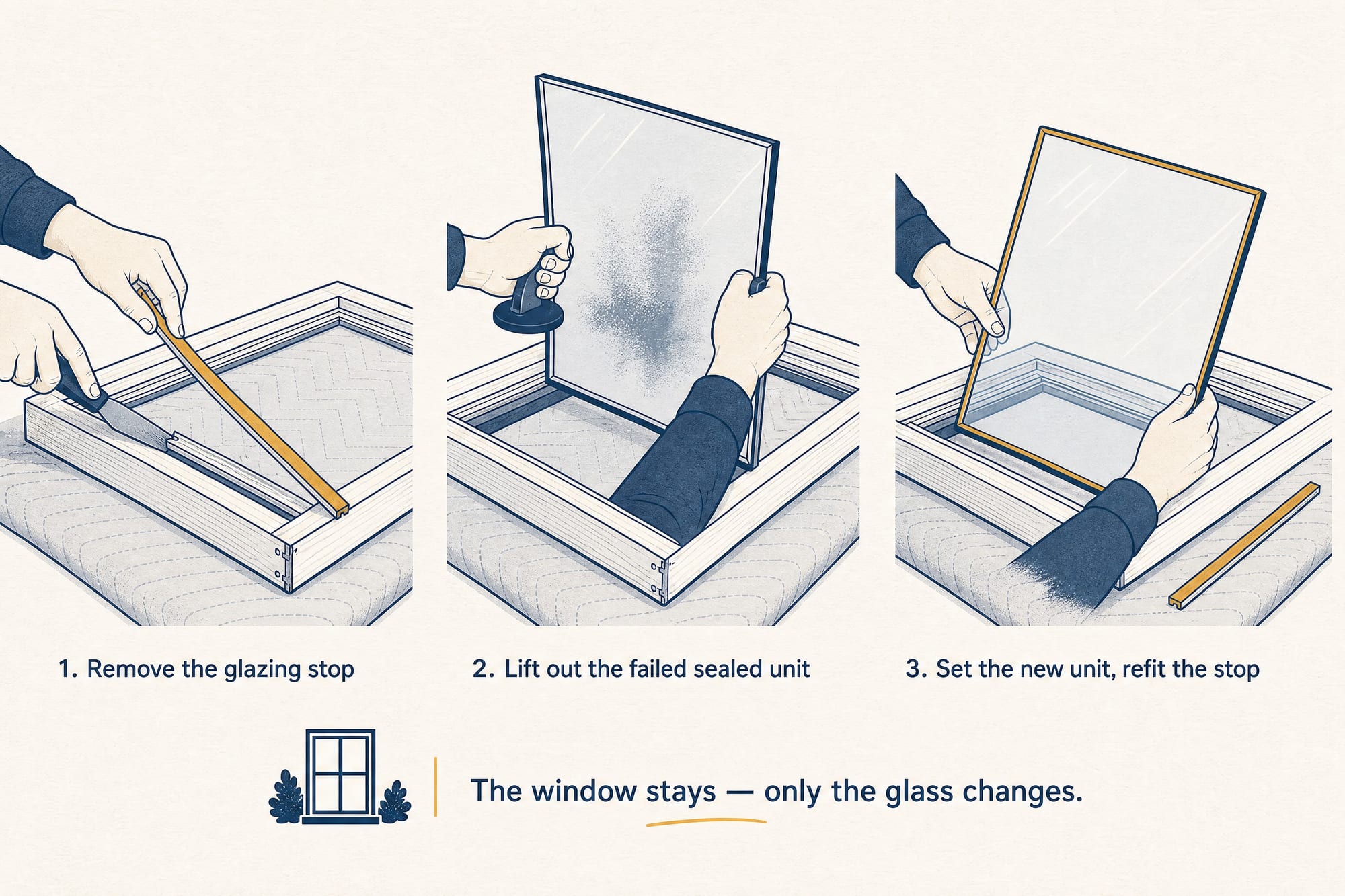
The job itself is smaller than most people picture. Four moves, no drama:
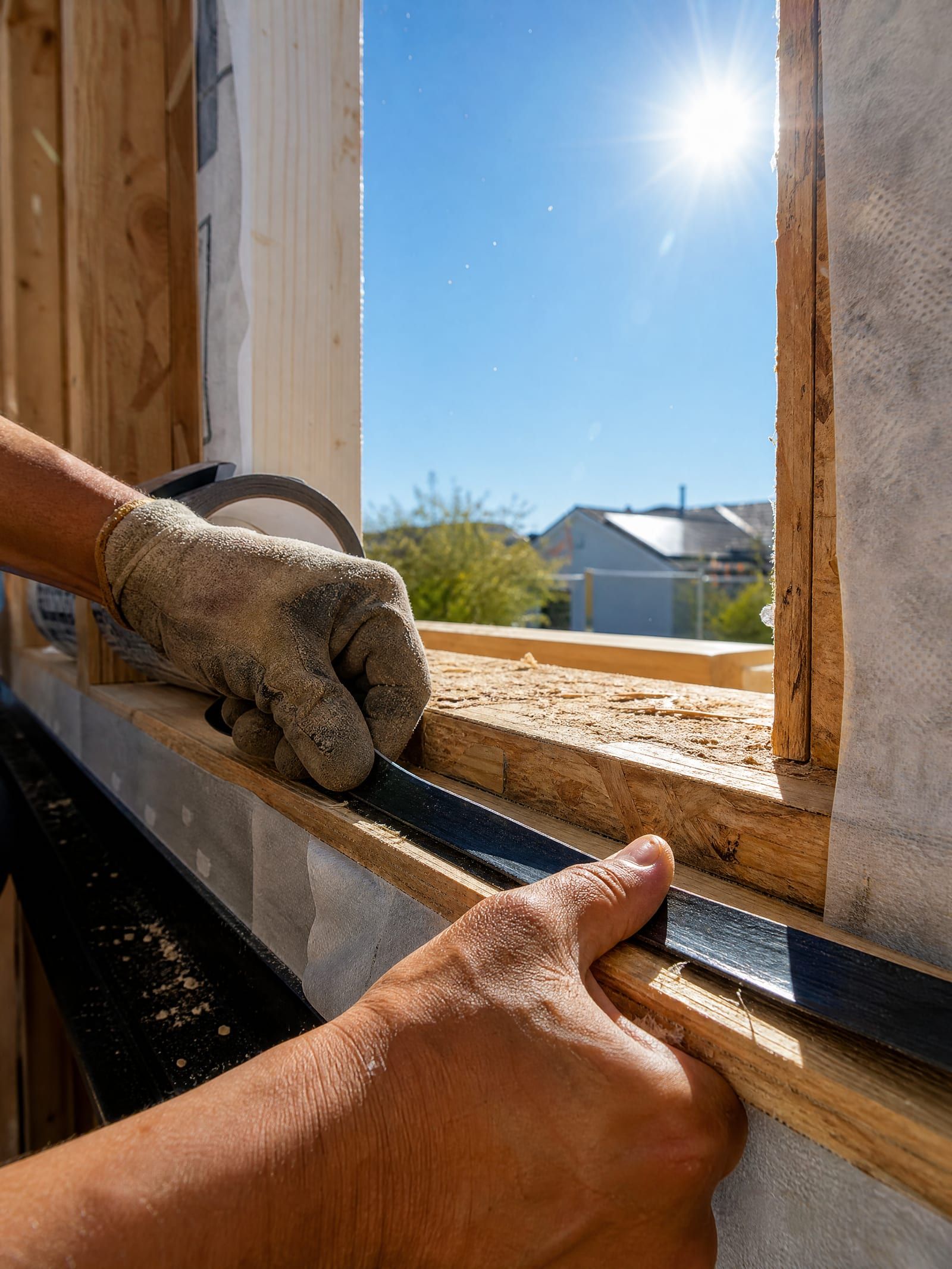
- The glazing bead or stop comes off.
- The dead unit lifts out of the sash.
- The new sealed unit sets in its place.
- The trim goes back.
No wall opened, no siding touched, usually no permit conversation — the window you own stays the window you own, minus the fog.
When the glass-unit swap is the right call:
- The frame is sound. No rot, no soft spots at the corners, no water staining below the sill.
- The window is square. Sashes move freely and lock without a fight.
- It’s one unit, or a few. You’re fixing failures, not fleeing the product.
Ask for it plainly: “Can you quote replacing just the glass unit, if the frame checks out?” A good company will answer that question straight. The answer tells you a lot about the company, too.
When is the whole window the right call?
When the failure isn’t just the glass. A dead IGU in a dying frame is a part swap on a totaled car. Replace the window when:
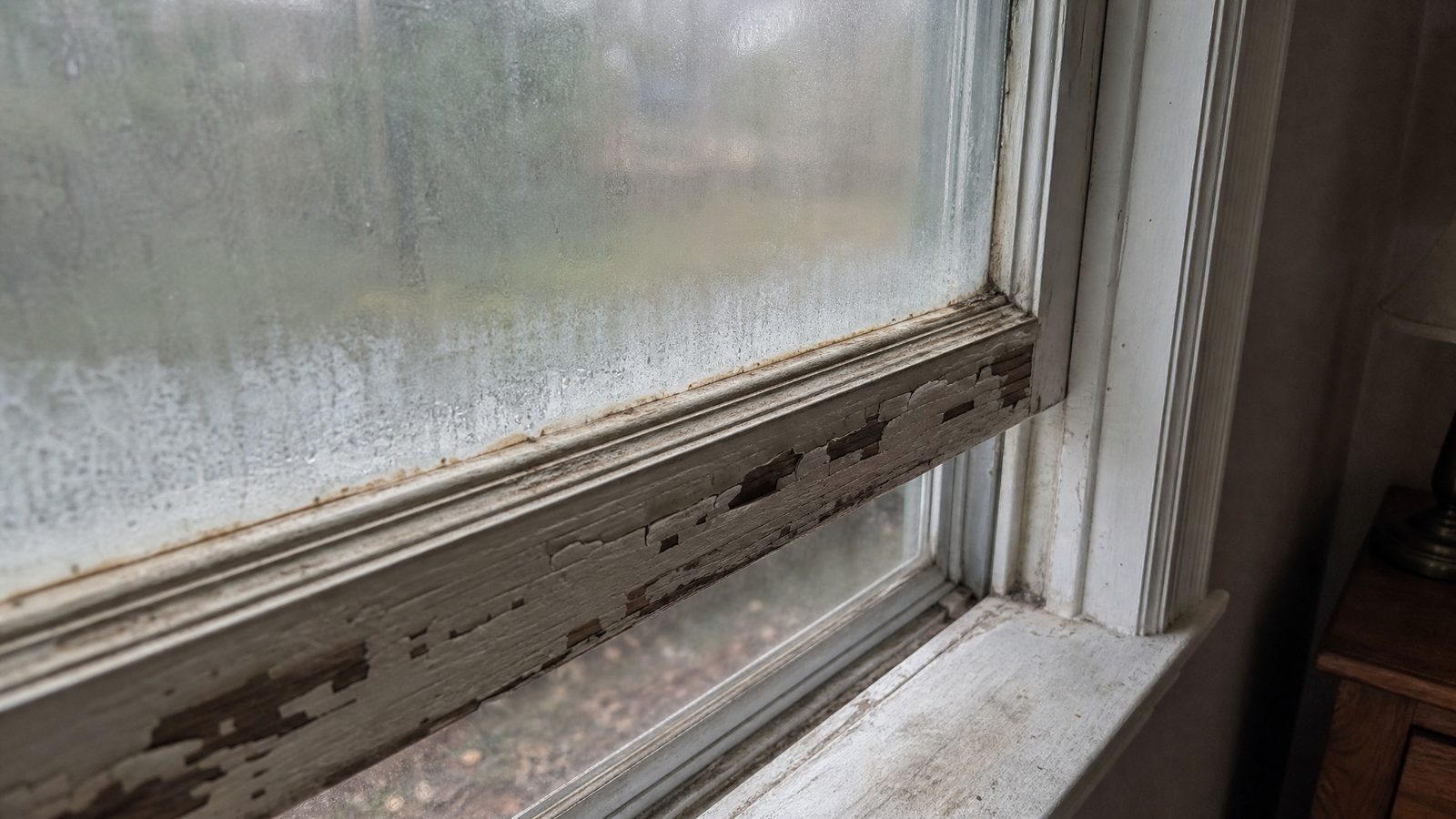
- There’s rot. A soft sill or decaying frame means water is winning. New glass won’t stop it.
- The frame is racked. Out-of-square openings that bind the sash put the same stress on the next seal — the new unit inherits the problem.
- Failures are stacking up. Several fogged units, drafts, and hardware problems across the house shift the math toward replacement. Same-age seals do tend to age on a similar clock, so a wave of failures in one install generation is common — though that’s a pattern to watch for, not a rule to buy by.
- It’s single-pane original glass. There’s no sealed unit to swap; an upgrade is the fix.
The full decision framework — the honest walk-through of every symptom — lives at the hub: the repair-or-replace test.
And if you do replace, what it costs in NC and why the install decides whether the new seal lasts are the two pages I’d read next.
A drafty window is the same seal story at a different edge: drafts, diagnosed.
Fog on the surface vs fog between the panes
Not all window fog is a dead seal — where the moisture sits tells you which problem you have.
- Inside surface (you can wipe it off from indoors): that’s household humidity condensing on cool glass — a ventilation and condensation-resistance question, not a seal failure.
- Outside surface (wipes off from outdoors, usually summer mornings): that’s dew. It means your glass insulates well enough that the outer pane runs cool. Normal, even a good sign.
- Between the panes (no side wipes it): dead seal. That’s this page.
Thirty seconds with a cloth sorts it: wipe inside, wipe outside. If the haze survives both, you’ve diagnosed a failed IGU from your kitchen.
So the whole triage fits on an index card. Between the panes? The unit is dead. Frame sound and square? Quote a glass-unit swap. Rot, racking, or failures stacking up? That window has earned a replacement conversation. Everything else on this decision is detail.
Your secret hope walking into this was that you don’t need new windows. Often, you’re right.
A phone photo of the fogged glass and the frame corner is usually enough for me to tell which fix your window deserves — send it over, no pressure attached.
Sources, Verification & Fact-Checking verified July 2026
Every load-bearing fact on this page is sourced and verified against a primary authority.
Verified July 2026 via direct review of the cited authority — the links open the controlling source so you can check it yourself rather than take our word.
- Fog or moisture between the panes means the sealed unit’s edge seal has failed: the argon escapes, humid air enters, the desiccant saturates, and moisture condenses where it can’t be wiped. The unit has lost its gas fill and most of its insulating effectiveness. (view source — ENERGY STAR, Is It Time to Replace Your Windows?)
- A double-pane window is an insulated glass unit (IGU): two panes, a sealed gas-filled gap, a spacer holding desiccant, and an edge seal. (view source — U.S. Dept. of Energy, Building Science Education)
- Typical sealed-unit seal life runs roughly 10–20 years, varying by unit quality, install, and climate; causes of failure include age, thermal cycling, UV exposure, humidity, and install stress. (Seal-life range corroborated at the ENERGY STAR source above.)
- ”Defogging” (drill, dry, reseal) is cosmetic only: it does not restore the edge seal, the argon fill, or the unit’s insulating value, and moisture can return. The functional fixes are replacing the IGU in a sound frame or replacing the window. This reflects how the defogging process works — it clears the cavity but leaves the failed seal and lost gas fill in place; confirm any defogging service’s own terms on whether it restores insulating value.
- A standard double-pane IGU (glass-only) swap commonly runs roughly $350–$700 per window installed nationally — typically cheaper than a full window replacement of the same opening when the frame is sound. National cost-guide range, not an NC quote; varies with size, glass package, and accessibility. (Grounded July 2026 via aggregated glazier/cost-guide research.)