

The number was $44,000. Then, before the coffee went cold, it was $35,000.
If you’ve sat through that evening — or you’ve got the appointment on the calendar — this page is how to sit through it with your shoulders down. Not because you’re braced for a fight, but because you know exactly what a comparable quote looks like.
I write window quotes for a living. Here’s exactly what I’d check on one before signing my own name.
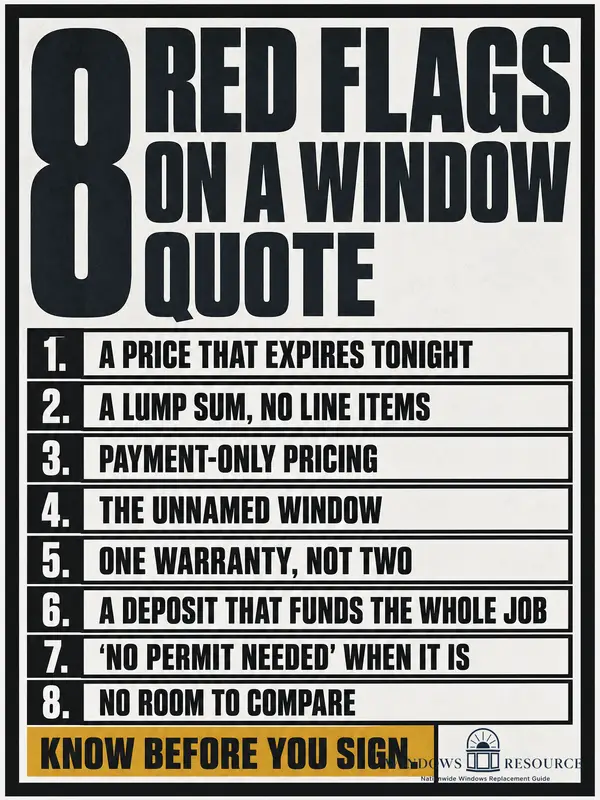
How do I know if a window quote is trustworthy? Check eight things: it’s itemized, the product and specs are named, both warranties are in writing, the price doesn’t expire tonight, you’re shown the total cost (not just a monthly payment), the deposit is reasonable, permits are handled openly, and you’re given time to compare. A quote that passes all eight is a quote you can shop with confidence.
The 8 things to check on any window quote
A fair quote survives daylight. Each item below is a pattern to understand, a why, and the calm question that resolves it — normal professional questions any good rep can answer without blinking.
1. The price that expires tonight
A durable price is the baseline. The lists offers that are “only good today” among its classic warning signs to slow down on.
A real number for real work is still real next week. Ask: “What’s this price next week?” — then compare on your own clock.
2. A lump sum with no line items
One number can’t be compared to anything. A comparable quote names each window unit (type, size, material, glass package), labor, trim and sealants, old-window disposal, permits, both warranties, and a timeline.
Ask: “Can I get that itemized, line by line?” A revised, itemized quote is a normal request, not a difficult one.
3. Payment-only pricing
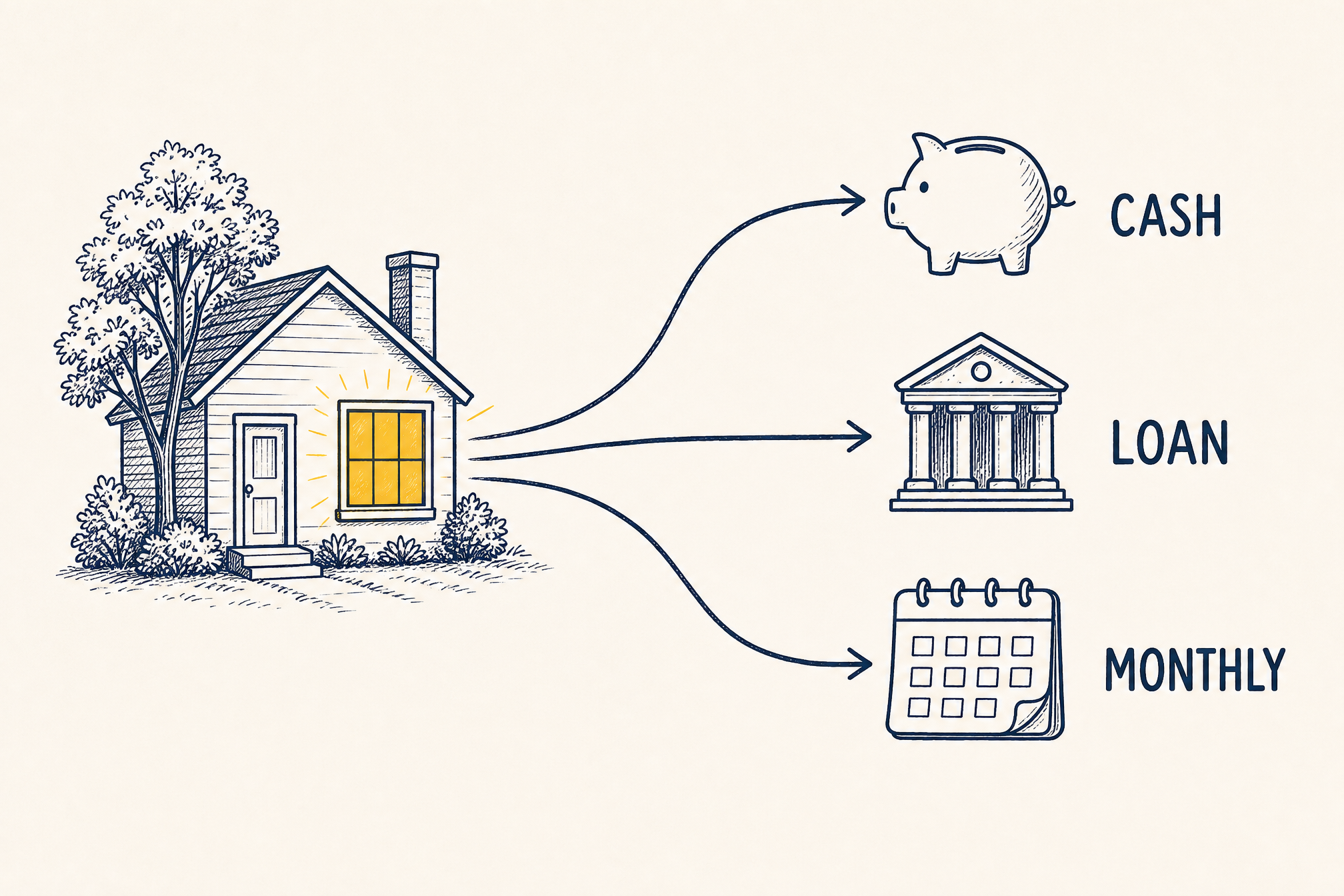
“Just $200 a month” answers a different question than “what does this cost.” Monthly framing is comfortable, but it hides the total and the term.
Re-anchor on the total project cost. Ask: “What’s the cash price, and what’s the financed total — separately?” Then read the honest financing picture (payment vs price) before you compare.
4. The unnamed window
If the quote can’t tell you the U-factor, it can’t be compared. ENERGY STAR’s own buying guidance says estimates should name the brand, model, , and , with labor and materials broken out.
Ask: “What’s the brand, line, U-factor, and SHGC on this exact window — in writing?” Then compare the spec on the label.
5. One warranty where there should be two
The window’s warranty and the install’s warranty are different documents on different clocks. The manufacturer covers the product. The installer covers the workmanship — and an install problem is the more common early failure.
Ask: “What are the product warranty AND the labor warranty, in writing?” The full buyer’s playbook walks through what each one actually covers.
6. A deposit that funds the whole job
Money should follow milestones, not precede them all. A deposit is normal — custom windows get ordered against it.
A deposit that pays for the entire project before a single unit is on site leaves you with no leverage and all the risk. Ask: “What’s the payment schedule, and what triggers each payment?”
North Carolina doesn’t set a statutory cap on home-improvement deposits — despite what a “the law requires 50% down” line might imply, that’s not accurate under NC law. It’s a negotiated number.
Consumer-protection guidance commonly points to a much lower figure — often cited around 10% — as a reasonable deposit, with the rest tied to delivery and completion milestones. A request for 50% or more upfront is a commonly cited caution sign, not proof of a problem, but it’s worth asking about directly.
7. “No permit needed” on work that needs one
Permit handling should be open, named, and on the quote. In North Carolina, whether your project needs a permit turns on scope and on the state’s $40,000 threshold — the details live at who pulls the permit in NC.
What you’re checking here isn’t the code. It’s the posture. A company that handles permits routinely will say who pulls it, where, and for how much. Ask: “Who pulls the permit, and is it a line item?“
8. No room to compare
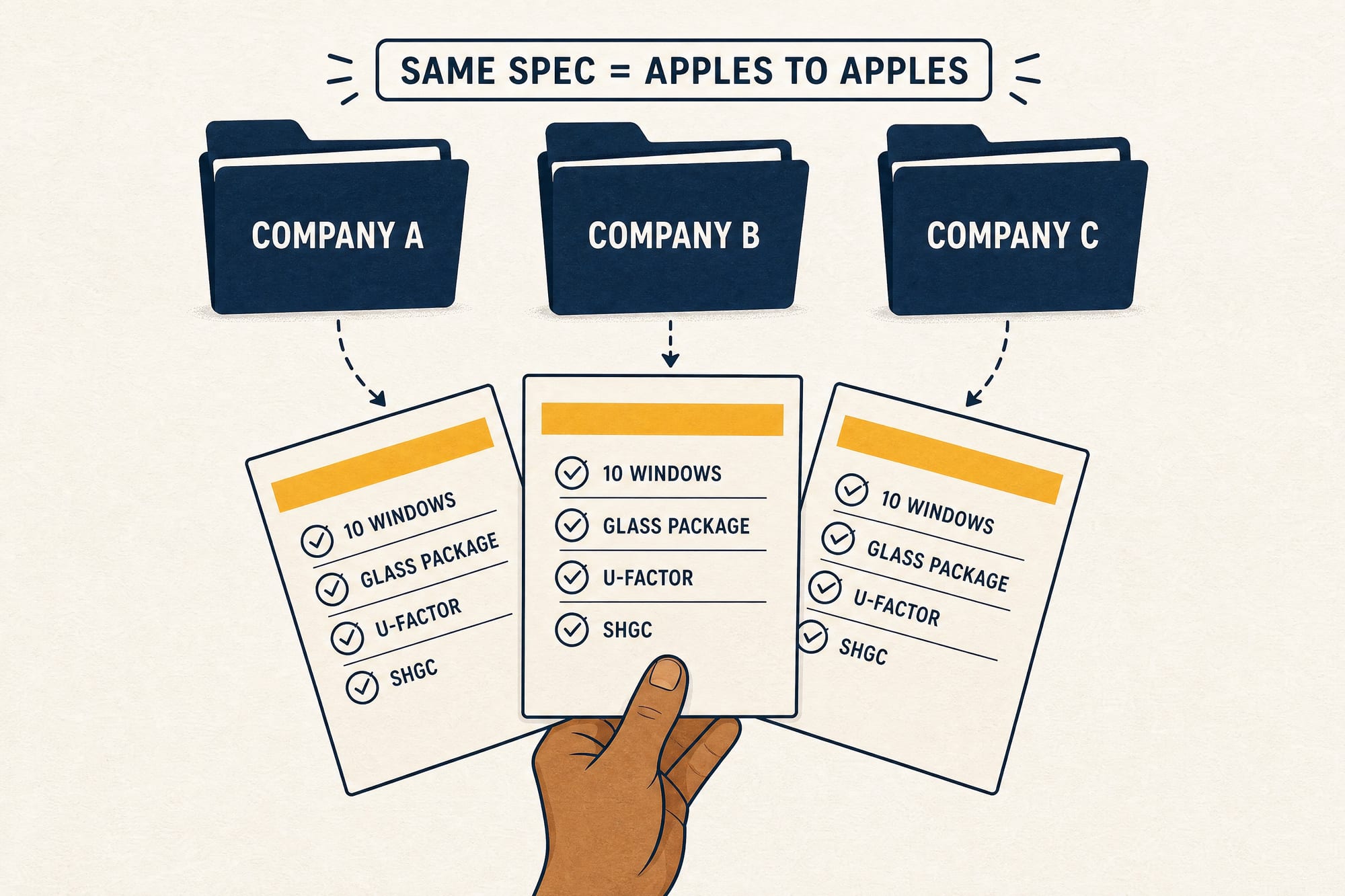
A confident quote invites comparison. ENERGY STAR’s guidance is to get several quotes on the same spec — same window count, same glass package — so the numbers are apples-to-apples.
A quote built for comparison (itemized, spec named, durable price) is a quote from a company expecting to win on the merits. Ask: “Here’s my spec sheet — can you price exactly this?”
Before the theory section — try the eye you just built.
Practice round
Spot the Red Flags
Here's a made-up practice quote — every number on it is fictional. Five of the eight lines are tricks you just read about. Tap the ones you wouldn't sign.
Sample quote — for practice only
0 of 5 red flags found
Tap any line to check it
Why big price drops happen (without the villain story)
Anchor-and-discount is a sales structure, not a character judgment. Plenty of legitimate companies open with a high number and negotiate down — it’s how that model is built.
Homeowners on forums share versions of it constantly: a $44,000 quote becoming $35,000 the same evening, or $18,000 for two windows becoming $11,000 (homeowner-shared figures, illustrative).
What those stories actually teach is simple and useful: the first number isn’t the market number. Neither, necessarily, is the discounted one.
The market number is what several comparable, itemized, durable quotes converge on. Your job isn’t to out-negotiate anyone — it’s to find that convergence. The eight checks above are how.
The three questions that reset any appointment
Asked calmly, these three do all the work. They’re not confrontational.
They’re the questions an informed buyer asks, and a rep with a comparable quote is glad to hear them.
Copy these into your phone and read them back at the table
- “Can I get that itemized, line by line?”
- “What are the U-factor and SHGC on this exact window?”
- “Is this price good next week?”
Three yeses and you’ve got a quote you can compare. Any hesitation tells you what to ask about next.
What a great quote looks like
The positive mirror: here’s the anatomy of a quote you can shop. When one of these lands on your table, you’ll know it.
And you can hold every other quote against it.
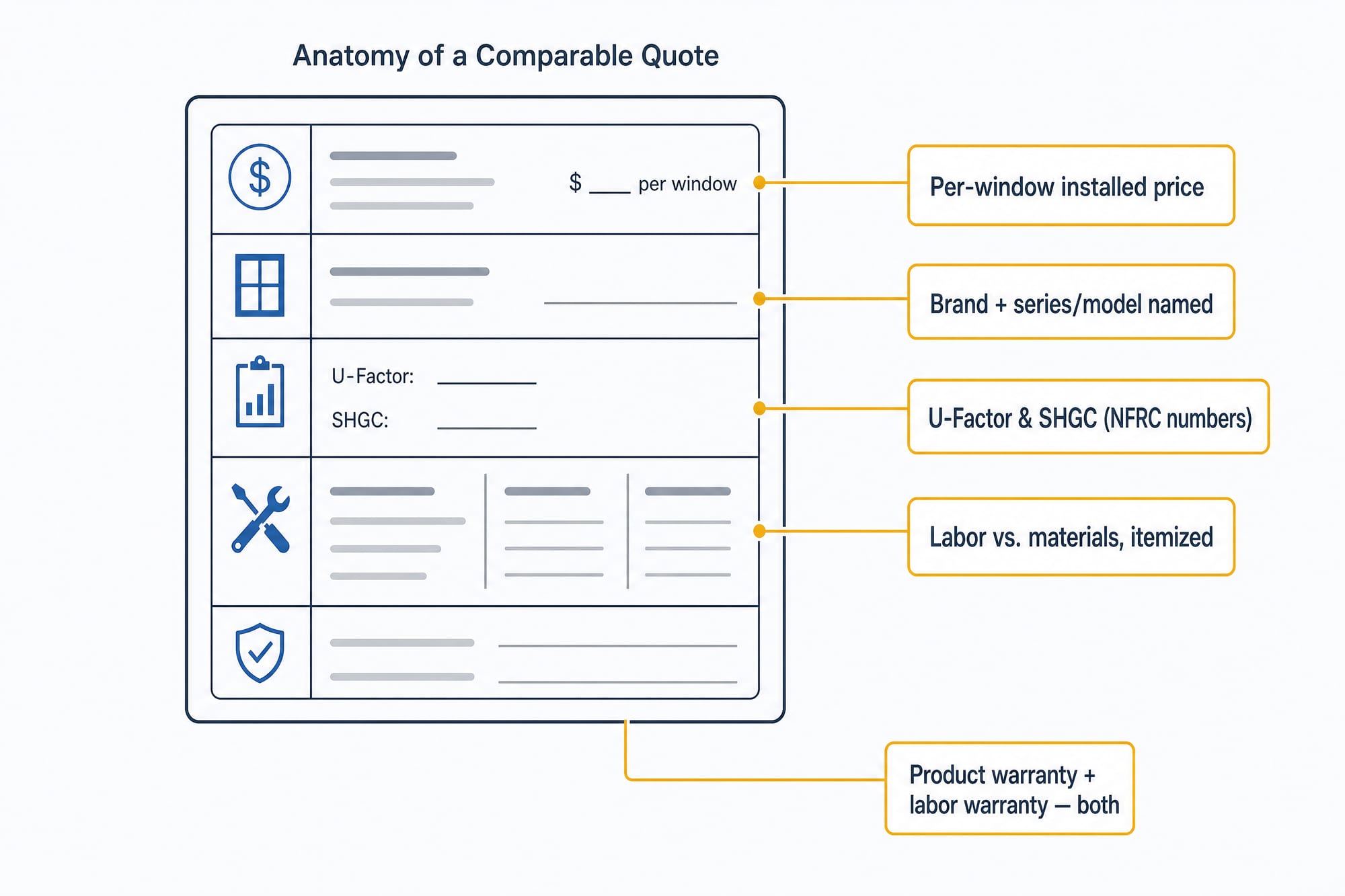
| What you're looking at | A vague quote | A comparable quote |
|---|---|---|
| The windows | "10 premium windows" | Each unit: type, size, material, glass package, brand and line, U-factor + SHGC |
| The price | One lump sum, good tonight | Per-window line items; dated price that holds for a stated period |
| The labor | Bundled, unnamed | Labor broken out; install method (insert vs full-frame) named |
| The warranties | "Lifetime warranty" | Product warranty AND labor warranty, each in writing with its term |
| The extras | Unmentioned | Disposal, trim/sealants, permits — each a line |
| The timeline | "A few weeks" | Order-to-install window, in writing |
The windows
- A vague quote
- "10 premium windows"
- A comparable quote
- Each unit: type, size, material, glass package, brand and line, U-factor + SHGC
The price
- A vague quote
- One lump sum, good tonight
- A comparable quote
- Per-window line items; dated price that holds for a stated period
The labor
- A vague quote
- Bundled, unnamed
- A comparable quote
- Labor broken out; install method (insert vs full-frame) named
The warranties
- A vague quote
- "Lifetime warranty"
- A comparable quote
- Product warranty AND labor warranty, each in writing with its term
The extras
- A vague quote
- Unmentioned
- A comparable quote
- Disposal, trim/sealants, permits — each a line
The timeline
- A vague quote
- "A few weeks"
- A comparable quote
- Order-to-install window, in writing
Once you’ve got two or three quotes in the right-hand column’s shape, the comparison almost runs itself: normalize each to a per-window installed price and sanity-check the number itself against what windows actually cost in NC.
And if you’d like a second set of eyes before you sign — someone who reads these documents daily — that’s exactly what a no-pressure second opinion on your quote is for. Bring the line items; I’ll tell you what’s there, what’s missing, and what to ask next!
Sources, Verification & Fact-Checking verified July 2026
Every load-bearing fact on this page is sourced and verified against a primary authority.
Verified July 2026 via direct review of the cited authority — the links open the controlling source so you can check it yourself rather than take our word.
- ”Only good today” offers are a classic warning sign to slow down on: Consumer Financial Protection Bureau consumer guidance on classic warning signs of possible fraud and scams — cited here as the reason a durable price is the baseline, not as a claim about any company. (view source — CFPB)
- Get several quotes on the same spec, with brand, model, U-factor, and SHGC named and labor/materials broken out: ENERGY STAR’s replacement-window buying guidance. (view source — ENERGY STAR buying tips)
- The $44k→$35k and $18k→$11k price-drop examples are homeowner-shared figures from homeowner forum accounts — illustrative of the anchor-and-discount structure, attributed to homeowners, not verified list prices or claims about any named company.
- The $65k→$33k→$26k “call the manager” story is a homeowner-shared forum account, retold here as reported — illustrative of the anchor-and-discount structure and the “call to the manager” tactic, not a verified list price or a claim about any named company.
- The two-warranty split (manufacturer product warranty vs installer labor warranty): consistent with ENERGY STAR’s product/glass/installation warranty framing at the link above.
- NC permit threshold ($40,000) and permit mechanics: covered in depth, with statute citations, on the site’s NC window permits page — linked in the body rather than restated here.
- Deposit norms: North Carolina sets no statutory percentage cap on home-improvement deposits; it is a negotiated figure between homeowner and contractor. Consumer-protection guidance commonly cites a modest deposit (often around 10%) as reasonable, with milestone-based payment for the remainder, and flags requests for 50%+ upfront as a caution sign. Complaints can be directed to the NC Department of Justice Consumer Protection Section and, for contractors on jobs of $30,000+, the NC Licensing Board for General Contractors. (view source — NC Department of Justice, Consumer Protection; view source — NC Licensing Board for General Contractors)