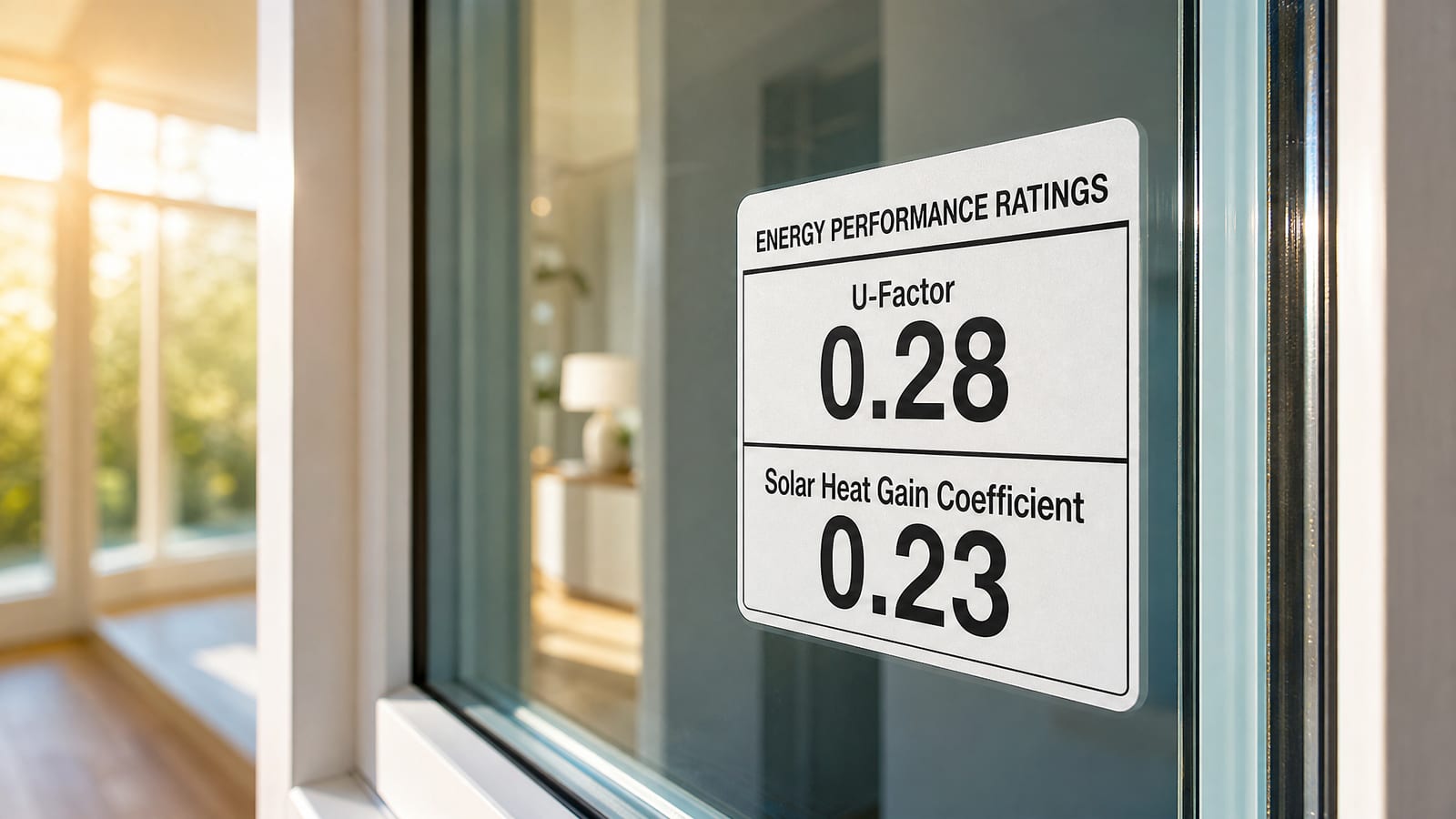



You’ve probably done the reading already. You can say what U-Factor is. You know SHGC stands for solar heat gain coefficient.
And you’re still stuck — because knowing the words and knowing what the numbers do to your house are two different things.
One homeowner put it perfectly on a forum: “I’ve read the window AMA and understand the terms. However, understanding the real-world impact of these numbers is a different story.”
That’s the whole reason this page exists. Let me translate the two numbers into a July west room and a January cold pane, tell you what’s actually good for your part of North Carolina, and show you how to read it straight off the sticker.
Which two numbers actually matter? Of the five on a window’s label, two decide how a room feels: U-Factor (winter heat escaping out) and SHGC (summer sun coming in). Get both into your climate zone’s range and you can stop listening to most of the sales pitch.
What U-Factor actually measures
U-Factor rates how well the whole window insulates — the winter number. Lower is better.
Think of it the way you’d think of an insulation rating: it measures the rate at which heat escapes through the entire window, glass and frame and spacer together, not just the glass. A high U-Factor is a window that pours heat out on a cold night — the “cold just falls off the glass” feeling by the sofa in January.
For windows the scale runs roughly 0.15 to 1.20, and lower means better insulation. A single-pane sits up near the top of that range; a good double-pane lands near the bottom. Some ultra-efficient windows dip below that, but that’s showcase territory, not an NC requirement.
In North Carolina, U-Factor is real but it’s the number we lean on least — because most of the state fights heat more than cold. Which brings up the number you read first.
What SHGC actually measures
SHGC is the fraction of the sun’s heat the glass lets in — the summer number. Lower blocks more. In NC, read this one first.
runs on a 0-to-1 scale. An SHGC of 0.30 means roughly 30% of the sun’s heat passes through the glass and about 70% is blocked. Lower is better in a cooling-dominated climate — and NC is cooling-dominated. It’s the number you feel in a west-facing room at 4pm in July, when the sun is low and pouring straight at the glass.
The lever that drives SHGC down is the Low-E coating — a microscopically thin metallic layer sealed inside the glass that reflects heat while still passing light. That’s why a low SHGC doesn’t have to mean a dim room. The full story on Low-E glass is here.
The label carries three more numbers worth a glance — (how much daylight comes through, higher is brighter), (draftiness, lower is tighter), and (resistance to that edge-sweat on humid mornings, higher is better). Useful, but U-Factor and SHGC are the two that decide comfort.
| U-Factor | SHGC | |
|---|---|---|
| What it measures | How well the whole window insulates — winter heat escaping out | Fraction of the sun's heat the glass lets in — summer heat coming in |
| The scale | Roughly 0.15–1.20 for windows; lower is better | 0 to 1; lower blocks more sun |
| NC target — most of the state (South-Central) | 0.28 or lower | 0.23 or lower |
| NC mountains (North-Central) | 0.25 or lower | 0.40 or lower |
| Which to read first in NC | Second — the winter number | First — NC is cooling-dominated |
| The tradeoff | Chasing it far below target usually means paying for triple-pane you may not need here | Cut it too hard and daylight (VT) can dip — Low-E is what keeps light while blocking heat |
What it measures
- U-Factor
- How well the whole window insulates — winter heat escaping out
- SHGC
- Fraction of the sun's heat the glass lets in — summer heat coming in
The scale
- U-Factor
- Roughly 0.15–1.20 for windows; lower is better
- SHGC
- 0 to 1; lower blocks more sun
NC target — most of the state (South-Central)
- U-Factor
- 0.28 or lower
- SHGC
- 0.23 or lower
NC mountains (North-Central)
- U-Factor
- 0.25 or lower
- SHGC
- 0.40 or lower
Which to read first in NC
- U-Factor
- Second — the winter number
- SHGC
- First — NC is cooling-dominated
The tradeoff
- U-Factor
- Chasing it far below target usually means paying for triple-pane you may not need here
- SHGC
- Cut it too hard and daylight (VT) can dip — Low-E is what keeps light while blocking heat
What’s actually good in NC
For most of North Carolina, aim for a U-Factor of 0.28 or lower and an SHGC of 0.23 or lower. Those are ENERGY STAR’s targets for the South-Central climate zone, which covers the Piedmont, the Sandhills, and — yes, even the coast.
Here’s the catch worth knowing before you shop: NC spans two ENERGY STAR window zones, and they don’t run the same direction.
- Most of the state — South-Central. Greensboro, the Triad, the Sandhills, and the coast down to Wilmington: U 0.28 or lower, SHGC 0.23 or lower. SHGC is the strict number here because we’re cooling-dominated.
- The mountain west — North-Central. Boone and Asheville sit in a colder tier: U 0.25 or lower, SHGC 0.40 or lower. Up there the window needs to insulate a little better, but it’s allowed to let in more winter sun.
You’ll see a lot of loose advice online — a “just aim for SHGC under 0.40 for NC’s mixed climate” number floats around, including on some NC contractor pages. That’s the mountain number applied to the whole state. For the roughly nine-in-ten of NC that’s South-Central, 0.40 is far too loose — the target there is 0.23 or lower.
Want one spec that qualifies anywhere in North Carolina, mountains included? Aim for U 0.25 or lower and SHGC 0.23 or lower. That single package clears both zones at once. Either way, confirm your own county on the official ENERGY STAR Climate Zone Finder before you buy — and if you want the whole map reconciled, that’s its own page: which NC climate zone you’re in.
(One thing these are not: the IECC building-code climate zones your inspector uses. Different map, different purpose — don’t carry code-zone thinking over to window shopping.)
Reading it off the NFRC label
Both numbers live on the NFRC label — the white sticker on the glass of any certified window — and that label is the one part of any quote that can’t spin you. Every manufacturer reports it the same way, so it’s the honest, apples-to-apples layer under all the brochure language.
Where to look: the two boxes at the top left. U-Factor is the top-left box; SHGC sits directly below it. VT and AL are off to the right. That’s it — you don’t need to decode the whole sticker, just those two boxes.
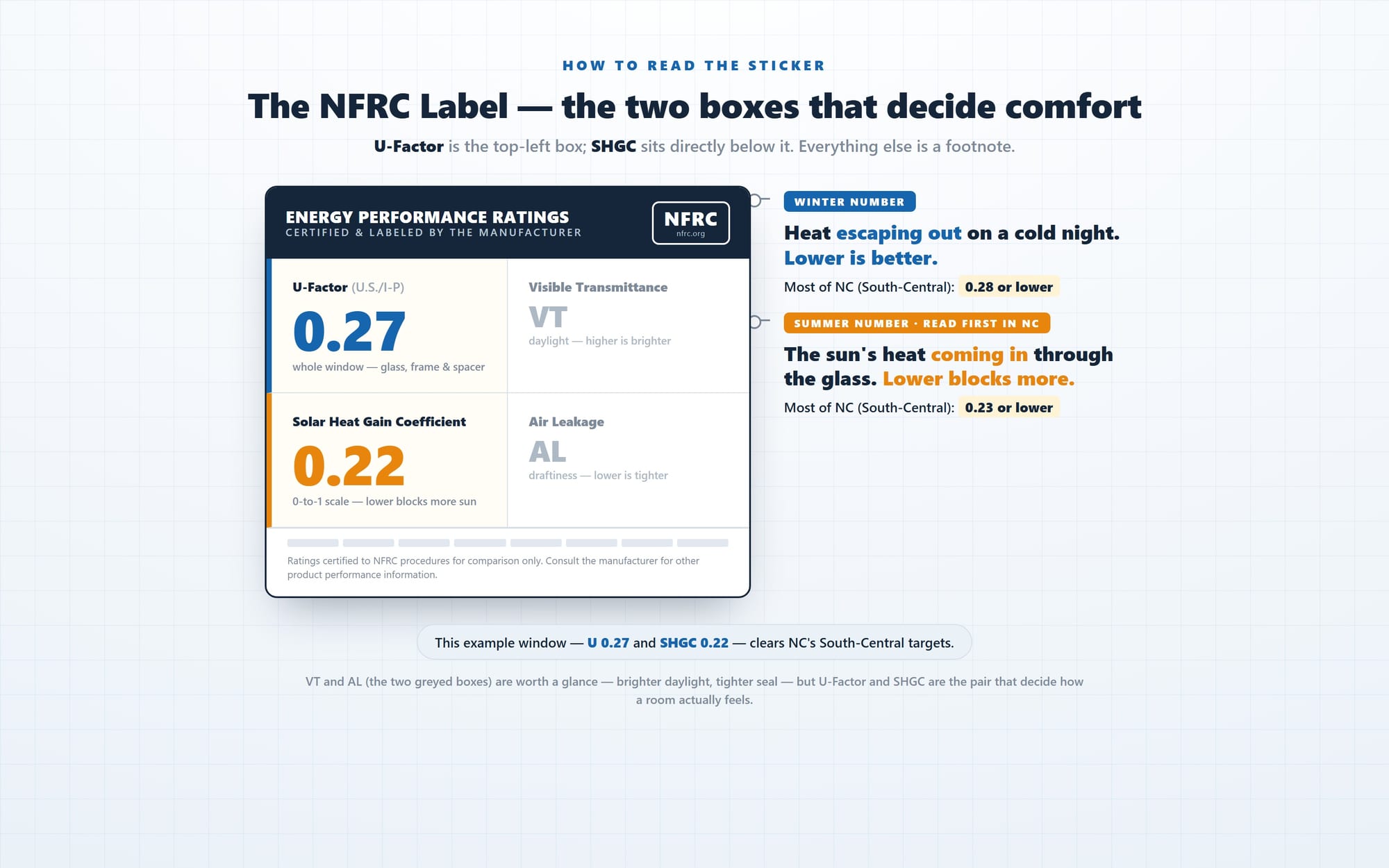
Reading the label to yourself — or asking a salesperson to walk you to those two boxes on the actual line they’re quoting — is the single most useful move you can make. A good rep can point to them in thirty seconds. And you’ve just validated your own instinct to check the spec rather than take the pitch on faith.
Why one SHGC can’t fit every wall
A single SHGC is always a compromise, because your walls don’t all face the sun the same way. That’s not a flaw in the number — it’s physics.
East and west glass takes the worst of it. The sun sits low in the morning and late afternoon and drives straight at those windows during the hottest stretch of a summer day.
A homeowner described the east side of their house exactly: “from sunrise until noon the east side takes a sun pounding… within 5 to 7 feet you can just feel the heat.”
North glass barely notices.
So the low-SHGC glass that saves a west room in July is doing very little for a shaded north window. In cooling-dominated NC the honest guidance is simple: lean low-SHGC across the board, and lean hardest on the walls that cook — the west and east elevations.
The bottom line
Two numbers do the deciding. U-Factor is winter heat escaping out; SHGC is summer sun coming in; lower is better on both, and in North Carolina you read SHGC first. Get them into your county’s range — South-Central 0.28/0.23, mountains 0.25/0.40, or the statewide-safe 0.25/0.23 — and read them straight off the NFRC label, and the sales language loses most of its grip.
From here, two doors: the exact package that hits those numbers is the most efficient spec for NC, and the whole label — all five numbers — is broken down on the energy-ratings hub.
If you’d rather just have someone translate the sticker to your actual house — which walls take the afternoon sun, what each room needs — that’s a no-pressure second opinion, and you’ll leave with numbers you can take to any company.
Sources, Verification & Fact-Checking verified July 2026
Every load-bearing fact on this page is sourced and verified against a primary authority.
Verified July 2026 via direct review of the cited authority — the links open the controlling source so you can check it yourself rather than take our word.
- The NFRC label reports five window ratings; U-Factor measures how well the product keeps heat from escaping (lower is better) and SHGC measures how much solar heat it lets in on a 0–1 scale (lower resists more). VT rates daylight, Air Leakage is capped at ≤ 0.3, and Condensation Resistance runs higher-is-better. (view source — NFRC energy performance label)
- Independent corroboration of the ranges: U-Factor and SHGC both read lower-is-better, SHGC and VT run 0.00–1.00, and an air-leakage rating above 0.3 disqualifies a window from ENERGY STAR. (view source — Efficient Windows Collaborative)
- U-Factor is a whole-window measure of heat loss (glass, frame, and spacer together); SHGC is the fraction of solar heat admitted. Lower is better on both for a cooling-dominated NC climate. (view source — U.S. Dept. of Energy, Building Science Education)
- North Carolina spans TWO ENERGY STAR window zones, confirmed county-by-county on the official finder (Version 7.0 criteria, effective Oct 23, 2023): most of the state is South-Central (Guilford/Greensboro and New Hanover/Wilmington both verified — U ≤ 0.28, SHGC ≤ 0.23), while the mountain west is North-Central (Watauga/Boone and Buncombe/Asheville verified — U ≤ 0.25, SHGC ≤ 0.40). NC has no Southern-zone counties. A single spec of U ≤ 0.25 and SHGC ≤ 0.23 qualifies statewide. This is a separate map from the IECC building-code climate zones. (view source — ENERGY STAR Climate Zone Finder)
- ENERGY STAR residential window criteria are Version 7.0, effective October 23, 2023; re-verify each cycle, as ENERGY STAR versions and zone criteria change. (view source — ENERGY STAR key product criteria)
- Orientation guidance (lean lowest-SHGC on the east- and west-facing walls that take direct low-angle sun) is directional, grounded in NC’s cooling-dominated climate — not a certified per-elevation spec. Figure hedged pending a linked public source.