


Try to look up “what climate zone is North Carolina in” and you’ll collect three different answers before your coffee cools. One chart says Zone 3A. Another says South-Central. A cousin in Boone got told a completely different pair of numbers than the ones on your quote in Greensboro.
None of those sources are lying to you. They’re reading different maps.
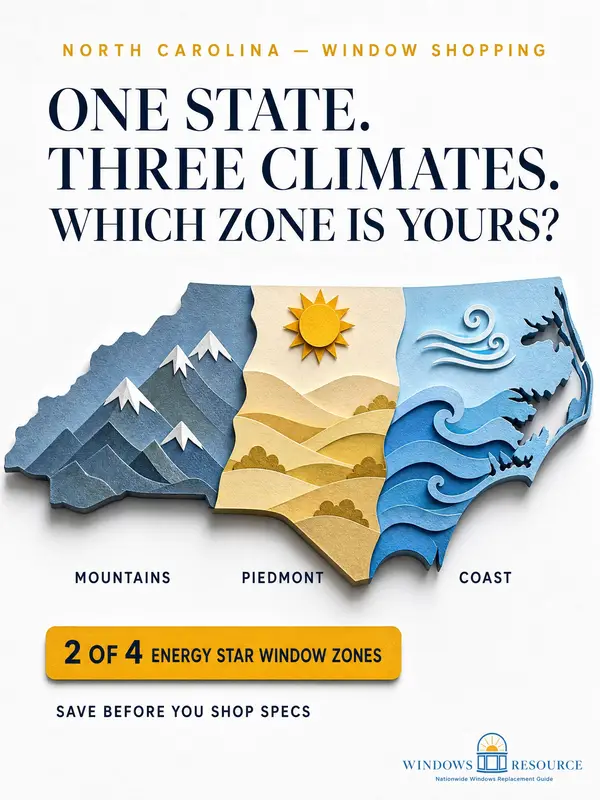
North Carolina runs from Atlantic beaches to mile-high ridgelines, and it wears two different zone systems at once — one for shopping, one for building code — plus a third rulebook on the coast that has nothing to do with energy at all. Untangle the maps and the whole thing collapses into two numbers for your county.
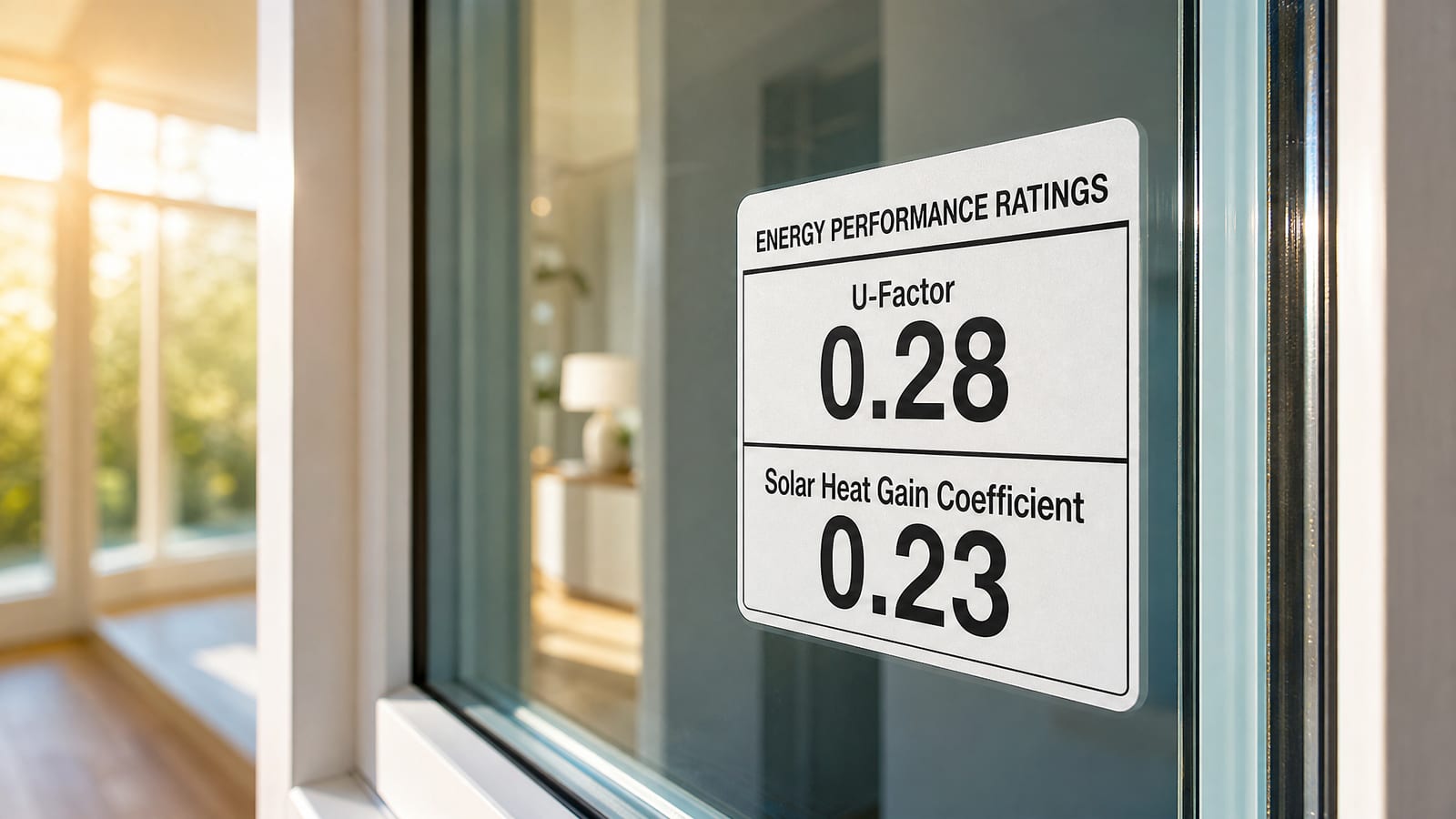
What does NC’s climate mean for your windows? On the map that matters for shopping — ENERGY STAR’s window zones — most of North Carolina is South-Central: U-factor ≤ 0.28, SHGC ≤ 0.23. The mountain west is North-Central: U-factor ≤ 0.25, SHGC ≤ 0.40 — tighter on insulation, looser on sun. One spec clears the whole state: U ≤ 0.25 with SHGC ≤ 0.23. Confirm your county on the official finder before you buy.
Why does every climate-zone chart look different?
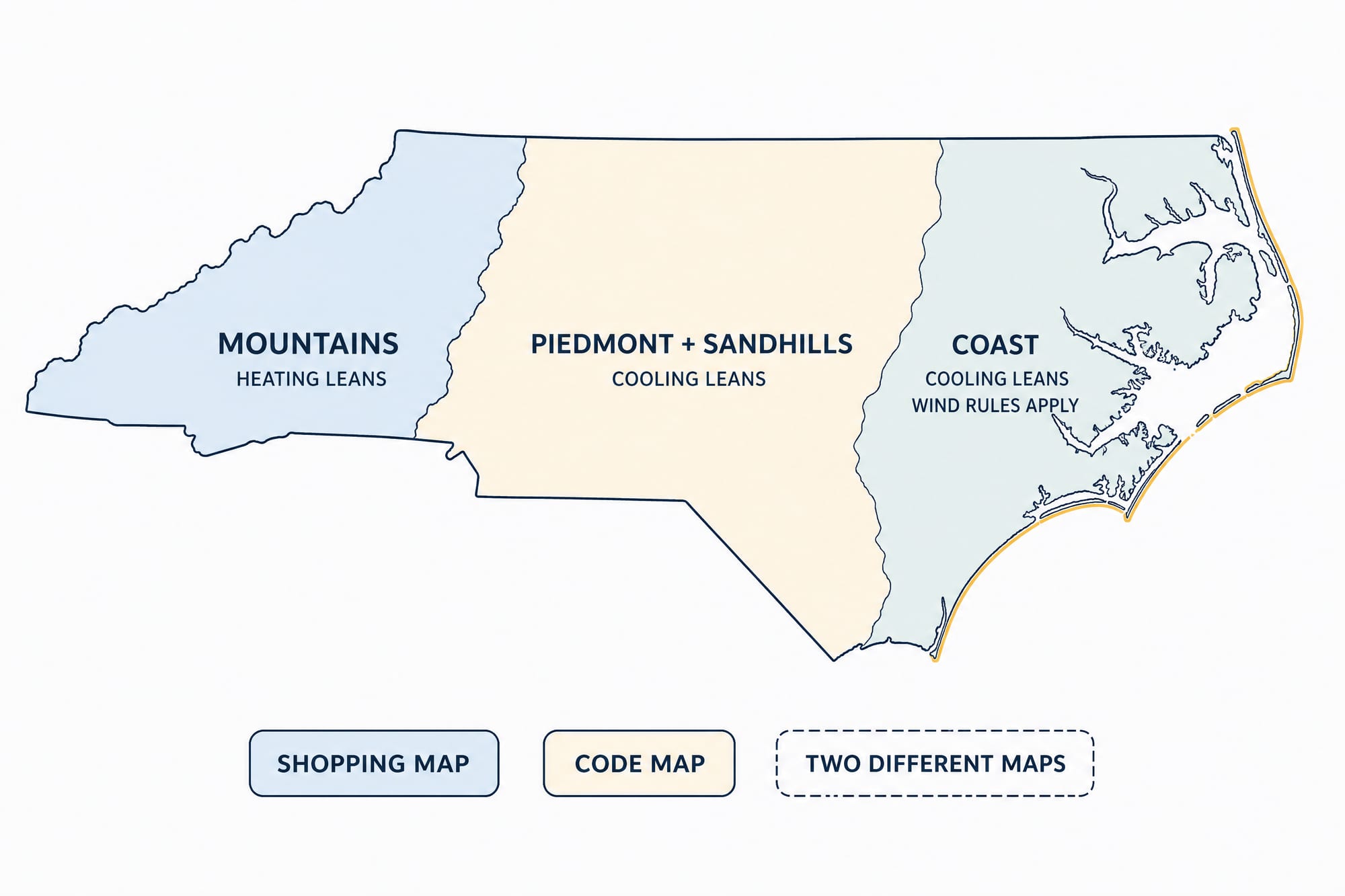
Because “climate zone” is two different systems wearing one name. Both are real. They just answer different questions.
- ENERGY STAR window zones — four zones nationwide, and the map that matters when you’re shopping. It sets the U-factor and targets a window should hit in your county.
- IECC building-code climate zones — the map your inspector uses. It drives code requirements like insulation levels, and it slices NC into different tiers than the shopping map does.
Carry a number from one map into the other and you get the classic mix-up: someone quotes a code-zone figure while you’re trying to buy to the shopping map, and the conversation stops making sense.
There’s a third layer on the coast — a wind rulebook, not an energy one — and we’ll get to it. But first, the map you actually shop with.
Which ENERGY STAR zone is my part of NC in?
North Carolina spans two of the four ENERGY STAR window zones — and I checked the official county lookup rather than trusting the usual charts.
- Most of the state is South-Central. The Piedmont, the Sandhills, and — this surprises people — the coast. Guilford County (Greensboro and High Point) comes back South-Central, and so does New Hanover (Wilmington), right on the water.
- The mountain west is North-Central. Watauga (Boone) and Buncombe (Asheville) both come back North-Central — a colder-climate tier with its own targets.
- No part of NC is in the Southern zone. Some older charts drop our coast into it. The official finder says otherwise.
Your county takes one minute to confirm: the official ENERGY STAR Climate Zone Finder looks it up by state and county, from your phone. Do that before you trust any chart — including the one on a quote.
What does each zone actually want from a window?
Here’s the part that catches people: the two zones don’t just differ — they run backwards from each other.
| South-Central (most of NC) | North-Central (mountain west) | |
|---|---|---|
| Where | Piedmont, Sandhills, coast — Greensboro to Wilmington | High-elevation west — Boone, Asheville |
| The climate fight | Long, humid cooling season — the sun is the enemy | Heating-dominated — keeping warmth in is the job |
| U-factor target | ≤ 0.28 | ≤ 0.25 (tighter — insulation is the strict number) |
| SHGC target | ≤ 0.23 (strict — block the sun) | ≤ 0.40 (relaxed — some solar gain is welcome) |
| Read first | SHGC — the number you feel in a west room in July | U-factor — the number you feel sitting near glass in January |
Where
- South-Central (most of NC)
- Piedmont, Sandhills, coast — Greensboro to Wilmington
- North-Central (mountain west)
- High-elevation west — Boone, Asheville
The climate fight
- South-Central (most of NC)
- Long, humid cooling season — the sun is the enemy
- North-Central (mountain west)
- Heating-dominated — keeping warmth in is the job
U-factor target
- South-Central (most of NC)
- ≤ 0.28
- North-Central (mountain west)
- ≤ 0.25 (tighter — insulation is the strict number)
SHGC target
- South-Central (most of NC)
- ≤ 0.23 (strict — block the sun)
- North-Central (mountain west)
- ≤ 0.40 (relaxed — some solar gain is welcome)
Read first
- South-Central (most of NC)
- SHGC — the number you feel in a west room in July
- North-Central (mountain west)
- U-factor — the number you feel sitting near glass in January
The logic is honest once you see it. The mountains want a window that insulates better, because up there the year is about holding heat. They’ll forgive solar gain — a sunny January afternoon through the glass is free warmth.
The rest of the state is the reverse. Our long, humid cooling season makes the sun the bill you fight, so SHGC is the strict number and the U-factor bar relaxes slightly.
Same state. Opposite priorities. The perfect Wilmington window can be the wrong Boone window — not a worse window, a mismatched one.
What those numbers physically mean — the label, U-factor, SHGC, and the rest — is decoded on the energy-ratings hub. And the coating doing most of the SHGC work is the Low-E layer, riding inside an ordinary double-pane — that everyday baseline is here.
What about the building-code zones — 3A, 4A, all that?
Those belong to the other map. The climate zones are the code framework — the map inspectors and builders use for things like insulation requirements.
On that map, North Carolina spans three tiers — 3A, 4A, and 5A — running from the warm-humid coastal plain at the 3A end up to 5A in the highest mountain counties (Watauga, where Boone sits, among them). A noticeably colder classification than the rest of the state, on a completely different map than the one you shop with.
Two things to keep straight:
- You don’t shop with the IECC map. Its job is code compliance. Even when no permit is required for a like-for-like swap, a replacement window is still supposed to meet the NC Energy Conservation Code’s limits for the unit — the code map is doing its work in the background either way.
- Its zone numbers are not your targets. “Zone 3A” is not a U-factor, and hearing it on a sales call doesn’t change the two numbers you ask for. When zone talk gets confusing, come back to the shopping map and your county lookup.
One map is for your inspector. The other is for your shopping list. Keep them in separate pockets and every chart you meet suddenly makes sense.
Does the coast get its own climate rules?
For energy: no — for wind: very much yes. The coast shops in the same South-Central zone as the Piedmont. Salt air and sea breeze don’t change the U-factor and SHGC targets at all.
What changes at the coast is a third map that has nothing to do with energy: the windborne-debris regions, where the building code requires glazed openings to be impact-protected — rated glazing or approved shutters. That’s a code requirement layered on top of the same energy zone everyone else uses, and it’s address-specific.
If that’s your situation, the whole thing gets its own page: impact windows on the NC coast — what the code actually requires. The short version for this page: an impact rating and an energy rating answer two different questions, and coastal buyers need a good answer to both.
So what spec do I ask for in my county?
Confirm your county on the finder, then ask for your zone’s two numbers.
- Most of NC (South-Central): U-factor ≤ 0.28 and SHGC ≤ 0.23.
- The mountain west (North-Central): U-factor ≤ 0.25, with SHGC relaxed to ≤ 0.40.
- Want one spec that qualifies anywhere in the state? U ≤ 0.25 with SHGC ≤ 0.23 clears both zones at once — the mountain U-factor plus the flatland sun number. A window at U 0.28 meets South-Central but misses the mountain bar, so it isn’t a true statewide baseline.
Those targets are the destination. The package that gets you there — coating, argon fill, warm-edge spacer, and what it should cost — is the job of its own page: the most energy-efficient windows for NC, spec by spec.
Your instinct to look this up yourself before an appointment is exactly right. Knowing your county’s two numbers turns every spec sheet into something you can check in thirty seconds, and it makes competing quotes comparable — they’re finally describing the same job.
If you’d rather just hand the question to someone: tell me your county and which rooms run hot or cold, and I’ll translate the map into the two numbers for your house — a no-pressure second opinion, and you keep the numbers wherever you buy.
Sources, Verification & Fact-Checking verified July 2026
Every load-bearing fact on this page is sourced and verified against a primary authority.
Verified July 2026 via direct review of the cited authority — the links open the controlling source so you can check it yourself rather than take our word.
- North Carolina spans TWO ENERGY STAR window zones, verified county-by-county on the official finder (Version 7.0 criteria, effective Oct 2023): most of the state is South-Central (Guilford/Greensboro and New Hanover/Wilmington verified — U ≤ 0.28, SHGC ≤ 0.23); the mountain west is North-Central (Watauga/Boone and Buncombe/Asheville verified — U ≤ 0.25, SHGC ≤ 0.40); NC has no Southern-zone counties. (view source — ENERGY STAR Climate Zone Finder)
- ENERGY STAR Version 7.0 residential window criteria by zone (South-Central U ≤ 0.28 / SHGC ≤ 0.23; North-Central U ≤ 0.25 / SHGC ≤ 0.40), effective Oct 23, 2023. (view source — ENERGY STAR criteria)
- The statewide-safe spec — U ≤ 0.25 with SHGC ≤ 0.23 — clears both NC zones simultaneously; U 0.28 meets South-Central but not North-Central. Derived directly from the two zones’ published thresholds above; stated as shopping guidance, with the finder recommended for county confirmation.
- ENERGY STAR window zones are NOT the IECC building-code climate zones — two separate maps. On the code map, NC spans IECC zones 3A, 4A, and 5A, with the highest mountain counties (including Watauga) in 5A. Per the climate-zone table of the 2018 NC Energy Conservation Code in effect as of 2026. (view source — 2018 NC Energy Conservation Code)
- Replacement fenestration is expected to meet the NC Energy Conservation Code’s limits for the unit even when the like-for-like permit exemption applies — the permit exemption is not a code exemption. Per N.C.G.S. 160D-1110(c) (work must be performed in accordance with the NC State Building Code). (view source — NCGS 160D-1110)
- Coastal windborne-debris regions require glazed-opening protection (impact-rated glazing or approved shutters) — a code overlay separate from the energy zones; the coast remains South-Central for energy purposes. Stated to the 2018 NC Residential Code in effect as of 2026; detail and address-verification guidance live on the coastal-impact page. (view source — 2018 NC Residential Code)
- Climate characterization — mountains heating-dominated, most of NC cooling-dominated and humid — matches the zone structure above (the tighter mountain U-factor and the flatland SHGC emphasis) and is kept qualitative; no degree-day or bill-savings figures appear on this page.