


Somewhere near the water, you’ve got replacement-window quotes that don’t agree with each other. One carries an impact-glazing line item and calls it required. Another says shutters will do. A third never brought it up.
All three can sound confident, because the honest answer depends on something none of them printed on the quote: where your address sits relative to a line on a wind map.
I can’t see your address from here. But I can show you exactly how the rule works, what the code makes the glass prove, and how to find out which side of the line you’re on — so the quotes stop being a debate and start being checkable.
Do you need impact windows on the NC coast? If your address sits in a windborne-debris region — the highest-wind band along the coast — the building code requires every glazed opening to be protected: impact-rated glazing or approved shutters. Outside that band it’s a choice, not a requirement. The line is address-specific, so verify yours with the local inspections office before you sign either way.
Is impact glass required, or is someone selling me an upgrade?
Both things exist, and telling them apart is the whole game. Inside North Carolina’s windborne-debris regions, protecting glazed openings is building code. Nobody is upselling you — the requirement will outlast every quote on your table.
Outside those regions, impact glazing is an option you weigh like any other: real benefits, real cost, entirely yours to skip.
Your instinct to question a line item that doubles the glass budget is the right instinct. The move isn’t to argue about it in your kitchen, though. It’s to pin down which conversation you’re in — code is settled by your address, not by whoever pitches best.
So let’s find the line.
Where is the windborne-debris line, exactly?
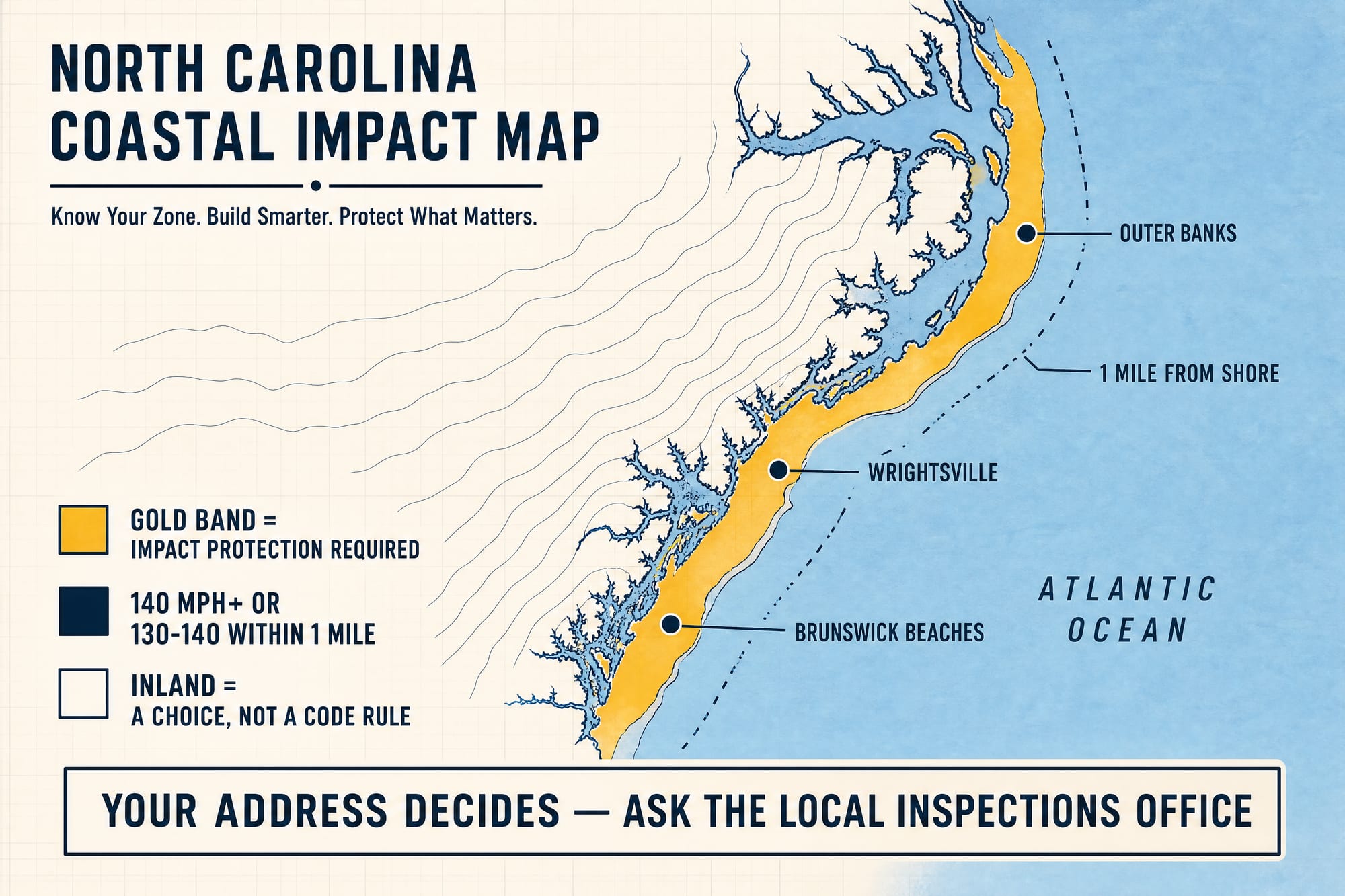
The region is defined by design wind speed, not by county name or distance to the beach. Under the wind maps the 2018 NC Residential Code uses, a glazed opening needs impact protection where:
- the basic design wind speed is 140 mph or greater, or
- the design wind speed is between 130 and 140 mph and the site is within one mile of the coastal mean high-water line.
In practice, that draws a band along the coast. Barrier islands and oceanfront lots — the Outer Banks, Wrightsville Beach, the Brunswick beaches — sit at the highest wind contours and are essentially always inside it. Move inland and the band thins out street by street.
That street-by-street part matters more than any list I could print. The wind-speed contours are address-specific. A house a mile or two inland can sit outside a region its beachfront neighbor is squarely in, and two quotes for two nearby addresses can honestly disagree.
Which coastal counties are affected? Broadly: New Hanover and Brunswick, the Outer Banks counties, and parts of Pender, Onslow, and the other coastal-plain counties — partially, depending on the contour and the one-mile line. I’m not going to pretend a tidy county list exists, because it doesn’t.
The one authoritative answer is local. Call your county or town inspections office, give them the address, and ask whether it falls in a windborne-debris region. It’s a question they answer all day.
What does the code actually make the window prove?
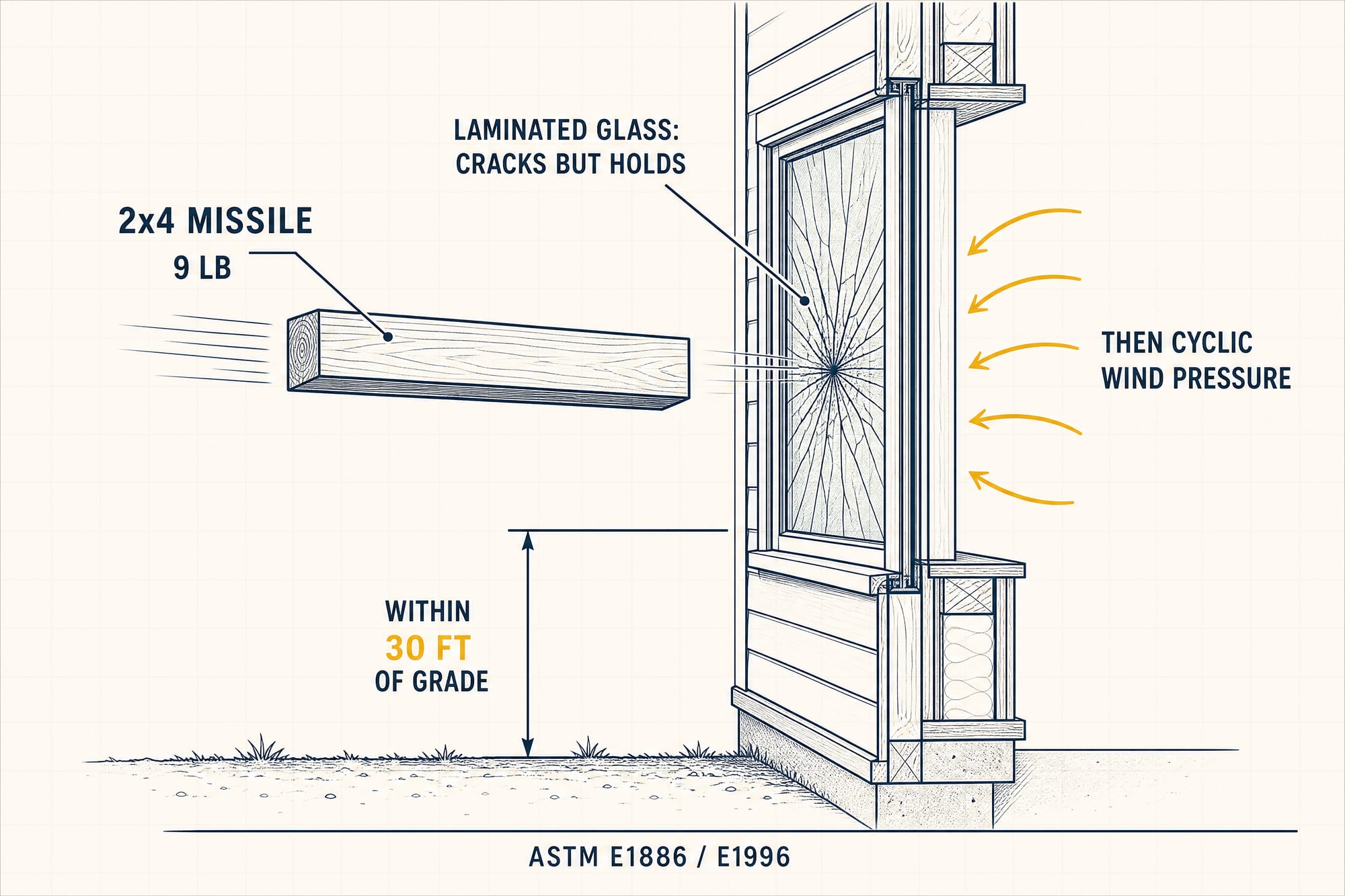
Inside the region, glazing near the ground has to survive being hit — literally. The standard is called the large-missile test. A piece of lumber gets fired at the window, and then the window gets pressure-cycled to simulate hurricane winds working on it afterward.
The details, because they’re worth knowing when you read a spec sheet:
- The “large missile” is a 9-pound two-by-four, roughly eight feet long, fired at the glazing.
- After the impact, the assembly takes cyclic wind-pressure loading — the test checks that a cracked window keeps doing its job, not just that it looks brave.
- The governing standards are E1886 (the test method) and ASTM E1996 (the performance spec). Those designations on a product’s paperwork are what “impact-rated” actually means.
- The large-missile requirement applies to glazing within 30 feet of grade — which covers essentially every window on a one- or two-story house. Higher openings get a small-missile test instead.
Why the code cares this much about one broken pane: in a major wind event, a breached opening lets the storm pressurize the house from inside. That internal pressure pushing up under the roof is how roofs come off. Keeping the opening sealed keeps the building envelope intact — in a hurricane, the window is structural.
The glass that passes this test is laminated — built to crack and hold instead of falling out of the frame. That crack-but-hold behavior is its own story, and it’s told here: how laminated glass works, and what else it’s good for.
Impact glazing or shutters — which path should I take?
The code gives you two legitimate ways to comply, and neither one is a trick. You can protect the opening with impact-rated glazing, or you can put approved shutters over ordinary glass.
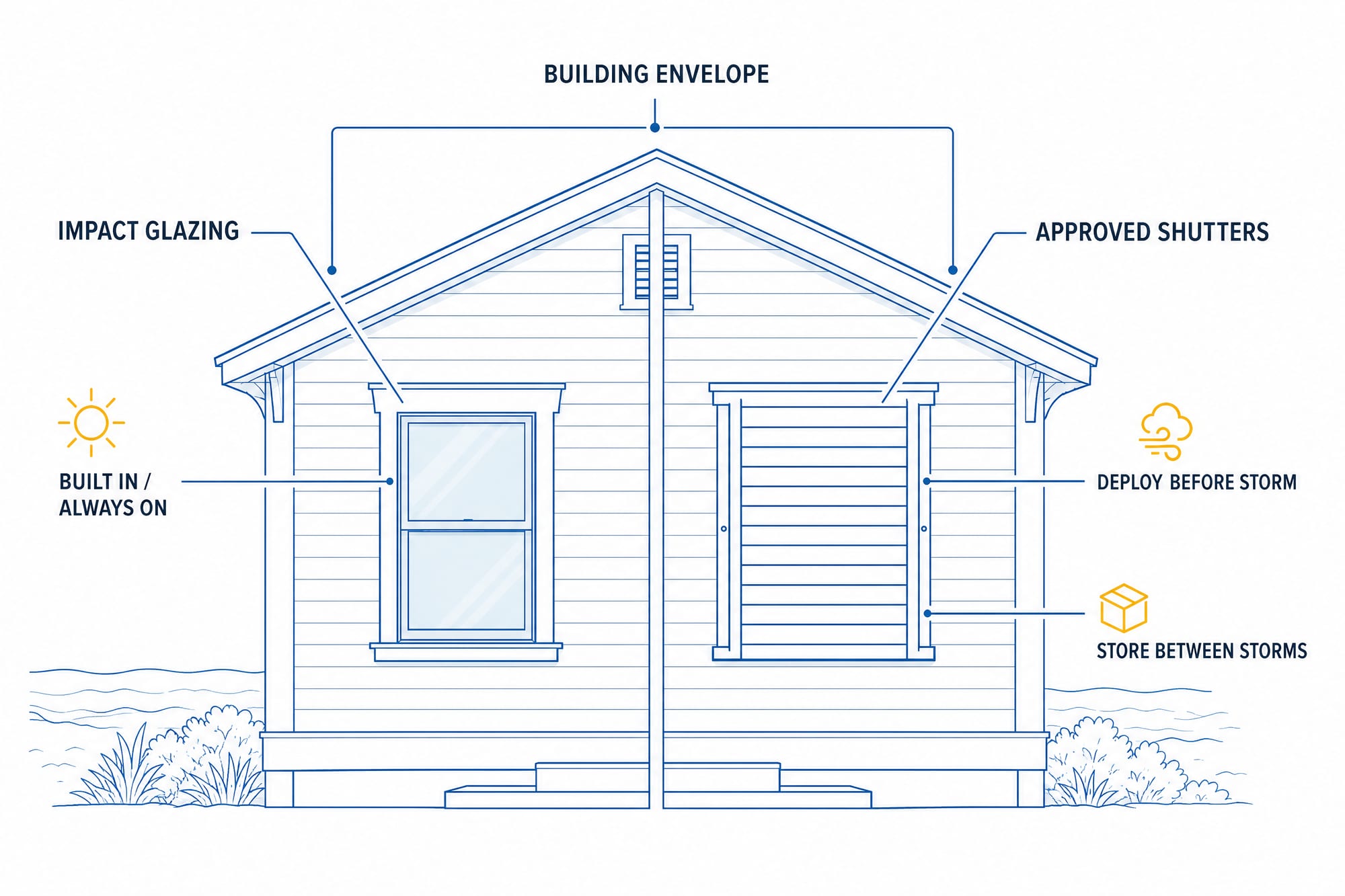
| Impact-rated glazing | Approved shutters | |
|---|---|---|
| How it complies | The glazing itself passes the large-missile test | Rated panels protect ordinary glazing |
| When it protects | Always — nothing to deploy | Only when installed before the storm |
| Before a storm | Nothing to do | Someone puts every panel up — ladders, fasteners, daylight |
| Between storms | It's just your window | Hardware to store, label, and keep complete |
| If you're away when one forms | Protected | Unprotected unless a neighbor owes you a big favor |
| Glass cost | Higher | Lower — the protection budget moves to panels and labor |
| Everyday extras | Laminated glass also damps sound and slows forced entry | None — ordinary glass the rest of the year |
How it complies
- Impact-rated glazing
- The glazing itself passes the large-missile test
- Approved shutters
- Rated panels protect ordinary glazing
When it protects
- Impact-rated glazing
- Always — nothing to deploy
- Approved shutters
- Only when installed before the storm
Before a storm
- Impact-rated glazing
- Nothing to do
- Approved shutters
- Someone puts every panel up — ladders, fasteners, daylight
Between storms
- Impact-rated glazing
- It's just your window
- Approved shutters
- Hardware to store, label, and keep complete
If you're away when one forms
- Impact-rated glazing
- Protected
- Approved shutters
- Unprotected unless a neighbor owes you a big favor
Glass cost
- Impact-rated glazing
- Higher
- Approved shutters
- Lower — the protection budget moves to panels and labor
Everyday extras
- Impact-rated glazing
- Laminated glass also damps sound and slows forced entry
- Approved shutters
- None — ordinary glass the rest of the year
The row that decides it for most people is the second one. Glazing protects without being told to. Shutters protect when someone puts them up — every time, in time, including the storm that forms fast while you’re out of town.
That’s not a knock on shutters. For some budgets and some houses they’re the sensible path, and the code agrees. It’s just a trade you should make on purpose, on a sunny day, rather than discover during a watch announcement.
Do I need a permit to replace windows out here?
Usually not for a straight swap — and that surprises people. North Carolina law exempts like-for-like replacement of windows, doors, and siding from a building permit, below a project-cost threshold that currently sits at $40,000. Same opening, same size, no structural change — typically no permit, statewide.
Three coastal-flavored catches:
- The permit exemption is not a code exemption. The work still has to meet the NC State Building Code — which, inside a windborne-debris region, includes the impact-protection requirement. Skipping the permit doesn’t make the 2x4 test go away.
- Change the opening and a permit is back. Enlarging, shrinking, or cutting a new opening is structural work — permit territory, everywhere in the state.
- Local offices can be stricter. Cities and counties administer the code, and coastal jurisdictions handle wind requirements every week. When in doubt, ask them first — it’s a five-minute call.
The full statewide permit picture, thresholds and all, lives here: when NC window replacement needs a permit.
What about energy ratings on the coast?
An impact rating and an energy rating answer two different questions, and a coastal window needs a good answer to both. The impact side answers “will the opening survive a debris strike.” The label answers “how does this glass handle heat” — U-factor for insulation, for solar gain.
Here’s the part coastal shoppers get told backwards: the NC coast is not a special hot zone for energy purposes. Wilmington’s county comes back South-Central on the official ENERGY STAR lookup — the same zone as the Piedmont — so the same two targets apply: U-factor ≤ 0.28 and SHGC ≤ 0.23.
Impact-rated units routinely carry coatings and argon fills inside the same laminated , so you’re not choosing between surviving the storm and surviving the AC bill. Ask for both sets of numbers.
How the zones work statewide is here: NC’s climate zones, both maps decoded — and the exact spec to request is here: the most efficient package for NC.
One more coastal note: wind-mitigation premium credits are real in North Carolina. The coastal insurance pool (NCJUA/NCIUA) publishes windstorm mitigation credits for its territories, and opening protection is one of the qualifying features.
The fine print matters. The protection generally has to be certified (that ASTM E1996 paperwork again) and installed on every opening — and what a credit is worth on your policy is territory- and carrier-specific. Ask your agent before you count it as savings.
If you’re staring at quotes that disagree, the order of operations is short. Confirm the address against the windborne-debris line with your inspections office. Ask each company whether their unit is rated to ASTM E1996, and for the report. Then compare prices on products that are finally the same thing.
And if you’d like a second set of eyes on the whole stack first, book a no-pressure second opinion — bring the quotes, I’ll bring the questions.
Sources, Verification & Fact-Checking verified July 2026
Every load-bearing fact on this page is sourced and verified against a primary authority.
Verified July 2026 via direct review of the cited authority — the links open the controlling source so you can check it yourself rather than take our word.
- Windborne-debris region definition — design wind speed 140 mph or greater, OR between 130 and 140 mph within one mile of the coastal mean high-water line: per IRC R301.2.1.2 / ASCE 7 as adopted in the 2018 NC Residential Code in effect as of 2026 (the 2024 NC cycle is delayed). Contours are address-specific; the page directs readers to their local inspections office rather than stating county-blanket rules. (view source — 2018 NC Residential Code)
- Large-missile test — a 9 lb, roughly 8 ft two-by-four fired at the glazing, followed by cyclic wind-pressure loading; applies to glazing within 30 ft of grade (small-missile above): ASTM E1886 (test method) per ASTM E1996 (performance specification). (view source — ASTM E1996)
- Two compliance paths — impact-rated glazing OR an approved shutter/impact-protective system: both satisfy the glazed-opening protection requirement in windborne-debris regions; the NC code’s high-wind provisions (Chapter 45) also permit ICC 600 as a compliance standard in the high-wind zones. (view source — 2018 NC Residential Code)
- Envelope pressurization logic — a breached glazed opening lets wind load the building from inside, raising roof-uplift risk: the reason openings are protected rather than treated as cosmetic. Kept conceptual, no pressure figures. (view source — ASTM E1996 (impact + cyclic-pressure basis))
- Tempered “safety glass” alone is not impact-rated and does not satisfy the windborne-debris requirement: impact-rated systems use laminated glazing (or protected ordinary glazing); a load-bearing distinction stated plainly, with no company or salesperson characterized as deceptive — the page frames it as a vocabulary collision. (view source — ASTM E1996)
- NC permit exemption for like-for-like window/door/siding replacement, below a $40,000 project-cost threshold (raised from $20,000 effective Oct 1, 2023); windows and doors are not “load-bearing structures” for the exemption; altering the opening requires a permit; the exemption is not a code exemption: N.C.G.S. 160D-1110(c). The threshold has moved over time ($15k → $20k → $40k by session law) and is re-verified each publish cycle. (view source — NCGS 160D-1110)
- The NC coast is in ENERGY STAR’s South-Central window zone (U ≤ 0.28, SHGC ≤ 0.23), the same zone as most of the state: New Hanover County (Wilmington) verified South-Central on the official ENERGY STAR Climate Zone Finder; NC has no Southern-zone counties. (view source — ENERGY STAR Climate Zone Finder)
- Code-cycle status: the 2018 NC Residential Code remains in effect as of 2026; the 2024 cycle is delayed by session law and is available only as an alternative method pending its effective date. (view source — NC OSFM)
- Wind-mitigation insurance credits exist on NC coastal policies — the NCJUA/NCIUA coastal pool publishes windstorm/hail mitigation percentage credits, with opening protection (certified impact protection installed on all openings) among the qualifying features: credit amounts are territory-, construction-, and policy-specific, so no dollar or percentage figures appear on this page — confirm yours with your agent. (view source — NCJUA/NCIUA mitigation credits)