


Nobody puts “collect window quotes” on the calendar for fun. It means phone calls, scheduling, and letting a stranger with a tape measure and a price book into your kitchen — three separate times.
I sell windows for a living, so I’ve been the person on the other side of that table. And here’s what I can tell you from that seat: the homeowners who get the best outcomes aren’t the toughest negotiators. They’re the ones who turned the whole thing from three sales appointments into one bid — same spec, three bidders, decision next week on paper.
This page is the how. How many quotes, from whom, what to hand each company, what the visit is actually like, and how to read the three numbers when they land.
How do you get window quotes the right way? Get three, from a mix of company types (at least one local installer). Hand every bidder the same one-page spec — window count, install method, glass package — and say up front that you’re comparing quotes and deciding later, in writing. Then compare per window, installed, on the same spec. Three comparable quotes converge on the market number; this page walks each step.
Why is three the magic number?
Because one quote is an opening bid, two is a coin flip, and three is a pattern.
With one quote, you have a number and no way to test it. The homeowner-shared stories that fill the forums — a quote dropping from $44,000 to $35,000 in an evening — are what happens in a one-quote world. The number moves because there’s nothing anchoring it.
With two quotes that disagree, you know one of them is off. You don’t know which.
With three quotes on the same spec, something better happens: convergence. Two of the three usually land near each other, and that neighborhood — not the outlier, not the discount theater — is the market number for your job. You didn’t out-negotiate anyone. You just gave the real price enough witnesses.
This isn’t just my arithmetic. ENERGY STAR’s buying guidance says to get quotes from multiple installers on the same product, and the flags “only good today” offers — the natural predator of the one-quote buyer — among its classic warning signs.
Could you get four or five? Sure, and for a very large job it can be worth it. But every quote costs you an evening, and past three the new information per evening drops fast. Three is where the pattern shows up and your calendar survives.
Who should the three be?
A mix — because different kinds of companies are selling you different things, and you want to see the spread.
In this market, most bidders are one of three animals:
- A local installer or regional window company. Leaner overhead, often quoting a dealer-channel window (Simonton, ProVia, Pella, and the like) plus their labor. The price mostly reflects the product and the work.
- A full-service national brand. One company that makes or sources the window, sells it in your home, installs it with its own crews, and warranties the whole job — one phone number for everything. That turnkey package, and the marketing engine behind it, is priced into the number. (Full disclosure: I work for a company in this category. It’s a legitimate model — and it’s rarely the cheapest number in the stack, for reasons that have nothing to do with the glass.)
- A big-box program. You buy the window at retail through the store’s brand lineup and the install is subcontracted through their program. Convenient and standardized; the person measuring is usually not the person installing.
| Local installer | Full-service national | Big-box program | |
|---|---|---|---|
| What you're buying | A product plus that company's labor, priced separately | One package: product, install, and whole-job warranty from one company | A retail product plus a standardized subcontracted install |
| Where the price lives | Mostly in the window and the work | In the window, the work, and the sales/marketing overhead | In the retail product price plus program install rates |
| Who installs | The company's own crew or regulars — ask which | The company's own or contracted crews | Subcontractors in the store's program |
| Warranty shape | Manufacturer product warranty + the installer's own labor warranty — two documents | Often one whole-job warranty covering product and labor together | Manufacturer warranty + program labor coverage — read both |
| Ask this one | "Who exactly is on my job, and what's your labor warranty in writing?" | "What's the cash price, itemized, good next week?" | "Who installs, and who do I call in year three?" |
What you're buying
- Local installer
- A product plus that company's labor, priced separately
- Full-service national
- One package: product, install, and whole-job warranty from one company
- Big-box program
- A retail product plus a standardized subcontracted install
Where the price lives
- Local installer
- Mostly in the window and the work
- Full-service national
- In the window, the work, and the sales/marketing overhead
- Big-box program
- In the retail product price plus program install rates
Who installs
- Local installer
- The company's own crew or regulars — ask which
- Full-service national
- The company's own or contracted crews
- Big-box program
- Subcontractors in the store's program
Warranty shape
- Local installer
- Manufacturer product warranty + the installer's own labor warranty — two documents
- Full-service national
- Often one whole-job warranty covering product and labor together
- Big-box program
- Manufacturer warranty + program labor coverage — read both
Ask this one
- Local installer
- "Who exactly is on my job, and what's your labor warranty in writing?"
- Full-service national
- "What's the cash price, itemized, good next week?"
- Big-box program
- "Who installs, and who do I call in year three?"
Why mix them? Because the same or similar glass can be quoted far apart depending on the sales model, not the window — that’s the honest structure of this industry, not a scandal. A bid with at least one local installer and one bigger outfit in it lets you see that structure in your own numbers instead of taking anyone’s word for it.
If a friend or neighbor just had windows done and raves about the crew, that recommendation is worth a slot in your three. A crew that treated the last house well is the least fakeable credential in this business.
What do I hand each bidder so the quotes actually compare?
One page. The same page, to all three. This is the single highest-leverage move in the whole process, and it takes fifteen minutes.
Three quotes only work if they’re answering the same question. Left alone, each company will quote what it prefers to sell — different method, different glass, different line — and you’ll end up with three answers to three different questions. The fix is to set the question yourself:
The one-page bid sheet — what goes on it
- Window count and locations. “Ten windows: five front, three sides, two back,” with rough sizes if you have them.
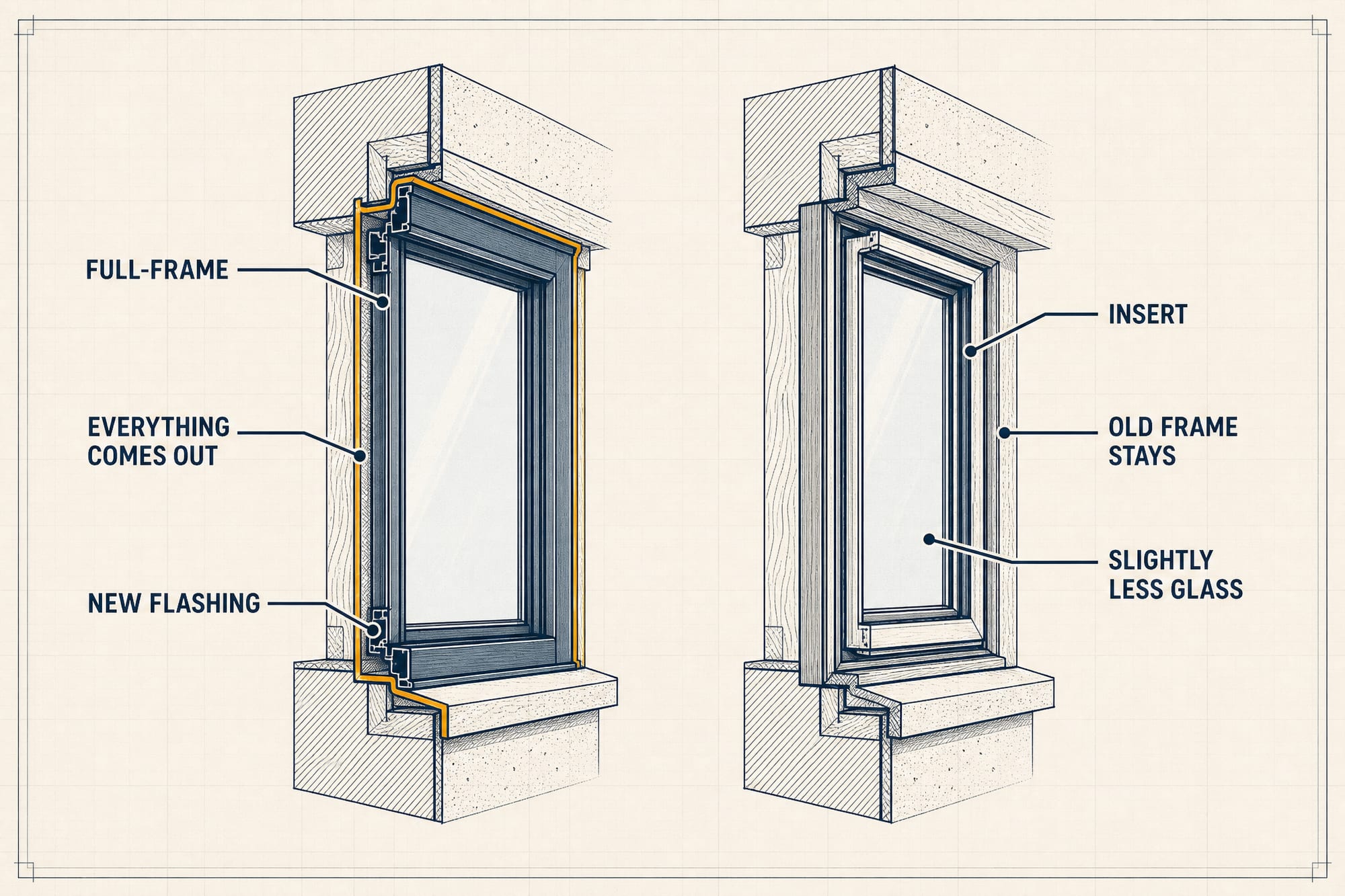
- Install method, per opening — insert or full-frame. If you don’t know yet, run the three-check condition test first, or write “quote both and tell me which each opening needs, and why.”
- Frame material you want quoted — vinyl, fiberglass, wood — so nobody swaps categories on you.
- Glass package, by the numbers. Double-pane, , gas fill — and ask every bidder to state the and of the exact unit, in writing.
- Both warranties in writing — the product warranty and the labor warranty, each with its term.
- Itemized pricing — per window, installed, with labor broken out.
- How long the price holds. A blank line that says “this price is good until ___” does more work than any negotiating tactic I know.
Hand this to all three. Now the numbers that come back are the same question, answered three times.
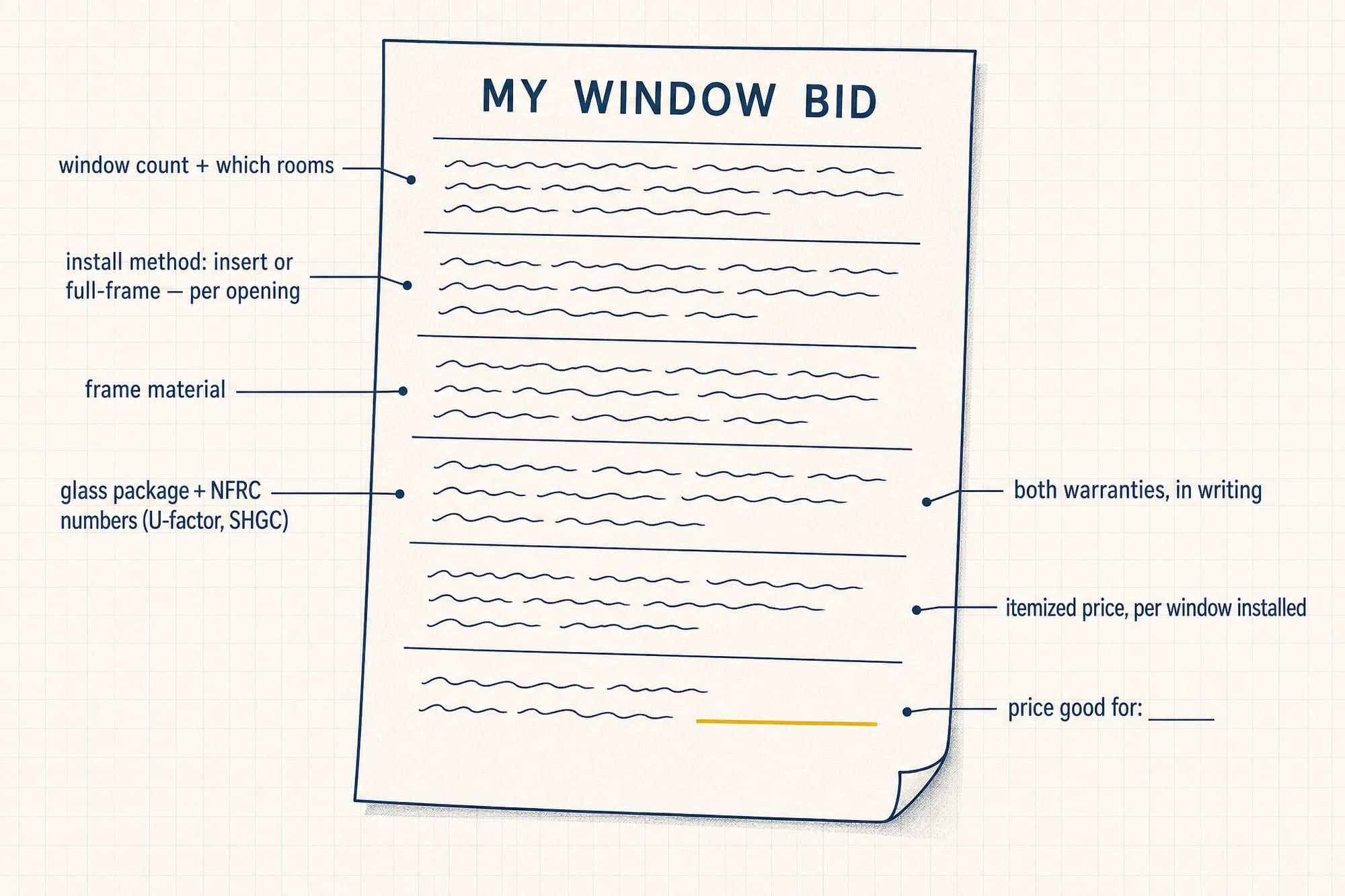
This is ENERGY STAR’s guidance turned into a homeowner’s tool: the same product priced by several installers, with the U-factor and SHGC stated and labor and materials broken out. The bid sheet just adds the rest — method, material, warranties — in writing.
One more line worth writing at the top: “We’re getting three quotes and deciding next week.” Not as a threat — as scheduling information. It tells every bidder the decision happens on paper, later, which is where good quotes win.
What actually happens during the in-home visit?
Roughly three acts: measuring, the presentation, and the ask. Knowing the shape ahead of time is most of the calm.
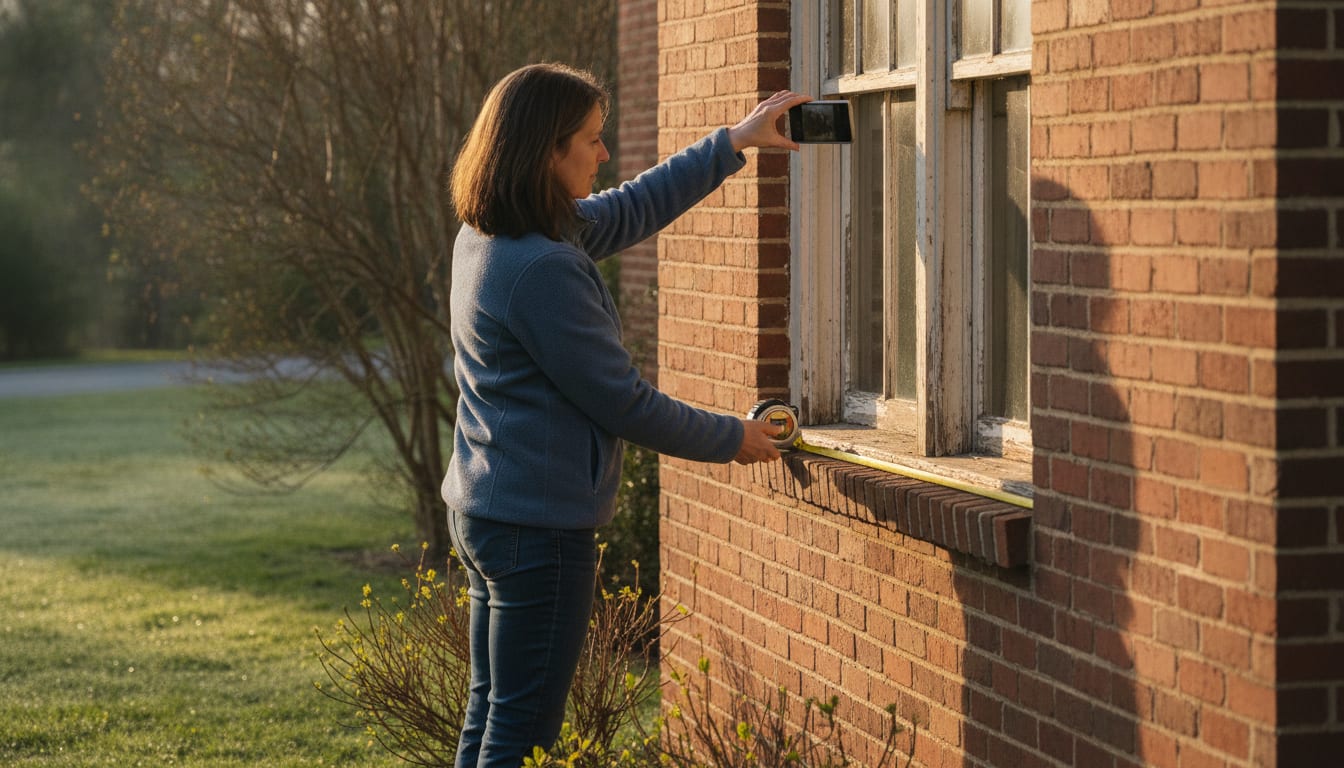
The measuring is the real work. The rep or estimator checks each opening — widths, heights, square, the condition of the sills. This part is genuinely necessary and worth watching. Someone probing a sill and pulling a tape across the diagonals is diagnosing your house — the same checks I’d run. Someone who quotes ten windows from the driveway is not.
The presentation is the company’s story — product samples, glass demos, warranty talk. Length varies a lot by company. You set the boundary when you book: “We’ve got about an hour, and we’re comparing three written quotes.” A professional works inside that comfortably.
The ask is where your one decision was already made. Some companies price on the spot and the visit naturally ends with “so what do you think?” — sometimes with tonight-only math attached. You don’t need a counter-tactic, because you decided before the doorbell rang: the decision happens next week, on paper, against two other quotes. Say that, warmly, as many times as needed. If the price genuinely can’t survive until next week, that tells you something about the price — the red-flags checklist covers that pattern and seven others.
A few practical notes from my side of the table:
- Both-spouses requests are common. Companies ask because decisions stick better with everyone present. It’s a reasonable request you’re free to decline — “I gather information, we decide together later” is a complete answer.
- Let them measure everything. A thorough measure makes the quote real. Skipped openings become change orders later.
- Take notes on the spec, not the pitch. The brand, line, glass package, and method going on paper are what you’ll compare. The demo was theater — enjoyable, but not on the bid sheet.
How do I read three quotes side by side?
Normalize, then compare — the arithmetic takes ten minutes once the quotes are comparable.
- Check they’re the same job. Same window count, same method per opening (the word insert or full-frame should appear — a method mismatch explains most shocking gaps), same glass package, U-factor and SHGC named. A quote that skipped your spec sheet gets one polite chance to re-quote to it.
- Divide to per-window, installed. Total price over window count. This is the one unit that compares across companies of different shapes and sizes.
- Line up the warranties. Product warranty and labor warranty, each with a term, each in writing. A longer labor warranty from a company likely to still exist in year five is worth real money; price it accordingly.
- Look for the convergence. Two of your three numbers usually land in the same neighborhood. That neighborhood is your market number. The outlier — high or low — isn’t automatically wrong, but it owes you an explanation: what is it doing, or skipping, that the others aren’t?
Then pressure-test the neighborhood itself against what replacement windows actually cost in NC, and run each document through the is-this-quote-reasonable check before you sign anything.
The short version
- Three quotes, one spec. Local installer in the mix. Decision next week, on paper — say so when you book.
- The bid sheet is the whole trick. Method, material, glass numbers, both warranties, itemized, price that holds.
- The visit has three acts — value the measuring, enjoy the presentation, and let your pre-made decision handle the ask.
- Per window, installed is the comparison unit; convergence is the market number.
And if you’d like a second set of eyes on round three — someone who writes these documents for a living — send me all three quotes and I’ll tell you which ones describe the same job and where the real gap is. That’s exactly what a no-pressure quote comparison is for.
Sources, Verification & Fact-Checking verified July 2026
Every load-bearing fact on this page is sourced and verified against a primary authority.
Verified July 2026 via direct review of the cited authority — the links open the controlling source so you can check it yourself rather than take our word.
- Get quotes from several installers on the same product, with the U-factor and SHGC stated and labor and materials broken out: ENERGY STAR’s replacement-window buying guidance — the basis for both the “three on one spec” method and the bid-sheet contents; naming the brand, model, and install method in writing is this page’s added method. (view source — ENERGY STAR buying tips)
- “Only good today” offers are a classic warning sign to slow down on: Consumer Financial Protection Bureau consumer guidance — cited as the reason the decision moves to next week, on paper, not as a claim about any company. (view source — CFPB)
- “Three is the magic number” is a practical floor, not a regulation: consumer guidance (ENERGY STAR above; CFPB-style comparison-shopping advice) says “multiple/several” quotes; three-as-minimum is this page’s working method, presented as method.
- The $44,000 → $35,000 price-drop example is a homeowner-shared figure from public forum accounts — illustrative of one-quote anchor dynamics, attributed to homeowners, not a verified list price or a claim about any named company.
- Company-type framing (local installer vs full-service national vs big-box; the sales model, not the glass, drives much of the spread): qualitative market structure, consistent with how manufacturers, full-service companies, and retailer install programs each publicly describe their own models — presented with no company disparaged, and with the author’s full-service employment disclosed in the body. No specific price multiples stated.
- Insert vs full-frame as the most common source of quote gaps, and the three-check condition test: covered in depth, with sources, on the site’s full-frame vs insert page — linked rather than restated here.
- The story callout (“three quotes, three different jobs”) is a composite of a recurring homeowner-forum pattern — incomparable quotes diagnosed as different scopes/specs, resolved by re-bidding on one spec — told as a representative pattern, not a single sourced thread.