

You typed “cheapest time to buy windows” hoping for a month. A specific month that unlocks a specific discount, so you can circle it and stop overpaying.
I sell windows for a living, and I’ll give you the month. But I’m also going to tell you something the sale-calendar pages leave out: the month is the smallest lever you’ve got.
Here’s the calendar at its real weight — and the two things that move your price more.
When is the cheapest time of year to buy replacement windows in NC? Usually the off-season — late fall through winter, roughly November into February — when demand softens and installers run their deepest promotions. But keep it in scale: that’s a real but modest thumb on the scale, not a different price class. Two levers move your number more than any month does — three or more itemized quotes compared line by line, and lead time, because windows are built to order and the month you sign isn’t the month they install.
When is the cheapest time to buy windows in NC?
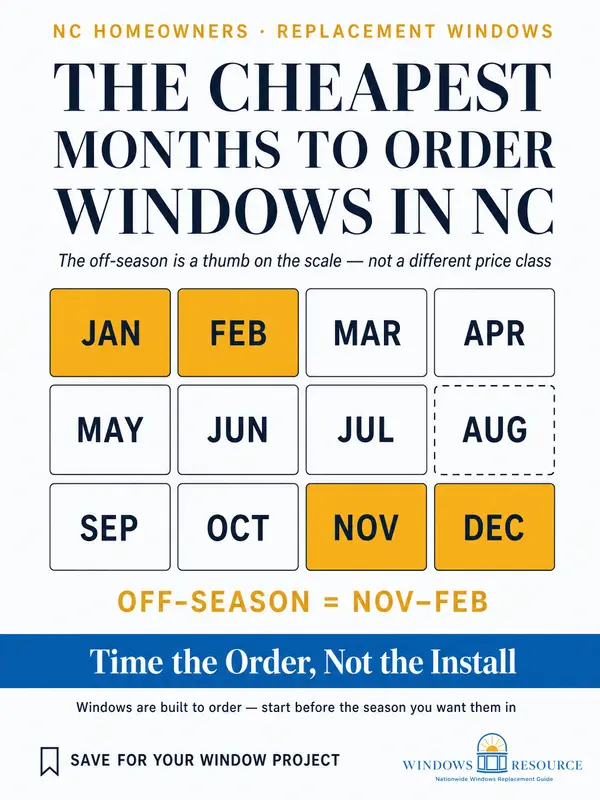
The off-season — roughly November through February, with a quieter lull around August. Demand softens when the weather turns, and installers publish their deepest promos to fill a slower calendar.
You don’t have to take that on faith. It’s advertised, not leaked: winter promo campaigns, often running December into late winter, sometimes with financing attached. Softer demand, softer prices.
The months below are the pattern buyers and installers both describe. Treat them as when to shop, not a guaranteed discount.
When window demand softens in NC (and promos deepen)
Gold = the off-season window (softest demand, deepest promos). Dashed = the late-summer lull. This is when to order, not a fixed discount.
One thing this timing shares with the best time of year to install in NC: winter here is closer to a shoulder season than a shutdown. NC’s mild Piedmont winters make a cold-season order low-risk — that page carries the sealant-temperature facts and the one-window-at-a-time method if you want the install side.
How much does buying in the off-season actually save?
Enough to be worth timing if your project is flexible — not enough to build the whole decision around. The honest number moves by company and by year, so I won’t hand you a fake one.
Industry cost guides tend to cite a modest saving. But treat any single figure with suspicion, because the seasonal lever is real and small.
Which brings up the number you will see plastered everywhere.
“Up to 50% off this weekend” is a sale structure, not a saving. It’s the same anchor-and-discount ritual that opens a quote at $44,000 and drops it to $35,000 before the coffee cools — a high anchor followed by a deadline. The lists “only good today” offers among its classic warning signs to slow down on.
A real off-season price is still real next week. If a discount evaporates at midnight, it was never the market number. Here’s how to read those quote red flags calmly when you’re across the table from one.
So if the month is a small lever, what are the big ones?
| The lever | How much it moves the price | When to pull it |
|---|---|---|
| Three-plus itemized quotes, compared line by line | The biggest reliable mover — the single most repeated advice from owners who've done it | Every project, always |
| Asking the number to move (re-bid, negotiate) | Real — owners routinely watch a re-bid come down | Once you have comparable quotes in hand |
| Buying in the off-season | Real but modest — a thumb on the scale | When your timing is flexible |
| The financing structure you accept | Can quietly cost more than the season saves | Read the terms before the promo, not after |
| The exact month you sign | The smallest lever on this list | Last thing to optimize |
Three-plus itemized quotes, compared line by line
- How much it moves the price
- The biggest reliable mover — the single most repeated advice from owners who've done it
- When to pull it
- Every project, always
Asking the number to move (re-bid, negotiate)
- How much it moves the price
- Real — owners routinely watch a re-bid come down
- When to pull it
- Once you have comparable quotes in hand
Buying in the off-season
- How much it moves the price
- Real but modest — a thumb on the scale
- When to pull it
- When your timing is flexible
The financing structure you accept
- How much it moves the price
- Can quietly cost more than the season saves
- When to pull it
- Read the terms before the promo, not after
The exact month you sign
- How much it moves the price
- The smallest lever on this list
- When to pull it
- Last thing to optimize
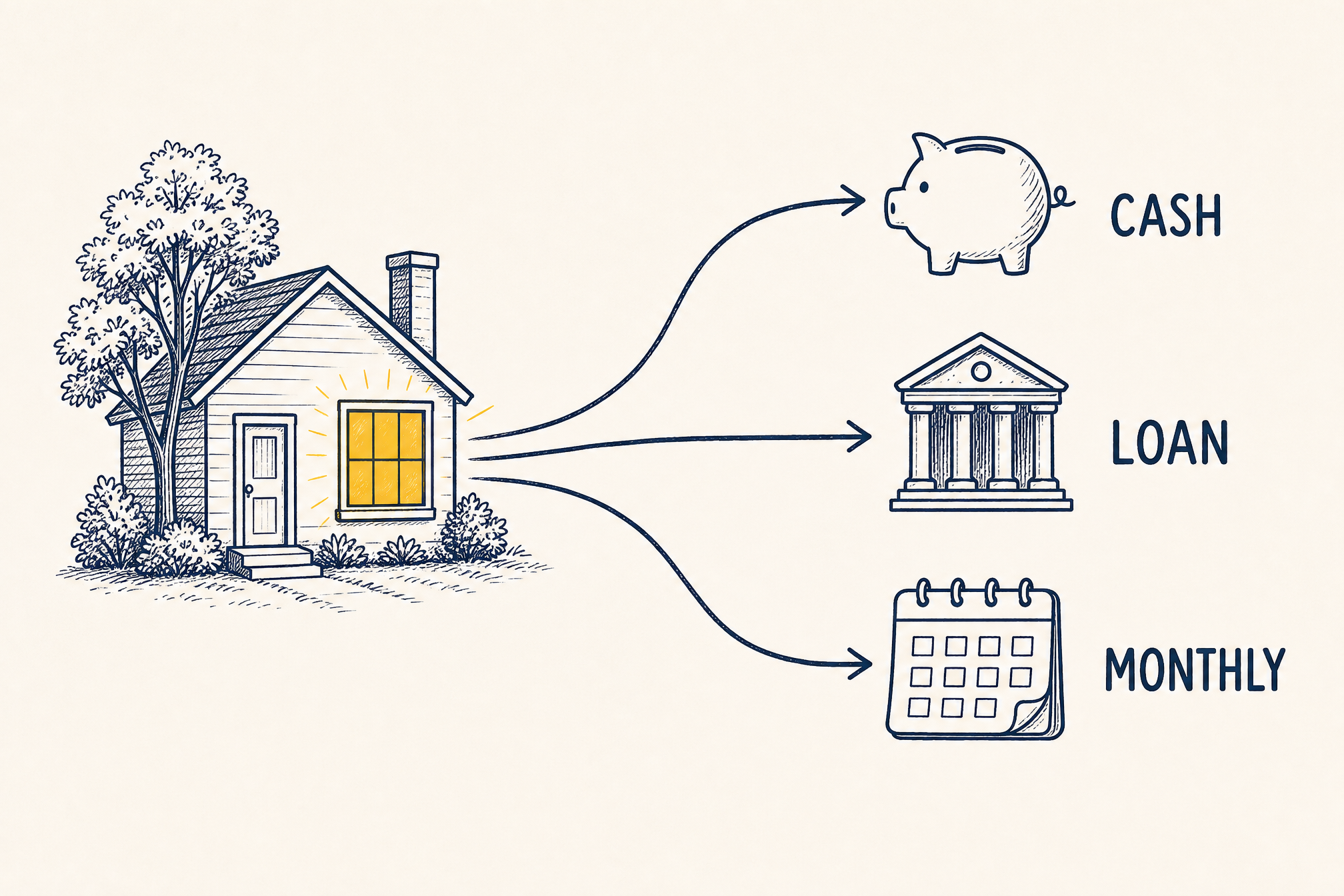
Two of those levers have their own pages worth a look: how to get quotes worth comparing, and how window financing actually works so a “0% for 60 months” promo doesn’t quietly claw back what the off-season handed you. And for the actual dollars, that’s the job of what replacement windows cost in NC — not this timing page.
Does waiting for a deal cost me a winter of drafts?
It can — and that’s the trap the sale calendars never mention. If your windows are already failing, a modest seasonal saving can be outrun by a season of discomfort.
Cold pouring off the glass. Condensation between the panes you can’t wipe off. A sash that won’t stay up. Those aren’t “wait for a sale” problems. Those are “I’m heating the yard every month you wait” problems.
And the discount isn’t the only thing moving. Window pricing has generally drifted upward year to year with materials and labor, so a year of waiting isn’t free either.
NC homeowner takeaway. Your deal-hunting instinct is a good one — don’t drop it. Just scope it right. If the windows are flexible and functional, time the order for the off-season and pocket the modest saving. If they’re actively failing, fix them and let the season fall where it falls. Timing is a bonus, not a reason to live with a broken window.
The month you buy isn’t the month they install
Replacement windows are built to order. The month you sign is the month you START — not the month the crew shows up. That lag is the timing lever almost nobody plans around.
The forum record is consistent on this. Someone orders in November and isn’t installed until months later. Someone signs in early May and watches the install land in October. The build time in between is the real boss of the calendar.
So flip the whole question around. Don’t ask “what month is cheapest” and sign on impulse. Ask “when do I want these in, and when do I start to hit it?”
Count backward from when you want them in
Want them in for a mild fall? You’re a summer shopper. Chasing a winter promo? Your install may land in spring — which, in NC, is a perfectly good outcome.
The install day itself — the flashing, the shimming, the sealing — is the same in any month, and it lives on what actually happens on install day. This page is only about when to buy.
So when should I actually start shopping?
Start before the season you want them in, get three itemized quotes, and ask when the price locks. Do those three and the exact month sorts itself out.
Put simply, in the order that matters:
- Get three or more itemized quotes and compare them line by line. This is the biggest lever, full stop — and it’s your instinct already. You’re right; run with it. Here’s how to get quotes worth comparing.
- If the timing’s flexible, aim your order at the off-season. Late fall through winter, or the August lull. Modest saving, low risk in NC’s mild winters.
- Ask when your price locks — at signing or at install — before you plan around any promo. A promo you sign during and install after is the off-season’s best version.
- If the windows are failing, don’t wait. The season’s saving won’t cover a winter of drafts and a year of price drift.
The short version
You don’t need the perfect month. You need three quotes, a little lead time, and the discipline to ignore a countdown clock.
- Cheapest to order: the off-season, roughly November through February, plus an August lull — a real but modest lever, not a different price class.
- Ignore the deadline: “50% off this weekend” is a sale structure. A real price holds next week.
- Bigger levers than the month: three-plus itemized quotes and asking the number to move.
- Time the order, not the install: windows are built to order, commonly 2–3 months out, so start well before the season you want them in.
- Don’t let a deal cost you a season: if they’re failing, fix them now.
If you’re trying to land an order so a promo actually lands when you want the windows in, that’s a five-minute timing conversation — no pressure attached. And whatever the month, the job should cost the same honest number: here’s what replacement windows cost in NC.
Sources, Verification & Fact-Checking verified July 2026
Every load-bearing fact on this page is sourced and verified against a primary authority.
Verified July 2026 via direct review of the cited authority — the links open the controlling source so you can check it yourself rather than take our word.
- The off-season — late fall through winter (roughly November–February), with a late-summer (August) lull — is when demand softens and installers publish their deepest promotions. Directional market pattern synthesized from multiple installer and buying-guide pages read in July 2026 (national installer promotional calendars running December into late winter; season-by-season buyer guides converging on winter/November/January/August as slower, cheaper stretches). Stated qualitatively; no discount magnitude asserted.
- The off-season saving is real but modest, not a different price class, and “up to 50% off” promos are anchor-and-discount sale structures rather than a 50% cut off the market rate. Industry cost guides cite a modest seasonal saving; the honest figure moves by company and year, so none is stated here as a market rate. The anchor-and-discount characterization is consistent with the CFPB warning-sign guidance cited below.
- ”Only good today” / deadline-priced offers are a classic warning sign to slow down on. Consumer Financial Protection Bureau consumer guidance on classic warning signs of possible fraud and scams — cited as the reason a durable price is the baseline, not as a claim about any company. (view source — CFPB)
- Replacement windows are built to order, with commonly reported waits of roughly two to three months (many owners report eight to twelve weeks) from signing to install, and longer for custom or specialty units; owners report signing in one season and installing in another (e.g., a May signing installing in October). Attributed accounts from working installers and homeowners in public forum threads plus manufacturer/installer lead-time pages read in July 2026 — reported as attributed experience, not measured market data. Consistent with the sibling installation page’s owner-reported range, and with published manufacturer/installer lead-time guidance (standard units commonly 6–10 weeks; custom and specialty lines longer).
- Window pricing has generally drifted upward year to year with materials and labor. Directional trend from 2025–2026 market cost commentary and construction-materials price reporting read in July 2026 (materials, labor, and tariff pressure); stated qualitatively, with no specific percentage anchored.
- Dollar figures, per-window and whole-house cost ranges, and financing terms are deliberately not restated on this timing page — they live, with their own citations, on the NC window cost page and the financing page.
- Find an error? If a figure here reads wrong against a source you trust, tell me and I’ll check it — corrections make the page better, and this one is re-verified on a rolling basis (next review by January 2027).