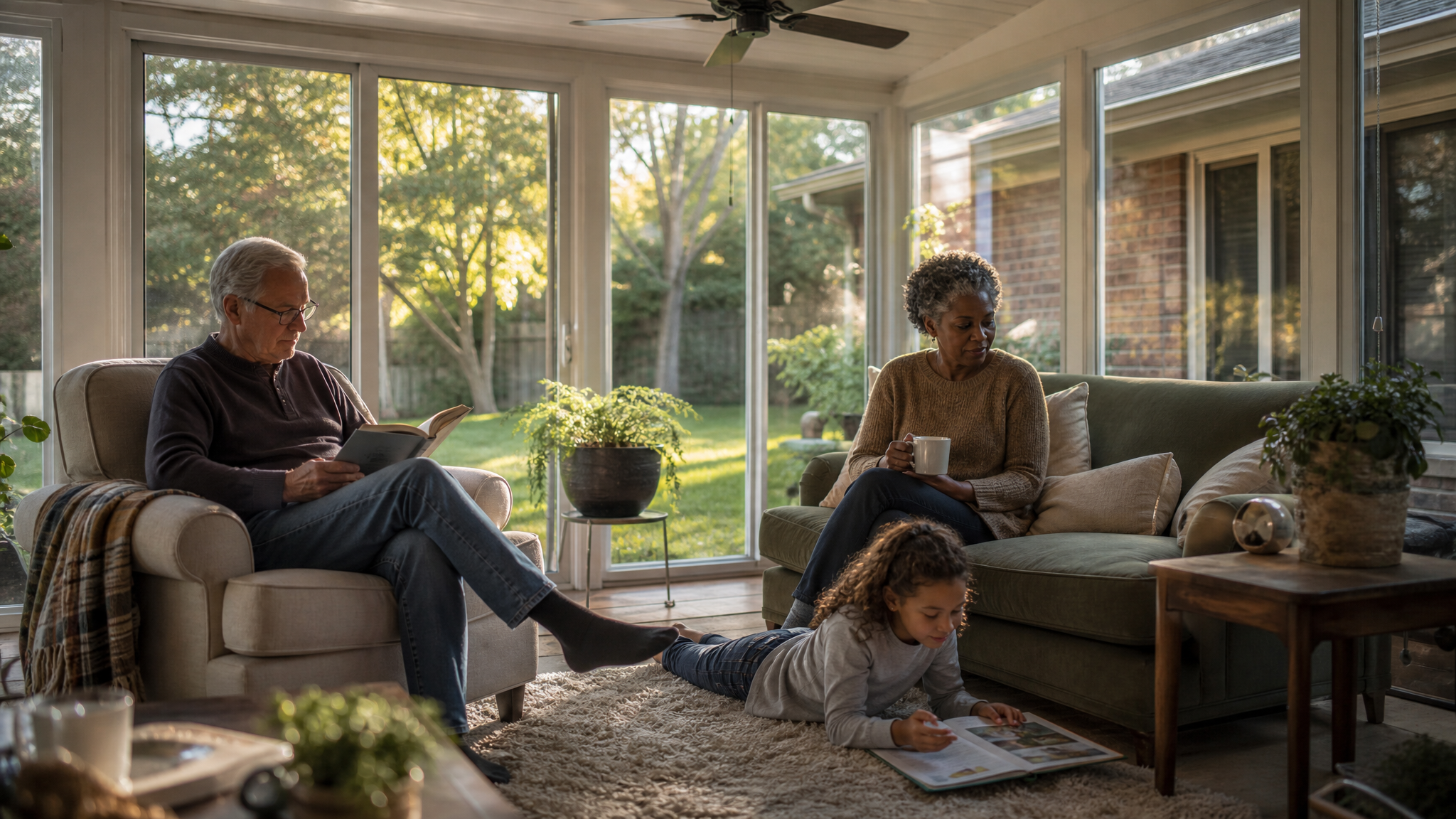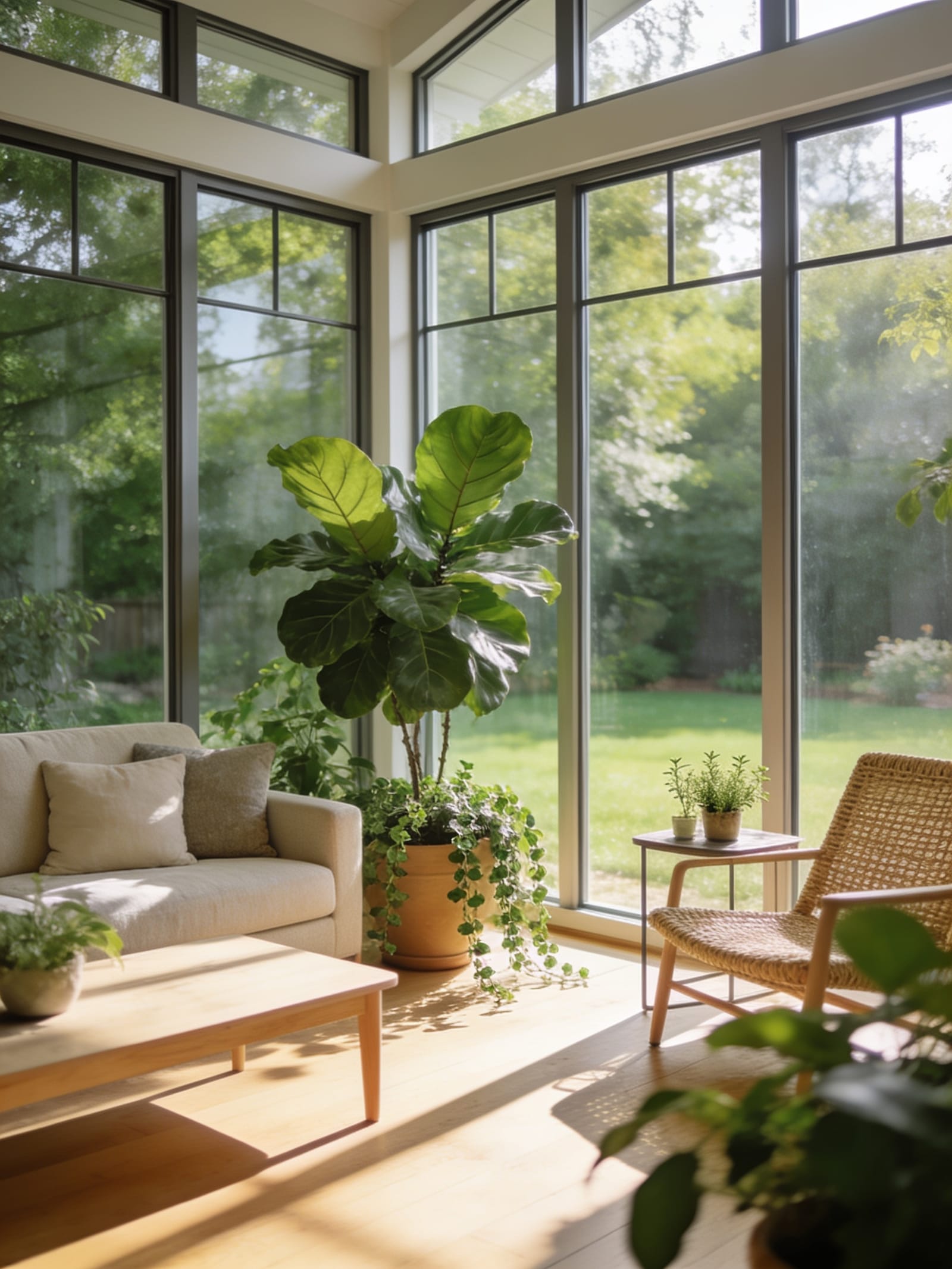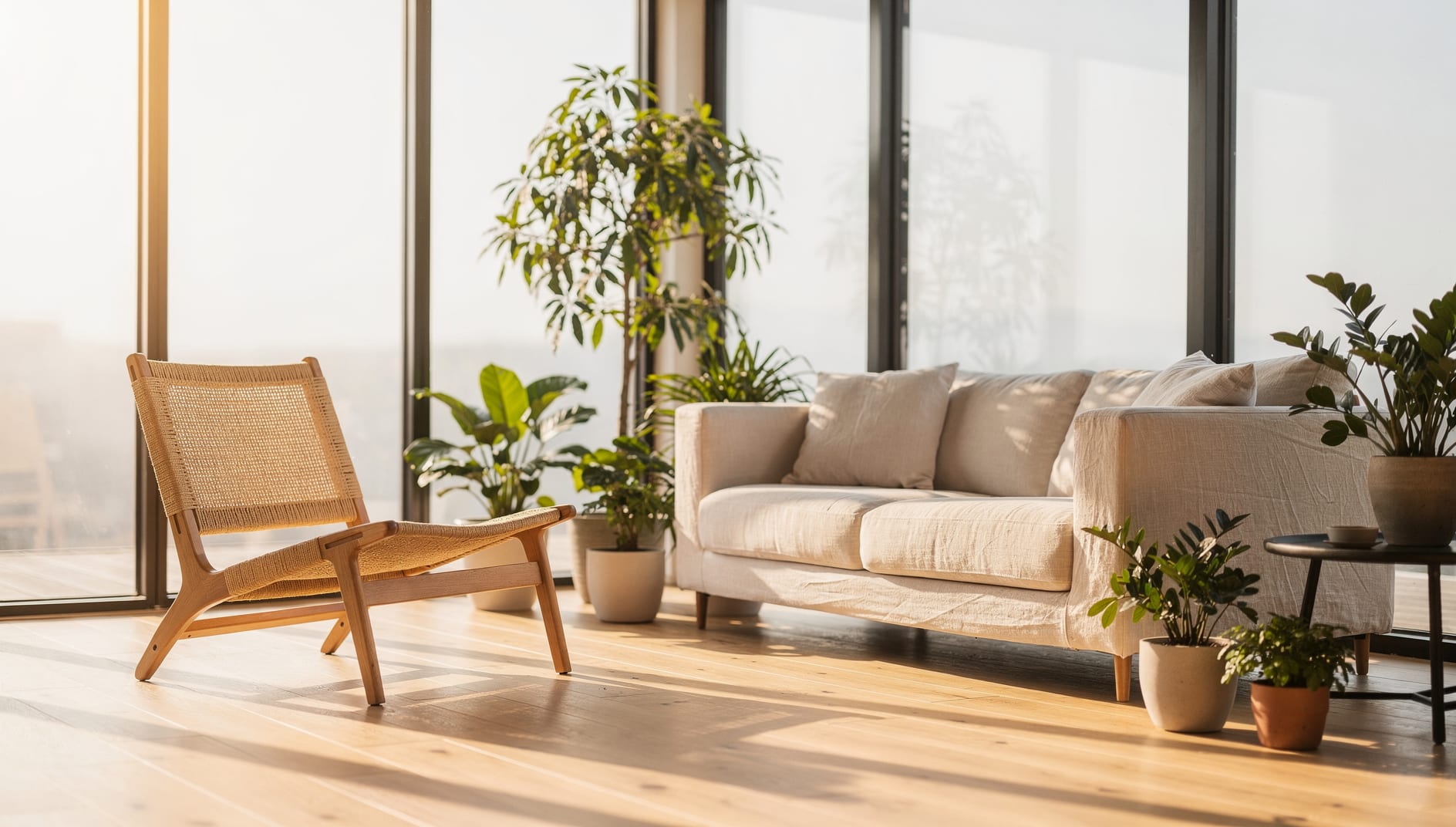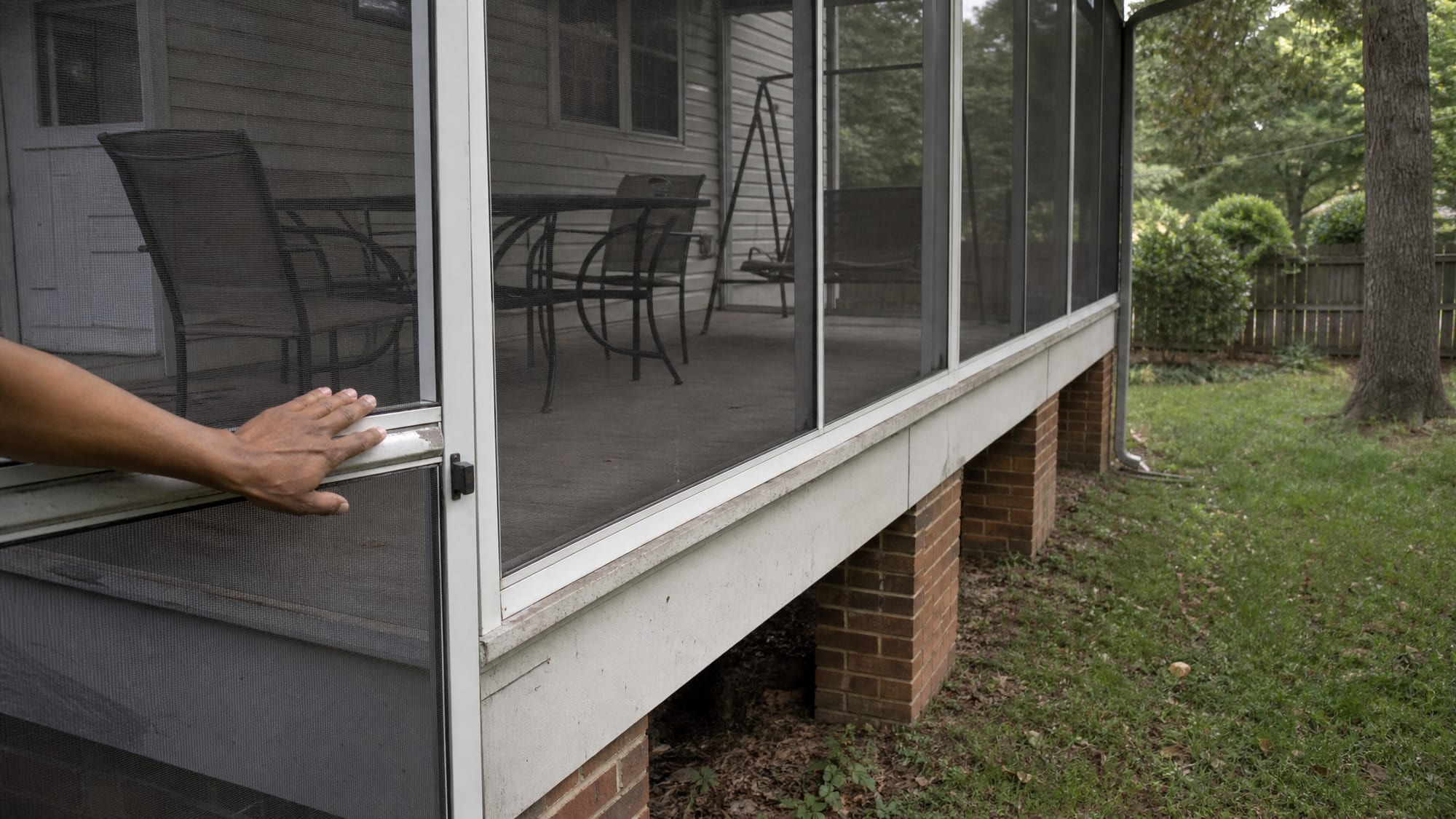



You can picture the room. Coffee in the morning, rain on the glass, the yard right there through the windows. What you can’t picture from a brochure is the July afternoon when the same room turns into an oven you pay to cool.
That’s the fear people bring to this page, and it’s the right fear. The most common thing NC homeowners say about a sunroom that went wrong isn’t “it cost too much.” It’s “we can only use it four weeks a year.”
Here’s the part almost no one tells you before you buy: whether your sunroom is a room you live in or a greenhouse you avoid comes down mostly to the glass — one number on it, and which way that glass faces. Not the brand. Not the frame color. I sell and measure these for a living, so let me show you the number.
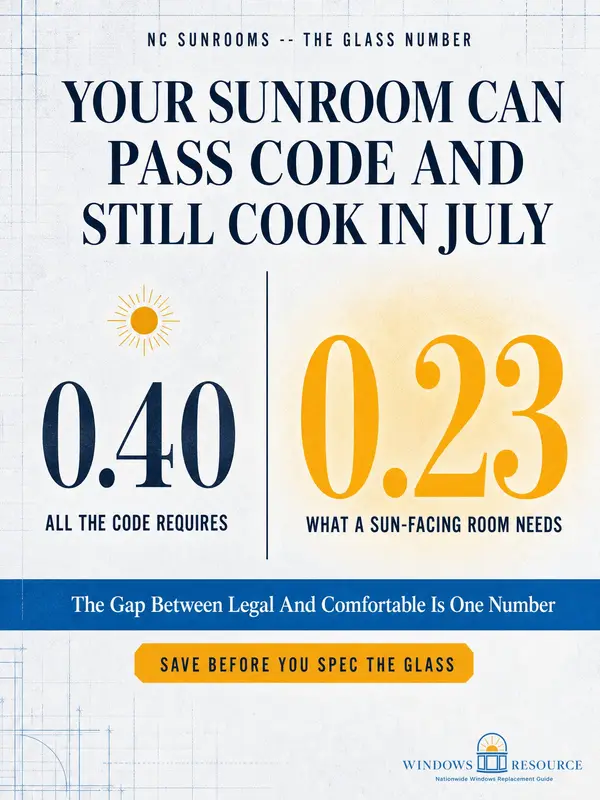
What windows should a sunroom have in NC? Insulated Low-E glass with a low SHGC (solar heat gain coefficient) — for most of NC, aim for SHGC around 0.23 or lower on the sun-facing walls, well under the 0.40 the building code merely allows. The single biggest variable is orientation: a south- or west-facing room takes the brutal afternoon sun and needs the lowest number; a north room can run higher. Get the SHGC right for your exposure first, then size the heating and cooling to what’s left. That order is the whole game.
Why does the same sunroom roast in one house and stay comfortable in another?
Because comfort in a glass room is one number — SHGC — times one variable — which way the glass faces. Same slab, same frames, same “sunroom,” and two completely different summers, all decided by those two things.
is the fraction of the sun’s heat that passes through the glass. It runs from 0 to 1, and lower means less heat coming in. In North Carolina, where cooling — not heating — is the real battle most of the year, that is the number that decides whether you sweat.
Now add exposure. A room facing north takes gentle, indirect light all day. A room facing south or west catches the full weight of the afternoon sun straight through the glass. Give both rooms the same glass and the west room bakes while the north one is fine. That’s not a defect. It’s physics doing exactly what it does.
So the honest answer to “will my sunroom cook me” is never a flat yes or no. It’s: which way does the glass face, and what’s the SHGC? Everything else on this page hangs off those two questions.
Sunroom windows aren’t a brand — they’re a glass package
“Sunroom windows” isn’t a product you pick off a shelf. It’s a glass spec — a package of coatings, panes, and ratings — and the way you check it is the NFRC label. Learn to read that sticker and you’ve skipped past every sales pitch.
Every rated window in the country carries an label — the little white sticker with the numbers on it. It reports five things, and for a sunroom two of them carry the whole decision.
- SHGC — solar heat gain, the heat-in number. In NC, this is the one that matters most. Lower keeps the room cooler.
- U-factor — how well the whole window insulates against heat loss. Lower is better; it’s what keeps a 4-season room warm in January.
- VT — , how much daylight comes through. You want light without the heat, which is the tradeoff we’ll get to.
- Air leakage — how drafty the unit is when closed. Matters for the “drafty even shut” complaint.
- Condensation resistance — how well it fights fogging and sweating, which matters in our humidity.
When a salesperson says “these are great energy windows,” the label is how you check. Ask to see it. The full glass-and-energy deep-dive walks all five numbers, but for a sunroom you’re really auditing two: SHGC first, U-factor second.
U-Factor
Heat it lets escape
Lower keeps a 4-season room warm in January.
SHGC — solar heat gain
Heat it lets in
Lower keeps the room cooler in July.
VT — visible transmittance
Daylight it lets through
Higher is brighter — the light-vs-heat tradeoff.
Air Leakage
Draft when closed
The “drafty even shut” number.
Condensation Resistance
How well it fights fogging and sweating
Matters in NC humidity.
SHGC is the one that decides your summer in NC. Audit it first, U-factor second.
The one number NC gets wrong: comfortable vs merely code-legal
North Carolina’s building code lets a sunroom’s glass hit a SHGC of 0.40. For a sun-facing room, that’s nearly twice the number I’d actually want. “Passed inspection” and “comfortable in July” are two different bars, and the gap between them is where the roasting happens.
Here’s the trap. The (R402.3.5) sets a ceiling for a conditioned, thermally-isolated sunroom: the glass can be no worse than a U-factor of 0.40 and, where the room is cooled, a SHGC no higher than 0.40. That’s the maximum the code allows — not the target for comfort.
The comfort target is a different, stricter number. ENERGY STAR’s window criteria for most of NC (the South-Central zone) call for roughly U ≤ 0.28 and SHGC ≤ 0.23. That 0.23 is nearly half the 0.40 the code merely tolerates.
This is why a room can pass inspection and still be miserable. The inspector checks that the glass is no worse than 0.40. Nobody at the county checks whether it’s good enough for your west wall in August. That part is on you — or on the person specifying your glass.
One quick honesty note while we’re on numbers: if a quote leans on a federal tax credit for the glass, the 25C window credit expired at the end of 2025 and isn’t available for a 2026 install unless Congress brings it back. Date any credit you’re promised.
Orientation decides the spec — the variable the brochures skip
The same glass roasts a west room and is fine on a north one, so the right SHGC isn’t one number for “a sunroom” — it’s a number per wall, set by exposure. This is the walk-your-space answer no national guide can give you, because it depends on your actual house.
Think of SHGC as a dial you turn by direction. The more direct afternoon sun a wall takes, the lower you want the number.
| Which way the glass faces | What the summer sun does | SHGC to aim for | The move |
|---|---|---|---|
| North | Gentle, indirect light all day | Higher is fine | Least demanding wall — you can prioritize daylight (VT) here |
| East | Morning sun, cooler afternoons | Moderate | Comfortable early; rarely the problem wall |
| South | High, steady sun most of the day | Low | A real load — keep the number down, mind the glare |
| West | Full, low afternoon sun straight through the glass | Lowest | The wall that roasts rooms — the lowest SHGC and often the shading goes here |
North
- What the summer sun does
- Gentle, indirect light all day
- SHGC to aim for
- Higher is fine
- The move
- Least demanding wall — you can prioritize daylight (VT) here
East
- What the summer sun does
- Morning sun, cooler afternoons
- SHGC to aim for
- Moderate
- The move
- Comfortable early; rarely the problem wall
South
- What the summer sun does
- High, steady sun most of the day
- SHGC to aim for
- Low
- The move
- A real load — keep the number down, mind the glare
West
- What the summer sun does
- Full, low afternoon sun straight through the glass
- SHGC to aim for
- Lowest
- The move
- The wall that roasts rooms — the lowest SHGC and often the shading goes here
Same room, four exposures — turn the SHGC dial by direction
If your room only faces one direction, this is simple. If it wraps a corner — south and west, say — the west glass is doing the hardest work and deserves the tightest spec. A good installer specs the glass to the walls, not the walls to one catalog number.
Low-E, panes, and the light-vs-heat tradeoff
Low-E glass is how you block the heat without turning the room dark — and a double-pane insulated unit is the floor for a room you’ll use past spring. This is where “energy glass” earns its place, and where a real tradeoff hides.
is a coating thinner than a human hair that reflects heat back where it came from — keeping summer heat out and winter warmth in.
It’s also the anti-fade layer, blocking a large share of the that bleaches your furniture and floors. Better coatings are commonly rated up to the high-90s percent, though the exact figure varies by coating — treat it as a real secondary benefit, not the headline.
The panes matter too. A single pane is a screen porch with delusions — fine for a true 3-season room, hopeless if you want January.
A double-pane insulated unit, ideally with argon fill between the panes, is the real floor for a room you condition. Triple-pane exists, but in most of NC’s climate that third pane buys noise control and deep-cold insurance more than everyday comfort — the 3-season versus 4-season glass package is where that call gets made.
Now the tradeoff nobody mentions. Push SHGC very low with a cheap tint and you can dim the room — the VT drops, and suddenly your bright sunroom is a shaded one.
The answer is spectrally-selective Low-E (the SmartSun / Low-E 366-type coatings): it blocks the heat while keeping most of the visible light. That’s how you get a low SHGC and a bright room instead of choosing between them.
It also cuts the harsh glare people complain about — the sunbeams off the floor that make a room hard to read or work in.
NC Homeowner Takeaway: the internet’s “always go triple-pane” advice isn’t wrong so much as mis-aimed for our climate. In most of NC, a good Low-E double-pane with the right SHGC does the comfort work; triple-pane is worth it mainly for noise or a cold mountain exposure. Spend your money on the coating and the SHGC before the third pane.
Which windows should open, and which should stay fixed?
Fixed picture units seal tightest and cost least; operable windows — casement and awning especially — give you ventilation, which is a genuine cooling lever in a sunroom. The right mix is by wall, not a single answer.
Ventilation matters more here than in the rest of the house. On a mild evening, being able to dump the day’s hot air out the top of the room is the cheapest cooling you’ll ever get. Two window styles do that best:
- Casement — hinged at the side, cranks out like a door; seals tight when closed and scoops breeze when open.
- Awning — hinged at the top, opens outward at the bottom; vents hot air and sheds rain even while open, which suits a room made of windows.
- Picture (fixed) — doesn’t open at all, so it seals the tightest and costs the least per square foot. Great for the big view walls where you don’t need airflow.
The move most rooms want: fixed glass for the big views, operable units placed to cross-ventilate — low on one wall, high on another — so heat rises and leaves. You don’t need every window to open. You need the right few in the right spots. If your room opens to the yard, the patio door is part of this same airflow-and-glass decision.
Do sunroom windows have to be tempered?
Usually, yes — not as an upsell, but because building code treats big panes near the floor as a safety-glazing hazard. A room made of large, low glass panels almost always trips the trigger.
Safety glazing rules (IRC R308.4) call out “hazardous locations.” One common trigger is a large pane you could walk into — and it takes four conditions all true at once:
- Larger than 9 square feet
- Bottom edge less than 18 inches above the floor
- Top edge more than 36 inches up
- A walking surface within 36 inches of the glass
Sunroom windows are big and they run close to the floor, so they frequently meet that definition. Other R308.4 triggers — like glass in and around doors — can apply too.
When tempered glass is required, it’s not a trim line an installer added to pad the quote — it’s code doing its job. The honest ask: have your installer point to which panes need tempering and why. A straight answer there tells you a lot about who you’re dealing with. The tempered and safety glass page covers where it’s required across the house.
Glass is also the single biggest line on a sunroom quote — often around a quarter of a mid-range build in national cost breakdowns — which is exactly why it’s worth getting right rather than cheap. The full cost breakdown shows where the money goes.
Get the glass spec’d for your exposure
A cost range tells you whether a quote is sane. A brand name tells you almost nothing. What actually decides whether you love this room is the glass spec matched to your walls — the SHGC for each exposure, the Low-E coating, and the U-factor if you’re going year-round.
That’s a walkthrough, not a web page. If you want a no-pressure read, have me spec the glass for your room.
I’ll tell you honestly what SHGC each wall wants, whether you need spectrally-selective Low-E for the west side, and what “comfortable in July” actually costs on the label — before you sign for a room you can only use four weeks a year.
And if your exposure is gentle enough that a simpler glass package will do, I’ll say so. Better that than selling you a number you didn’t need.
Sources, Verification & Fact-Checking verified July 2026
Every load-bearing fact on this page is sourced and verified against a primary authority.
Verified July 2026 via direct review of the cited authority — the links open the controlling source so you can check it yourself rather than take our word.
- NC comfort target — for most of NC (the ENERGY STAR South-Central window zone), a comfortable sun-facing sunroom wants roughly U ≤ 0.28 and SHGC ≤ 0.23; the statewide-safe single spec that also clears the mountains is U ≤ 0.25 and SHGC ≤ 0.23. These are ENERGY STAR Version 7.0 window-criteria targets, distinct from the building-code cap; NC spans two ENERGY STAR window zones (South-Central at U ≤ 0.28 / SHGC ≤ 0.23, and North-Central — the mountains — at U ≤ 0.25 / SHGC ≤ 0.40). The ENERGY STAR county finder is image-based, so confirm your county’s zone against the live finder. View source
- NC sunroom energy-code cap — a conditioned, thermally-isolated sunroom’s glazing is capped at a max fenestration U-factor of 0.40 and, where cooling is present, a max SHGC of 0.40 (skylight U-factor 0.75). Set by the 2018 NC Energy Conservation Code (R402.3.5), which tightens the national IECC 0.45 ceiling to 0.40 for NC’s climate zones (3–5) — the same national-vs-NC amendment pattern as the egress rule. This is a code ceiling, not a comfort target. The controlling ICC code text sits behind a subscription, so confirm the exact figure and current cycle (2018 in effect; 2024 pending) with your Authority Having Jurisdiction.
- SHGC meaning and NC priority — SHGC is the fraction of solar heat the glass admits (0 to 1, lower is cooler); because NC is cooling-dominated most of the year, SHGC is the headline number for a sunroom, ahead of U-factor. Per the NFRC rating definition carried on the window’s label; the one-liner is “U-factor keeps heat in, SHGC keeps heat out.”
- NC sunroom definition — a one-story structure attached to a dwelling with glazing exceeding 40% of its exterior wall and roof area, required to be thermally isolated from the main dwelling; many builds run roughly 70–90% glass. The 40% definition and thermal-isolation rule are set by the NC Residential Code / NCECC; the 70–90% figure is a directional typical range, not a requirement.
- Safety glazing — sunroom windows frequently require tempered (safety) glass because they meet the IRC R308.4 hazardous-location test: a pane larger than 9 sq ft with its bottom edge under 18 in above the floor, its top edge over 36 in, and a walking surface within 36 in — all four together (other R308.4 triggers, such as glass in and around doors, can also apply). Per the 2018 IRC R308.4 as adopted in NC. Confirm the current NC-adopted section with your AHJ.
- Low-E and UV — Low-E coatings block a large share of UV (basic coatings block a majority; higher-performance coatings are commonly rated up to 95–99%), reducing furniture and floor fading; spectrally-selective Low-E lowers SHGC while preserving most visible transmittance (VT). Manufacturer-consensus figures; the exact block varies by coating, so treated as a hedged secondary benefit, not the headline.
- Glass as cost driver — glazing is typically the single largest component line on a sunroom build (commonly cited near a quarter of a mid-range build); glass-package cost by season-rating runs roughly $80–$150/sq ft for 3-season and $150–$300/sq ft for 4-season (national bands, hedged). Directional national cost-guide ranges, not NC quotes; pricing lives on the NC sunroom cost page, not here.
- Federal 25C window tax credit — expired 12/31/2025 and not available for 2026 installs unless Congress restores it. Windows had to be placed in service before the end of 2025 to qualify (30% of cost, $600/yr window cap); date any credit a quote references. View source