

There’s a line on your siding quote that says “insulated,” and it’s asking for a few thousand more than the plain version. The salesman mentioned energy savings. You’ve heard that pitch before.
So the real question isn’t “is insulated vinyl siding good.” It’s is the upgrade worth what they’re charging you for it, on your house.
I’ll give you the honest version. Because there’s a genuine upgrade buried in that line item — it’s just not the one the energy-savings pitch leads with.
Is insulated vinyl siding worth it? Sometimes — but for reasons the brochure buries. The foam adds real rigidity, dent resistance, and a little comfort, and about R-2 to R-3.5 of insulation (premium panels to roughly R-5) versus near-zero for hollow-back. But that’s a fraction of the R-13 to R-19 already inside your wall — it is not a substitute for wall insulation. And in North Carolina’s cooling-dominated climate, the energy payback runs long, often past a decade. Worth it if you want a wall that feels solid and takes a hit — not if you’re buying it to pay for itself on your power bill.
Figures here are national and directional — a starting point to read a quote against, not a promise for your wall. Last reviewed July 2026.
This is the worth-it call inside the vinyl cluster. The base numbers live on what plain vinyl siding costs in NC, and the panel itself is broken down on the vinyl siding deep-dive. This page is only about the insulated upgrade — whether to check that box.
What R-value do you actually get? (and does it replace wall insulation?)
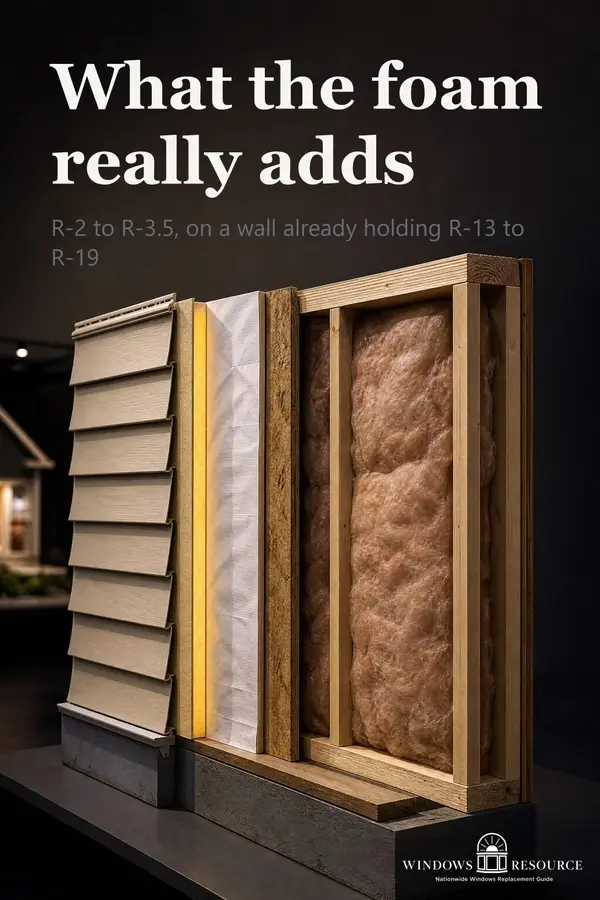
About R-2 to R-3.5, up to roughly R-5 on premium panels — real, but a fraction of the wall it hangs on. This is the single most useful honest fact on the page, and it’s the one the sales math tends to blur.
Insulated vinyl laminates a layer of rigid foam to the back of the panel. That foam is continuous insulation — it lays a thin blanket across the studs, which plain hollow-back vinyl (near zero) doesn’t do at all.
But look at the scale before you pay for it.
What the foam actually adds — R-value, to scale
The insulated panel is a real jump over hollow-back vinyl, and still a fraction of the wall behind it.
Directional, drawn to scale. Insulated siding is continuous insulation over the studs — a real but small add, not a replacement for what’s inside the wall.
So here’s the trap to sidestep. Some quotes park a whole-wall R-value recommendation (the R-13-plus your insulation contractor talks about) right next to an insulated-siding pitch, as if they’re the same lever. They aren’t. If your walls are already insulated — most NC homes built with cavity insulation are — the siding foam is a small top-up, not the main event.
How much more does the insulated upgrade cost?
Roughly $2 to $4 more per square foot than comparable hollow-back — about 20% to 50% more. Installed, insulated vinyl commonly lands in the neighborhood of $7 to $12 per square foot, against roughly $4 to $7 for standard hollow-back.
On a typical wall area, that upcharge adds up to a few thousand dollars over plain vinyl. It’s a real number, and it’s exactly the number the energy pitch is trying to justify.
These are national cost-guide bands (Fixr and similar) that move with the market and vary by home, region, and scope. Read them as order-of-magnitude, then check the actual upcharge on your own quote against the base vinyl price on the cost page. The gap between the two lines is what you’re really deciding on.
Does it pay for itself? The NC payback reality check
Not on a timeline most NC homeowners would call “paying for itself” — so don’t buy it for that. This is where I’d slow down, because the payback math is the part that gets oversold.
You’ll see a savings figure around 14% attached to insulated siding. Here’s what that number actually is: a best-case model of a two-story home with no wall insulation at all, weighted toward heating. Strip out the cavity insulation your NC home probably already has, and the real-world savings shrink fast.
And North Carolina is cooling-dominated — hot, humid summers (IECC climate zone 3A and 4A), mild winters. Most of those headline studies are built on cold-climate heating loads. In our climate, the annual savings are smaller and the payback stretches out — commonly past a decade.
If a quote leans on energy-savings math to justify the upgrade, that’s worth a skeptical read — the same oversold-efficiency red flag that shows up on window quotes. The comfort you can feel is a fair reason to spend. A payback promise you can’t verify is not.
So what actually makes it worth it?
A wall that goes on straighter and takes a hit — that’s the honest upgrade. The best reasons to say yes have almost nothing to do with your power bill.
Foam behind the panel changes how the siding behaves, and those changes are real and immediate:
- Rigidity and a straighter wall. The foam backs the panel, so it lays flatter, resists waviness, and reads more like a solid cladding than a hollow shell you can flex with a thumb.
- Dent and impact resistance. A backed panel shrugs off a stray ball, a mower-flung rock, or a hailstone far better than hollow-back. Manufacturers claim big multiples here — one product line advertises up to about 5x the impact resistance of hollow-back — and while the exact figure is theirs, the direction is genuinely real.
- A little comfort and quiet. Continuous insulation trims some thermal bridging across the studs, and the foam dampens some outside noise (one foam maker’s third-party lab test puts the sound-transmission reduction at up to about 39%). Modest, but you can notice it on the sunniest wall.
That’s the case for insulated vinyl, made straight: it’s a comfort-and-solidity upgrade, not an energy investment.
If a wall that feels solid and looks straight for the next twenty-plus years is worth a few thousand dollars to you, it’s a fair buy. If you want the comfort lever with the biggest payoff in NC, that’s usually the glass and frames on your windows, not the siding foam.
Does foam-backed siding trap moisture?
It’s a real debate — and the answer is “it depends on the install,” which is true of all siding. I’m going to show you both sides, because the one-sided version (from whichever camp) is how people get surprised.
The reassuring side: a 22-month wall-monitoring study by (Home Innovation Research Labs) found insulated siding did not create moisture problems — the insulated-vinyl assemblies had among the lowest sheathing moisture of the nine wall types tested, by warming the sheathing and letting the panel breathe.
The cautious side: building scientists (Green Building Advisor’s Martin Holladay among them) prefer separate, taped continuous rigid foam under plain vinyl — because a foam-backed panel’s foam isn’t a continuous, sealed layer (the panels butt and leave expansion gaps, and you can’t tape the joints the way you would dedicated sheathing), and it gives up the built-in drainage gap plain vinyl has.
So a careless install can still let water sit where it shouldn’t.
Both are true. Insulated vinyl is still a rain screen, like all vinyl — water is expected behind it and has to drain, with the house wrap doing the real moisture-barrier work. Get the flashing and house wrap right and the foam is not a problem. Get them wrong and the foam doesn’t save you.
When it’s worth it, and when it isn’t
Insulated vinyl is worth it for specific, nameable reasons — and a waste of money for equally nameable ones. Here’s the honest sort, side by side.
| Factor | Hollow-back (standard) vinyl | Insulated (foam-backed) vinyl |
|---|---|---|
| Added R-value | Near zero (about R-0.7) | About R-2 to R-3.5 (premium to about R-5) |
| Up-front cost | The base price | About $2 to $4 more per sq ft (roughly 20% to 50%) |
| Panel rigidity / straight wall | Flexes; can telegraph wall imperfections | Backed and stiffer — lays flatter, reads solid |
| Dent & impact resistance | Least — cracks and dents more easily | Meaningfully better (manufacturer claims run to multiples) |
| Energy payback in NC | N/A | Long — often past a decade in a cooling climate |
| Best when | Budget leads; sheltered walls; short stay | You want the wall to feel solid and take a hit — and you're staying |
Added R-value
- Hollow-back (standard) vinyl
- Near zero (about R-0.7)
- Insulated (foam-backed) vinyl
- About R-2 to R-3.5 (premium to about R-5)
Up-front cost
- Hollow-back (standard) vinyl
- The base price
- Insulated (foam-backed) vinyl
- About $2 to $4 more per sq ft (roughly 20% to 50%)
Panel rigidity / straight wall
- Hollow-back (standard) vinyl
- Flexes; can telegraph wall imperfections
- Insulated (foam-backed) vinyl
- Backed and stiffer — lays flatter, reads solid
Dent & impact resistance
- Hollow-back (standard) vinyl
- Least — cracks and dents more easily
- Insulated (foam-backed) vinyl
- Meaningfully better (manufacturer claims run to multiples)
Energy payback in NC
- Hollow-back (standard) vinyl
- N/A
- Insulated (foam-backed) vinyl
- Long — often past a decade in a cooling climate
Best when
- Hollow-back (standard) vinyl
- Budget leads; sheltered walls; short stay
- Insulated (foam-backed) vinyl
- You want the wall to feel solid and take a hit — and you're staying
So, plainly:
Lean toward insulated when you want the straightest, most solid-feeling wall, your exposures take abuse (kids, hail, mowers), you’re staying in the home long-term, or the walls have little existing insulation and you’re chasing every bit of comfort.
Skip it when your walls are already well insulated, you’re on a tight budget, you’re moving in a few years, or a salesman is selling you the upgrade primarily on energy-payback math.
NC homeowner takeaway: the durability and the straighter wall are real, and worth paying for if that’s what you want. The energy-payback pitch is not the reason to say yes here. If you’re weighing insulated vinyl against a step up in material entirely, that’s the vinyl vs fiber cement decision — a different and bigger question than the foam upgrade.
Doing siding and windows together
Same wall, same crew, same quote conversation — the insulated-siding question usually sits next to a windows question. If you’re re-siding an older NC home, the windows are often part of the same project, and the flashing details overlap where they meet.
And it’s worth knowing where comfort actually comes from before you spend on it. In most NC homes, the glass and frames move comfort more than a few R-points of siding foam. If a room roasts in July, the window energy ratings are usually the bigger lever — same budget, more felt difference.
Get a straight read on the upgrade
A range tells you whether an upcharge is in the right neighborhood. It can’t tell you whether it’s worth it on your wall — that depends on your exposures, your existing insulation, and what the crew is actually installing.
If you’ve got a siding quote with an insulated line on it, send it over or have me walk the house. I’ll look at the panel, the upcharge, and the exposures, and tell you honestly whether the foam earns its money on your house — or whether plain vinyl, installed right, is the smarter buy.
Sources, Verification & Fact-Checking verified July 2026
Every load-bearing fact on this page is sourced and verified against a primary authority.
Verified July 2026 via direct review of the cited authority — the links open the controlling source so you can check it yourself rather than take our word.
- Insulated (foam-backed) vinyl adds roughly R-2 to R-3.5, with premium panels reaching about R-5; hollow-back vinyl is near zero (about R-0.7); a typical insulated wall cavity is R-13 to R-19. The foam is EPS laminated to the panel back, recognized by the U.S. Dept. of Energy as continuous insulation that reduces thermal bridging across the studs. Product R-values are modest and vary by foam thickness; the wall-cavity range is the standard framed-wall figure and is the anchor for “not a substitute for wall insulation.” Ranges checked July 2026 and tightened down from an earlier internal note that overstated the premium upper bound. (view source — U.S. Dept. of Energy, Building Science Education)
- Cost premium — insulated vinyl runs roughly $2 to $4 more per square foot than comparable hollow-back (about 20% to 50% more); installed insulated vinyl commonly lands around $7 to $12 per square foot, against roughly $4 to $7 for standard hollow-back. National cost-guide ranges that move with the market and vary by region, home, and scope. Not an NC quote — verify the actual upcharge against a real itemized bid. The installed $7–$12 and standard $4–$7 bands were confirmed live July 2026 against the Fixr vinyl-siding cost guide. (view source — Fixr vinyl siding cost guide.)
- Energy payback — the widely quoted savings figure near 14% comes from a best-case model (a two-story home with no wall insulation, weighted toward heating); in North Carolina’s cooling-dominated climate (IECC zones 3A/4A), real-world savings are smaller and payback commonly runs past a decade. The headline percentage is an industry/lab modeling figure, not a measured NC result; savings depend heavily on existing insulation, climate, and energy prices. The current 2025 Cost vs. Value data reports resale only for generic vinyl siding (about 96.5%), and insulated vinyl is no longer broken out — so older “recoups 70–80%” resale claims for insulated siding are stale and are not used here. (Modeling figure and cost-vs-value context checked July 2026; treat the 14% as a ceiling, not an expectation.)
- Moisture — a Home Innovation Research Labs (HIRL) study found insulated siding did not create moisture problems and could help keep walls drier; building scientists counter that a foam-backed panel’s foam is not a continuous, sealed layer, so a poor install can still trap water. The reassuring finding is from Drumheller & Carll, “Effect of Cladding Systems on Moisture Performance of Wood-Framed Walls in a Mixed-Humid Climate” (Home Innovation Research Labs / NAHB Research Center, presented at ASHRAE Thermal Performance of the Exterior Envelopes of Whole Buildings XI, 2010) — a 22-month monitoring study in which the insulated-vinyl walls carried among the lowest sheathing moisture of the nine assemblies tested. The counterpoint reflects the Green Building Advisor / Martin Holladay position favoring separate taped continuous rigid foam under plain vinyl over foam-backed panels. Both are presented deliberately: insulated vinyl remains a rain-screen cladding with house wrap as the moisture barrier, and install quality (house wrap, flashing, drainage plane) decides the outcome. (Study title, authors, and finding confirmed via grounded search July 2026; the HIRL report’s own web pages returned dead links at review, so no direct URL is cited.)
- Durability benefits — foam backing improves panel rigidity and straightness and raises dent/impact resistance versus hollow-back; some added comfort and noise dampening. The direction is well established. The specific figures remain manufacturer claims and are presented as such: the “up to about 5x hollow-back” impact figure traces to a product line (e.g. ProVia CedarMAX); the “up to about 39%” noise reduction traces to a foam maker’s (Progressive Foam) commissioned third-party sound-transmission test versus a base wall. Both were confirmed July 2026 to be manufacturer/industry figures, not independent measurements. Lifespan is roughly the same as standard vinyl (about 20 to 40 years) — the foam does not materially extend it.