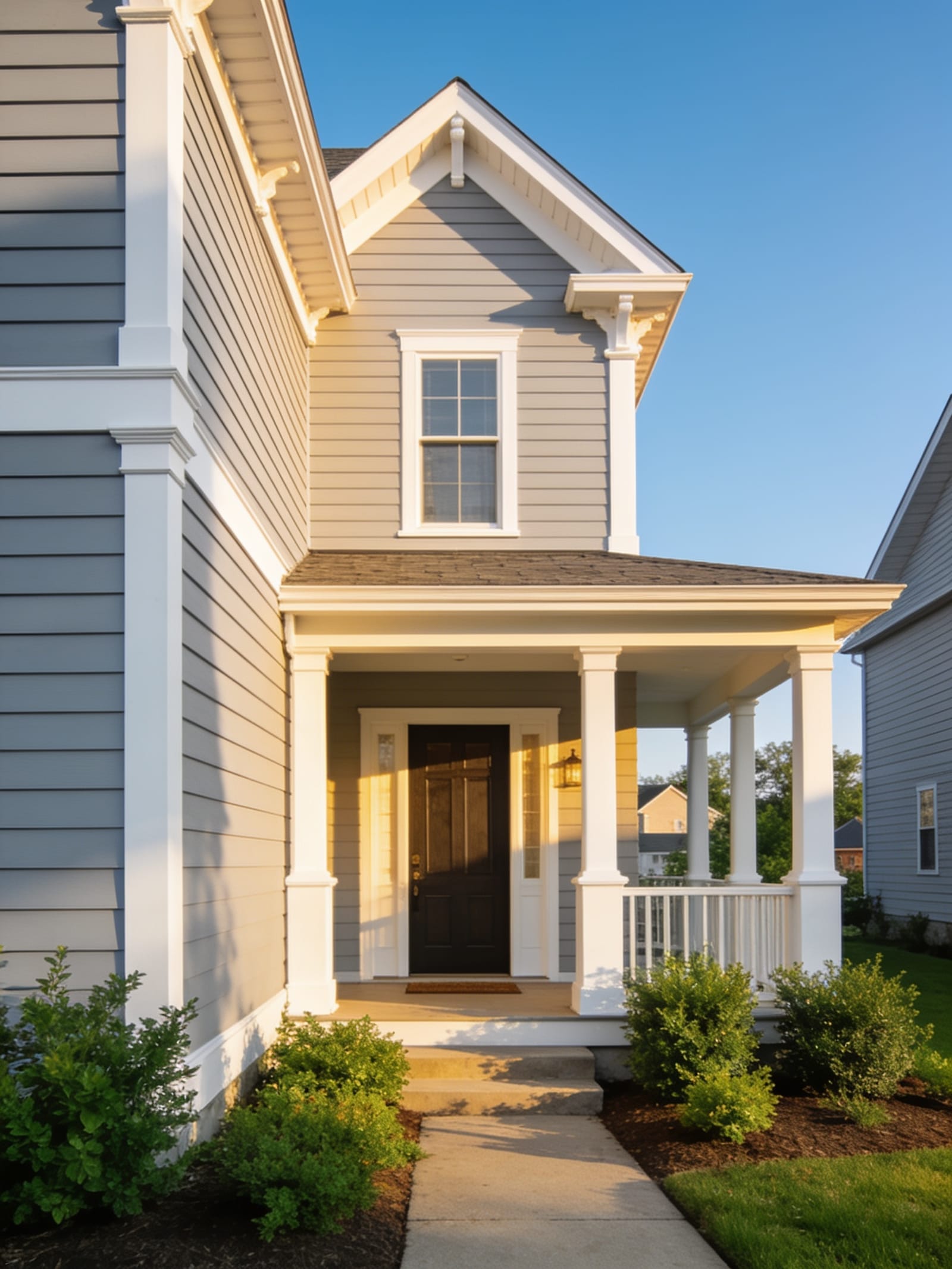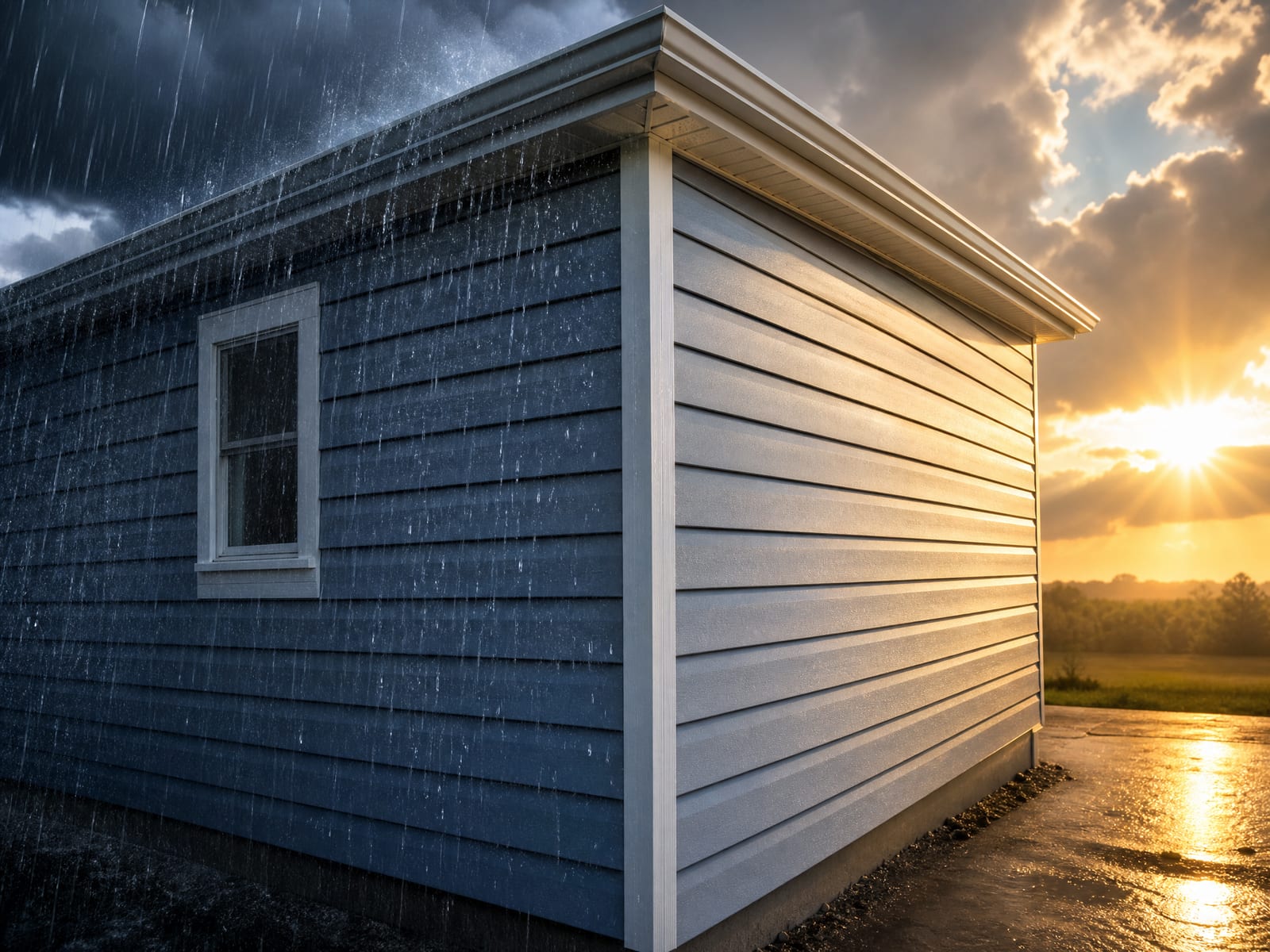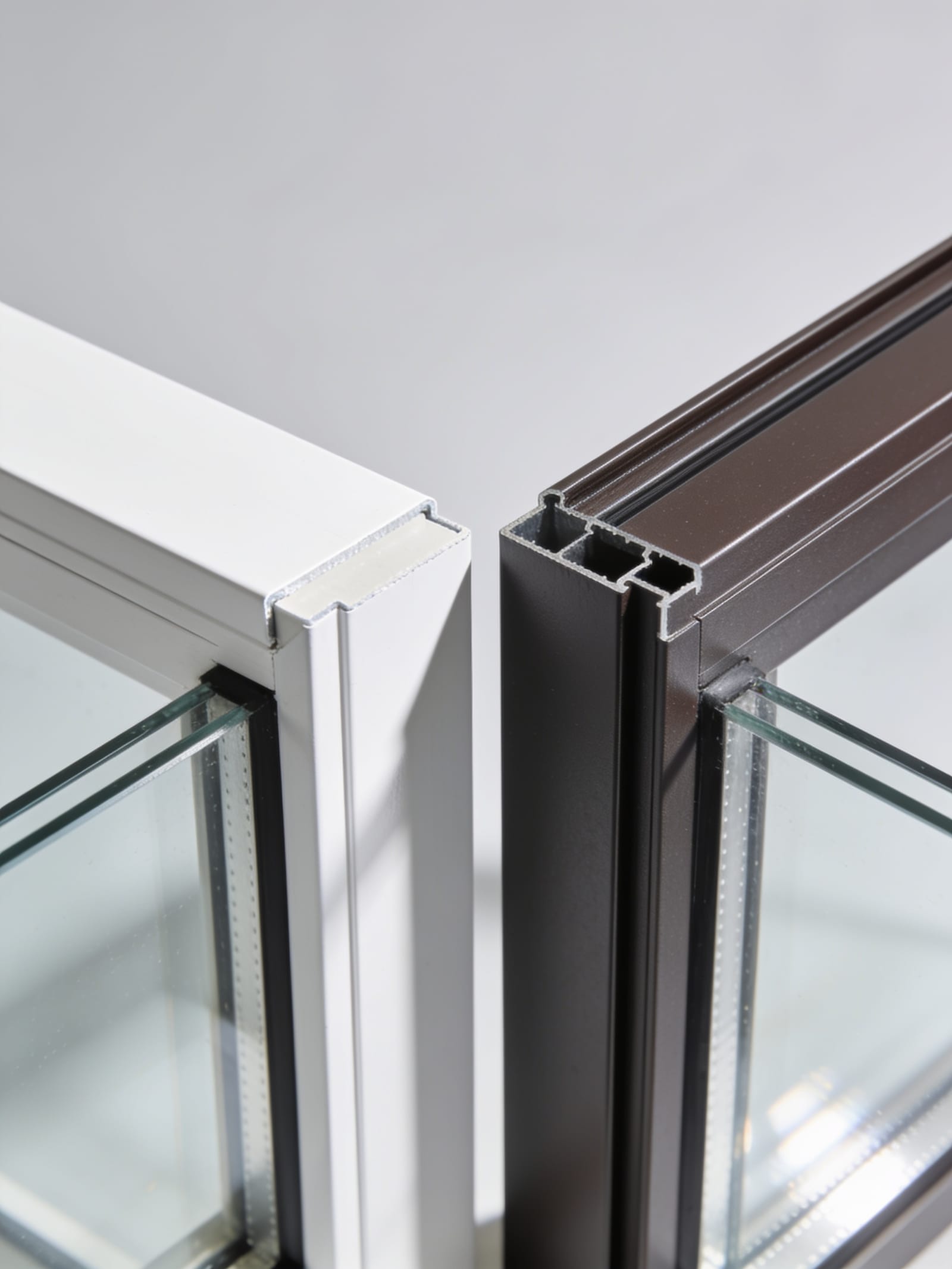


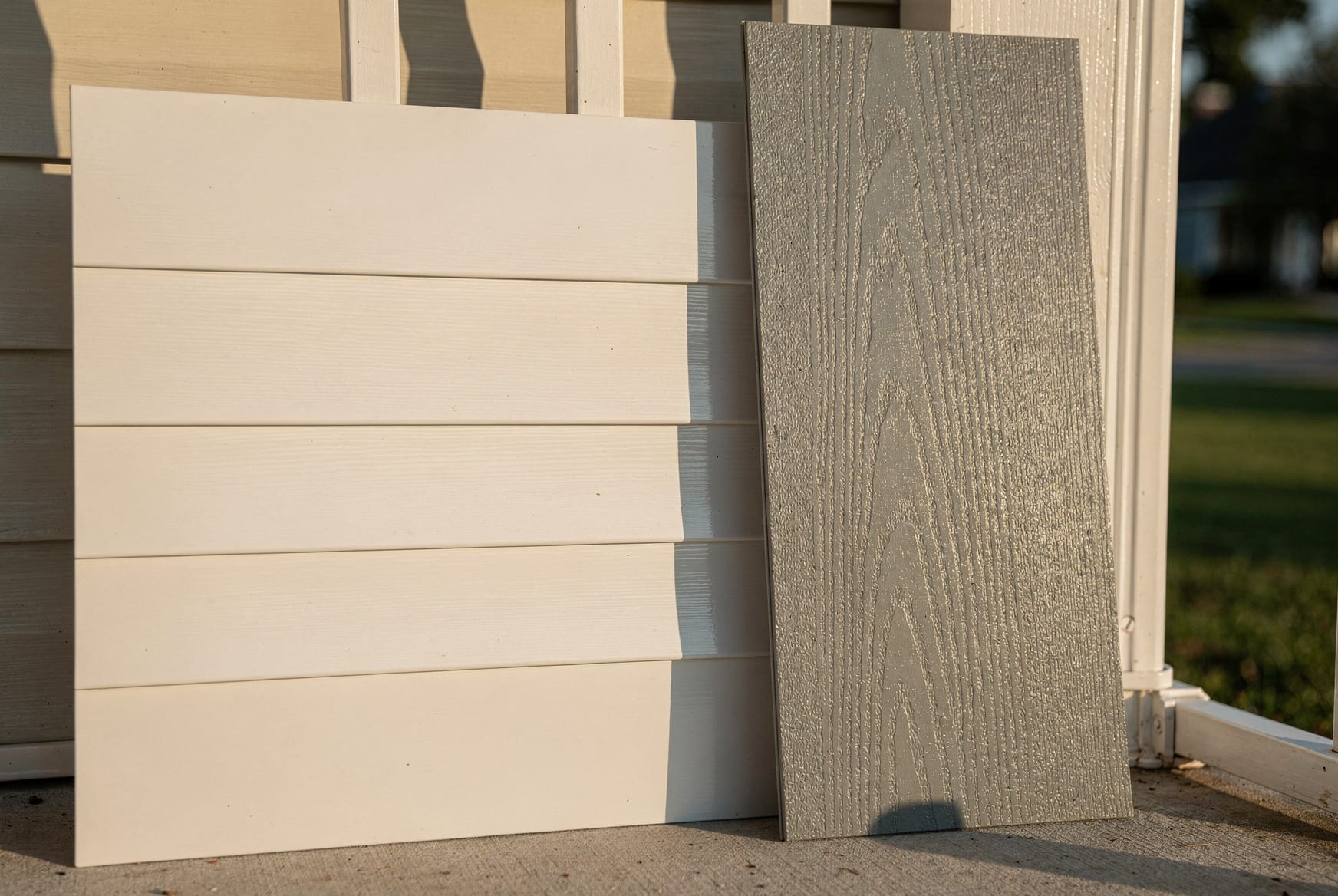
Lean a vinyl sample square and a fiber-cement board against the same porch rail and the argument starts before anyone speaks. One is light enough to flex in your hand and costs half as much. The other is dense, cool, and heavy — a board that might outlive your mortgage.
I’ve set both in front of homeowners, and the right pick is never the same house twice.
It isn’t a quality contest. It’s a horizon question: how long will you own these walls, and what does NC weather throw at them? There’s no universal winner — your horizon and exposure decide it. Here’s how I’d choose between them on my own house.
Vinyl or fiber cement for an NC house? Vinyl: lower cost, wash-only maintenance, and a solid choice well-installed — best for budget-first projects and shorter stays. Fiber cement (Hardie): higher cost, a 50-plus-year board, better against NC sun, storms, and humidity, and top-tier resale — best for forever homes and exposed sites. There is no universal winner; your horizon and your exposure decide it.
The quick verdict: pick vinyl if, pick fiber cement if
Neither material is the “right” one — each wins real scenarios, and yours is probably on this list.
Pick vinyl if:
- Budget leads the decision. Vinyl’s installed cost per square foot is the lowest of the mainstream claddings, and a mid-grade panel well-installed is a genuinely good wall.
- You’re staying under ~10 years. A shorter horizon rarely gives the pricier board time to earn its gap.
- Your exposure is mild. A sheltered lot in the Piedmont doesn’t test siding the way a coastal or wide-open site does.
Pick fiber cement if:
- This is the forever home. A 50-plus-year board matches a stay-forever plan.
- Your walls face real weather. Coastal wind, long southern sun, storm exposure — fiber cement holds up better in all three.
- The wood look matters. Deep-embossed fiber cement reads like painted wood in a way vinyl doesn’t.
- Resale is part of the math. Recent Cost-vs-Value data puts fiber cement at the top of remodel tables.
The rest of this page is the evidence behind those rows. For the full dollar picture on the budget option, start with what siding costs in NC, in full.
Cost: the real gap
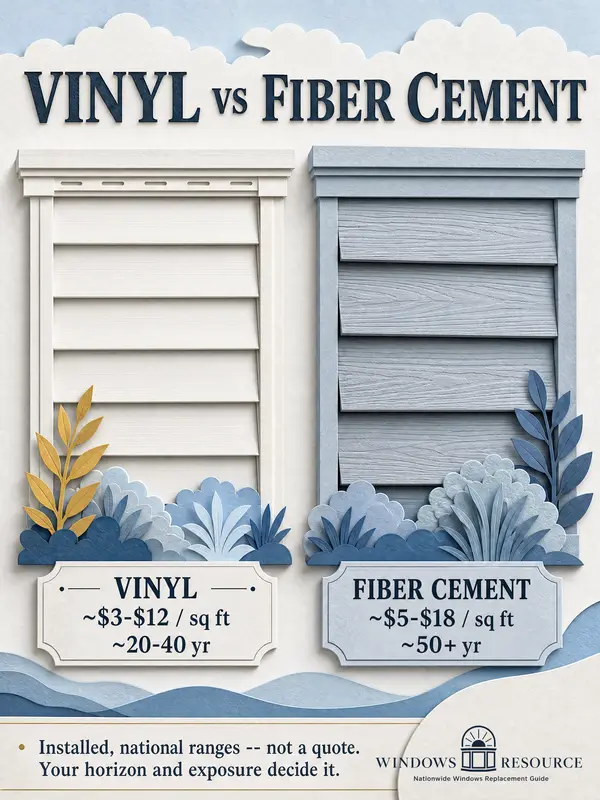
As national market bands, vinyl runs roughly $3–$12 per square foot installed and fiber cement roughly $5–$18 — and the interesting part is the overlap. Whole-house projects commonly land around $10,000–$24,000 for vinyl and $10,000–$25,000 for fiber cement, with size, stories, tear-off, and trim scope moving the number.
These are national bands, not an NC quote.
Installed cost per square foot — where the two materials land
National market bands, not your quote. The shaded zone is the overlap — where premium vinyl meets entry-level fiber cement.
National aggregator bands, current as of 2026 and time-sensitive — treat as order-of-magnitude and verify against a real itemized quote for your square footage.
That overlap zone matters. A premium, thick-walled insulated vinyl can cost as much as entry-level HardiePlank — so at the boundary, the spec beats the category. Compare the actual products on the quotes, not the material names.
Part of fiber cement’s labor premium is physics: the board weighs roughly 300 pounds per 100 square feet versus roughly 60–70 for vinyl, so it takes specialized tools and a skilled crew.
That’s real labor on the quote, not padding. Reading any exterior quote line by line is the same skill either way.
National cost guides put fiber cement installed at roughly $5–$18 per square foot — Angi’s reported average sits around $12.50/sq ft, Fixr’s range runs $5–$14/sq ft — with most whole projects landing between about $6,600 and $25,000.
| Factor | Vinyl | Fiber cement (Hardie) |
|---|---|---|
| Installed $/sq ft (national) | about $3–$12 | about $5–$18 |
| Lifespan | about 20–40 yrs (premium, well-installed: longer) | about 50+ yrs |
| Fire | Melts/burns; low fire performance | Non-combustible (A2 rating) |
| Pests / rot | Doesn't feed pests; can trap moisture if drainage is wrong | Inedible to termites; resists rot and moisture |
| Wind / impact | Can crack or unzip in high wind | Withstands about 150 mph; better hail/impact resistance |
| NC humidity / UV | Fades under NC sun; not designed for repainting | Dimensionally stable in humidity; ColorPlus resists fade |
| Maintenance | Wash only | Wash + re-caulk about 5–10 yrs; repaint primed board about 10–15 yrs |
| Repaintable | Limited — vinyl-safe paint exists but isn't standard | Yes — ColorPlus delays the first repaint |
| Resale / ROI | about 96.5% national average (2025 Cost vs. Value) | about 113.7% average (2025 Cost vs. Value) |
Installed $/sq ft (national)
- Vinyl
- about $3–$12
- Fiber cement (Hardie)
- about $5–$18
Lifespan
- Vinyl
- about 20–40 yrs (premium, well-installed: longer)
- Fiber cement (Hardie)
- about 50+ yrs
Fire
- Vinyl
- Melts/burns; low fire performance
- Fiber cement (Hardie)
- Non-combustible (A2 rating)
Pests / rot
- Vinyl
- Doesn't feed pests; can trap moisture if drainage is wrong
- Fiber cement (Hardie)
- Inedible to termites; resists rot and moisture
Wind / impact
- Vinyl
- Can crack or unzip in high wind
- Fiber cement (Hardie)
- Withstands about 150 mph; better hail/impact resistance
NC humidity / UV
- Vinyl
- Fades under NC sun; not designed for repainting
- Fiber cement (Hardie)
- Dimensionally stable in humidity; ColorPlus resists fade
Maintenance
- Vinyl
- Wash only
- Fiber cement (Hardie)
- Wash + re-caulk about 5–10 yrs; repaint primed board about 10–15 yrs
Repaintable
- Vinyl
- Limited — vinyl-safe paint exists but isn't standard
- Fiber cement (Hardie)
- Yes — ColorPlus delays the first repaint
Resale / ROI
- Vinyl
- about 96.5% national average (2025 Cost vs. Value)
- Fiber cement (Hardie)
- about 113.7% average (2025 Cost vs. Value)
Lifespan and NC weather
Vinyl commonly lasts about 20–40 years. Fiber cement boards commonly run 50 or more — and North Carolina weather widens that gap. Our state throws long high-humidity stretches, hard summer UV, and real storm wind at a wall. Each one favors the denser board.
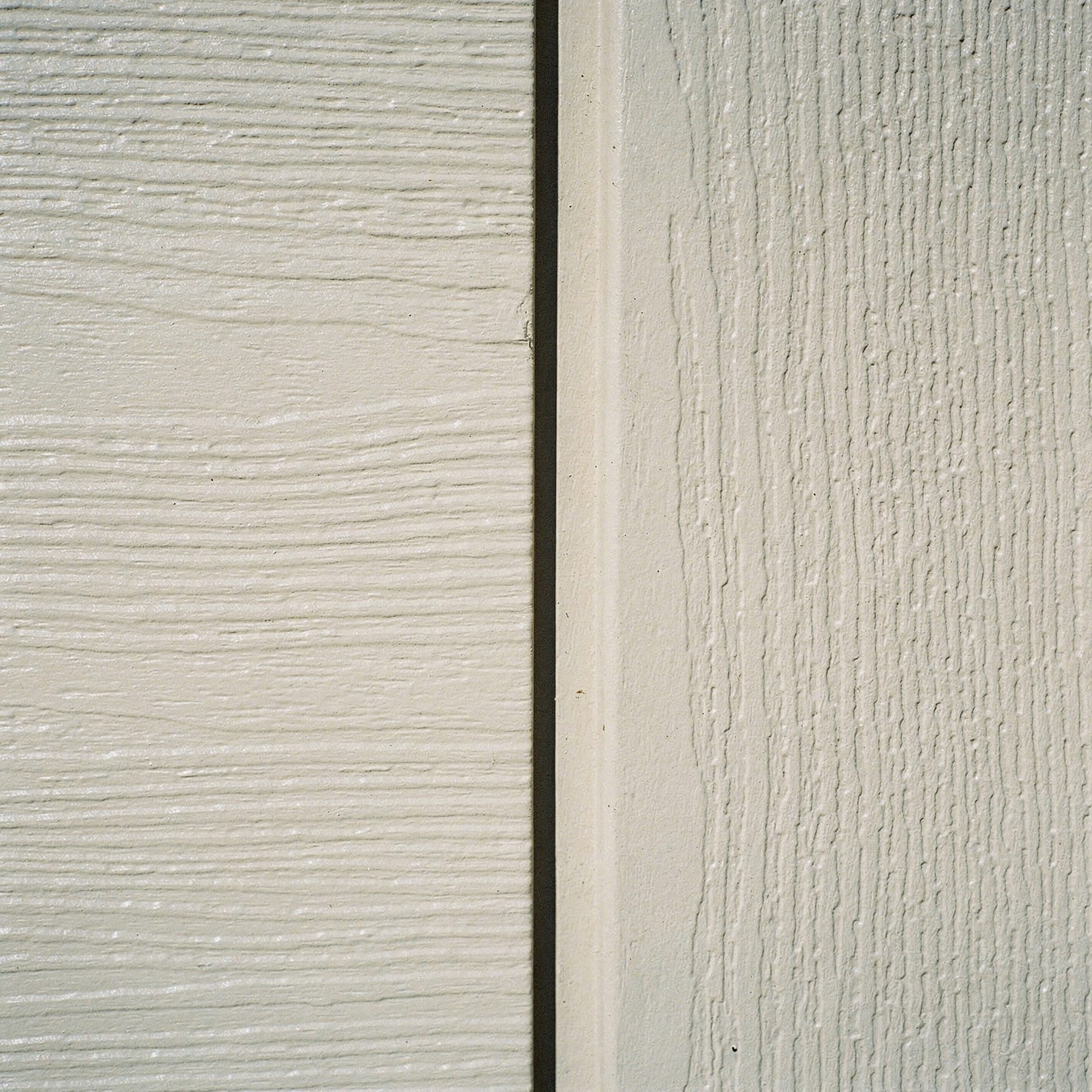
- Humidity and mold. Fiber cement holds its dimensions and resists moisture and mold. Vinyl doesn’t rot, but if drainage behind it is wrong it can trap moisture against the wall — an install issue more than a material one.
- Sun and fade. NC UV fades vinyl over the years, and vinyl isn’t designed to be repainted — vinyl-safe acrylics exist but aren’t a standard refresh, so replacement is the usual path. A factory-baked ColorPlus finish on fiber cement resists fade far better.
- Coastal wind. Fiber cement withstands roughly 150 mph and shrugs off salt air. Vinyl’s failure mode in high wind is unzipping — panels rattling loose course by course. On exposed coastal sites, that’s the picture I’d weigh.
James Hardie builds climate-specific product lines, and HZ10 is the family engineered for hot, humid, salty, hurricane-prone regions — the North Carolina spec. If a quote says Hardie, make it say which line.
Confirmed current for 2026: James Hardie’s own HardieZone system page still places North Carolina — coastal and Piedmont alike — in HZ10, the line engineered for hot, humid conditions, heavy rain, and hurricane-force wind. HZ5 is the cold-climate counterpart (freeze/thaw, snow load).
James Hardie’s zip-code lookup tool at jameshardie.com/hardie-zone-system is the way to confirm a specific address, since the HardieZone system is designed around zip-level lookups rather than a single static county map.
Fire, pests, and impact: the quiet differences
Fiber cement is non-combustible, inedible to termites, and tough against hail — three advantages that never show up in a showroom but matter for decades. James Hardie cladding carries an A2 fire rating: it won’t ignite or feed a fire. Vinyl melts and burns.
Termites and carpenter ants can’t eat cement, and the board is dense enough to discourage woodpeckers. Vinyl doesn’t feed pests either — the pest risk with vinyl is what happens in a moisture-trapped wall behind it, which circles back to install quality.
Some insurers do factor non-combustible cladding into pricing, and fiber cement’s fire resistance can be part of that conversation. But it’s not a guaranteed discount, and it isn’t universal.
One real-world counter-example: at least one homeowner reported their premium going up after switching to fiber cement, because the material raises a home’s insured rebuild cost, and rebuild cost is a bigger lever on premiums than fire rating alone.
In coastal NC, the more reliable savings path is a formal wind-resilience certification like the IBHS FORTIFIED designation, which does have documented premium discounts tied to it — fiber cement can be part of a FORTIFIED-qualifying build, but the siding material alone doesn’t earn the discount.
Bottom line: don’t assume an insurance discount — call your carrier first. Ask specifically what they credit, and ask about FORTIFIED if you’re coastal.
Maintenance, honestly — in both directions
Vinyl is wash-only with no standard refresh. Fiber cement is low-maintenance but not no-maintenance. Most comparison charts flatten this into “vinyl easy, Hardie hard.” The truth is more useful in both directions.
Vinyl’s honest deal: wash it and you’re done — no painting on any normal schedule. The catch is the flip side of that: when NC sun finally fades it, there’s no easy repaint. Vinyl-safe acrylic paints exist, but they’re a niche fix with real limits — not a warrantied refresh. So fade is usually the beginning of the replacement conversation, which is why panel grade and fade warranty matter on day one.
Fiber cement’s honest deal: wash it annually with low pressure, and re-caulk joints and window perimeters roughly every 5–10 years. Factory ColorPlus finish carries a 15-year finish warranty. Primed, field-painted board typically wants repainting roughly every 10–15 years.
The board itself is backed by a 30-year non-prorated limited warranty and commonly outlasts it. So: a 50-year board with a paint clock inside it. Budget for the clock, not just the board.
Confirmed current for 2026, directly against James Hardie’s own published warranty terms: Hardie siding, trim, and soffit carry a 30-year, non-prorated, transferable substrate warranty covering manufacturing defects.
The ColorPlus Technology finish carries a separate 15-year limited warranty against peeling, cracking, and chipping — James Hardie covers reasonable paint and labor costs in year one, then the covered amount steps down roughly 6.67% per year through year fifteen, after which the finish warranty ends (the substrate warranty keeps running).
Both warranties require proper installation to James Hardie’s specifications and can be voided by things like pressure-washing above spec or painting over ColorPlus. The repaint (~10–15 yr) and re-caulk (~5–10 yr) intervals for non-ColorPlus, field-painted board remain a reasonable-maintenance estimate rather than a warranty-document figure.
If vinyl’s wash-only appeal is what wins you over, the grades and profiles — clapboard, Dutch lap, board and batten — are covered on the siding overview.
Resale: what the data says
The 2025 Cost vs. Value report (Remodeling/Zonda, the 38th annual edition, published September 2025) puts fiber cement siding replacement at 113.7% recouped at resale — genuinely more than the project costs, one of the report’s standout figures — and vinyl siding replacement at roughly 96.5% nationally.
Both numbers moved slightly from the figures earlier drafted here (vinyl was estimated around 80%, climbing to 96–97% regionally). The confirmed 2025-edition national average for vinyl is 96.5%, essentially at the top of that earlier estimated range rather than the middle.
Two honest caveats before that settles the argument:
- ROI shifts by report year and region. The 2025 edition is current as of this writing, and Cost vs. Value publishes a new edition annually — re-check the year before quoting either number in a year or two.
- Resale is one input, not the whole decision. If you’re staying twenty years, how the wall serves you matters more than what the next owner pays for it.
The data leans Hardie; it doesn’t order you to buy it.
The same-project question: your windows
If you’re re-siding a 1980s NC home, you’re one decision away from the windows — same wall, same scaffold, same month of disruption. Siding replacement is the natural moment to fix what’s behind and beside it: tear-off exposes the sheathing and the window flashing, and a crew staged on your exterior once is cheaper than twice.
The choice you just worked through has a parallel on the window side — the same vinyl-vs-premium call on windows runs on the same logic of horizon and exposure.
Start with what replacement windows cost in NC if you’re pricing both, and the windows pillar covers the rest of that decision. One plan for the whole wall usually beats two projects a few years apart.
Get both numbers, then decide
The material question settles fastest when both quotes describe the same job. Here’s the ask, word for word:
Ask them, word for word
”Quote me both: same profile, same trim scope, tear-off included, per-square-foot line shown — vinyl grade named, and HZ10 if it’s Hardie.”
Two quotes built to that ask are finally comparable — same house wrap and flashing scope underneath, same trim, honest per-foot lines.
If you want a second set of eyes on them, or on the vinyl-versus-Hardie call for your actual walls, book a no-pressure consult. I’ll weigh your exposure and your horizon with you, and if vinyl is the honest answer for your house, that’s the answer you’ll get.
Sources, Verification & Fact-Checking verified July 2026
Every load-bearing fact on this page is sourced and verified against a primary authority.
Verified July 2026 via direct review of the cited authority — the links open the controlling source so you can check it yourself rather than take our word.
- Installed cost bands — vinyl about $3–$12/sq ft (whole-house about $10k–$24k); fiber cement about $5–$18/sq ft (whole-house about $10k–$25k). National aggregator ranges, not NC quotes; they move with the market and vary by region, home, and scope, current as of 2026. (view source — Angi, vinyl siding cost, HomeAdvisor, and Fixr cost guides.)
- Lifespan, fire, pest, wind, and weight comparisons — vinyl ~20–40 yrs vs fiber cement ~50+; fiber cement non-combustible (A2), inedible to termites, withstands ~150 mph; ~300 lb vs ~60–70 lb per 100 sq ft. Manufacturer and trade-source facts drawn from James Hardie product documentation (A2 rating, HardieZone HZ10 climate engineering, 30-year board warranty, ColorPlus 15-year finish warranty). These manufacturer documents are named rather than linked here — confirm the current warranty terms on James Hardie’s own published documents before relying on them.
- Vinyl cannot be effectively repainted; fade is a replacement conversation; panels must float on the wall and rely on house wrap and flashing for moisture management. Vinyl Siding Institute (now Polymeric Exterior Products Association) product-certification program and standard installation practice; ASTM D3679 governs residential rigid-PVC siding. (view source — VSI/PEPA certified products)
- Resale ROI — vinyl siding replacement ~96.5% national average; fiber cement ~113.7% average. 2025 Cost vs. Value Report, 38th annual edition, Remodeling magazine / Zonda, published September 2025 — the current edition as of this writing; ROI shifts by report year and region, so re-verify against the newest edition annually. (The report’s own site, costvsvalue.com, redirects to a subscription-gated JLC Online page, so these figures are cited from the published report rather than a free public link.)
- James Hardie warranty — 30-year non-prorated, transferable substrate warranty on Hardie siding/trim/soffit; ColorPlus Technology finish carries a separate 15-year limited warranty (full paint+labor coverage year one, stepping down ~6.67%/year through year 15); both require installation per James Hardie’s specifications. (view source — James Hardie, Lifetime Value Siding Products)
- HardieZone HZ10 — confirmed current for 2026: James Hardie’s HardieZone system places North Carolina in HZ10, engineered for hot, humid, salty, hurricane-prone climates; HZ5 is the cold-climate counterpart. James Hardie’s zip-code lookup tool confirms the zone for a specific address. (view source — James Hardie, Hardie Zone System)
- Homeowners-insurance discounts for non-combustible siding are plausible but not guaranteed or universal — at least one documented case shows a premium increase after switching to fiber cement, because higher insured rebuild cost outweighs the fire-rating benefit for that insurer. In coastal NC, the more reliable discount path is a formal wind-resilience certification (e.g., the IBHS FORTIFIED designation), not the siding material alone. Call your carrier to confirm before assuming a discount — how insurers treat non-combustible cladding varies, so this is a reader hedge rather than a promise.