


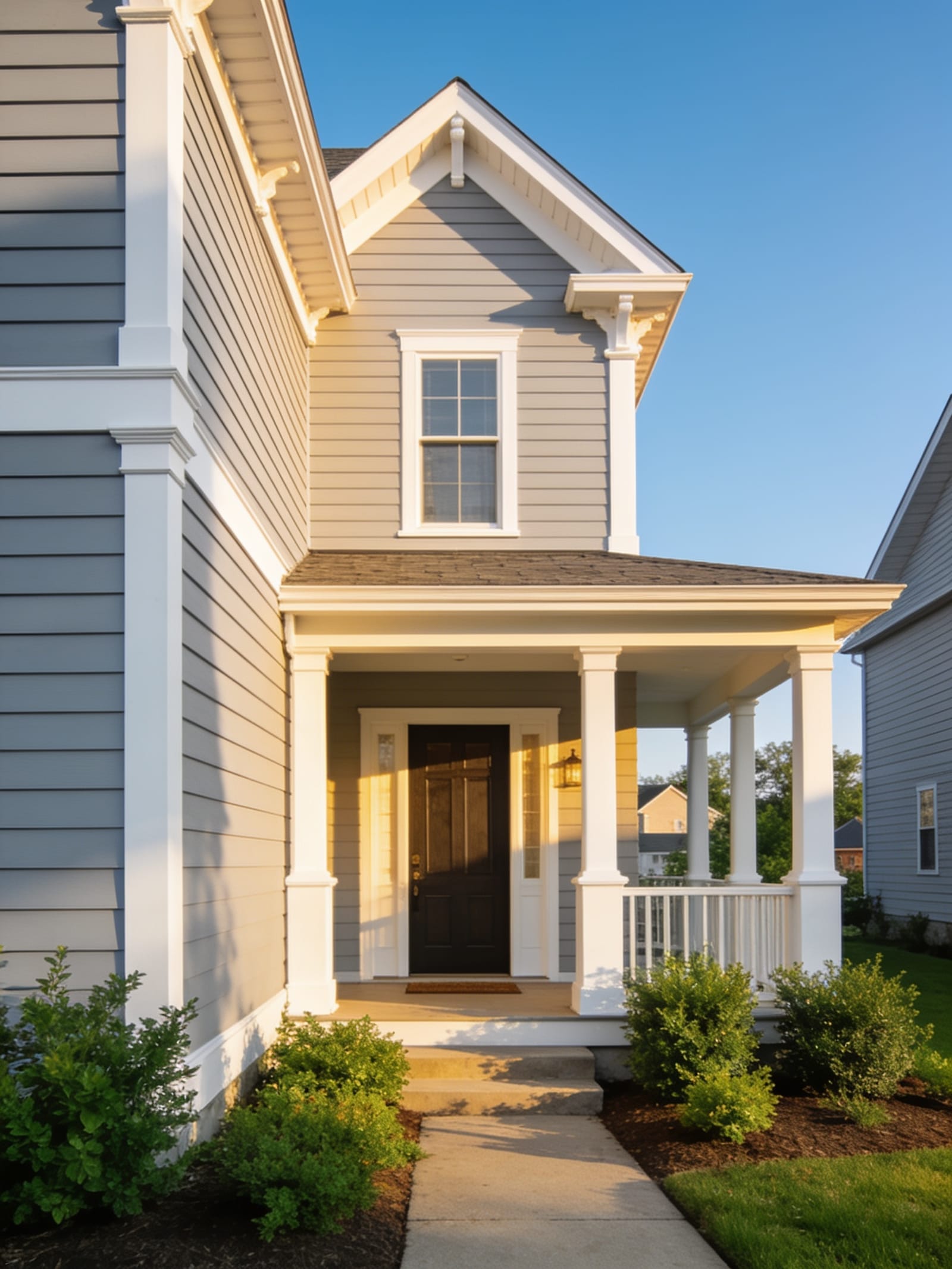
You’ve got two siding quotes and they’re eight thousand dollars apart, and nobody will tell you why.
I’d start by ignoring the brand name on each and looking at what’s underneath the number — because in vinyl, the install and the scope move the price far more than the label. Here’s how I’d read them.
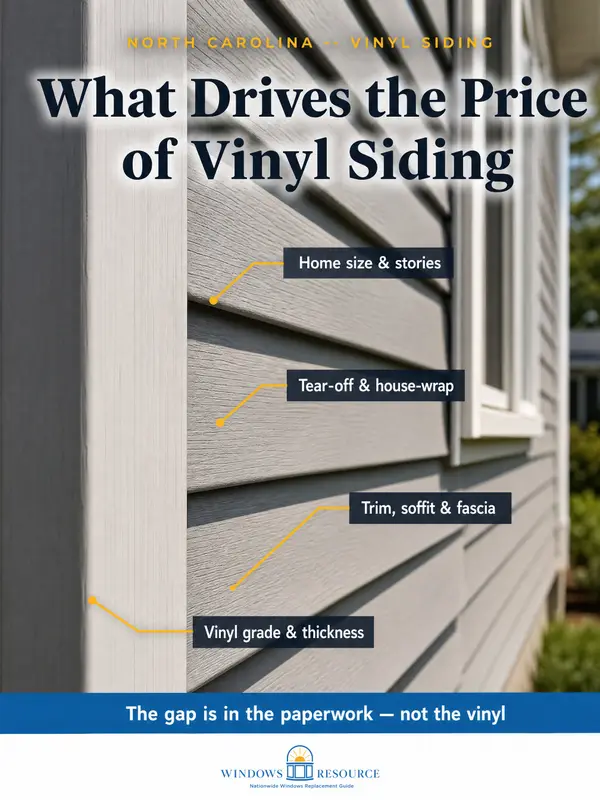
What does vinyl siding cost in NC? As a general market range, roughly $3–$12 per square foot installed — standard vinyl around the middle of that, premium or insulated higher. A typical North Carolina whole-house replacement lands in the low-to-mid five figures. The spread is driven by home size, tear-off, trim, and vinyl grade — not the label. These are national bands that move with the market; verify for your home.
Ranges here are general market bands, not your quote — a starting point to read a contractor’s number against. Last reviewed June 2026.
What vinyl siding costs per square foot in NC
The honest per-foot range is wide because “installed” means different things on different quotes. Some bake in tear-off and trim; some don’t.
So read the per-foot number as a starting point, then look at scope.
The thickness matters here. D3679 (the rigid-PVC siding standard) sets 0.035” as the minimum for residential vinyl.
Economy panels sit near that floor and telegraph every wall imperfection; standard mid-grade is the value pick for most NC homes; premium grades buy UV and wind resistance. That grade spread is a real material-cost difference — and it’s where a builder-grade job gets sold at a premium price.
Installed cost per square foot — where the grades tend to land
General market bands, not your quote. The shaded zone is where most standard NC jobs settle.
Cost data is national and time-sensitive — treat the marks as order-of-magnitude, then verify against a real quote for your square footage.
Where the grades tend to land, as national installed bands (materials plus labor, not an NC quote): economy/builder-grade runs roughly $2–$6 per square foot, standard residential around $3–$7, premium $6–$12, and insulated (foam-backed) $5–$12 — the insulated version typically adds about $2–$4 per square foot over a comparable hollow-back profile.
These are national aggregator ranges (Angi, HomeAdvisor, Fixr) that move with the market and vary by region, home, and scope. Read them as order-of-magnitude and verify against a real quote for your square footage.

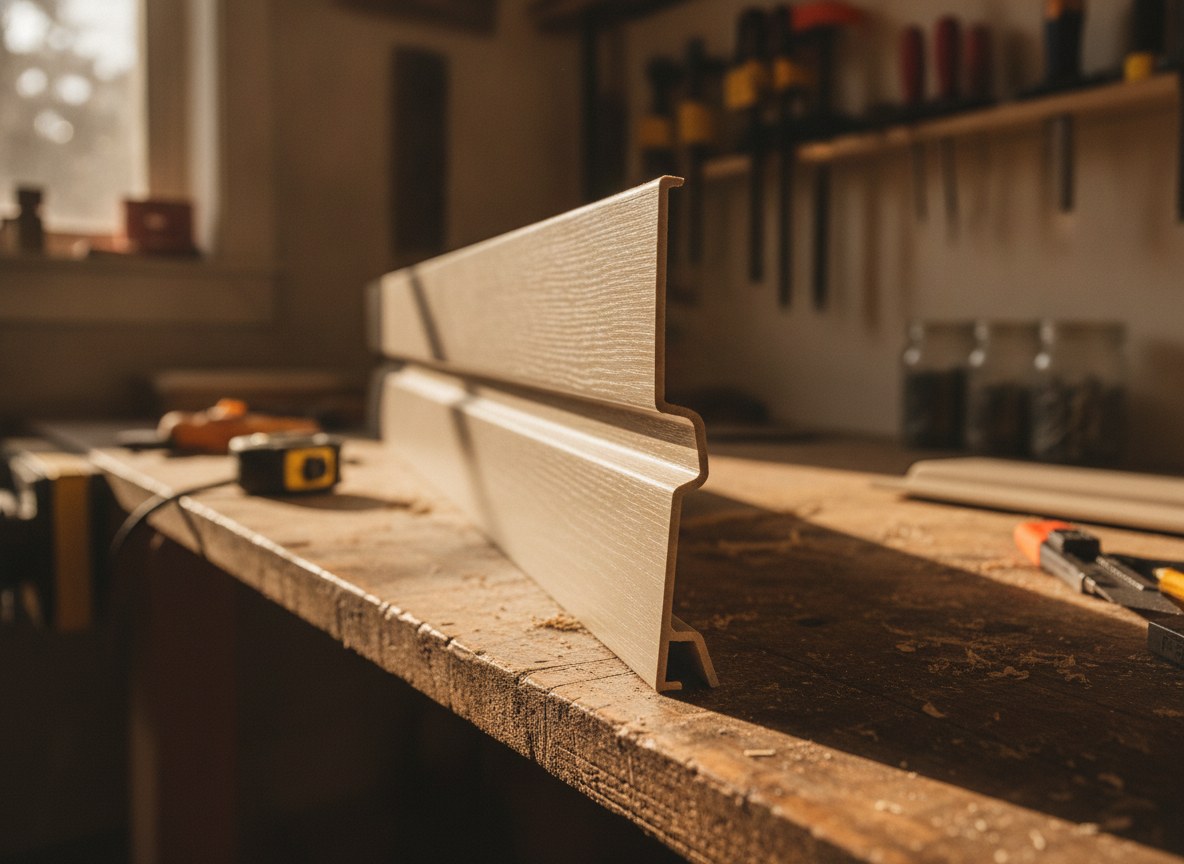

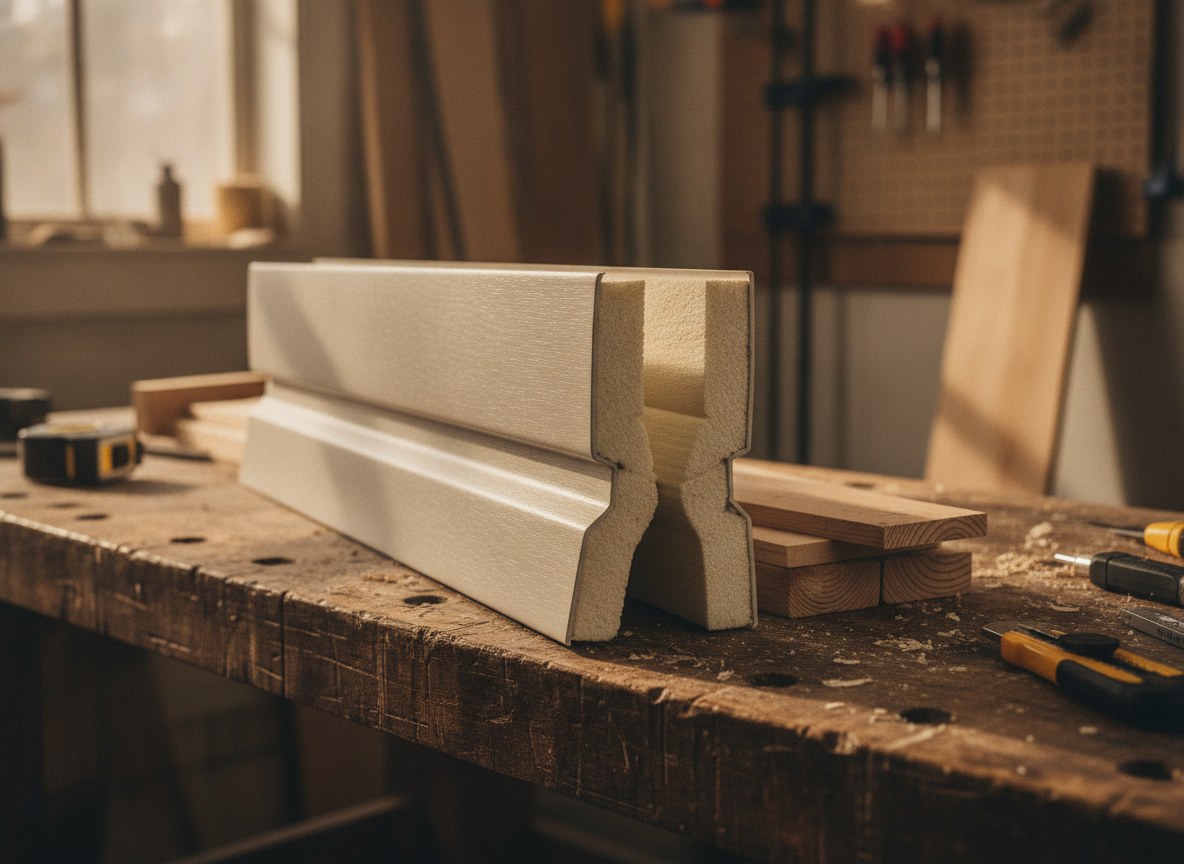
| Grade / type | The panel itself | Installed $/sq ft (national range) | Durability note | When it's the right call |
|---|---|---|---|---|
| Economy / builder (~0.035") |  | ~$2–$6 | Shows wall imperfections; least UV/wind margin | Tight budget, low expectations |
| Standard mid-grade (~0.042–0.046") | 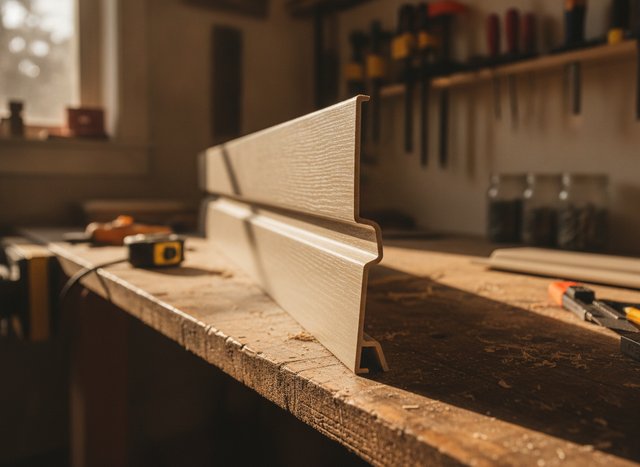 | ~$3–$7 | The value sweet spot for most NC homes | Most re-sides — the default |
| Premium (~0.048"+) | 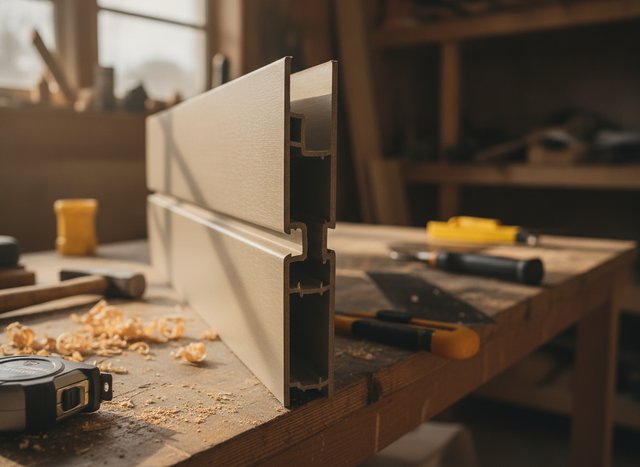 | ~$6–$12 | Better UV and wind resistance, stiffer panel | High-sun / high-wind elevations |
| Insulated (foam-backed) | 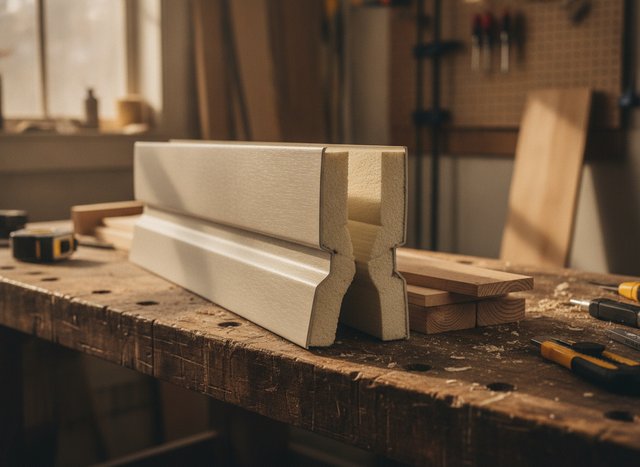 | ~$5–$12 (adds ~$2–$4/sq ft) | Rigidity + dent resistance, not guaranteed payback | You want the wall to feel solid |
Economy / builder (~0.035")
- The panel itself
-
- Installed $/sq ft (national range)
- ~$2–$6
- Durability note
- Shows wall imperfections; least UV/wind margin
- When it's the right call
- Tight budget, low expectations
Standard mid-grade (~0.042–0.046")
- The panel itself
-
- Installed $/sq ft (national range)
- ~$3–$7
- Durability note
- The value sweet spot for most NC homes
- When it's the right call
- Most re-sides — the default
Premium (~0.048"+)
- The panel itself
-
- Installed $/sq ft (national range)
- ~$6–$12
- Durability note
- Better UV and wind resistance, stiffer panel
- When it's the right call
- High-sun / high-wind elevations
Insulated (foam-backed)
- The panel itself
-
- Installed $/sq ft (national range)
- ~$5–$12 (adds ~$2–$4/sq ft)
- Durability note
- Rigidity + dent resistance, not guaranteed payback
- When it's the right call
- You want the wall to feel solid
What a whole house costs
A typical whole-house vinyl replacement commonly runs in the low-to-mid five figures. National cost trackers put the average full replacement around $12,000, with most homeowners landing roughly $6,400 to $18,400 and larger or more complex homes climbing toward $24,000 and up.
What pushes you to the top of the band is size, a second story, and architectural complexity — more corners, gables, and trim runs. Those are national figures, not an NC quote — get your own number in writing.
A whole-house number is also where overpricing hides. A total feels like the price, but it’s really square footage times a per-foot rate plus scope. Get the quote down to those parts and a padded number has nowhere to hide.
Why two quotes are thousands apart: the cost drivers
The gap between a fair quote and a padded one is almost always explainable. Here’s what actually moves the number:
- Home size and stories. More wall area and a second story mean more material, more labor, and staging.
- Tear-off and disposal. Pulling the old siding and hauling it off is real work. Skipping it is a red flag, not a savings.
- Trim, soffit, and fascia. J-channel, corner posts, and detail around windows and doors add up fast on a complex elevation.
- Flashing detail. Proper flashing at windows, doors, and roof-to-wall (kick-out flashing especially) is what keeps water out — it’s labor you want on the quote.
- Vinyl grade and thickness. Economy 0.035” to premium 0.048”+ is a real material-cost spread, and it’s where a builder-grade job gets sold at a premium price.
- Insulated vs hollow-back. Foam-backed () panels cost more up front but add rigidity and dent resistance.
The failure the cheap quote is buying you
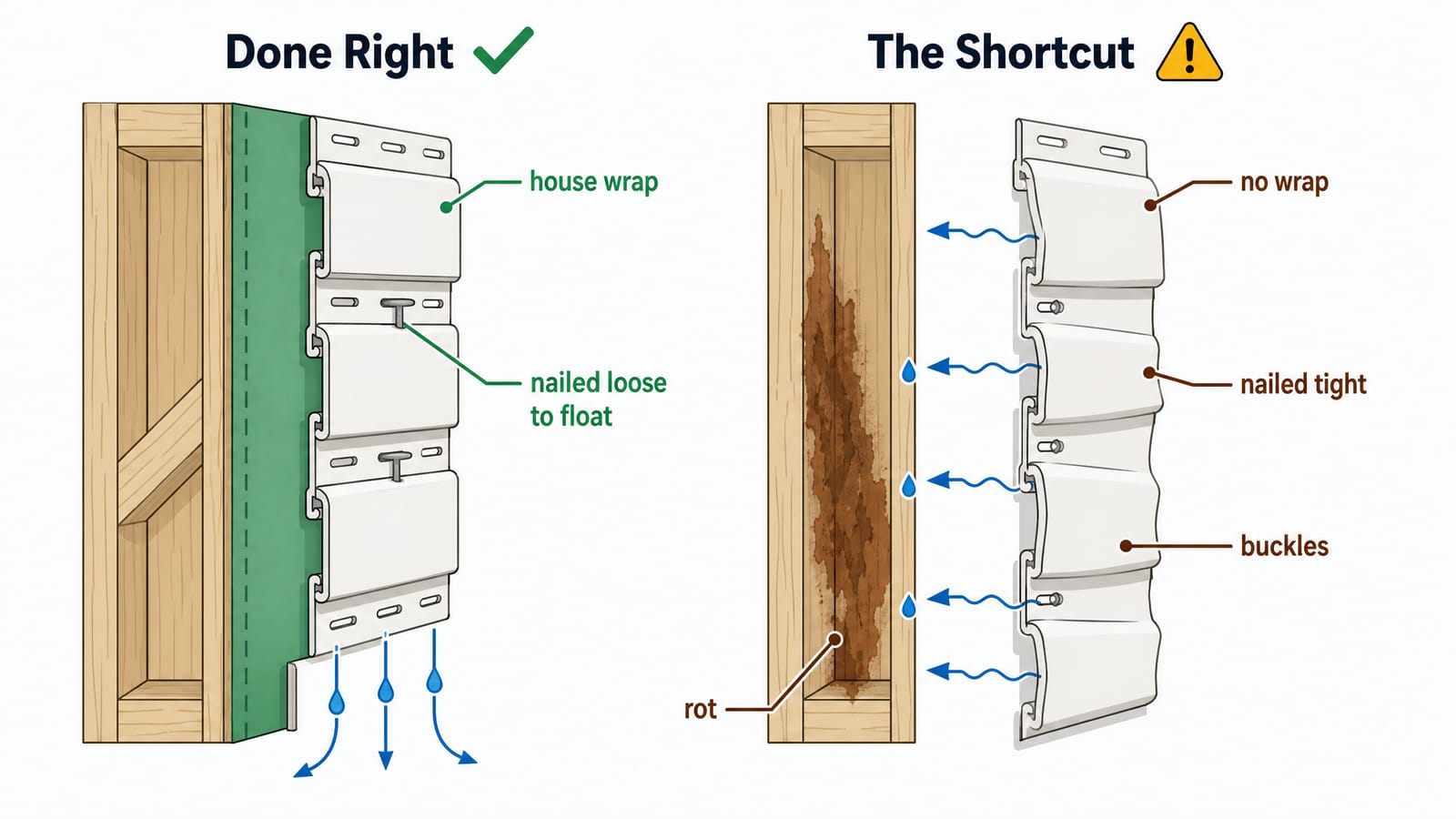
The single most expensive mistake in vinyl isn’t grade — it’s a bad install. Vinyl panels have to float: nailed loose with an expansion gap so they slide as they heat and cool, hung over house-wrap and flashing that carry water back out.
Nail them tight, skip the wrap, and you get buckled panels and a wall that rots from the inside. That’s what a “no tear-off, we’ll go right over the old stuff” price is quietly buying you.
Does tear-off cost extra? (and other line items that surprise people)
Usually yes — and the surprises here are legitimate, not padding. Vinyl is a rain screen, not a waterproof barrier. Water is expected behind it and must drain.
That’s why house-wrap and flashing are non-negotiable scope.
If there’s hidden rot in the substrate, repairing it is an honest add — you don’t want new siding hung over a soft wall. Disposal of the old material is also real.
None of that is a contractor playing games. It’s the difference between a job that lasts and one that traps moisture.
What a fair itemized siding quote should include
A fair quote names the scope so you can spot padding from real work. Look for these lines spelled out:
- Tear-off and disposal of the existing siding
- House-wrap (the moisture barrier) and flashing detail
- The vinyl grade/thickness in mils, not just “vinyl siding”
- Trim package — J-channel, corner posts, soffit, fascia
- Substrate/rot repair handling (priced or noted as TBD on inspection)
- -certified product, if claimed
Ask them, word for word
”Is tear-off and disposal of the old siding included, and what vinyl thickness — in mils — are you quoting?”
If the answer to either is vague, that’s your opening to push.
Red flags: the quotes I’d walk away from
- The “no tear-off” lowball. Siding over old siding hides rot and traps moisture — a cheap quote that skips tear-off can cost you a wall later.
- Vinyl grade left off the quote. “Vinyl siding” with no thickness or grade named is how a builder-grade 0.035” job gets sold at a premium price. Make them name the mils.
- The same-day siding discount. A price that only holds if you sign today is a pressure tell, not a deal. A real price is a real price next week.
Is the insulated upgrade worth the extra money?
Insulated vinyl is a comfort-and-durability upgrade, not a payback promise. Foam-backed panels add rigidity (straighter walls), better dent resistance, and some noise dampening.
They add a modest amount of too — a modest added R-value that varies with foam thickness, versus the near-zero of a hollow-back panel.
The upcharge is real: national cost data puts insulated vinyl at roughly 25% to 100% more than a comparable hollow-back product — that’s roughly $2–$4 per square foot added to the base profile. Those are national ranges, not an NC quote; verify the upcharge for your home.
I wouldn’t sell you on energy savings paying it back — that’s the part that gets oversold.
I’d say this: if you want the wall to feel more solid and the panels to shrug off a stray ball or hailstone, it’s worth a look. NC homeowner takeaway: the durability and the straighter wall are real and worth paying for if that’s what you want. The energy-payback pitch is not the reason to say yes. More on that on the insulated vinyl page.
Doing siding and windows together
Same wall, same installer, same quote conversation — siding and windows often belong in one project. The crew is already staging your exterior, the flashing details overlap, and you’ll read one combined budget instead of two.
If you’re pricing both, it’s worth knowing what replacement windows cost in NC before you sign anything on the siding side. The buyer is the same person; the trust test is the same.
Get a real number for your house
A range tells you whether a quote is in the right neighborhood. It can’t tell you your number — that depends on your wall area, your trim, and whether there’s rot hiding behind the old panels.
If you want a no-pressure second opinion on a quote you’ve already got, have me walk the house with you. I’ll measure, name the drivers, and let you decide.
Sources, Verification & Fact-Checking verified July 2026
Every load-bearing fact on this page is sourced and verified against a primary authority.
Verified July 2026 via direct review of the cited authority — the links open the controlling source so you can check it yourself rather than take our word.
- Vinyl siding installed cost bands — roughly $3–$12/sq ft nationally (economy ~$2–$6, standard ~$3–$7, premium ~$6–$12, insulated ~$5–$12); whole-house average ~$12,000, most ~$6,400–$18,400. These are national aggregator ranges, not an NC quote; they move with the market and vary by region, home, and scope. Verify against a real itemized quote for your square footage. (view source — Angi, vinyl siding cost, HomeAdvisor, and Fixr cost guides.)
- ASTM D3679 sets 0.035” as the minimum thickness for residential rigid-PVC (vinyl) siding. Verified against the ASTM D3679 standard, “Standard Specification for Rigid Poly(Vinyl Chloride) (PVC) Siding,” which governs material, dimensions, thickness, and performance for extruded single-wall vinyl siding. (Standard: ASTM D3679 — the controlling text is the ASTM specification itself.) The grade bands above 0.035” (economy ~0.035–0.040”, standard ~0.042–0.046”, premium ~0.048”+) are industry grade conventions rather than part of the standard’s minimum, so treat them as approximate.
- Vinyl is a rain-screen cladding, not a waterproof barrier — house-wrap and flashing carry water back out, and panels must be nailed loose to float. Standard vinyl siding installation and product practice; the Vinyl Siding Institute (now Polymeric Exterior Products Association) runs an independent, ISO/IEC 17065 third-party program certifying products to ASTM D3679 (weatherability, wind load, impact, expansion/shrinkage). Nailing panels tight or omitting the moisture barrier causes buckling and substrate rot. (view source — Polymeric Exterior Products Association (formerly Vinyl Siding Institute), certified products)
- Insulated (foam-backed) vinyl adds rigidity, dent resistance, and a modest R-value (varies with foam thickness) at roughly 25–100% more than hollow-back — not a guaranteed energy payback. (Full breakdown: is insulated vinyl siding worth it?) The DOE recognizes insulated siding (EPS foam laminated to the vinyl) as continuous insulation that reduces thermal bridging across the studs; product R-values are modest and vary by foam thickness. The exact R-value is described qualitatively rather than as a single number, since it depends on the specific product’s foam thickness; the ~25–100% premium and the ~$2–$4/sq ft add are national cost-guide ranges (HomeAdvisor / Fixr), time-sensitive and not an NC quote. (view source — U.S. Dept. of Energy, Building Science Education; premium and R-value ranges via HomeAdvisor and Fixr cost guides.)