

The math problem shows up before the window does. Twelve openings, a replacement quote with five digits on it, and a house you love that’s older than the company that quoted you.
Between “do nothing” and “replace everything” there’s a layer. It used to hang in every hardware aisle in North Carolina, and it quietly still exists — you just have to know where to look now.
This page is the honest map: what a storm window actually is, what it measurably does, where to buy one in 2026, and the two things it will never be — a hurricane product, or a replacement.
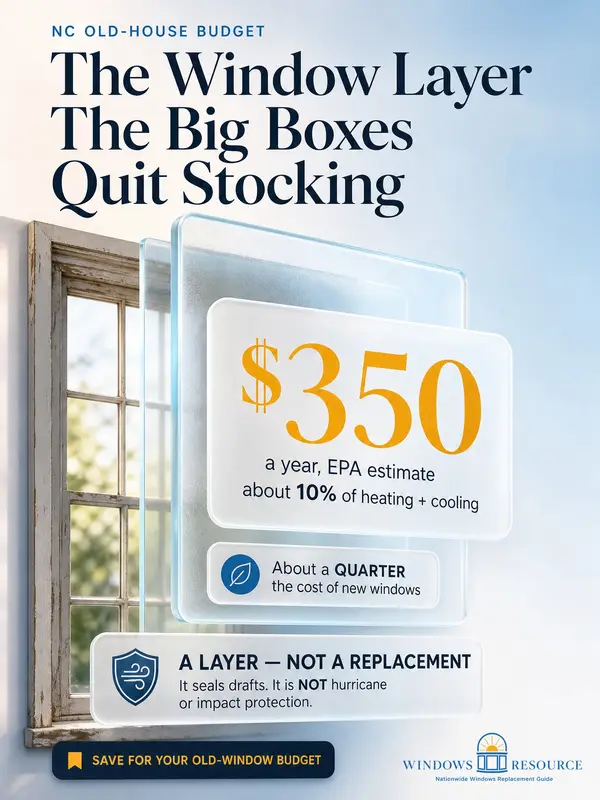
Are storm windows worth it instead of replacing? Often, yes — as a layer, not a substitute. A storm window is a secondary panel mounted over your existing window, inside or out. Over old single-pane windows, estimates low-e storms save about $350 a year — roughly 10% of heating and cooling costs — and puts them at about a quarter of the cost of replacement. They’re strongest on sound old wood windows and tight budgets. They are not hurricane protection, and they don’t fix rot.
What is a storm window, exactly?
A storm window is a second, simpler window mounted over the one you already have — a glass or acrylic panel that traps a layer of still air against your existing window. The window underneath — your prime window — stays put and keeps doing its job.
That trapped air layer is the whole mechanism. It’s the same physics that makes a double-pane outperform single glass: still air is a poor conductor, so heat stops pouring through the pane and cold stops pouring off it.
A good storm also cuts air leakage — often the bigger felt difference in an old house. The draft you can feel on your ankles is air movement, and a sealed panel with decent weatherstripping blocks the path.
Modern storm windows come in two placements — mounted outside over the exterior casing, or fitted inside the interior trim — and the better ones carry a low-e coating: a thin metallic layer that reflects heat back toward the warm side. More on both below.
One thing a storm window is not, and this needs saying before anything else on this page.
Do they even make storm windows anymore?
Yes — but not where you last bought one, and that’s the whole story behind this question. The product didn’t fail. The shelf it lived on disappeared.
Here’s what actually happened, as best the record shows. Larson — the name most people remember from the big-box aisle — wound down its storm-window lines in late 2022; its product-bulletins page marks its interior and exterior storm windows “no longer available for purchase” as of December 22, 2022, and directs owners to customer support, where replacement parts and product help continue. Its site today sells storm doors, screens, and replacement parts.
Homeowners report the same vacuum at the chains: the big boxes largely stopped stocking storm windows, and other manufacturers have dropped them from their lineups. That part is owner-reported from the forums, not company statements — but the empty shelf is easy to confirm in person.
So a homeowner who last bought a storm window in 2005 walks the aisle, finds nothing, and reasonably concludes the product is extinct. It isn’t. The distribution moved from the shelf to the order desk.
Where they actually live now:
- Custom exterior makers — a handful of specialty manufacturers build storm windows to your measurements and sell direct or through local channels.
- Local glass shops and independent lumber yards — the quiet channel homeowners keep rediscovering. They order custom storms routinely, and in the forums they beat big-box leftovers on both fit and price.
- Interior insert companies — interior storms are a healthy market of their own, from measure-kit custom makers like Indow to WindowDressers, a nonprofit that builds low-cost inserts through community volunteer programs.
- Stock exterior units — national suppliers still sell standard-size exterior storms off the shelf, online.
Interior or exterior storms — which way makes sense?
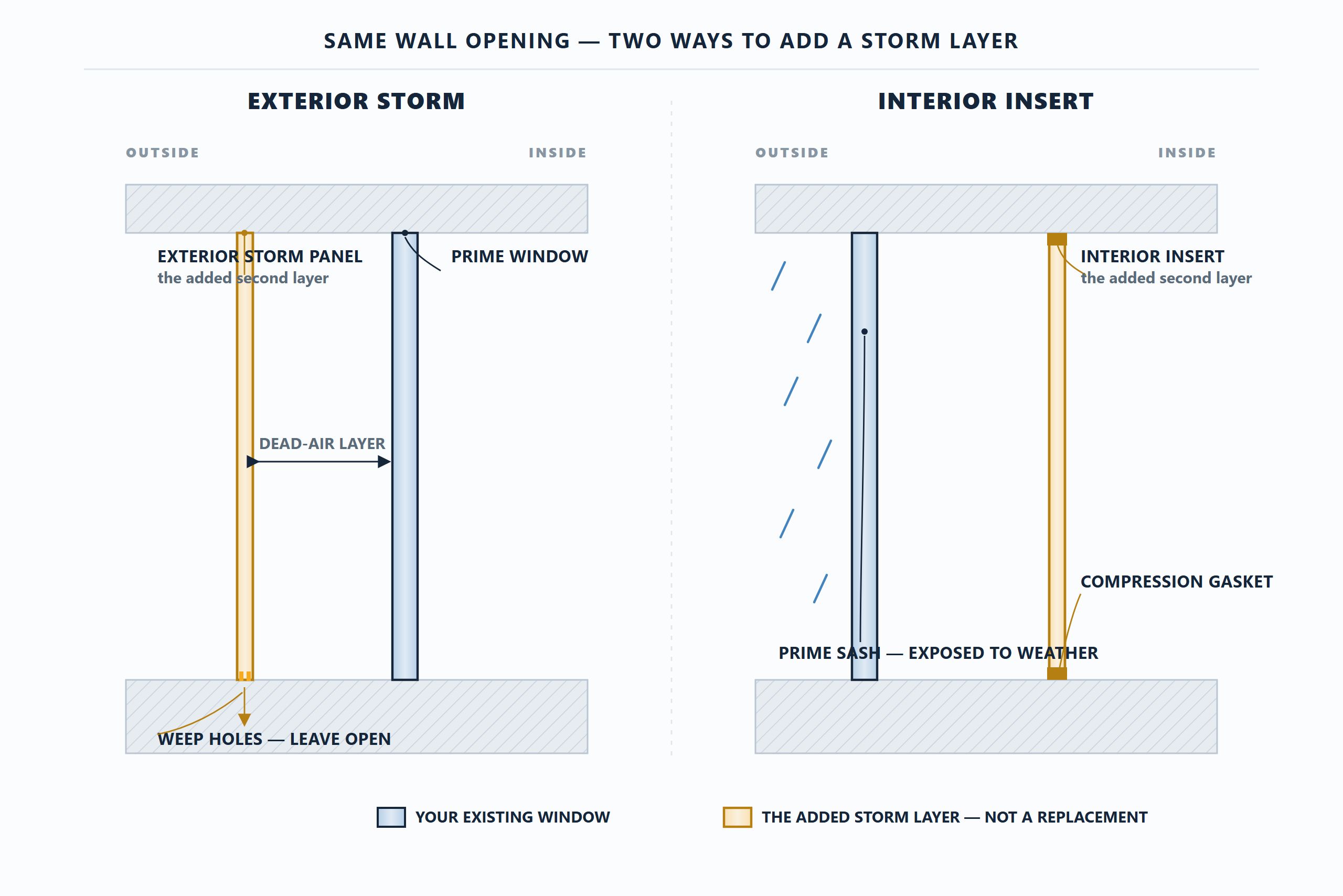
Exterior storms protect the window underneath and stay up year-round. Interior storms seal tighter for less money and effort — but they leave your prime window out in the weather. That’s the real trade, and one century-home owner said it better than any spec sheet.
Weighing interior inserts for his mid-1800s house, the top answer he got was blunt: “The downside to an interior storm window of course is that it doesn’t protect your prime sash.” The insert stops the draft at the trim. The original wood sash still takes every rainstorm alone.
Exterior storms mount over the outside casing. The classic triple-track style holds two glass panels and a screen, so the window still opens seasonally. They shield the prime sash from rain and sun — a real benefit over irreplaceable old wood — and on a historic facade, the frame color and profile are worth choosing carefully.
One spec detail that matters: certified exterior storms are required to have weep holes — small drainage slots at the sill — or an equivalent drainage path, so moisture that gets between the windows can escape. Don’t caulk them shut, ever. Trapped water against a wood sill is how a cheap fix becomes an expensive one.
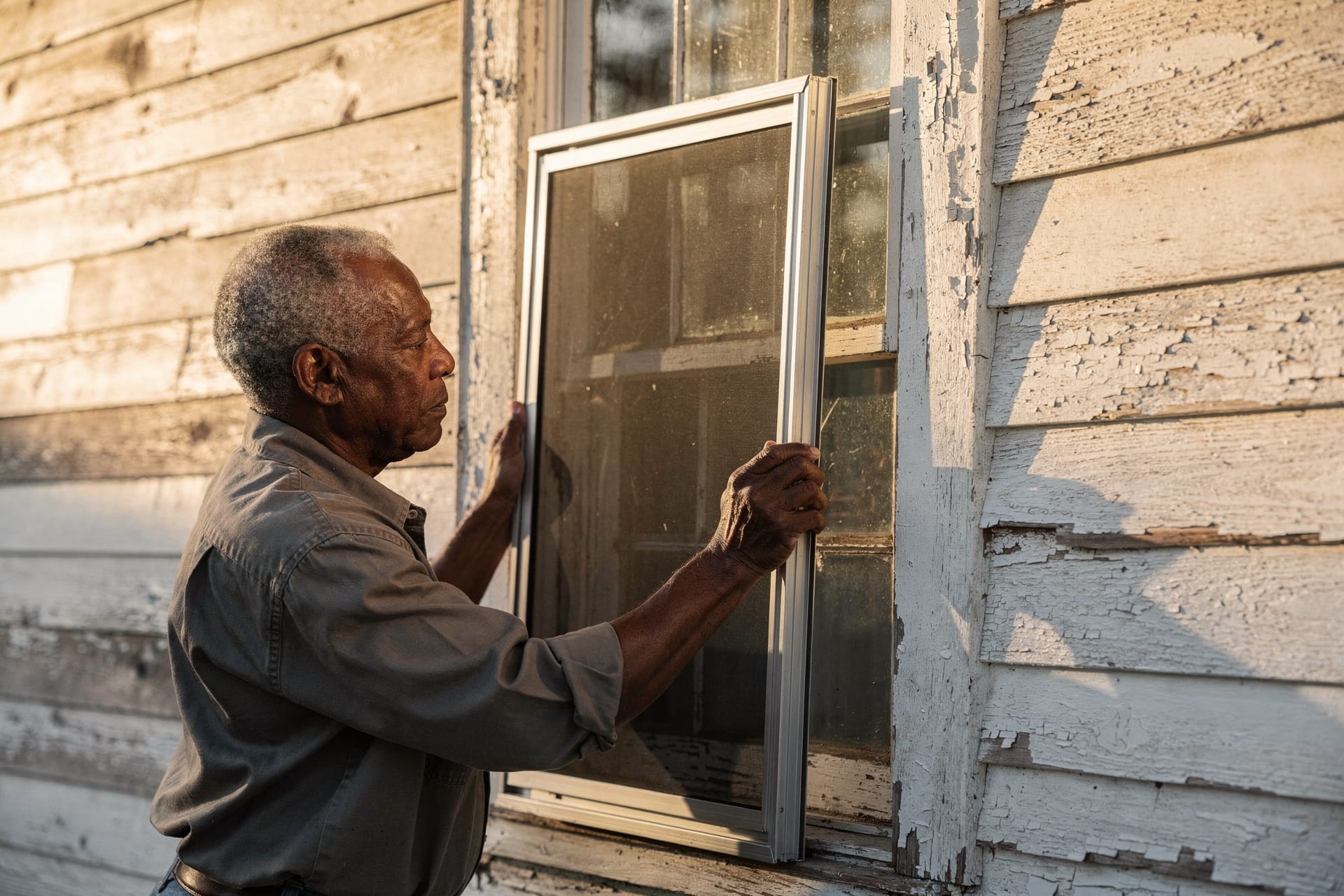
Interior storms press or fasten into the window opening from inside, usually sealing with compression gaskets. They’re the renter-and-old-house favorite: no ladder, no facade change, often DIY-installable, and a tight air seal.
Their honest tax is the calendar. Removable inserts are “another winterizing chore to put all those in place every year,” as one owner put it — a real cost measured in Saturdays, not dollars.
Either placement can carry a low-e coating, and that’s where the measured savings below come from. Clear glass storms help; low-e storms do meaningfully more for a small price difference.
| Interior storm (insert) | Exterior storm | Low-e storm (either side) | |
|---|---|---|---|
| Where it mounts | Inside the opening, against the trim | Over the outside casing | Same mounts — the coating is on the glass |
| What it protects | The room — drafts and heat loss | The room AND the prime sash beneath it | Adds reflected heat to either one |
| Install and upkeep | Often DIY; seasonal in-and-out chore if removable | Ladder work or a pro; triple-tracks stay up year-round | No change from its base type |
| Moisture behavior | Tight gasket seal; watch for condensation on the prime glass | Weep holes at the sill are required drainage — never caulk them | No change from its base type |
| Measured savings | Real, from air-sealing and dead air | Real, from air-sealing and dead air | The strongest numbers — the EPA figures on this page assume low-e |
| Best fit | Renters, historic facades that can't change, DIY budgets | Old wood sash worth shielding, set-and-forget owners | Anyone buying new — the coating is the cheap upgrade |
Where it mounts
- Interior storm (insert)
- Inside the opening, against the trim
- Exterior storm
- Over the outside casing
- Low-e storm (either side)
- Same mounts — the coating is on the glass
What it protects
- Interior storm (insert)
- The room — drafts and heat loss
- Exterior storm
- The room AND the prime sash beneath it
- Low-e storm (either side)
- Adds reflected heat to either one
Install and upkeep
- Interior storm (insert)
- Often DIY; seasonal in-and-out chore if removable
- Exterior storm
- Ladder work or a pro; triple-tracks stay up year-round
- Low-e storm (either side)
- No change from its base type
Moisture behavior
- Interior storm (insert)
- Tight gasket seal; watch for condensation on the prime glass
- Exterior storm
- Weep holes at the sill are required drainage — never caulk them
- Low-e storm (either side)
- No change from its base type
Measured savings
- Interior storm (insert)
- Real, from air-sealing and dead air
- Exterior storm
- Real, from air-sealing and dead air
- Low-e storm (either side)
- The strongest numbers — the EPA figures on this page assume low-e
Best fit
- Interior storm (insert)
- Renters, historic facades that can't change, DIY budgets
- Exterior storm
- Old wood sash worth shielding, set-and-forget owners
- Low-e storm (either side)
- Anyone buying new — the coating is the cheap upgrade
When does a storm window beat replacing?
When the window underneath is worth keeping and the budget is real — which describes more old North Carolina houses than the replacement industry’s marketing does. Three lanes where the storm layer is genuinely the smart move, not the consolation prize.
Old-growth wood windows, especially in historic districts. A sound pre-war wood sash is repairable more or less forever, and the wood itself is often better than anything sold today. Preservation boards across NC push repair-over-replace for exactly that reason, and a storm window is the approved way to make an original window perform. The full wood-versus-replacement case lives in the wood vs vinyl comparison.
This isn’t a niche opinion. EPA’s own framing of who certified storm windows serve names households “in historic preservation districts” alongside those where full replacement is out of reach. In the century-home forums, new storms over 1806-original sash draw applause, not pity — “thank you for keeping the og windows” is a direct quote.
Budget triage. One homeowner with a 97-year-old house and a 100-year-old house put the whole lane in eight words: “Can’t afford all new windows. Need storm windows.” If the honest choice is a storm layer now versus nothing for five years, the layer wins — and your instinct that you might not need to replace everything is exactly right in the right house.
Rentals and short horizons. Interior inserts don’t alter the building, come with you when you leave, and fix the draft you’re actually living with. A renter fixing a landlord’s window has no better tool.
Do storm windows actually work? The measured numbers
Yes — and you don’t have to take a forum’s word for it, because the federal government measured it. These are the figures I trust enough to print, every one of them from EPA or DOE program pages and checked against the live source before this page publishes.
A fair skeptic’s question from the century-home threads: “If they were super effective, you’d think they’d be more common.” The honest answer is that the numbers are strong for a specific situation — a low-e storm over a poor window — and the section above explains why the shelf emptied anyway. Distribution isn’t evidence.
What the measurements say:
- About $350 a year, roughly 10% of heating and cooling costs — EPA’s national-average estimate for installing certified low-e storm windows over single-pane windows with no existing storms.
- About a 3-year payback on the incremental cost, by EPA’s estimate — their word for these figures is “conservative,” because the estimates exclude air-sealing gains.
- 10% to 35% off heating and cooling costs — the range DOE cites from field validation of low-e storms installed over low-performing windows, work done at a national laboratory.
- About $50 a year more when replacing old clear-glass storms with low-e ones — worthwhile when a storm ages out, not a reason to rip out working clear storms.
Two North Carolina notes on those national numbers. First, they assume single-pane or badly underperforming windows underneath — pre-1980s NC housing stock, in other words. A storm over a decent double-pane saves little.
Second, storms read as a northern product, but the certified spec includes options with low solar transmittance — coatings that reject summer heat gain — which is the version that earns its keep against a Piedmont cooling bill.
And the number your body reports before any bill does: the draft stops. Cold quits pouring off the glass onto the sofa under the window. If your real complaint is a specific drafty room, start with why windows get drafty and what fixes it — a storm is one tool on that page’s list, not the first one.
What a storm window won’t fix
It’s a layer over a working window — and every honest use case on this page assumes the window underneath is basically sound. The failure modes, plainly:
- It is not hurricane protection. Said once more because the name invites the error: NC’s coastal windborne-debris rule is satisfied by impact-rated glazing or approved shutters, and a storm panel is neither. The coastal-impact page has the actual rule.
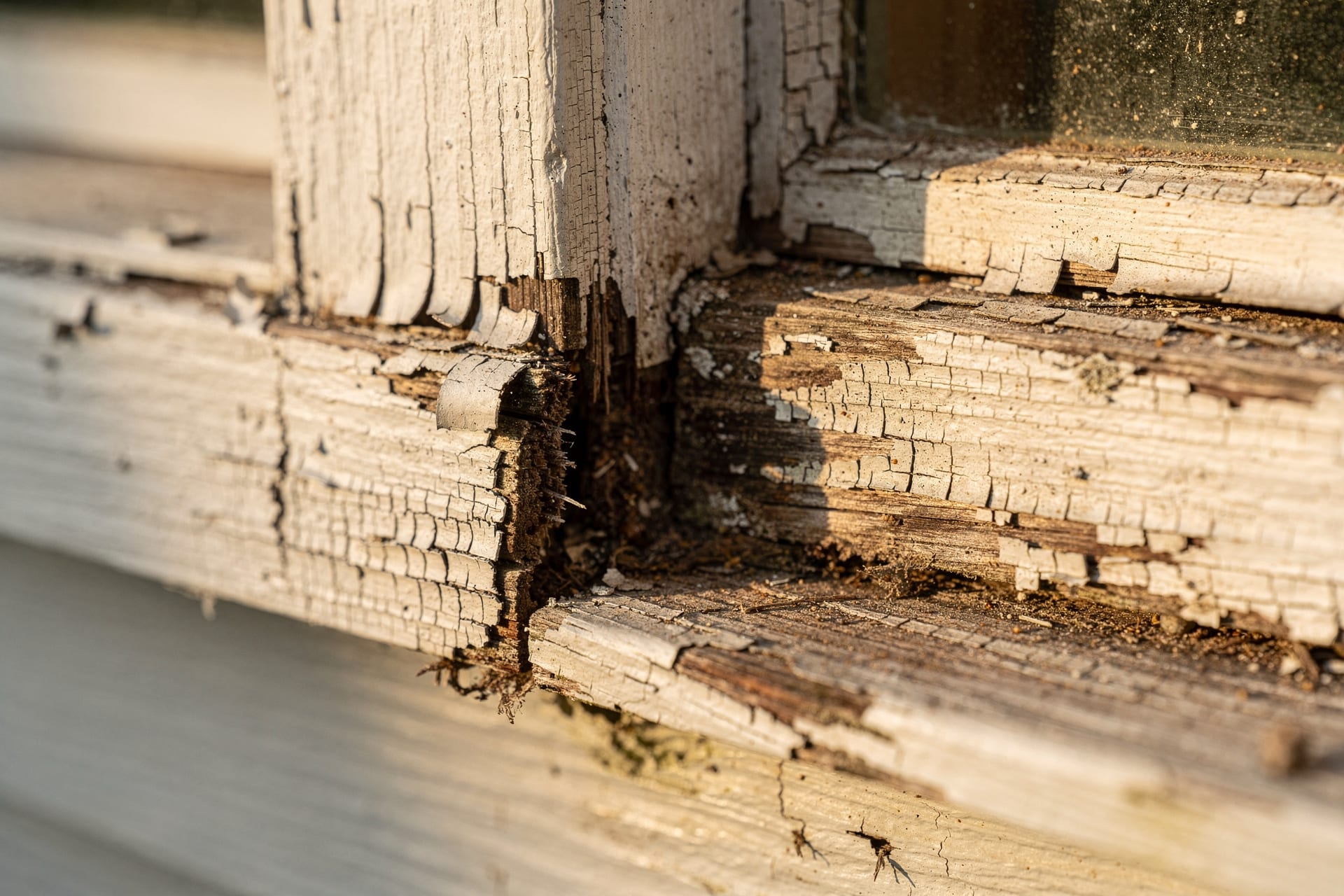
- It is not a rot fix. A storm panel over a rotting sill seals moisture in — the one thing wet wood needs less of. Sort the wood first: rotted sill triage is its own page.
- It won’t rescue a failed prime window. Broken sash cords, a sash that won’t stay up, glass that’s cracked through — a storm hides those problems from the street, not from the house. That’s repair-or-replace territory.
- The chore tax is real. Removable interior inserts go in and come out every year, and storage space for a houseful of panels is a genuine line item. Triple-track exteriors dodge this; budget the honesty either way.
- Condensation needs somewhere to go. Moisture between the prime window and the storm is normal in small amounts. Exterior weep holes exist to drain it — blocked weeps, or an interior insert over a leaky prime window, can pool water where you can’t see it.
What do storm windows cost next to replacement?
Roughly a quarter of the price — that’s DOE’s figure for low-e storms versus full window replacement, and it’s the only cost framing on this page you should carry into a decision. Storm-window money and replacement-window money are different orders of magnitude, and that’s the point of the product.
For scale, not for budgeting: one national supplier’s stock exterior storms run about $399 to $468 per unit, and custom orders through a local glass shop or lumber yard can come in under big-box pricing — the $250 lumber-yard story above is one attributed example, not a promise.
Interior insert makers price by the measured opening, so treat any insert number you read online as a guess.
What replacement actually costs is its own well-documented question, and it belongs next to these numbers when you decide: what replacement windows cost in NC.
One buying spec worth writing down before any of those calls: certified low-e storms carry an label, same as full windows — DOE’s purchasing guidance requires it. If a quoted panel has no label and no test data, you’re buying a sheet of glass with a story.
How I’d read it on your house
Here’s the order I’d work the question, anchored to what’s checkable. Is the sill and frame sound wood, or is there rot? Rot first, always. Does the prime window still operate — sash moves, locks, holds? If not, price the repair before the layer.
Then the address questions. Near the coast, check the windborne-debris map before anything on this page — code outranks savings. In a historic district, exterior changes may need approval, which often makes a wood-matched exterior storm or an invisible interior insert the path of least resistance.
If the answers come back “sound old window, real budget, no coastal rule” — that’s the storm-window house, and the numbers above are yours to claim.
And if you’re staring at a replacement quote wondering whether you even need it, that’s a fair question to ask out loud. Book a no-pressure consult and I’ll walk your actual windows with you — repair, layer, or replace, in that order of suspicion.
Sources, Verification & Fact-Checking verified July 2026
Every load-bearing fact on this page is sourced and verified against a primary authority.
Verified July 2026 via direct review of the cited authority — the links open the controlling source so you can check it yourself rather than take our word.
- Low-e storm windows over single-pane windows save about $350 a year (roughly 10% of heating and cooling costs) on EPA’s national-average estimate, with about a 3-year payback on incremental cost; replacing clear-glass storms with low-e adds about $50 a year (about 2%); EPA labels these estimates conservative because they exclude air-sealing gains. The same program page requires weep holes (or equivalent moisture drainage) on certified exterior units, notes low-solar-transmittance options for cooling climates, and names households where full replacement is difficult — including historic preservation districts — as target users. (view source — ENERGY STAR certified storm windows)
- Installing a low-e storm window over a low-performing window can reduce a home’s heating and cooling costs by 10% to 35%, at about one-quarter the price of full window replacement, per DOE’s published validation of the technology — field work performed through a national laboratory, with 90+ million U.S. homes cited as candidates and historic properties named as applicable. (view source — DOE EERE success story, low-e storm window validation)
- DOE’s purchasing guidance for residential storm windows requires qualifying units to be certified and labeled by the National Fenestration Rating Council (NFRC), and excludes storm windows without weep holes; it also describes the low-e mechanism — reflecting heat inward in winter and outward in summer. (view source — DOE FEMP, purchasing energy-efficient residential storm windows)
- Larson wound down its storm-window products — its product-bulletins page lists the interior and exterior storm-window lines (Performance, Premium, and Secure Pro series among them) as “no longer available for purchase” as of December 22, 2022, directing owners to customer support — and its current site navigation sells storm doors, screens, and replacement parts, with no storm-window product line. Stated from the company’s live pages (checked July 2026), because stale search listings still describe discontinued lines as current. (view source — Larson product bulletins)
- Stock exterior storm windows remain available from national suppliers at roughly $399 to $468 per unit (standard sizes, before installation), per a leading retailer’s live category pricing (checked July 2026) — cited as scale context, never as an NC installed quote. (view source — exterior storm window category pricing)
- Owner-reported market and product themes: the big-box vacuum (chains no longer stocking storm windows; a manufacturer dropping them from its lineup — owner-reported, not confirmed as company fact), the $250-delivered lumber-yard custom storm versus a $450 seamed big-box unit, the interior-storm trade-off (“it doesn’t protect your prime sash”), the seasonal-chore objection, and the celebrated storms-over-original-sash outcome — attributed to homeowner forum threads (July 2026: r/HomeImprovement “Storm Windows… do they yet exist?” and r/centuryhomes “Interior Storm Windows?” and the 1806-house post), reported as what homeowners say, never editorialized into company claims. Interior-insert makers named without pricing: Indow (custom-priced by measured opening; no public price list) and the WindowDressers nonprofit (owner-recommended community-build inserts).
- A storm window does not satisfy North Carolina’s windborne-debris (coastal impact) requirement: that rule is met by impact-rated glazing or approved shutter systems, and the code detail — wind-speed contours, test standards, compliance paths — is stated and sourced on the coastal-impact page rather than duplicated here. (see — impact windows on the NC coast)