

You typed “Marvin vs Pella” into a search bar and got a tug-of-war. One page crowns Marvin. The next talks you into Pella. A forum thread has thirty people arguing and nobody agreeing.
They’re mostly arguing about different windows that happen to share two premium names.
Both Marvin and Pella are manufacturers with wide ladders — fiberglass at one rung, wood and wood-clad higher up — sold through dealers and branded showrooms. So two honest people can review “Marvin” or “Pella” and describe completely different purchases.
This page pairs the lines fairly, keeps every brand-specific claim attributed, and flags anything I couldn’t independently confirm so nothing here reads as gospel it hasn’t earned.
Marvin or Pella — which is better? Neither wins outright. Both are premium manufacturers with genuinely good windows across their ladders. The comparison that settles it is line-to-line, not badge-to-badge: Marvin Essential vs Pella Impervia in fiberglass, Marvin Elevate vs Pella Lifestyle in wood-clad. Match the lines, then compare the numbers and the installed price on your actual quotes. The one gap most comparison pages skip — the finish warranty and who the coverage follows when you sell — is where these two genuinely separate.
Marvin vs Pella: the quick verdict
Stop comparing the brands and start comparing the lines — because up here the two ladders overlap more than they differ. The decision in one block:
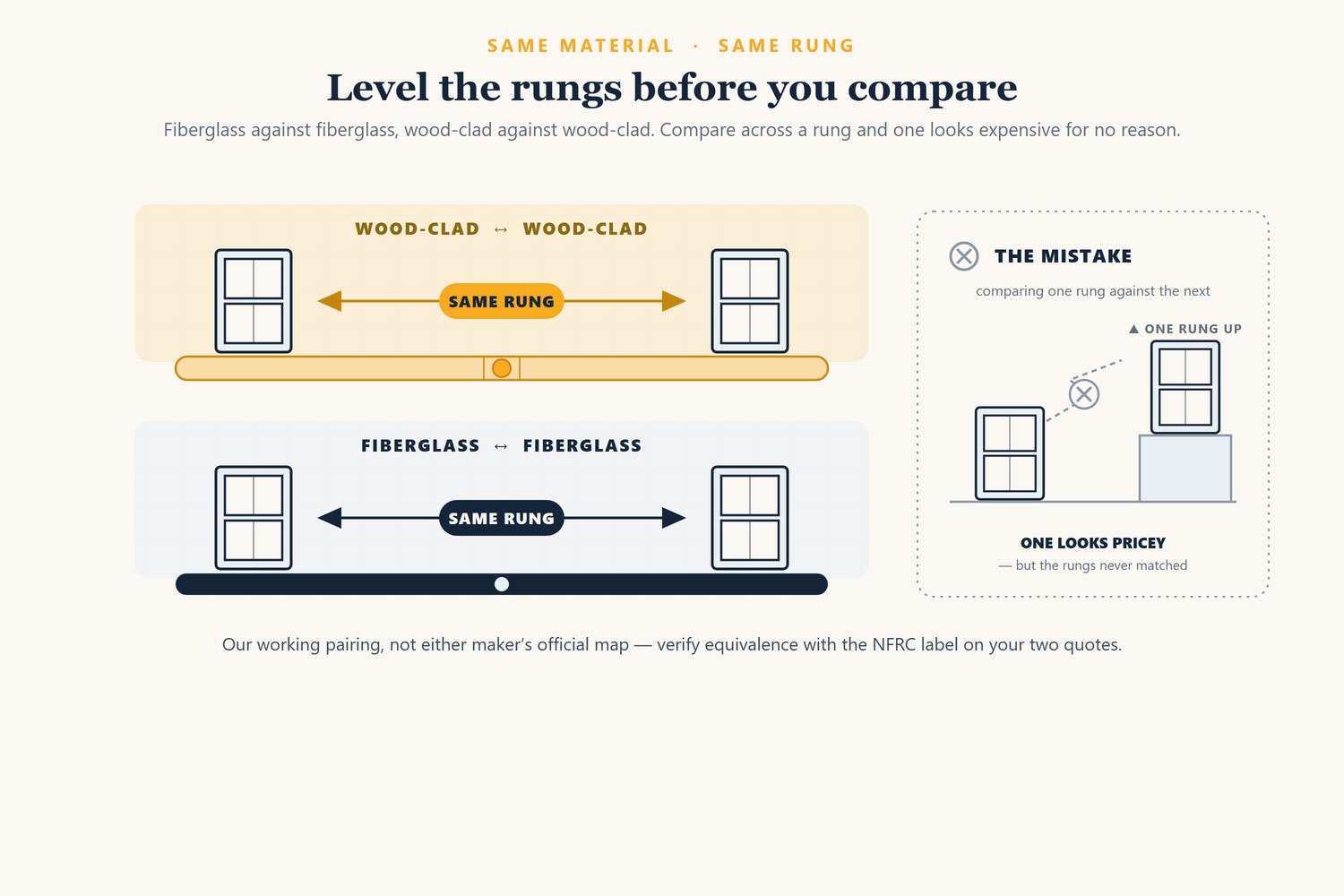
- The honest truth: a Marvin Essential and a Pella Impervia are the same rung — all-fiberglass windows aimed at the same buyer. A Marvin Elevate and a Pella Lifestyle are the same rung a step up — wood interior, tougher exterior. The rung matters more than the badge.
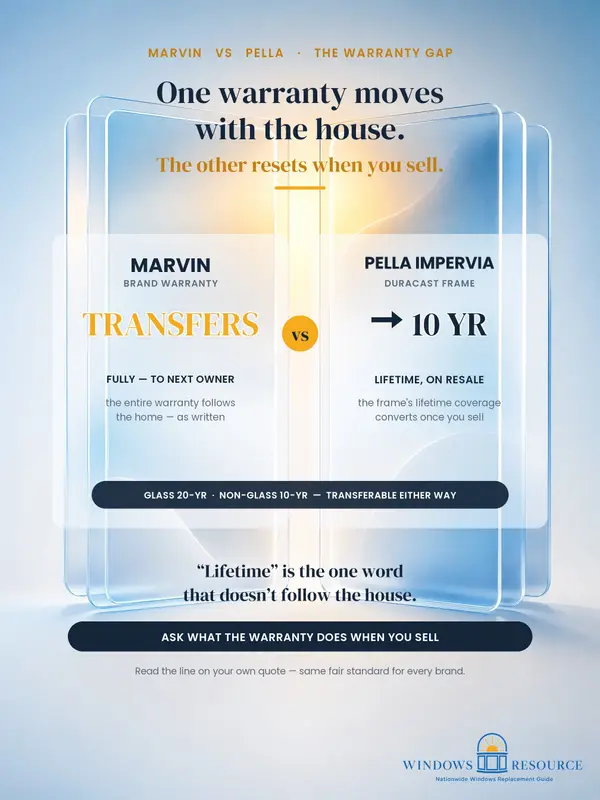
- The one gap worth the read: the warranties are not the same shape. Marvin’s brand warranty is fully transferable to the next owner. Pella Impervia’s lifetime coverage is tied to the original owner and converts to a shorter transferable term on sale. That difference, plus the finish coverage, is the sharpest real separator on this page.
Both make genuinely good windows across their ladders. The trap isn’t a bad brand — it’s comparing two different rungs, or missing the fine print that actually differs.
Which line is on your quote?
“Marvin vs Pella” is unanswerable until you name the line — so here’s the pairing buyers and builders actually use. Neither company publishes a crosswalk, so treat this as the working translation, then verify with the NFRC numbers on your quotes.
| Tier | Marvin | Pella | Honest note |
|---|---|---|---|
| Fiberglass, single-material | Essential (all Ultrex) | Impervia (all Duracast) | The most-searched pair, and the fairest fight on this page |
| Wood interior, mid | Elevate (wood + Ultrex exterior) | Lifestyle Series (wood + aluminum clad) | The wood-clad mid pair; compare catalog, dealer, and NFRC label |
| Flagship / architectural | Ultimate (wood + aluminum-clad) | Reserve / Architect Series | Custom territory — quotes here are a rung above the mid pair, not equal to it |
| Signature material story | Ultrex pultruded fiberglass | Duracast fiberglass (Pella's lineup adds between-the-glass blinds) | Different personalities; the label is still the fair comparison |
| How you buy it | Dealers and showrooms | Branded showroom, dealer/contractor, or big-box at the budget end | The channel moves the price as much as the line does |
Fiberglass, single-material
- Marvin
- Essential (all Ultrex)
- Pella
- Impervia (all Duracast)
- Honest note
- The most-searched pair, and the fairest fight on this page
Wood interior, mid
- Marvin
- Elevate (wood + Ultrex exterior)
- Pella
- Lifestyle Series (wood + aluminum clad)
- Honest note
- The wood-clad mid pair; compare catalog, dealer, and NFRC label
Flagship / architectural
- Marvin
- Ultimate (wood + aluminum-clad)
- Pella
- Reserve / Architect Series
- Honest note
- Custom territory — quotes here are a rung above the mid pair, not equal to it
Signature material story
- Marvin
- Ultrex pultruded fiberglass
- Pella
- Duracast fiberglass (Pella's lineup adds between-the-glass blinds)
- Honest note
- Different personalities; the label is still the fair comparison
How you buy it
- Marvin
- Dealers and showrooms
- Pella
- Branded showroom, dealer/contractor, or big-box at the budget end
- Honest note
- The channel moves the price as much as the line does
The practical takeaway is the same for both brands: the line is the real product name. “Marvin” or “Pella” on a quote tells you the manufacturer. The line and material tell you what you’re actually buying — and whether two quotes are even describing the same window.
Ultrex vs Duracast: the fiberglass head-to-head
Both are proprietary pultruded fiberglass doing the same job — a stiffer-than-vinyl frame that holds dark colors in hard NC sun — and each maker’s claims stay in its own mouth here.
Ultrex is Marvin’s pultruded fiberglass: glass fibers pulled through resin into a rigid profile, marketed for low thermal movement and stiffness. Duracast is Pella’s fiberglass, used for the Impervia line inside and out.
On the spec that matters for an NC hot wall — a frame that won’t soften or warp holding a dark exterior color — both are in the same class, and well clear of standard vinyl.
Marvin markets strength multipliers for Ultrex — figures like “stronger than vinyl” by some multiple. That’s Marvin’s marketing, not my measurement, and I’m leaving it in their mouth. The honest cross-brand read isn’t a strength slogan from either side. It’s the label.
Where owners actually split is fit and finish, and it’s worth being precise about what that is. In aggregated owner reviews, a recurring pattern is that Impervia’s surface reads as busier or less refined than Marvin’s, while Marvin’s joinery gets called clean.
That’s a labeled aesthetic preference, not a performance claim — the same owner discussions note the finish difference doesn’t necessarily change how the window performs. So don’t buy on someone else’s eye: go look at a Marvin corner and a Pella corner in person and trust yours.
The tiebreaker that isn’t an opinion: the NFRC label. and are measured identically for both materials. Compare the two labels on your two quotes and the material debate mostly resolves itself — here’s how to read the ratings, and here’s the deeper fiberglass read.
The warranty comparison most pages skip
Here’s the gap the ranking pages under-cover: the two warranties are shaped differently, and the difference is the single most useful thing to know before you sign. This directly answers the question owners ask most — is the warranty transferable?
Marvin publishes one cross-collection limited warranty covering all its collections. Owners shorthand it as “10/20”: 20 years on the insulating-glass seal (units up to 60 square feet; larger units get 10), 10 years on non-glass components. It’s fully transferable to the next owner as written.
One North Carolina carve-out worth knowing: within about a mile of salt water the 20-year cladding-finish term drops to 10, and specialty finishes aren’t covered at the coast.
Pella Impervia carries a lifetime component on the Duracast fiberglass — with a catch that matters for resale.
Pella’s own warranty makes the Duracast lifetime coverage nontransferable: it runs only as long as the original owner owns and occupies the home, and when the home sells (or stops being owner-occupied) it converts to a transferable 10-year term measured from the original date of sale.
The glass carries a transferable 20-year term and the non-glass components a transferable 10-year term, sale or no sale.
So the honest headline isn’t “Marvin’s warranty is better” — it’s narrower and truer: the frame’s lifetime piece is the one part that doesn’t follow the house, while Marvin’s whole warranty does.
Worth clearing up a myth here, because it usually runs the other way: the exterior finish warranty — chalking and fading — is not a wide gap at the fiberglass rung.
Read from each maker’s own document, both carry a transferable 10-year finish warranty: Pella Impervia’s exterior powder coat and Marvin’s standard exterior fiberglass finish are both 10 years.
The one place a finish-term gap actually opens is a rung up, on aluminum cladding: Marvin warrants its standard aluminum cladding finish for 20 years, where Pella’s aluminum EnduraClad finish is 10 — a real difference, but one that lives on the wood-clad and flagship tiers, not on an Essential-vs-Impervia fiberglass quote.
If a page tells you Pella’s finish coverage is only a year or two, check it against Pella’s actual warranty before you believe it.
Where each one wins
My take, labeled as opinion: each brand has a real, specific edge — and neither edge wins the whole decision. Fairly, both directions:
- Where Marvin has the edge: the fully transferable brand warranty and the long finish term are genuine, verifiable advantages if you might sell or you’re putting a dark color in hard sun. Many owners also prefer Ultrex’s finished surface — a real, if labeled, preference. (fact on the warranty; opinion on the surface)
- Where Pella has the edge: across its lineup Pella offers between-the-glass blinds and shades (tucked inside the insulating glass, so you never dust them — on Impervia patio doors and Pella’s wood lines) and hidden or retractable screens on several series — features Marvin doesn’t match. If blinds you never clean or a screen that disappears matter to you, that’s a genuine Pella win. At the fiberglass rung, an Impervia quote also often lands below an Essential quote, so if budget is the deciding axis, Pella frequently gets there for less. Pella’s broad ladder also gives you more entry-level options below the premium tier. (feature and price facts)
Neither list is a verdict. They’re the levers — pick the one that matches your house and how long you’ll own it.
Price posture — who’s more expensive?
Both sit premium, and both span a band so wide it’s almost a category rather than a price — so “which is cheaper” depends entirely on which line you put against which line. At the fiberglass rung, Impervia commonly undercuts Essential; step up to wood-clad and the order can flip on catalog and channel.
I’m deliberately not printing a dollar figure here, because any single number would be a national estimate dressed up as an NC fact — and each brand’s own range is too wide for one number to mean anything.
The broader cost levers — line, install type, glass package, window count — live on the cost page, and they usually move your total more than the brand name does.
Get your line’s price per opening, itemized, and compare it line-to-line. A budget-channel Pella and a showroom Marvin aren’t the same purchase, even before you reach the window.
Who each one fits
My take, labeled as opinion: pick by which rung and which edge fit your job — both brands are worth shortlisting. By scenario:
- You want all-fiberglass and you might sell the house someday → this is the Essential-vs-Impervia fight, and the transferable warranty tilts it toward Marvin if resale coverage matters to you. If it doesn’t, weigh Impervia’s lower price honestly. (opinion, resting on the verified transfer difference)
- You want a wood interior at the mid tier → Elevate vs Lifestyle, a genuine coin-flip. Compare the two catalogs, the local dealer or showroom, the NFRC labels, and the installed price. The wood-and-clad trade-offs and your own eye should settle it. (opinion)
- You want between-the-glass blinds or a hidden/retractable screen → those are real Pella-lineup features Marvin doesn’t match (the blinds on Impervia patio doors and Pella’s wood lines; the hidden and retractable screens on several Pella series); if you want them, they point to Pella. (fact)
- You want the lowest number at the fiberglass rung → Impervia often gets there for less, but compare both against good vinyl too, all on the NFRC label and the installed price. The label doesn’t care about the badge.
- You’re also weighing Andersen → same method, different matchup: the Marvin-vs-Andersen head-to-head and the Pella-vs-Andersen one run it.
Whichever way you lean, the two protective moves never change: get the line and NFRC numbers named in writing, and vet the installer like they’re the product — because with a manufacturer brand, half the time the install is the thing that decides whether the window performs.
So — Marvin or Pella?
Get both quotes, on the same rung, and let the labels and the warranties argue. Hand each dealer the same window count and configuration, insist on per-window itemization with the line, material, U-factor, and SHGC named, and ask each one, in writing, what the warranty does when you sell. Most of the brand question dissolves on its own.
For NC, keep two extra things in view. In hard sun, both fiberglass lines hold dark colors far better than vinyl — a real comfort-and-looks win on a west-facing wall. And on the coast, impact-rated glazing is a separate code matter from the energy label; confirm what your county requires before you compare glass packages.
NC homeowner takeaway: the myth to drop is that “Marvin vs Pella” has a single winner. It has pairings — Essential↔Impervia, Elevate↔Lifestyle, the flagship tiers — and the answer flips on which pairing, which channel, and how long you’ll own the house.
Match the rungs, read the two labels, read the two warranties, and vet the installer. The deeper reads: the full Marvin review, the full Pella review, and the rest of the head-to-heads.
Got a Marvin quote and a Pella quote and want a straight read on which line each one really is — and whose warranty actually follows your house? That’s exactly what a no-pressure second opinion is for.
Bring both. Same fair standard for each.
Sources, Verification & Fact-Checking verified July 2026
Every load-bearing fact on this page is sourced and verified against a primary authority.
Verified July 2026 via direct review of the cited authority — the links open the controlling source so you can check it yourself rather than take our word.
- Marvin’s current lineup and materials (five peer collections including Essential — all-Ultrex fiberglass inside and out — Elevate — wood interior with Ultrex fiberglass exterior — and Ultimate — wood interior with extruded-aluminum-clad exterior; Ultrex is Marvin’s proprietary pultruded fiberglass; no “Signature” umbrella): reused from this site’s Marvin review fact-check, itself confirmed against Marvin’s own product and compare-collections pages (fetched July 2026). Line names shift over time — confirm the current lineup before quoting from it. (view source — Marvin windows, official site · compare collections)
- Marvin warranty (“10/20” — 20 years on the insulating-glass seal for units up to 60 sq ft, 10 years on non-glass components; one cross-collection document; fully transferable to the next owner; coastal-finish carve-out within about a mile of salt water where the 20-year cladding-finish term drops to 10): reused from this site’s Marvin review fact-check, confirmed from Marvin’s official cross-collection Limited Warranty PDF, effective January 2026 (text-extracted July 2026). (view source — Marvin warranty index + PDF)
- Pella’s lineup and materials (manufacturer with a wide ladder; Impervia is Pella’s fiberglass line, built from Pella’s Duracast fiberglass — a five-layer pultruded fiberglass composite — with a powder-coat exterior finish meeting AAMA 624; Lifestyle Series is a wood/aluminum-clad line; Reserve and Architect Series sit at the flagship tier): confirmed July 2026 against Pella’s own Impervia product page and named as “Duracast” in Pella’s own Impervia limited-warranty PDF. (view source — Pella Impervia, official product page · Pella Impervia limited-warranty PDF)
- Between-the-glass blinds/shades and hidden/retractable screens are Pella-lineup features Marvin doesn’t match: Pella’s between-the-glass blinds and shades are offered on Impervia patio doors and Pella’s wood lines; the Hidden Screen appears on the 250 and Lifestyle series and the Integrated Rolscreen on Reserve — i.e. they span Pella’s ladder rather than shipping on every Impervia window. Confirmed via manufacturer-sourced grounded search, July 2026; framed as capabilities across Pella’s lineup, not a spec on the Impervia unit on your quote. (view source — Pella Impervia)
- Pella Impervia warranty — verified verbatim from Pella’s own PDF (©2020, effective Nov 30 2020–present, doc WPI1220): the Duracast material carries a Nontransferable Limited Lifetime Warranty to the original owner (“provided to the original homeowner and may not be assigned or transferred”), which the Transferable Ten-Year (10-Year) Limited Warranty “replaces … when you transfer ownership of your single-family home or cease to occupy your home”; glass is a Transferable Twenty-Year (20-Year) term; non-glass components a Transferable Ten-Year (10-Year) term. Text-extracted (pdftotext) this pass. (view source — Pella Impervia/fiberglass limited-warranty PDF · Pella warranty index)
- Exterior finish (chalk/fade) warranty — CORRECTED against both makers’ own documents: at the fiberglass rung the terms match — Pella Impervia’s exterior powder coat is a Transferable Ten-Year (10-Year) chalk/fade warranty, and Marvin’s “standard exterior fiberglass cladding finish is warranted … per AAMA 625-10, Section 5 for ten (10) years.” A finish-term gap exists only on aluminum cladding a rung up: Marvin’s standard aluminum cladding finish is warranted 20 years (AAMA 2605 §8.4/8.9), where Pella’s aluminum EnduraClad chalk/fade term is 10 years (Transferable). The single-source competitor figure putting Pella’s finish term at ~2 years is contradicted by Pella’s own warranty (the only 2-year Pella finish term is the interior factory finish on bay/bow frames) and is not printed. (Pella Impervia PDF · Pella wood/EnduraClad PDF · Marvin warranty PDF)
- Ultrex and Duracast are both proprietary pultruded fiberglass, stiffer than vinyl and better at holding dark exterior colors; any Marvin strength multiplier (“stronger than vinyl” by a stated factor) is Marvin’s attributed marketing, never adopted in Marc’s voice: Duracast confirmed as pultruded fiberglass composite from Pella’s Impervia page; Ultrex from Marvin’s pages (both July 2026); strength claims left attributed, no multiplier printed. (view source — Marvin, Ultrex; view source — Pella, Impervia/Duracast)
- Fit-and-finish “Marvin looks more refined than Impervia” is a labeled aesthetic preference, not a performance claim: attributed pattern from aggregated owner reviews, which themselves note the finish difference does not necessarily change window performance. Reported as a theme, never adopted as fact, and never used to disparage either brand. No verbatim owner quote and no single-thread attribution is printed on this page, so no single source thread is cited.
- Cost posture (both premium; wide national installed bands; Impervia commonly undercuts Essential at the fiberglass rung; order can flip a rung up): directional aggregate from national cost guides, never presented as a quote. No dollar figure printed in the body, by design — real NC numbers live on the cost page, and every quote should be compared line-to-line on a live bid.
- The NFRC label is the one fair comparison standard across both brands and all materials, with ENERGY STAR climate-zone targets as the benchmark for any glass package. Most of NC (Piedmont, coast, Sandhills) is the ENERGY STAR South-Central zone — target U-factor ≤ 0.28, SHGC ≤ 0.23 — while the mountain-west counties are North-Central (U-factor ≤ 0.25, SHGC ≤ 0.40); verified county-by-county against the live ENERGY STAR finder (2026-07-06). No NC target figure is stated in the body by design — the reader is routed to the energy-ratings page. Coastal NC wind-borne-debris zones separately require impact-rated (laminated) glazing as a code/safety matter distinct from energy ratings; the exact wind-speed contours are address-specific and set by the locally enforced code. (view source — NFRC; view source — ENERGY STAR criteria)
- The line-pairing table (Essential↔Impervia, Elevate↔Lifestyle, Ultimate↔Reserve/Architect): a working translation — labeled judgment supported by how buyers and builders commonly pair the lines, not either company’s official mapping. Line facts within it come from the manufacturer sources above; verify equivalence on your own quotes with the NFRC label.