
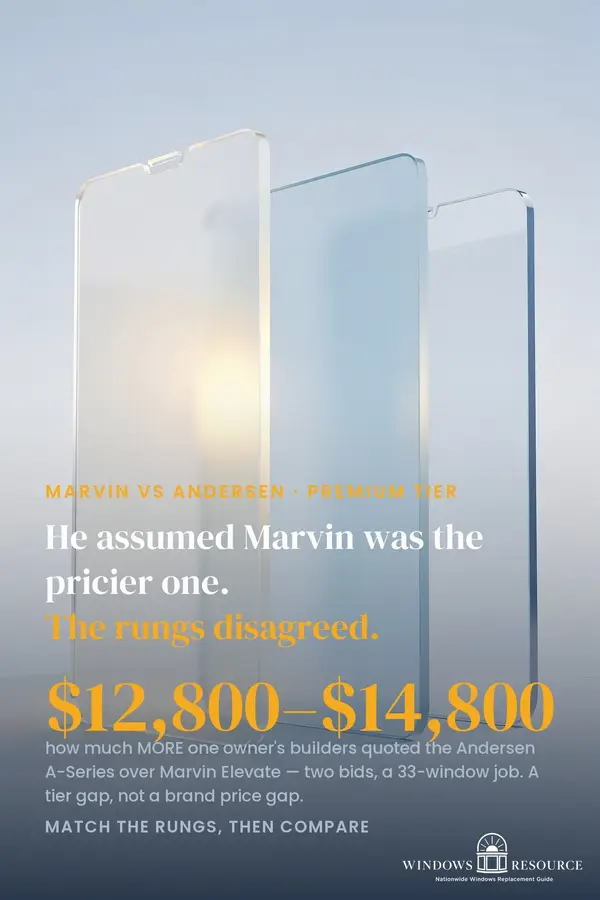

Here’s a real one from the building forums. A homeowner pricing 33 windows for a new build assumed Marvin would be the expensive quote — “I was under the impression that they would be about equal or Marvin a bit more.”
Then the Andersen bid came back $12,800 to $14,800 higher than the Marvin bid.
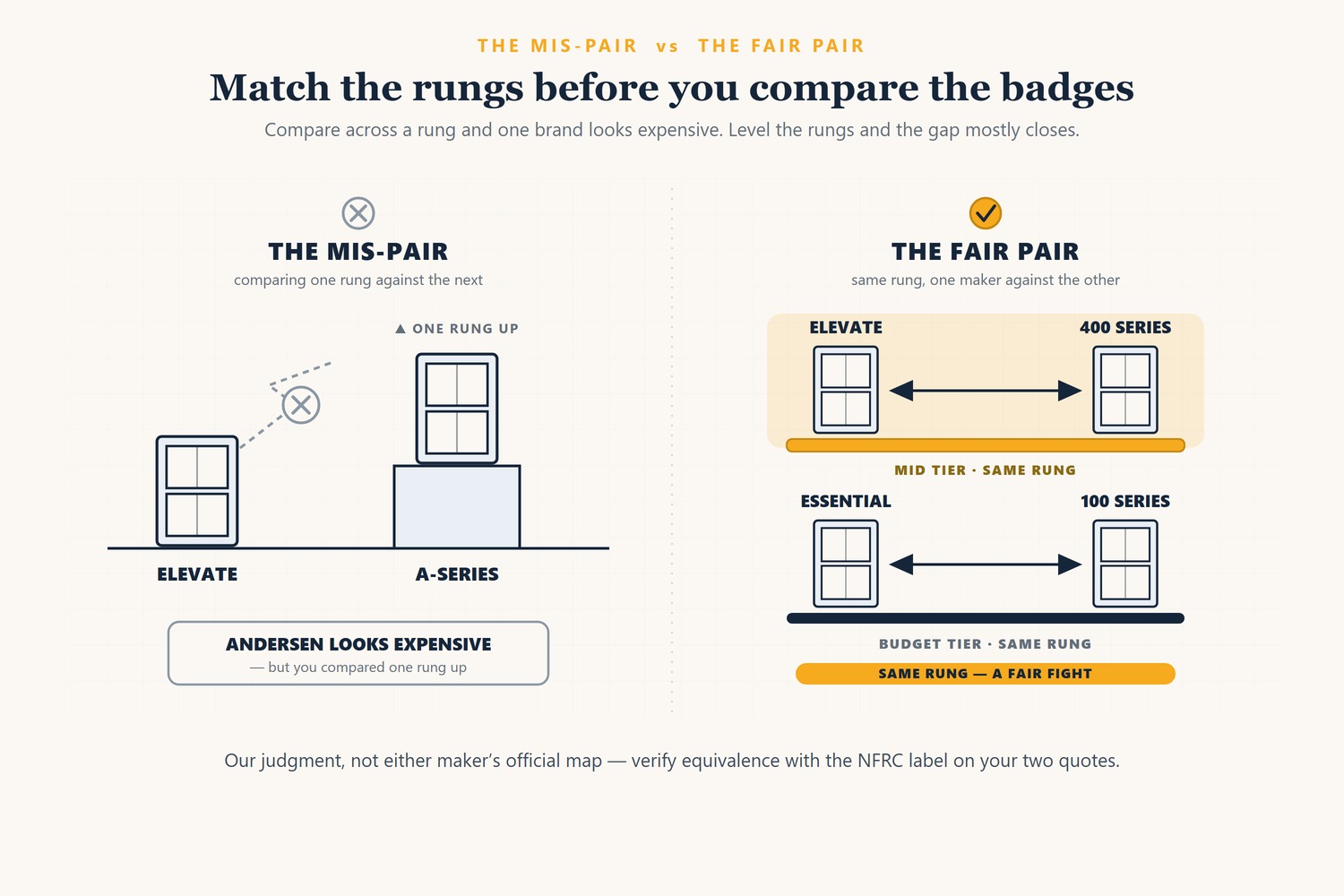
The thread’s diagnosis took one comment. He wasn’t comparing brands — he was comparing rungs, one apart. “Elevate would be similar to the Anderson 400 series,” a commenter told him. “A series I would think is a level up from Elevate… pick the window you prefer and have the builders quote the same.”
That’s this whole page in miniature. Marvin and Andersen are both premium manufacturers with laddered lineups, and almost every “which brand is better” argument is secretly two people standing on different rungs. This page lines the current rungs up — from each maker’s own documents, sourced below — so your two quotes describe the same window.
Marvin or Andersen — which is better? Neither wins outright — both are premium manufacturers with genuinely good windows across their ladders. The comparison that settles it is line-to-line, not badge-to-badge: Marvin’s five collections plus its Infinity replacement brand, against Andersen’s 100-to-E-Series ladder plus its Renewal division. Match the rungs, then compare the NFRC numbers and installed price on your actual quotes. Here’s the honest breakdown: both current line maps verified from each maker’s own pages, prices kept as attributed context, and my opinion labeled as opinion.
What are Marvin’s current lines?
Marvin’s main lineup is five peer collections — Ultimate, Modern, Vivid, Elevate, and Essential — plus a separate replacement brand, Infinity by Marvin. That’s from Marvin’s own current pages, and the “current” part matters.
A heads-up if you’ve been reading older comparisons: many still group Marvin’s premium lines under a “Signature” family. Marvin’s current site doesn’t — the five collections sit as peers, and “Signature” survives mainly on the coastal impact warranty (“Signature Coastline”). Two of the top-ranking comparison pages on this exact search still use the stale grouping.
The quick shape, cheapest lane to flagship:
- Essential — Ultrex fiberglass inside and out; the streamlined value collection.
- Elevate — wood interior, Ultrex fiberglass exterior; the in-demand traditional mid lane.
- Ultimate, Modern, and Vivid — the premium, architectural end: wood-and-aluminum-clad (Ultimate), aluminum-and-fiberglass contemporary (Modern), and the newer big-glass Vivid.
- Infinity by Marvin — a separate all-Ultrex replacement brand with its own retrofit dealer network. If you’re replacing windows in an existing NC home, this is often the Marvin that shows up.
Ultrex, the material doing the heavy lifting across that list, is Marvin’s proprietary pultruded fiberglass. The full collection-by-collection read lives on the Marvin review.
What are Andersen’s current series?
Andersen runs a series ladder — 100, 200, 400, A-Series, E-Series — sold through dealers and lumberyards, plus a separate wholly-owned replacement division, Renewal by Andersen. Also from the company’s own pages.
- 100 Series — the budget line, all Fibrex composite.
- 200 Series — the value wood-interior line, Perma-Shield vinyl exterior, popular sizes.
- 400 Series — the wood-interior flagship, vinyl or Fibrex cladding — what most contractors mean when they just say “an Andersen.”
- A-Series and E-Series — the premium custom tier: architectural shapes, composite/fiberglass or extruded-aluminum exteriors.
- Renewal by Andersen — not a series but a different purchase: a full-service division that sells, builds, and installs one Fibrex line as a packaged project.
Fibrex is Andersen’s proprietary composite — the company describes it as roughly 40% reclaimed wood fiber and 60% thermoplastic polymer. The series-by-series read lives on the Andersen review.
Which Marvin rung matches which Andersen series?
Here’s the practical pairing buyers and builders actually use — my judgment plus the forum consensus, not either company’s official map. Neither manufacturer publishes a crosswalk, so treat this as the working translation, then verify with the NFRC numbers on your quotes.
| Tier | Marvin | Andersen | Honest note |
|---|---|---|---|
| Budget, single-material | Essential (all Ultrex) | 100 Series (all Fibrex) | The all-composite-or-fiberglass entry pair; compare on the NFRC label |
| Wood interior, mid | Elevate (wood + Ultrex exterior) | 400 Series (wood + vinyl/Fibrex clad) | The most-searched pair, and the fairest fight on this page |
| Value wood interior | — (no direct twin) | 200 Series | Andersen's simpler wood line sits between the budget pair and the mid pair |
| Premium / architectural | Ultimate, Modern, Vivid | A-Series, E-Series | Custom territory — quotes here are one rung above the mid pair, not equal to it |
| Replacement channel | Infinity by Marvin | Renewal by Andersen | The head-to-head an NC retrofit buyer actually meets — details below |
Budget, single-material
- Marvin
- Essential (all Ultrex)
- Andersen
- 100 Series (all Fibrex)
- Honest note
- The all-composite-or-fiberglass entry pair; compare on the NFRC label
Wood interior, mid
- Marvin
- Elevate (wood + Ultrex exterior)
- Andersen
- 400 Series (wood + vinyl/Fibrex clad)
- Honest note
- The most-searched pair, and the fairest fight on this page
Value wood interior
- Marvin
- — (no direct twin)
- Andersen
- 200 Series
- Honest note
- Andersen's simpler wood line sits between the budget pair and the mid pair
Premium / architectural
- Marvin
- Ultimate, Modern, Vivid
- Andersen
- A-Series, E-Series
- Honest note
- Custom territory — quotes here are one rung above the mid pair, not equal to it
Replacement channel
- Marvin
- Infinity by Marvin
- Andersen
- Renewal by Andersen
- Honest note
- The head-to-head an NC retrofit buyer actually meets — details below
The forum thread from the intro is what happens when this table is missing: an A-Series (one rung up) quoted against an Elevate (mid rung), and a buyer concluding “Andersen costs more.” Match the rungs before you compare the badges.
Ultrex vs Fibrex: what’s the actual material difference?
Both are proprietary composites doing the same job — a stiffer-than-vinyl frame that holds dark colors in hard sun — but they’re built differently, and each maker’s claims stay in its own mouth here.
Ultrex is Marvin’s pultruded fiberglass — glass fibers pulled through resin into a rigid profile. Low thermal movement and stiffness are its verified selling points, and the owner loyalty around it is real.
Fibrex is Andersen’s wood-plastic composite — roughly 40% reclaimed wood fiber, 60% thermoplastic polymer, by Andersen’s own description. Andersen claims it’s “twice as strong as vinyl.” That’s Andersen’s marketing, not my measurement.
Owners argue this matchup hard, and honestly, it’s unsettled. One camp ranks fiberglass above Fibrex outright. The other side points out that Andersen’s mid-ladder cladding wraps “a solid wood core” they value over a hollow fiberglass profile. Both are attributed owner opinions — I’m not adopting either.
One owner in these threads has both brands on the same property — Andersen 400s in the house, two Marvins on the garage — and his read is the most useful of all: the Andersens “look more like furniture,” the Marvins are “a little more utilitarian in appearance” — and “their both solid products, the installer is where it goes wrong.”
The tiebreaker that isn’t an opinion: the label. and are measured identically for both materials. Compare the two labels on your two quotes, and the material debate mostly resolves itself — here’s how to read the ratings, and here’s the deeper fiberglass read.
Is Marvin more expensive than Andersen?
There is no brand-level answer — and I can show you the receipts. Three live owner threads on this exact decision, three different outcomes:
- A new build, budget pair: Andersen 100 quoted at $27,000 against Marvin Essential at $29,000 — Marvin higher, by a little. (Owner-reported figures, not NC quotes.)
- A new build, mis-paired rungs: Andersen A-Series quoted $12,800 to $14,800 above Marvin Elevate — Andersen higher, by a lot, because the rungs were one apart.
- A replacement job: the contractor had gotten a good deal on the Andersen 400 and recommended it over Marvin Essential — Andersen cheaper, because of the channel and the deal.
Same two brands. The premium flipped all three ways. The rung and the channel move the number more than the badge does.
For directional context only: national aggregators put Marvin roughly at $900 to $2,500 per window installed and Andersen roughly at $400 to $4,000 — bands that overlap so much they answer nothing at brand level. Your number lives on a live, itemized quote.
Two quote-reading tips from inside those threads, both attributed. On the budget pair, watch the add-ons: a Marvin regional manager posting in the budget-pair thread noted that Essential with extension jambs “do approach elevate pricing” — the rung can drift upward on paper. And on a new build, lead time is a real decision axis alongside price — delivery windows shift, so ask both dealers for current ones.
Marvin quotes carry one more lever worth knowing: owners report the same Marvin package coming back roughly 20% apart between dealers. Shop the dealer, not just the brand — the full story is on the Marvin review, and any bid that still looks strange goes through the quote sanity-check.
How do the warranties compare?
Here’s an honest asymmetry: I can print Marvin’s terms, because they’re one current document — and I won’t print Andersen’s year-terms, because they vary by series. That difference in structure is itself the most useful thing to know.
Marvin publishes a single cross-collection limited warranty naming all five collections. Owners shorthand it as “10/20”: 20 years on the insulating glass seal (units up to 60 square feet; larger units get 10), 10 years on non-glass components and hardware. It’s fully transferable to the next owner.
One North Carolina-specific carve-out: within about a mile of salt water, the 20-year cladding-finish term drops to 10, and specialty finishes aren’t covered at the coast. Coastal impact products carry a separate document — the “Signature Coastline” warranty.
Andersen publishes a limited warranty whose terms vary by series and component. I’m deliberately not quoting year-terms — public sources print conflicting ones, and the honest move is to read the current document for the exact series on your quote.
That’s not a knock on Andersen. When the claim process works, it can work well: one owner reported a stress-cracked sash claimed by video call and a paint-matched replacement sash arriving in a little over a week, free — with the selling dealer long out of business. Attributed anecdote, and a fair balance to the service complaints the Andersen review reports.
Either way, the question that matters most in year three is local, not corporate: who honors the labor side of an install problem? Get that in writing from whoever installs.
Infinity vs Renewal by Andersen: the replacement-channel head-to-head
If you’re replacing windows in an existing North Carolina home, this — not the dealer ladders — is often the head-to-head you actually get quoted. Both companies run a dedicated replacement arm, and the two arms are built differently.
- Infinity by Marvin is a separate all-Ultrex product brand sold and installed through its own retrofit dealer network. Its warranty is limited-lifetime for owner-occupants — with two catches worth knowing: you must register within 60 days to get the lifetime term at all, and it isn’t fully transferable (sell the house and it reverts to the remaining 10/20 term). Infinity Replacement locations add a separate five-year installation warranty.
- Renewal by Andersen is a wholly-owned full-service division — in-home sale, one Fibrex product line, their own crews, the whole job priced as one project. It’s a different purchase model, not just a different window, and it’s reviewed on its own terms on the Renewal by Andersen review.
So the replacement matchup isn’t symmetric: Infinity sells you a window through a retrofit network; Renewal sells you a finished project. Compare an Infinity bid and a Renewal bid the same way as everything else on this page — name the product, name what the price includes, and put the NFRC numbers side by side.
Who fits which?
My take, labeled as opinion: pick by which rung and which purchase model fit your job — the brands themselves are both worth shortlisting. By scenario:
- You want a wood interior at the mid tier → this is the Elevate-vs-400 fight, the fairest on the board. Both pair a wood interior with a tougher exterior. Compare catalogs, the local dealer, the NFRC labels, and the installed price — a genuine coin-flip. (opinion)
- You want maximum fiberglass and plan to keep the house → Marvin’s all-Ultrex lanes (Essential, or Infinity on a replacement) are the natural lane, and the owner loyalty is real. (opinion)
- You want the budget composite pair → Essential vs 100 Series, and honestly, the threads split on it. Compare both against good vinyl too, all on the label and the installed number. Watch the extension-jamb line item.
- You want one company to own the whole replacement project → that’s Renewal’s model. Weigh it against an Infinity bid and a dealer-channel bid, because the full-service premium is real and sometimes worth it.
- You’re also weighing Pella → same method, different matchup: the Pella-vs-Andersen head-to-head runs it.
Whichever way you lean, the two protective moves never change: get the line and NFRC numbers named in writing, and vet the installer like they’re the product. One owner of both brands said it cleanest: both are solid — “the installer is where it goes wrong.”
So — Marvin or Andersen?
Get both quotes, on the same rung, and let the labels argue. Hand each dealer the same window count and configuration, insist on per-window itemization with the line, material, U-factor, and SHGC named, and most of the brand question dissolves on its own.
A commenter in the Essential-vs-100 thread closed the whole debate better than I can. Shopping these two on the badge, he wrote, is “the window version of coke vs pepsi” — what should actually decide it is who can sell you the better U-factor.
NC homeowner takeaway: the myth to drop is that “Marvin vs Andersen” has a winner. It has pairings — Essential↔100, Elevate↔400, the premium tiers, Infinity↔Renewal — and the price flips depending on which pairing and which channel you’re standing in. Match the rungs, read the two labels, vet the installer. The deeper reads: the full Marvin review, the full Andersen review, and the rest of the head-to-heads.
Got a Marvin quote and an Andersen quote and want a straight read on which rung each one really is — and whether they’re even comparable? That’s exactly what a no-pressure second opinion is for.
Bring both. Same fair standard for each.
Sources, Verification & Fact-Checking verified July 2026
Every load-bearing fact on this page is sourced and verified against a primary authority.
Verified July 2026 via direct review of the cited authority — the links open the controlling source so you can check it yourself rather than take our word.
- Marvin’s current lineup is five peer collections — Ultimate, Modern, Vivid, Elevate, Essential — with Ultrex as Marvin’s proprietary pultruded fiberglass, and no “Signature” umbrella (that framing persists on older comparison pages; “Signature” now appears mainly on the coastal impact warranty): confirmed against Marvin’s own product and compare-collections pages (fetched July 2026, verified for the Marvin review’s fact-check and reused here). (view source — Marvin windows, official site · compare collections)
- Marvin warranty (“10/20” — 20 years on the insulating glass seal for units up to 60 sq ft, 10 years on non-glass components; one cross-collection document naming all five collections; fully transferable; coastal-finish carve-out within about a mile of salt water; separate “Signature Coastline” impact warranty): confirmed from Marvin’s official cross-collection Limited Warranty PDF, effective January 12, 2026 (fetched and text-extracted July 2026). (view source — Marvin warranty index + PDF)
- Infinity by Marvin is a separate all-Ultrex replacement brand with its own retrofit network; limited-lifetime warranty for owner-occupants (glass seal 20 years, finish 10), registration required within 60 days, NOT fully transferable (reverts to the remaining 10/20 term on sale), plus a five-year installation warranty at Infinity Replacement locations: confirmed from Infinity’s warranty page and Limited Lifetime Warranty PDF, effective January 4, 2026 (fetched and text-extracted July 2026). (view source — Infinity by Marvin warranty)
- Andersen’s series ladder (100 = all-Fibrex budget; 200 = wood-interior value with Perma-Shield vinyl exterior; 400 = wood-interior flagship with vinyl or Fibrex cladding; A-Series = architectural with composite/fiberglass exterior; E-Series = wood interior with extruded-aluminum exterior) and the two-company structure (Andersen Corporation sells through dealers/lumberyards with install on the buyer; Renewal by Andersen is its wholly-owned full-service replacement division): confirmed July 2026 against both companies’ own sites. Andersen’s warranty is reported structure-only (limited; terms vary by series and component) with no year-terms printed, by policy — read the current document for the series on your quote. (view source — Andersen, Windows; view source — Renewal by Andersen)
- Fibrex composition (about 40% reclaimed wood fiber / 60% thermoplastic polymer) and “twice as strong as vinyl”: the composition is Andersen’s own published figure and the strength claim is Andersen’s attributed marketing, never adopted in Marc’s voice — verified July 2026 from Andersen’s material page. (view source — Andersen, Fibrex)
- Cost bands (Marvin roughly $900–$2,500 per window installed; Andersen roughly $400–$4,000, national context): directional aggregates from national cost guides, re-fetched live July 2026 for this page — both bands confirmed verbatim — and never presented as quotes: hedged in the body and routed to a live, itemized bid. (view source — Marvin cost overview · Andersen cost overview)
- The price-flip evidence and quote-reading tips (Andersen 100 at $27k vs Marvin Essential at $29k; Andersen A-Series quoted $12.8k–$14.8k above Marvin Elevate, with the same-rung diagnosis “Elevate would be similar to the Anderson 400 series… pick the window you prefer and have the builders quote the same”; a contractor’s deal putting Andersen 400 under Marvin Essential; the extension-jambs pricing drift; the furniture-vs-utilitarian both-owner comparison; “the installer is where it goes wrong”; the video-call warranty-claim anecdote; “the window version of coke vs pepsi”; the ~20% Marvin dealer spread): attributed homeowner-forum reporting — r/Homebuilding “Marvin Essentials vs Andersen 100 Windows” (2022), r/Homebuilding “Marvin Elevate vs Anderson A series pricing” (2024), and r/HomeImprovement “Anderson 400 Series vs Marvin Essential” (2023), all live-checked and quote-verified July 2026. Owner-reported figures and opinions, never NC facts or company claims.
- The rung-matching table (Essential↔100, Elevate↔400, Ultimate/Modern/Vivid↔A/E-Series, Infinity↔Renewal): a working translation — labeled judgment supported by the forum consensus above, not either company’s official mapping. Line facts within it come from the manufacturer sources in this list; verify equivalence on your own quotes with the NFRC label.