

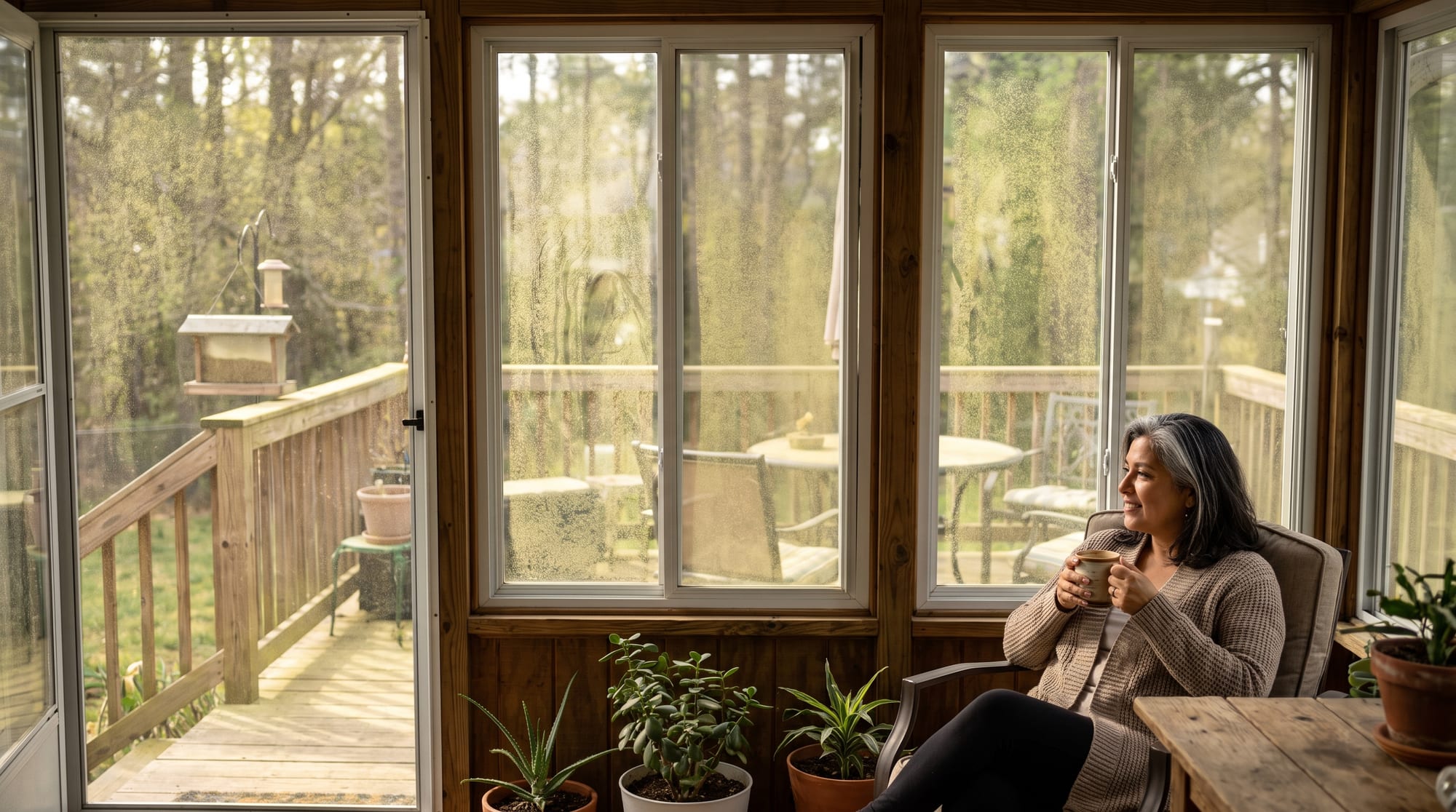
You already have the patio. You just can’t use it half the year.
Too many bugs in July. Too much pollen in April. Unusable the first evening the weather turns. So the furniture sits out there collecting a yellow film, and the room you paid for with the house goes to waste.
Closing it in fixes that — but “patio enclosure” isn’t one thing. It’s a four-rung ladder that runs from cheap mesh screens all the way up to a glassed, heated room. This page lays out the whole spectrum honestly, so you can find your rung instead of getting walked straight to the top of the ladder.
It’s part of the sunrooms decisions hub; the screens-only deep dive lives on what a screen room is, and the dollars live on what a sunroom costs in NC.
What is a patio enclosure, and which kind do I need? A patio enclosure is any way of closing in an existing patio or porch — a four-rung ladder: screen room (bugs out, everything else in), vinyl-panel enclosure (Eze-Breeze-type — blocks pollen, rain, and wind, opens for a breeze, usable into winter with a heater), 3-season glass (weather out, temperature mostly not), and 4-season glass (a true insulated, heated room). Buy the rung that matches the months and hours you’ll really be out there — not the most expensive one on the truck.
What a patio enclosure actually is: the four-rung ladder
A patio enclosure is the umbrella term for closing in an existing patio or covered porch — with anything from mesh screens to insulated glass. The vocabulary is loose and the sales pitches are louder than the definitions, so here’s the honest decoder before anyone quotes you.
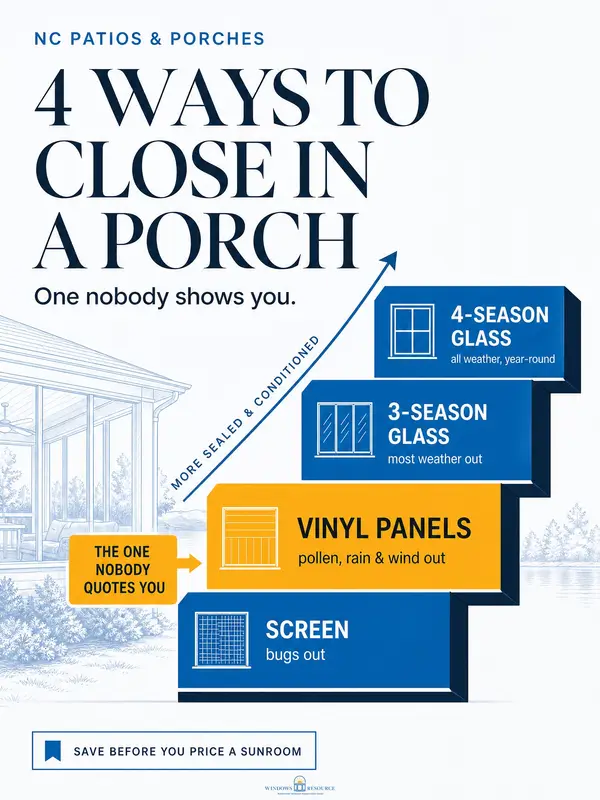
Picture it as one ladder with four rungs, each keeping out more weather — and costing more — than the last:
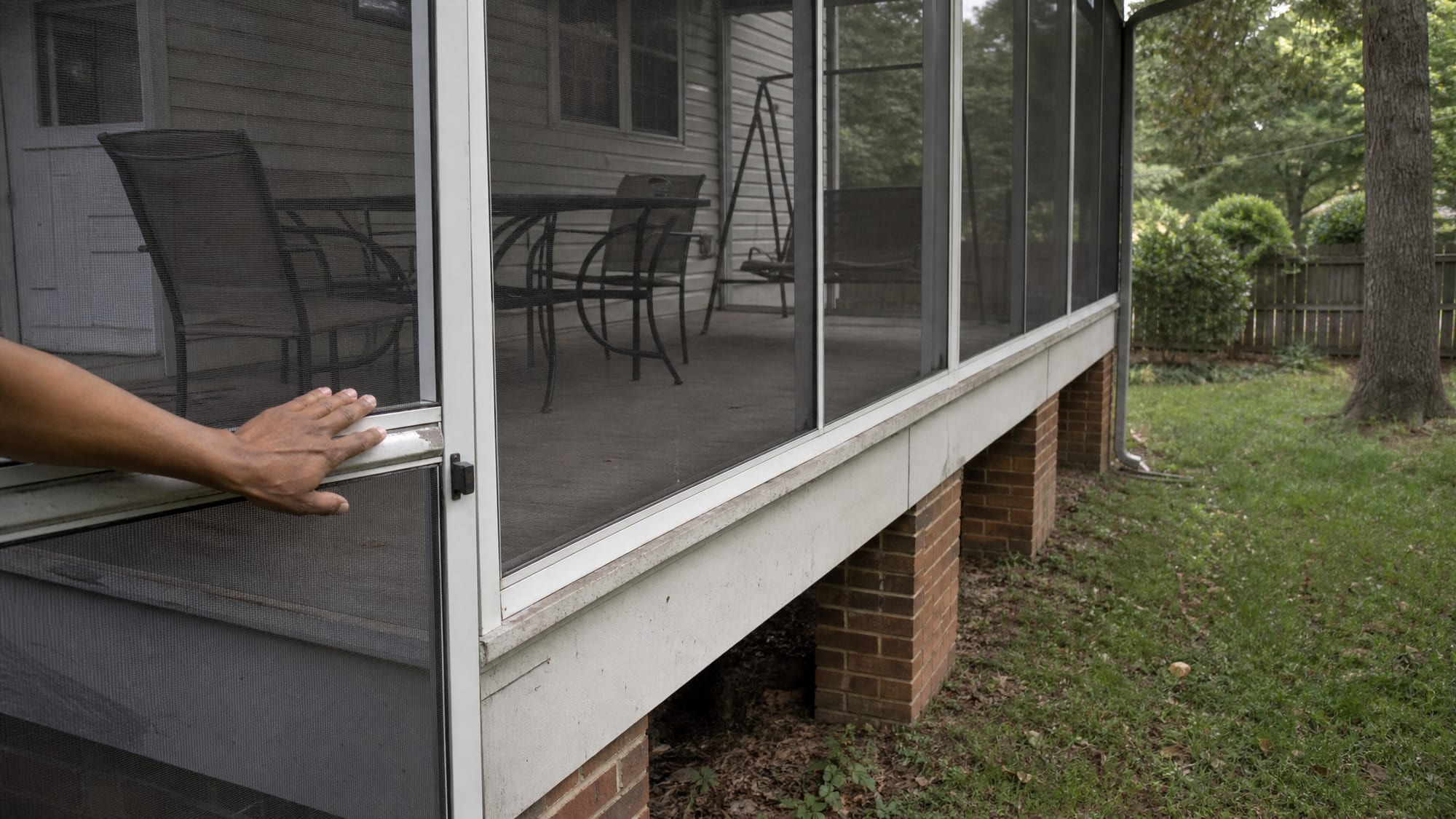
- Screen room — framed mesh panels under a solid roof. Bugs out, breeze in, everything else straight through. The lightest, cheapest rung.
- Vinyl-panel enclosure — flexible vinyl-glazed panels (the Eze-Breeze category) in a framed opening. Blocks pollen, rain, and wind; the panels slide open for airflow. The middle rung most rankers skip.
- 3-season glass room — real windows, often set over kneewalls. Weather stays out; temperature mostly doesn’t. Edging into sunroom territory.
- 4-season glass room — insulated walls, roof, floor, and glass, tied into heating and cooling. A true year-round room, built to addition standards.
The enclosure ladder — four rungs, one porch
Each step right keeps out more weather and costs more. Word labels only; the dollar bands live on the cost page.
Same porch, four different lives out there. The rest of this page is about matching the rung to yours.
Screen or glass: which enclosure is right for an NC patio?
No rung is “the best” — each buys a different amount of the year, and the honest move is to buy the one that matches the months and hours you’ll really be out there. Here’s the whole ladder side by side, in what living on each rung is actually like in North Carolina.
| What you're deciding | Screen room | Vinyl-panel (Eze-Breeze type) | 3-season glass | 4-season glass |
|---|---|---|---|---|
| Keeps out | Bugs and leaves | Bugs, pollen, wind, rain | Bugs and most weather | Bugs and all weather |
| Temperature inside | Whatever the yard is doing | Wind and chill cut; a small heater stretches it | Softened, not controlled | Climate-controlled, year-round |
| When you'll actually use it (NC) | Warm months, mostly evenings | Spring through fall, plus winter with a heater | Roughly spring through fall | All twelve months |
| The build | Mesh panels on the existing slab or deck | Vinyl-glazed panels in a framed opening, often over an existing porch | Windows, often over kneewalls; frequently a porch conversion | Insulated walls, roof, floor, and glass — addition-level |
| Clarity and longevity | Mesh (not applicable) | Vinyl — less clear than glass, can haze over years | Real single-pane glass | Insulated Low-E glass |
| Cost tier | Lowest | Low-to-middle | The middle rung | Top rung — a different budget conversation |
| Counts as heated square footage? | No — zero | No | Usually not | Yes, if built to code |
| Upgrade path | Glass it in later | Swap panels or convert to glass later | Condition and insulate later | Top of the ladder |
Keeps out
- Screen room
- Bugs and leaves
- Vinyl-panel (Eze-Breeze type)
- Bugs, pollen, wind, rain
- 3-season glass
- Bugs and most weather
- 4-season glass
- Bugs and all weather
Temperature inside
- Screen room
- Whatever the yard is doing
- Vinyl-panel (Eze-Breeze type)
- Wind and chill cut; a small heater stretches it
- 3-season glass
- Softened, not controlled
- 4-season glass
- Climate-controlled, year-round
When you'll actually use it (NC)
- Screen room
- Warm months, mostly evenings
- Vinyl-panel (Eze-Breeze type)
- Spring through fall, plus winter with a heater
- 3-season glass
- Roughly spring through fall
- 4-season glass
- All twelve months
The build
- Screen room
- Mesh panels on the existing slab or deck
- Vinyl-panel (Eze-Breeze type)
- Vinyl-glazed panels in a framed opening, often over an existing porch
- 3-season glass
- Windows, often over kneewalls; frequently a porch conversion
- 4-season glass
- Insulated walls, roof, floor, and glass — addition-level
Clarity and longevity
- Screen room
- Mesh (not applicable)
- Vinyl-panel (Eze-Breeze type)
- Vinyl — less clear than glass, can haze over years
- 3-season glass
- Real single-pane glass
- 4-season glass
- Insulated Low-E glass
Cost tier
- Screen room
- Lowest
- Vinyl-panel (Eze-Breeze type)
- Low-to-middle
- 3-season glass
- The middle rung
- 4-season glass
- Top rung — a different budget conversation
Counts as heated square footage?
- Screen room
- No — zero
- Vinyl-panel (Eze-Breeze type)
- No
- 3-season glass
- Usually not
- 4-season glass
- Yes, if built to code
Upgrade path
- Screen room
- Glass it in later
- Vinyl-panel (Eze-Breeze type)
- Swap panels or convert to glass later
- 3-season glass
- Condition and insulate later
- 4-season glass
- Top of the ladder
Notice the middle two rungs overlap in the messy real world — a loaded vinyl enclosure and a bare 3-season glass room can land close on both comfort and price. When quotes cluster there, compare what each actually keeps out and how clear the panels stay, not the label on the brochure.
The rung nobody quotes you: vinyl-panel enclosures
The middle rung — flexible vinyl-glazed panels, the Eze-Breeze category — is the one most product pages skip, and it’s the one that fits a lot of NC porches: it blocks the pollen and rain a screen can’t, opens up for a breeze like a screen can, and gets used well past when a screen room goes cold.
If you’ve only been shown “screens or a real sunroom,” this is the option that went missing.
Here’s what the panel system actually does. The panels are vinyl glazing, not glass — they slide open anywhere from half to fully open for airflow, then close against wind, rain, and the Carolina pollen that screens wave right through. Eze-Breeze, the best-known maker, has built them since 1980 and states the panels block 99% of UV.
The part that surprises people is the winter.
Because the panels close out wind and rain, a vinyl enclosure with a small supplemental heater is commonly usable into deep NC winter — the most consistent thing homeowners say about these rooms is that they use them far later into the year than they expected.
In our mild-but-real winters, that stretches a warm-month porch into a most-of-the-year room without paying for a full glass build.
Now the honest tradeoffs, because this is where the sales pitch usually goes quiet:
- Clarity. Vinyl glazing doesn’t have the optical clarity of glass. It’s clear enough to enjoy the view; it isn’t a picture window.
- Longevity. Vinyl can haze or discolor over years of NC sun. Panels are replaceable, but plan on it as maintenance, not “install once and forget.”
- It’s not an insulated room. It cuts wind and chill; it doesn’t hold heat like a 4-season build. No maker R-value means don’t let anyone imply it insulates like glass.
If a vinyl enclosure sounds close but you want to understand where it stops and real glass begins, that’s the 3-season versus 4-season decision — the next two rungs up.
Do screens keep pollen off a porch in NC?
No — screens stop bugs, not pollen. Pollen rides the air straight through the mesh, and in North Carolina that’s the single most underrated reason a screen room disappoints. It’s the honest limit nobody puts on the screen-room brochure.
Every spring, the Piedmont goes under a fine yellow-green film, and a screened porch is not a boundary that pollen respects. Furniture, floor, railings, the dog — all of it goes soft yellow. It hoses off in May; it does not stay out.
That’s not a defect in the screen. Mesh was built to stop insects, and it does that beautifully. Pollen was simply never on the job description — it moves on air, and air is the entire point of a screen room.
So the pollen question is really a rung question. If a screened porch you have to pressure-wash every April is fine with you, screens are enough. If keeping the yellow out is the goal, that’s the exact line where the vinyl-panel rung — or glass — starts earning its price. The screens-only tradeoffs get the full treatment on the screen room page.
Can you use an enclosed patio in the rain or an NC winter?
Depends on the rung — and this is where the honest ladder pays off. Two questions homeowners always ask, answered straight for each option.
In the rain? A screen room takes a vertical drizzle fine, but a wind-driven NC thunderstorm will wet the near half of the room — screen-room furniture should be outdoor-rated for exactly that reason. A vinyl-panel enclosure or any glass room closes the rain out entirely.
In an NC winter? A screen room is exactly as cold as the yard, so it goes unused. A vinyl-panel enclosure blocks the wind and, with a small heater, stays usable into deep winter. A 3-season glass room adds sunny-afternoon bonus days but isn’t insulated for cold nights. Only a 4-season room is a true, heated, all-twelve-months space.
That “which months do I actually get” question is the whole decision, and NC’s mild-but-real winter is what makes the two middle rungs punch above their price. The full climate math — how many months each rung realistically gives you here — lives on 3-season vs 4-season.
Where a porch enclosure becomes a sunroom
The ladder has a quiet line on it: somewhere between the vinyl-panel rung and a conditioned glass room, an “enclosure” stops being a porch and becomes a sunroom — and that line is where permits, code glass, and appraisal rules switch on. Knowing where it sits keeps you from buying a sunroom by accident, or under-building and wishing you hadn’t.
Below the line — screens and vinyl panels — you’re enhancing a porch. Light build, lightest permitting, and it counts as zero heated square footage no matter how much you love it.
Above the line — a conditioned, insulated glass room — you’re building living space. The actually defines a sunroom (glazing over 40% of the exterior wall and roof area, thermally isolated from the house), the glass has to hit real energy numbers, and only then can it count toward living area.
The common NC path is to climb that line in stages: screen or vinyl now, glass later, because the roof and floor already exist.
If a screened or vinyl porch might become glass down the road, the smart money says so before building the first rung — converting a porch to a sunroom is cheaper when the bottom rung was framed and founded with the destination in mind.
What it costs, and what it does for resale
Qualitatively the rungs price exactly how they stack: screens cheapest, vinyl panels a step up, 3-season glass the middle, and a 4-season room in a different budget conversation entirely — because you’re no longer enclosing a porch, you’re building a small addition. Averaging those into one “patio enclosure cost” produces a number that describes nobody’s project, so I won’t print one here.
Real ranges by rung, the drivers that swing them, and how to read a quote line by line are kept on what enclosing a patio costs in NC — one page, kept current, instead of numbers scattered here going stale.
On resale, the honest version is short. An enclosure you can’t heat adds zero heated square footage at appraisal, and enclosures recoup the least of the sunroom family — screen and vinyl least of all. That’s not a knock; it’s the frame that keeps you from building for a payback number instead of for the life.
Judged as equity, the low rungs are modest. Judged as dollars per evening actually used, they’re some of the best money on a house — precisely because the check is small. The full is-it-worth-it framework, including when the honest answer is “don’t build yet,” lives on are sunrooms worth it.
Do you need a permit to enclose a patio in NC?
Almost always — and it gets more real the higher you climb the ladder. A screen room is the lightest touch; a conditioned glass room is full habitable-space construction. Either way, ask your local inspections office what your specific rung triggers before you build.
Enclosing a covered porch into conditioned living space pulls the room under habitable-room rules — receptacle spacing, arc-fault protection — and requires a building permit. If the room will be conditioned, the caps the glass at a max fenestration of 0.45 and, where cooling is present, a of 0.40. When a glass-enclosure quote specifies glass, that’s the code talking, not an upsell.
One more NC note worth a sentence: if your porch sits on an open pier foundation — common here — a conversion to conditioned space generally needs stamped plans from an NC-licensed engineer or architect certifying the existing structure can carry the new loads. That’s the permit reality, and I’d rather you hear it now than at inspection.
So which rung is yours?
Here’s the whole page in one move. Picture the enclosed porch and ask two questions: which months do you want it, and can you live with pollen and cold, or not?
If the dream is bug-free warm-month evenings and April doesn’t bother you, a screen room is the honest answer — don’t let anyone climb you higher.
If you want the pollen and rain gone and the room to reach into winter without a full glass build, the vinyl-panel rung is the one the brochures forgot.
And if you catch yourself wanting it every morning in February, that’s a 3-season or 4-season glass decision, not an enclosure decision.
If you’d rather run your actual porch, budget, and February honesty past a person, that’s what a no-pressure consult is for — including, and I mean this, the answer where the cheapest rung is all your house needs.
Sources, Verification & Fact-Checking verified July 2026
Every load-bearing fact on this page is sourced and verified against a primary authority.
Verified July 2026 via direct review of the cited authority — the links open the controlling source so you can check it yourself rather than take our word.
- Enclosure-type definitions — a patio/porch enclosure is any closing-in of an existing patio or covered porch, spanning a screen room (mesh panels, solid roof, no glass or climate control), a vinyl-panel enclosure (flexible vinyl glazing, not glass), a 3-season glass room (windows, minimal insulation, no central HVAC), and a 4-season glass room (insulated walls/roof/floor, insulated glass, tied into heating and cooling for year-round use); screen and vinyl enclosures can often ride an existing slab or deck while a 4-season room needs a code-level foundation. Industry-standard definitions synthesized from manufacturer and remodeling-trade sources; the dividing lines (insulation, HVAC, foundation) are consistent across the trade.
- Vinyl-panel (Eze-Breeze) enclosures — vinyl-glazed (not glass) panels that open roughly 50–100% for ventilation and close against wind, rain, pollen, and bugs; the maker states the panels block 99% of UV; built since 1980; no published R-value or insulation rating. Live-checked at the manufacturer’s site, July 2026 — presented as the maker’s own product claims (UV and weather performance), not as an independent insulation rating. Usable-into-winter comfort is a common homeowner report with a small supplemental heater, not a manufacturer thermal spec. (view source — Eze-Breeze (PGT Custom Windows + Doors))
- Screens stop insects, not pollen — mesh panels keep out bugs and leaves but pass pollen, wind-blown rain, and outside temperature; a screened porch counts as zero heated square footage and enclosures recoup the least of the sunroom family at resale. Standard trade and appraisal practice; pollen-through-mesh is a well-documented Southern/NC reality. Resale recovery is national, highly market-dependent, and carries no single bright-line authority — confirm with a licensed NC appraiser for your county. Cost bands and ROI figures are national and time-sensitive, so they’re kept current on the cost and worth-it pages rather than printed here.
- NC permitting — enclosing a covered porch into conditioned living space almost always requires a building permit and pulls the room under habitable-room electrical rules (receptacle spacing, AFCI protection); conversions on open-pier foundations frequently require stamped plans from an NC-licensed engineer or architect certifying the existing structure can carry the new loads. NC permitting practice per municipal permitting guides; confirm the current code cycle and local requirements with your local inspections office before building. (view source — Town of Apex, NC Sunroom Permitting & Construction Guide)
- NCRC sunroom definition and energy limits — the NC Residential Code defines a sunroom as a one-story attached structure with glazing exceeding 40% of the gross area of its exterior walls and roof, requires thermal isolation from the main dwelling, and for thermally isolated (conditioned) sunroom fenestration caps U-factor at 0.45 and, where a cooling system is present, SHGC at 0.40. Verified 2026-07-01 against the 2018 NC Residential Code, Chapter 11 (energy efficiency); the 2018 code is in effect as of 2026 with the 2024 cycle pending — confirm with your Authority Having Jurisdiction. (view source — 2018 NCRC Chapter 11, codes.iccsafe.org)