

Two quotes on the counter. One’s thousands more than the other, for what looks like the same job. And there’s no line on either page that lets you set them next to each other and say this one’s the better buy.
That’s the whole problem with a window quote. Companies price the project — one big number — and a project total is almost impossible to compare against another project total. The counts differ. The install methods differ. The specs differ. So “cheaper” tells you nothing.
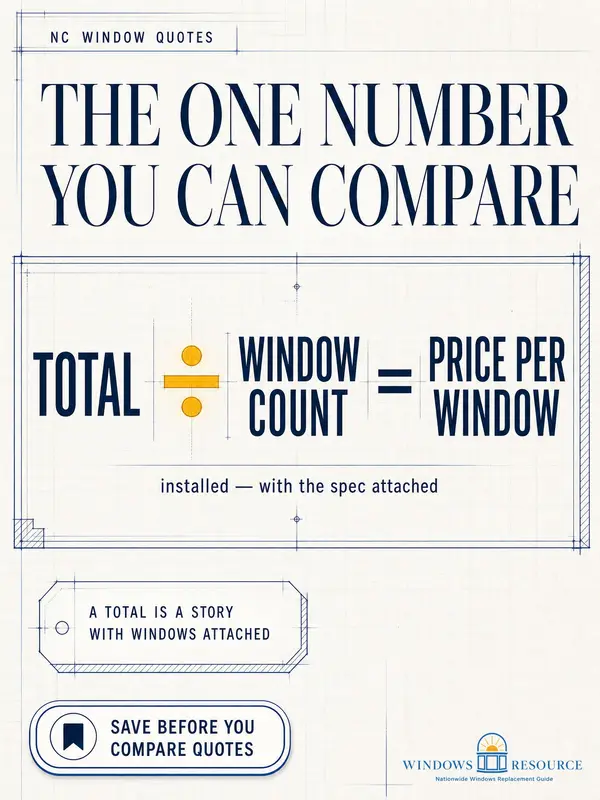
Here’s the fix, and you can do it at the kitchen table before you call anyone back: get every bid down to the price per window, installed — with the spec attached. That’s the one number that lines up.
What’s a fair price per window installed in NC? It runs in tiers. As general 2026 bands: recycled-content vinyl roughly $450–$1,600 per window installed; first-generation (virgin) vinyl about $800–$2,400; composite and fiberglass about $2,400–$4,400. But the per-window number only means something with the spec attached — material, install method, glass. Divide every quote’s total by its window count, pin the same spec on all of them, and the wildly different totals finally line up.
These are the same general NC bands carried on our full replacement window cost guide — a starting range, not your quote.
What’s a fair price for one window installed?
For most NC homes, a recycled-content vinyl double-hung lands around $450–$1,600 installed. Step up to first-generation vinyl and it’s about $800–$2,400; composite and fiberglass run $2,400–$4,400. Anything oversized, arched, or specialty is priced one-off.
That’s per window, installed — glass, frame, labor, and the old window hauled away. It’s the unit you want every quote to resolve to.
Notice how wide the vinyl band is. That width isn’t the window being mysterious. It’s who you call, whether it’s a full-frame or an insert (pocket) install, and the sales model behind the quote.
Two companies can put a nearly identical double-hung in the same opening and price it a thousand dollars apart. The cost guide breaks down why the same window prices so far apart — this page’s job is the unit, not the spread.
Here’s the honest per-window picture by material:
| Window (installed, per unit) | Honest NC range | Why it lands there |
|---|---|---|
| Recycled-content vinyl double-hung | $450–$1,600 | The NC value default. Low-maintenance and a solid U-factor for our climate. Within this tier the range is mostly install method and who you call, not the vinyl. |
| First-generation (virgin) vinyl | $800–$2,400 | Virgin PVC rather than reground stock — more consistent colour and weld strength over time. Commonly the tier the in-home-sales brands quote. |
| Composite / fiberglass | $2,400–$4,400 | Stronger frame, holds paint and shape in NC heat; a real upgrade, priced like one. The premium here is genuinely the material — and usually the sales model on top of it. |
| Casement / awning | Usually above the double-hung band | The crank hardware and sash seal add cost over a double-hung of the same size. |
| Large, arched, or specialty (bay, oversized picture) | Priced one-off, often well above | Custom sizes and shapes leave the standard price sheet. Every house has two or three of these — star them when you count. |
Recycled-content vinyl double-hung
- Honest NC range
- $450–$1,600
- Why it lands there
- The NC value default. Low-maintenance and a solid U-factor for our climate. Within this tier the range is mostly install method and who you call, not the vinyl.
First-generation (virgin) vinyl
- Honest NC range
- $800–$2,400
- Why it lands there
- Virgin PVC rather than reground stock — more consistent colour and weld strength over time. Commonly the tier the in-home-sales brands quote.
Composite / fiberglass
- Honest NC range
- $2,400–$4,400
- Why it lands there
- Stronger frame, holds paint and shape in NC heat; a real upgrade, priced like one. The premium here is genuinely the material — and usually the sales model on top of it.
Casement / awning
- Honest NC range
- Usually above the double-hung band
- Why it lands there
- The crank hardware and sash seal add cost over a double-hung of the same size.
Large, arched, or specialty (bay, oversized picture)
- Honest NC range
- Priced one-off, often well above
- Why it lands there
- Custom sizes and shapes leave the standard price sheet. Every house has two or three of these — star them when you count.
One thing a bare dollar figure can’t tell you: what kind of window, installed how. A $700 insert vinyl and a $700 full-frame fiberglass are not the same purchase. Which is why the per-window number always travels with its spec — the material, the install method, and the glass package off the label.
Why won’t anyone give me a straight per-window price?
Because most companies quote per project, not per window — a single bottom-line number is simpler to present and defend than a unit price. It usually isn’t hiding anything, but it also can’t be compared until you break it down.
There are real reasons the industry prices in lump sums. The install method changes per opening (an insert here, a full-frame there where the sill’s gone soft). Old-window disposal, custom sizing, and the occasional rotted-frame surprise all ride inside the total. A company would rather quote the whole outcome than commit to a per-unit sticker that varies opening to opening.
That’s defensible. It’s also not comparable — and comparable is what you need.
So make the number come out. You have every right to ask for a per-opening, line-item quote: the count, the unit price, and the install method for each window. A fair company gives you one without a fight.
Learn what a real line-item quote should list on the itemized-quote page. And if a bid stays a single lump sum after you’ve asked, that’s one of the quote red flags worth a second look.
How do I compare quotes with different window counts?
Divide each total by its window count to get a per-window installed price — then pin the same spec on every bidder so they’re all pricing the identical job.
This is the entire move, and it’s just arithmetic. Two steps:
- Divide first. Total ÷ window count = the price per window. Now a 9-window bid and a 14-window bid are on the same axis. (The count itself — how many openings your house really has — is the whole-house guide’s whole job; per-window is the price factor, whole-house is the count factor, and they multiply.)
- Attach the spec second. A per-window number is only half an answer until you say what window, installed how. Put the same material, same install method (full-frame vs insert), and same glass package in front of every company. Then the per-window prices are finally comparing like to like.
The normalize-your-quote script: Total ÷ window count = your per-window price. Then hand every bidder the same spec — material, install method, glass package — and re-price. The quote that was “wildly higher” either justifies itself in the spec, or it doesn’t.
Do that, and the number that looked like a better window often turns out to be a pricier bid on the same window. A quote far above the range is usually a pricier salesman, not a better window — but you only see it once you’ve divided. The full sanity-check, range-by-range, lives at is this quote reasonable?
Two quotes both say “$20,000” — which is the better deal?
Neither, until you divide. $20,000 is meaningless until you know how many windows it buys and how they’re installed.
This is the trap the project total sets. Say both quotes read exactly $20,000. Feels like a tie. It isn’t — because the totals are hiding two different window counts and two different install methods.
Laid side by side, the same $20,000 splits apart:
| Factor | Quote A | Quote B |
|---|---|---|
| Project total | $20,000 | $20,000 |
| Window count | 8 | 14 |
| Per window (total ÷ count) | about $2,500 | about $1,430 |
| Material | Fiberglass | Vinyl |
| Install method | Full-frame | Insert (pocket) |
| What the total hid | A premium material + method on fewer openings | More openings, standard material and method |
Project total
- Quote A
- $20,000
- Quote B
- $20,000
Window count
- Quote A
- 8
- Quote B
- 14
Per window (total ÷ count)
- Quote A
- about $2,500
- Quote B
- about $1,430
Material
- Quote A
- Fiberglass
- Quote B
- Vinyl
Install method
- Quote A
- Full-frame
- Quote B
- Insert (pocket)
What the total hid
- Quote A
- A premium material + method on fewer openings
- Quote B
- More openings, standard material and method
The point isn’t that A is a rip-off or B is a bargain. It’s that you cannot judge either total until you’ve turned it into a per-window price with the spec attached. Do that first, every time.
What makes one per-window number higher than another?
Mostly the install method, the window’s size and type, and add-ons — not the brand name on the sticker.
Once every quote is per-window, you’ll still see spread, and it’s worth knowing what legitimately moves the number so you can tell a fair driver from padding:
- Install method is the biggest hidden variable. A full-frame replacement — tearing out to the rough opening, new sill pan and flashing — runs meaningfully more than an insert (pocket) install that keeps the existing frame. Full-frame is the right call when the frame or sill is compromised, and it’s where a leak-proof install actually lives. See full-frame vs insert for which your house needs.
- Labor is a real slice, not a rounding error. Across the industry, labor tends to run about 30% of the per-window cost — more on a second-story opening that needs ladder or scaffold work.
- Size and type. A casement, a bay, an arched or oversized picture window leaves the standard price sheet. Bigger glass and more hardware cost more, per unit.
- Glass and coastal add-ons. A triple-pane or laminated upgrade adds per window; on the NC coast, impact-rated (laminated) glass carries its own premium to meet wind-borne-debris rules.
None of those is the brand. A recognizable name in an in-home sales quote can carry a markup that pays for advertising and a commissioned sales force — real money that doesn’t change the window in your wall. That’s exactly why you normalize to per-window first: it strips the total down to what’s actually going in the opening.
If you’d rather not do the dividing alone, that’s what a no-pressure second opinion is for — send me your total and your window count, and I’ll hand the per-window number back to you with the spec it should be wearing.
Sources, Verification & Fact-Checking verified July 2026
Every load-bearing fact on this page is sourced and verified against a primary authority.
Verified July 2026 via direct review of the cited authority — the links open the controlling source so you can check it yourself rather than take our word.
- Entry-tier band (recycled-content vinyl double-hung roughly $450–$1,600 installed): the general 2026 NC market band from our NC window cost guide, re-checked live in July 2026 against national cost guides — Fixr (avg $800, range $450–$1,200), This Old House (survey-backed, most $232–$740), and Homewyse ($632–$967, May 2026) — all of which fall inside this band. General ranges, not a quote; verify for your project.
- Upper-tier bands (first-generation vinyl about $800–$2,400; composite/fiberglass about $2,400–$4,400 installed): these come from quotes collected first-hand in the NC market in 2025, not from national aggregators. National cost guides survey the whole market — heavily weighted toward big-box and local-installer work — so they sit at or below the entry tier and do not capture what the in-home-sales channel actually quotes for virgin-vinyl and composite lines. That gap between the aggregator average and a real in-home quote is the point of this page, not an error in either number. Ranges, not a quote; verify for your project.
- Labor share (labor about 30% of a window’s installed cost): Fixr states labor makes up about 30% of the total. National estimator data spreads the labor line across roughly 15–40%, so treat 30% as a typical midpoint rather than a fixed rule — a second-story or complex opening runs higher.
- Install-method swing (a full-frame replacement runs meaningfully above an insert/pocket install): national cost guides consistently price full-frame higher because it removes the frame back to the rough opening, while an insert reuses the existing frame. The exact gap varies by opening and installer, so this page states no single premium figure.
- The sales-model markup (a recognizable in-home-sales brand can price a comparable window well above a local installer): the mechanism documented on our cost guide — normalize to per-window before comparing.
- Homeowner accounts (two close totals for “the same house,” the inability to get an apples-to-apples comparison): public homeowner discussion patterns; the “$20,000 vs $20,000” split is an illustrative worked example, not a specific cited quote.