


Per window, the number sounded survivable. Then the estimate multiplied it by seventeen.
That’s the whole-house moment. In the forum threads it reads the same way every time — “I am in sticker shock I think” — because nobody prices seventeen of anything else at once.
Here’s the honest way through it: count first, multiply second, believe the total last.
What does it cost to replace every window in a house? For a typical 10-window North Carolina home, roughly $10,000–$35,000 installed — a wide band because who you call moves the number more than the glass does. The honest method for your house: count the openings, multiply by a fair per-window price, then adjust for what only volume changes. Square feet don’t buy windows. Openings do.
Ranges are general 2026 NC figures, shared with our full NC cost guide — a starting band, not your quote.
How many windows does your house actually have?
Most homeowners are off by two or three — walk the house and count openings before you price anything.
This is the step no cost page teaches, and it’s the first factor in the multiplication. When I walk a house before quoting it, the count comes before anything else — because every number after it is count × price.
- Walk the outside, not the inside. Circle the house once and count elevation by elevation. Inside, rooms hide windows behind curtains and furniture. Outside, the wall can’t lie.
- Count openings the way a quote does. A double-hung is one. A bay or bow is three to five units sharing one hole. A picture window with two flankers is three.
- Catch the hiders. Bathroom, basement, laundry, garage, dormers, the half-moon up in the gable. Every house hides at least one window its owner forgot — usually the bathroom.
- Star the oddballs. Arched tops, oversized picture units, anything egress-sized in a basement bedroom. These price differently, and every house has two or three.
As a working range, a single-story North Carolina ranch usually carries about 8–15 openings, and a two-story runs about 15–25. That’s also why “how much for a 2,000 sq ft house” has no honest answer — two 2,000 sq ft homes can differ by ten windows.
Your count is the first factor. Now the multiplication.
The volume math: your count × a fair per-window price
A whole-house total is just multiplication plus three adjustments — and you can run it before anyone rings your doorbell.
What’s a fair per-window installed price? That’s the cost guide’s whole job — vinyl bands, the fiberglass premium, why the same window prices 3x apart. If you’re leaning vinyl like most NC homes, the vinyl cost page breaks out its own bands. This page borrows one rule from there: divide first, compare second.
Multiply your count by that per-window band and you have your honest starting range. Then three things bend the straight line:
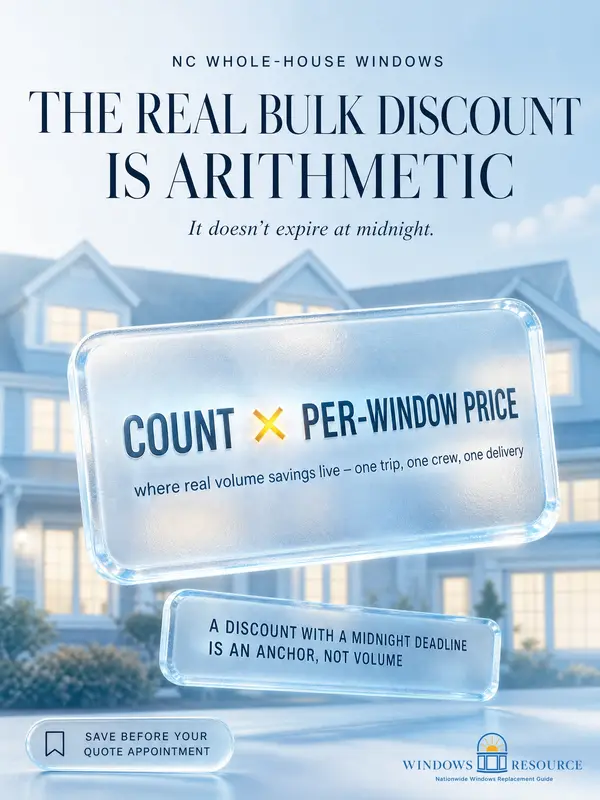
- Trip costs amortize — the price per window drops as the count rises. One measure visit, one delivery, one crew mobilization, spread across every opening instead of three.
- Stories raise it. Second-floor openings mean ladder or scaffold work — more labor per window than the same unit at grade.
- Oddballs raise it. The starred openings from your walk — arched, oversized, egress — carry custom pricing the standard ones don’t.
Is it cheaper to replace all windows at once?
Per window, usually yes — and nobody honest will hand you a percentage.
The mechanism is real, and it’s boring in the best way. A window project carries fixed costs that don’t care how many windows you buy: the measure visit, the factory order, the delivery, the crew showing up with a full trailer. Do ten openings in one pass and those costs spread thin. Do three, and each window carries a fatter slice.
A national manufacturer’s cost page, an editorial cost guide, and an installer’s own volume-pricing explainer all describe that same mechanism. Here’s the part I respect: none of the three puts a number on it. Neither will I — the amortization is real, but its size depends on your count, your access, and the company’s overhead.
So hold the two ideas apart:
- Real volume savings show up inside the per-window price — quietly, because the trip costs amortized. You find them by comparing per-window prices at different counts.
- Anchor theater shows up as a dramatic discount with a deadline. Homeowners in the threads say it bluntly: a price that can drop by thousands tonight was inflated this morning. That move has its own section in the cost guide’s red flags — here, just know it isn’t volume math.
If a whole-house “discount” only exists tonight, it isn’t a bulk price. It’s an anchor with your count on it.
Replace all at once, or phase it worst-first?
All-at-once buys the best per-window math and one matched house. Phasing is legitimate — if you sequence it worst-first and stay on one line.
Nobody teaches phasing because nobody selling windows profits from it. But the budget reality in the threads is verbatim: “If the window replacement is 20k I can manage that. 10k and finance the other 10k.” If that’s your math, phase on purpose instead of by panic.
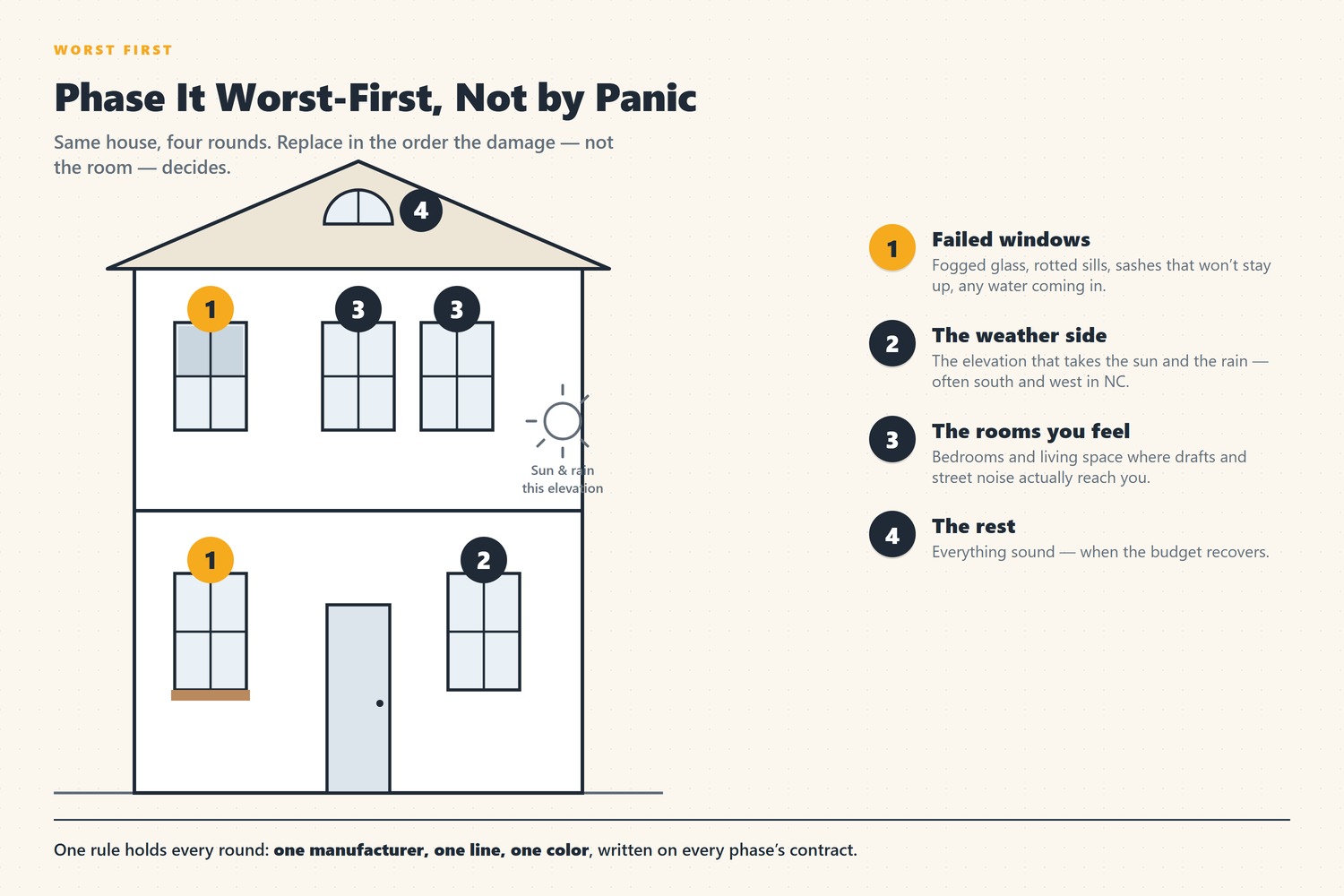
The worst-first sequence:
- Failed windows first. Fogged , soft or rotted sills, sashes that won’t stay up, anything leaking water. (Not sure which of yours qualify? Start with the signs you actually need new windows.)
- The weather side next. The elevation that takes the sun and the rain — for a lot of NC houses, the south and west faces age fastest.
- The rooms you feel. Bedrooms and the living space where drafts and street noise actually reach you. Comfort per dollar lives here.
- The rest when the budget recovers.
And the rule that makes phasing survivable: one manufacturer, one line, one color, written on every phase’s contract. Lines get discontinued. Whites drift between product families. Vinyl fades a shade over the years between rounds, and each phase’s warranty clock starts on its own install date. The house remembers which windows came first — your job is making sure a stranger can’t tell.
It’s done in the wild, and done well: one homeowner in the threads documented a century-old house re-windowed in two phases over two years — the full-frame round first, the insert round later, the same clad line both times. The one-line rule, followed to the letter.
| Factor | All at once | Phased (worst-first) |
|---|---|---|
| Trip & mobilization costs | Paid once, spread across every opening | Paid again each phase — the hidden surcharge |
| Per-window price | Usually the best volume math | Smaller batches carry fatter fixed-cost slices |
| Matching | One line, one color, one install date | Discontinued colors, fading, a visible seam if you switch lines |
| Warranty | One clock, one start date | A separate clock per phase |
| Budget | One big check or one financing decision | Spreads the cost into rounds you can actually fund |
| When it wins | Most windows are tired and you can fund it | The budget is real, or one elevation clearly failed first |
Trip & mobilization costs
- All at once
- Paid once, spread across every opening
- Phased (worst-first)
- Paid again each phase — the hidden surcharge
Per-window price
- All at once
- Usually the best volume math
- Phased (worst-first)
- Smaller batches carry fatter fixed-cost slices
Matching
- All at once
- One line, one color, one install date
- Phased (worst-first)
- Discontinued colors, fading, a visible seam if you switch lines
Warranty
- All at once
- One clock, one start date
- Phased (worst-first)
- A separate clock per phase
Budget
- All at once
- One big check or one financing decision
- Phased (worst-first)
- Spreads the cost into rounds you can actually fund
When it wins
- All at once
- Most windows are tired and you can fund it
- Phased (worst-first)
- The budget is real, or one elevation clearly failed first
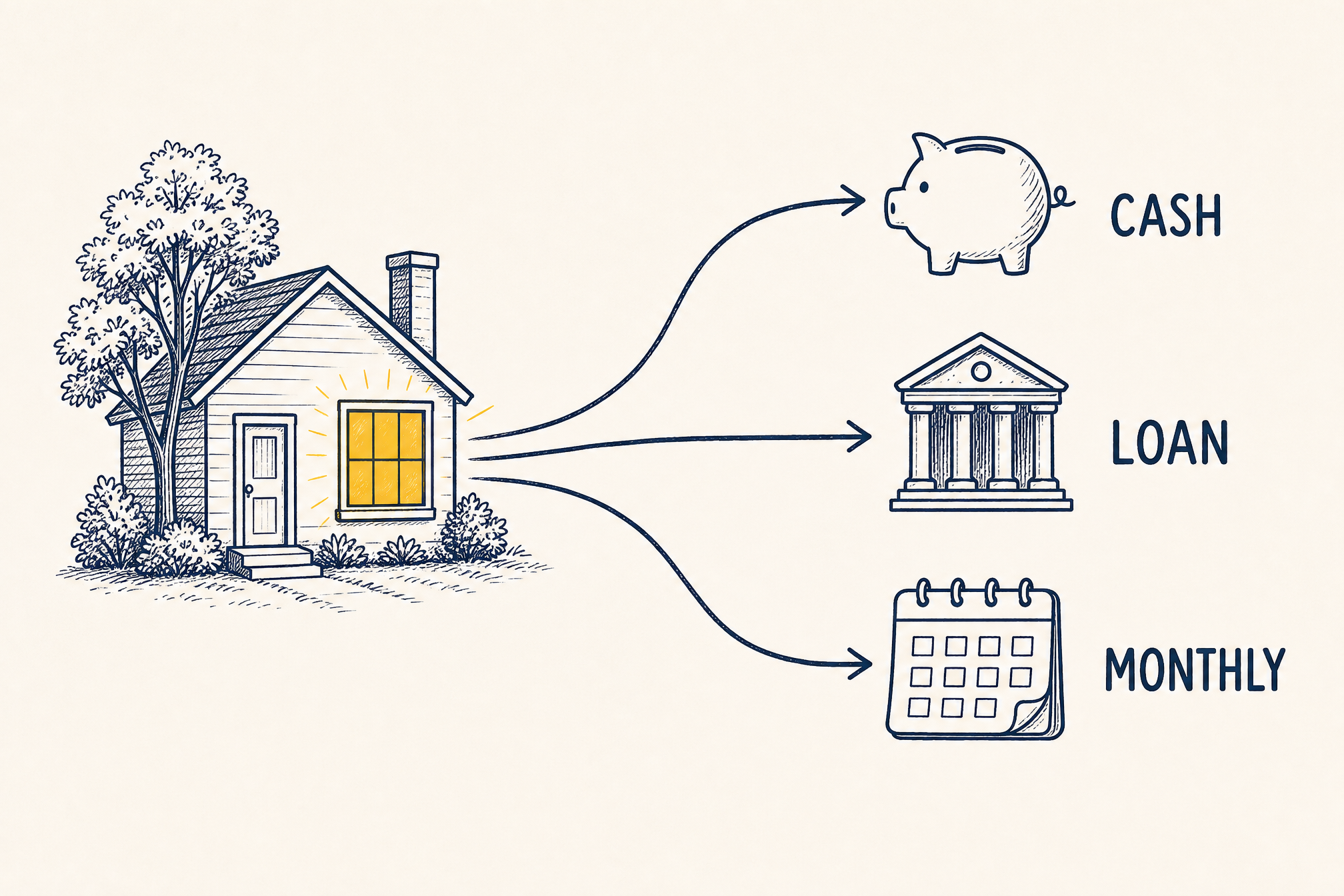
One more thing about that “10k now, finance 10k” instinct. It’s exactly where whole-house totals push people — into monthly-payment territory. Before a payment plan does your deciding, read how window financing actually works, because “0% for 12 months” comes in two very different flavors and one of them bites.
How a whole-house quote should be structured
Per-opening line items, the count in writing, and every bidder pricing the same spec.
Volume gives you leverage at quote time — but only if the paperwork lets you see it.
- Per-opening line items, not a lump sum. The quote should show the count, the unit price, and the install method (insert vs full-frame) per opening. A single bottom-line number on a 17-window job is where padding hides.
- The same count and spec to every bidder. Make all of them price the identical project, then divide each total by the count. The full method lives at is this quote reasonable?
- Ask where the volume went. A fair whole-house bid can show you its per-window price beating its own small-job pricing. If volume savings are real, they survive being written down.
Count, multiply, compare per window, and the scariest number in home improvement turns back into arithmetic.
And if you’d rather have a second set of eyes on the total before you sign anything, that’s exactly what a no-pressure consult is for — bring the count, I’ll bring the division!
Sources, Verification & Fact-Checking verified July 2026
Every load-bearing fact on this page is sourced and verified against a primary authority.
Verified July 2026 via direct review of the cited authority — the links open the controlling source so you can check it yourself rather than take our word.
- Whole-house cost bands (typical 10-window NC home roughly $10,000–$35,000 installed): the same general 2026 market bands carried on our NC window cost guide, cross-checked against current national cost guides. General bands, not a quote — verify for your project.
- Volume pricing improves per window because fixed trip costs amortize (one measure visit, one delivery, one crew mobilization; no published discount percentage): stated independently by a manufacturer’s whole-house cost page, a current editorial cost guide, and an installer’s volume-pricing explainer — none of the three publishes a discount percentage. (view source — Pella, whole-house replacement cost · view source — NerdWallet, replacement window cost guide · view source — Energy Shield Windows & Doors, is it cheaper to replace all windows at once)
- Homeowner accounts (the $44,000 quote for nine double-hungs, an awning window, and a door, and the roughly $11,000 nine-window comparable; the “10k now, finance 10k” phasing math; the two-phase century-home project): public homeowner discussion threads, quoted with their own numbers; per-window figures are our division of those totals by their counts. (view source — “Cost of windows?” · view source — “Estimate to replace 20 windows” · view source — “How much are you paying for new windows?”)
- Typical window counts by home type (single-story about 8–15 openings, two-story about 15–25): working ranges matching a manufacturer’s whole-house project-size groupings (single-story 8–15 windows, two-story 15–25+; Pella page linked above) — orientation only. Count your own house before pricing anything.