

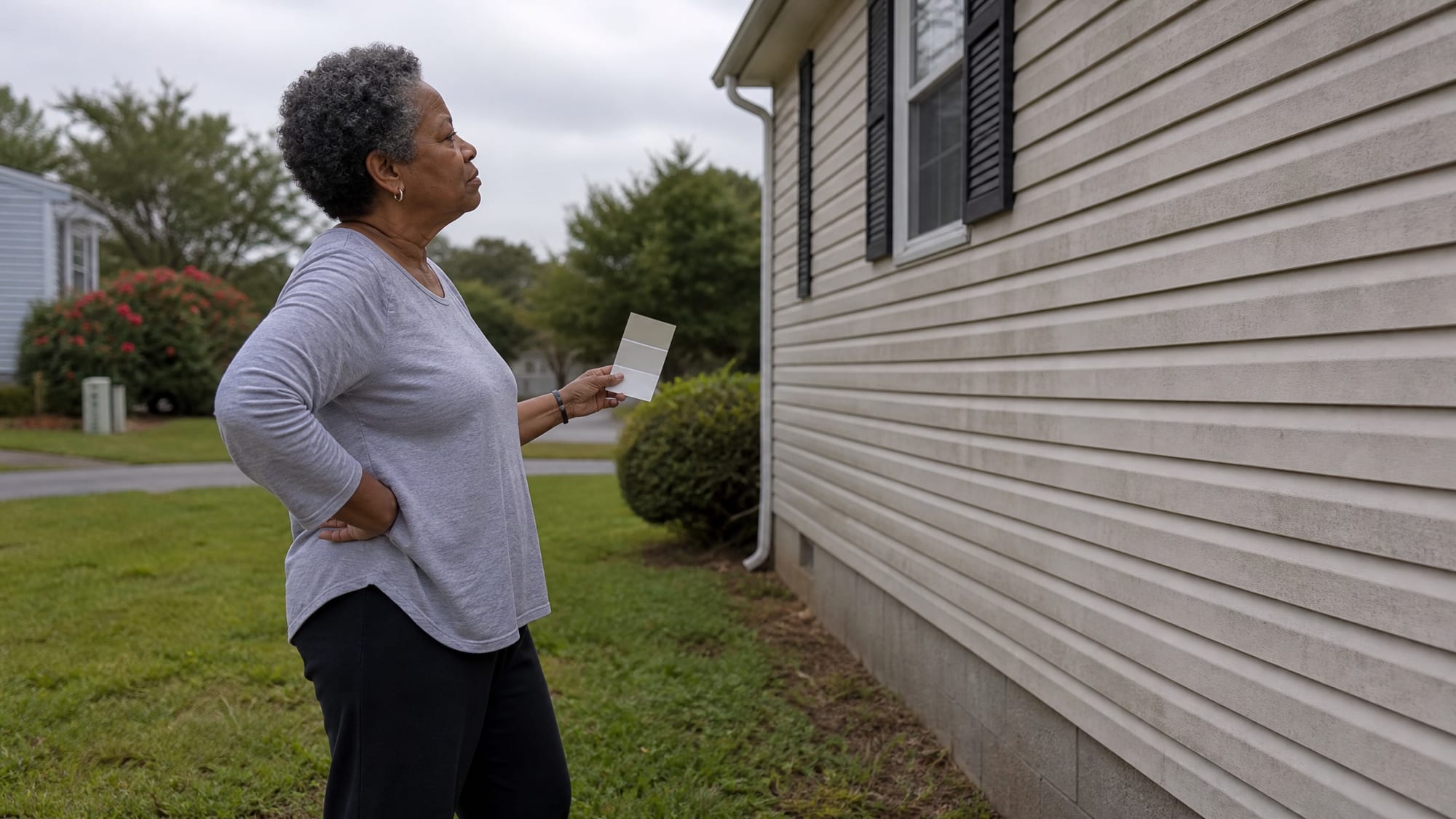
You power-washed it, and it’s still that tired non-color — a faded, chalky wash of what used to be a real shade. The paint aisle starts to look like a few hundred dollars standing between you and a wall you’d want to look at again.
So the question arrives on its own: can I just paint this?
Yes — you can. The more useful question, the one nobody selling you paint or selling you siding really wants to sit in, is should you, and for how long it holds.
This is the painting decision page for the siding hub. The fade mechanism — why vinyl loses its color and why that color runs through the panel — lives on the vinyl siding guide, and every replacement dollar lives on what siding costs in NC. This page is about the coat of paint: whether it’s a real fix or a way to postpone one.
Can you paint vinyl siding? Yes — with 100% acrylic latex exterior paint on panels that are clean, sound, and fully dry, and only the same shade or lighter unless you use a vinyl-safe formulation. Dark paint over light vinyl absorbs heat and can warp the panels, worst on sunny south and west walls. But painting re-inherits the maintenance you bought vinyl to avoid — a repaint clock measured in years — and often voids the manufacturer’s warranty. So paint when the siding is structurally sound and just looks tired and you’ll sell within a few years. Replace when it’s cracked, brittle, warped, or you’re painting to hide age rather than refresh a color.
Can you paint vinyl siding? Yes — if you win the prep
Yes. The paint sticks to vinyl fine when two things are true: it’s the right paint, and the surface underneath is genuinely clean and cured. Nearly every peeling-paint horror story is a prep story, not a paint-quality story.
The paint is the easy part. You want a 100% acrylic latex exterior paint — it grips vinyl and, just as important, flexes as the panels expand and contract.
A quality exterior acrylic latex is self-priming on sound vinyl (Sherwin-Williams says priming isn’t required when its Emerald acrylic latex goes over vinyl in good shape). Where priming earns its keep is a chalky, oxidized, or slick surface — a bonding primer rescues the grip paint won’t otherwise get.
The surface is where jobs fail. Vinyl that’s been in the NC sun for years builds up chalking — that fine powder that comes off on your palm — plus mildew, pollen, and oxidation. Paint can’t grip any of that. Wash it off, rinse it clean, and let it dry fully before the first coat.
Here’s the honest part the how-to pages skip: even the pros disagree on method. One painter swears you should scuff the panel and hit it with a bonding primer first. A contractor who does hundreds of exteriors a year says the opposite — never sand or abrade vinyl, and a peeling job is almost always contamination or paint that wasn’t allowed to cure. The reconcilable truth: clean it obsessively, prime it if it’s chalky or slick, and don’t gouge the panel.
Can you paint vinyl siding a darker color?
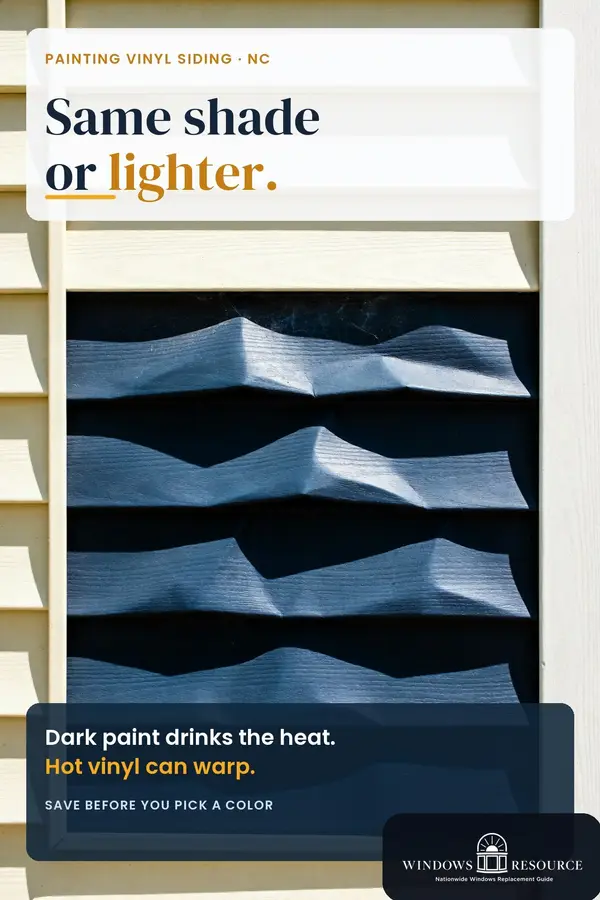
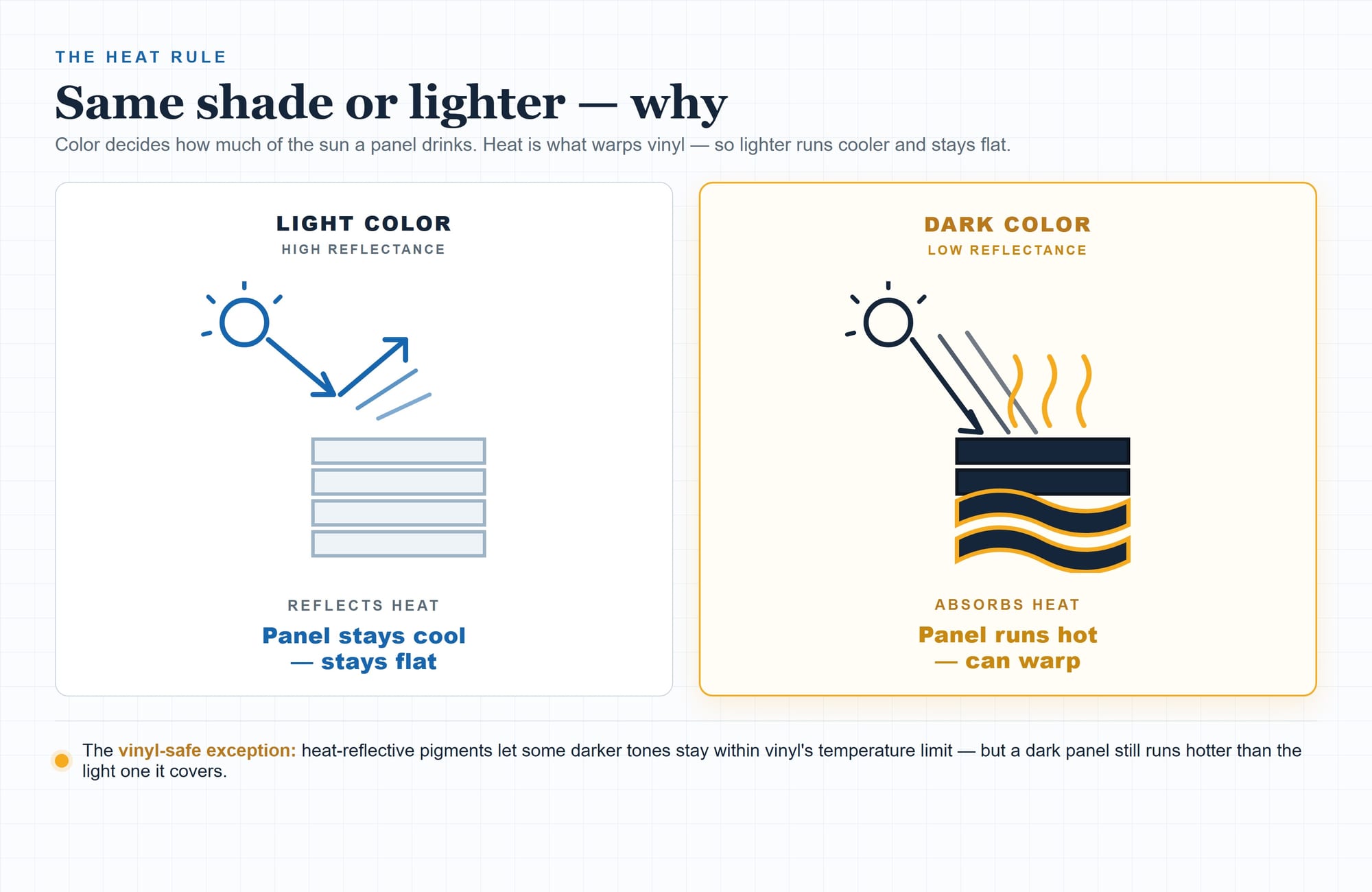
As a rule, no — paint the same shade or lighter than the original, unless you’re using a paint built for vinyl. This is the caveat that trips up the most people, and it has real physics under it.
Dark colors absorb solar heat. Vinyl is a thermoplastic — heat it enough and it distorts, buckles, and warps. Paint a light panel a deep navy or black, park it on a south-facing wall in the Carolina sun, and you’ve built a slow heat trap on your own house. The panel underneath was never rated to run that hot.
The why behind “go lighter” is — how much light (and therefore heat) a color bounces back instead of soaking up. Higher LRV, cooler panel. As a rule of thumb, keep the painted color at or above your factory vinyl’s own reflectance; some in the trade name a specific LRV floor, but treat that as a rule of thumb, not a published spec.
The modern exception is real: vinyl-safe paints — Sherwin-Williams VinylSafe, Benjamin Moore Colors for Vinyl — use heat-reflective pigments so some deeper tones stay within vinyl’s temperature limit. Sherwin-Williams says its VinylSafe colors are “uniquely formulated to resist warping and buckling — including an array of bold, dark colors.”
But keep the hedge honest: even a vinyl-safe dark color runs hotter than the light one it’s covering, so it still ages the panel faster than staying near your original shade.
The gap nobody warns you about: winter stripes at the lap lines
Paint your siding in the summer, and the following winter can hand you thin stripes of the old color at every lap. This is the single most useful thing on this page, and almost no one ranking for “paint vinyl siding” mentions it.
Here’s the mechanism. Vinyl has a large thermal-expansion coefficient — it’s hung loose, on purpose, so each course can slide as it heats and cools. Paint it on a hot day, when the panels are expanded to their longest, and the paint line covers everything you can see.
Come winter, the panels contract and pull back — and the strip that was tucked under the lap when you painted it is now exposed, showing the original color underneath, in a clean line along every course.
The fix is almost too simple: paint on a cool, mild day, when the panels are already near their contracted length. Then there’s no hidden strip to reveal later.
Does painting vinyl siding void the warranty?
Often, yes — painting commonly voids the manufacturer’s fade-and-defect warranty, and it varies by brand, so the document that came with your siding is the one that governs. This is the quiet cost that doesn’t show up on the paint receipt.
Most major vinyl-siding warranties cover fade and defects for years. Paint the panels and many of those warranties consider the product altered — the coverage lapses. It can also muddy a future insurance or color-matching claim, because now the wall isn’t the factory product anymore.
There’s a clean parallel to the material itself: heat distortion is a standard exclusion in vinyl warranties even when you don’t paint. Painting a light panel dark is, in effect, a self-inflicted version of the same excluded failure. Two reasons the warranty matters more here than people expect.
How long does painted vinyl siding last?
Plan on roughly 5 to 10 years before you’re repainting — longer with excellent prep and top-tier paint, dramatically shorter if the prep was rushed. And that number is the real heart of the decision, so sit with it for a second.
Here’s the reconciliation nobody on page one makes. The entire reason vinyl took over American walls is that you never paint it — the color runs through the panel and the maintenance is a garden hose.
Paint it, and you hand that promise back. You’ve re-inherited the exact repaint cycle vinyl was invented to end — plus adhesion and heat risks the factory finish never had.
That doesn’t make painting wrong. It makes it a trade: a few years of refreshed curb appeal in exchange for a maintenance clock you’d otherwise never own. Whether that trade is worth it depends entirely on the next section.
Paint or replace? How to actually decide
Paint when the siding is sound and the problem is only how it looks. Replace when the siding itself is failing — not just its color. That one line sorts almost every case.
Painting is far cheaper up front — think a fraction of a re-side. The dollars live on the siding cost page, not here, but the shape is simple: painting runs in the low thousands on a typical house; a full replacement runs several times that. What the cheaper number buys you, though, is time — not a permanent fix.
| Your situation | The honest call | Why |
|---|---|---|
| Panels are sound; the color's just faded, dated, or chalky | Paint it | This is what paint is genuinely good for. A clean coat on a sound wall buys real curb appeal for a few thousand dollars. |
| You're staying only a few more years and want it to show well | Paint it | You'll likely sell before the repaint clock comes due. A refresh serves the sale without funding a re-side you won't live with. |
| You want to go darker, on a sunny wall | Rethink it — or replace | Factory-dark vinyl runs cooler than any painted-dark panel. If dark is the goal, new panels in that color are the safer path. |
| Panels are cracked, brittle, warped, or pulling loose | Replace | That's age and damage, not color. Paint hides it for a season and the panels keep failing underneath. |
| You're painting mainly to hide how old and tired it looks | Replace (or plan to) | Painting to mask age postpones the re-side without stopping the clock. You're renting a fix, not owning one. |
| Anything soft, swollen, or moldy behind the panel | Stop — that's a wall problem | When the sheathing behind the siding is compromised, neither paint nor a panel swap is the answer. See repair-or-replace. |
Panels are sound; the color's just faded, dated, or chalky
- The honest call
- Paint it
- Why
- This is what paint is genuinely good for. A clean coat on a sound wall buys real curb appeal for a few thousand dollars.
You're staying only a few more years and want it to show well
- The honest call
- Paint it
- Why
- You'll likely sell before the repaint clock comes due. A refresh serves the sale without funding a re-side you won't live with.
You want to go darker, on a sunny wall
- The honest call
- Rethink it — or replace
- Why
- Factory-dark vinyl runs cooler than any painted-dark panel. If dark is the goal, new panels in that color are the safer path.
Panels are cracked, brittle, warped, or pulling loose
- The honest call
- Replace
- Why
- That's age and damage, not color. Paint hides it for a season and the panels keep failing underneath.
You're painting mainly to hide how old and tired it looks
- The honest call
- Replace (or plan to)
- Why
- Painting to mask age postpones the re-side without stopping the clock. You're renting a fix, not owning one.
Anything soft, swollen, or moldy behind the panel
- The honest call
- Stop — that's a wall problem
- Why
- When the sheathing behind the siding is compromised, neither paint nor a panel swap is the answer. See repair-or-replace.
The frame I’d hold onto: paint buys time and curb appeal on sound siding; replacement fixes siding that’s failing, not just faded. Painting to hide age is renting a fix. Re-siding is owning one. And if you’re re-siding anyway, remember the color is baked into new panels — no repaint clock at all.
This is the same repair-or-replace logic that decides the call on windows: read what’s actually failing before you price the answer. A fix that resets the symptom isn’t the same as a fix that resets the problem.
The NC angle: sun, humidity, and the temperature swing
Three North Carolina realities make the rules on this page bite harder than a national how-to admits. If you’re painting a wall in the Piedmont or anywhere in NC, these are the ones that matter.
- South and west walls take the hardest sun. The can’t-go-darker rule is sharpest here — a color that survives a shaded north wall can warp on a sun-blasted south elevation. Judge the color by your hottest wall, not your coolest.
- Humidity makes mildew prep non-negotiable. NC’s damp summers grow mildew and mold on siding. Skip the cleaning step and you’re painting over the exact contamination that makes paint peel.
- The July-to-January swing amplifies the lap-line reveal. Our summers are hot and our winters get genuinely cold, so the panels expand and contract across a wide range. Paint on a mild spring or fall day — not a July scorcher — to keep the winter stripes from ever showing up.
One thing NC does not add here: a permit. Repainting your own siding isn’t a code-triggered job, so there’s nothing to check with the county before you start.
Bottom line
Can you paint vinyl siding? Yes. Should you? Only in a narrow, honest window.
Paint it when the panels are sound and the problem is purely the look, you’ll go the same shade or lighter (or true vinyl-safe), and you accept a repaint clock a few years out. In that case a clean coat is a legitimate few-thousand-dollar win — say it plainly, take the win.
Replace it when the siding is cracked, brittle, warped, or you’re painting to cover age rather than refresh a color. That’s the wall telling you it’s done, and paint just quiets the messenger.
If you’re standing in front of a wall and genuinely can’t tell which case is yours, that’s a fair thing to get a second opinion on — send a photo and I’ll tell you whether it reads like a sound wall that wants a coat, or siding that’s past the point paint can help.
Sources, Verification & Fact-Checking verified July 2026
Every load-bearing fact on this page is sourced and verified against a primary authority.
Verified July 2026 via direct review of the cited authority — the links open the controlling source so you can check it yourself rather than take our word.
- Vinyl siding can be painted with a 100% acrylic latex exterior paint; on sound vinyl, priming is not required because a quality exterior acrylic latex acts as a paint-and-primer-in-one, though a bonding primer helps a chalky, oxidized, or slick surface — and obsessive cleaning plus full drying are the load-bearing prep steps. Verified on Sherwin-Williams’ vinyl-siding guide: its Emerald Exterior Acrylic Latex is “not required to prime vinyl siding that’s in sound condition,” with two coats on bare siding or one on previously painted. The “clean and cure, don’t gouge the panel” reconciliation reflects painter-and-homeowner accounts in live DIY forum threads. (view source — Sherwin-Williams)
- Paint vinyl the same shade or lighter than the original; darker colors absorb more solar heat and can warp or distort the panel, and Light Reflectance Value (LRV) is why “go lighter” works. Vinyl-safe paints (Sherwin-Williams VinylSafe, Benjamin Moore Colors for Vinyl) use heat-reflective pigments so some darker tones stay within vinyl’s temperature limit. Sherwin-Williams states plainly that “painting vinyl with any color darker than the original shade can cause warping and other defects,” while its VinylSafe colors are “uniquely formulated to resist warping and buckling — including an array of bold, dark colors.” The specific LRV floor (an above-55 rule of thumb) is a trade recommendation, not a published spec, and no authoritative surface-temperature warp threshold exists — so this page carries neither number. (view source — Sherwin-Williams)
- Painting vinyl on a hot day, when panels are thermally expanded, can expose thin strips of the original color at the lap joints the following winter when the panels contract; painting on a cool, mild day avoids it. Homeowner-reported and independently corroborated across two separate public forum threads (r/HomeImprovement and r/DIY); consistent with vinyl’s documented loose-hung, thermally-floating install. Comment-sourced; the quoted phrasing (“lines everywhere of the original colour”) is verbatim from the live threads.
- Painting vinyl siding commonly voids the manufacturer’s fade-and-defect warranty and can complicate a later insurance or matching claim; this varies by manufacturer, and your siding’s own warranty governs. Confirmed against CertainTeed’s vinyl-siding limited warranty, which reads: this warranty “is voided for any Vinyl Siding Products which have been painted, varnished, refinished, or similarly coated over the manufacturer’s original finish” unless CertainTeed authorizes it. Ply Gem/Mastic and Royal Building Products carry parallel painted-surface exclusions. (view source — CertainTeed warranties)
- A paint job on vinyl typically lasts about 5 to 10 years before a repaint — pushing toward 12–15 years with excellent prep and top-tier paint, and dropping to only a few years when prep is rushed — so painting re-inherits the repaint maintenance that factory-colored vinyl was designed to eliminate. Directional range corroborated across multiple contractor and paint-trade sources; no single authoritative figure, so it is presented as a hedged band rather than a precise promise.
- Dollar figures for painting versus replacing are deliberately kept off this page. Painting runs a fraction of a full re-side, but the real per-square-foot and whole-house numbers for North Carolina live on the siding cost page, verified against current North Carolina market bands — this page frames the decision, not the price.