

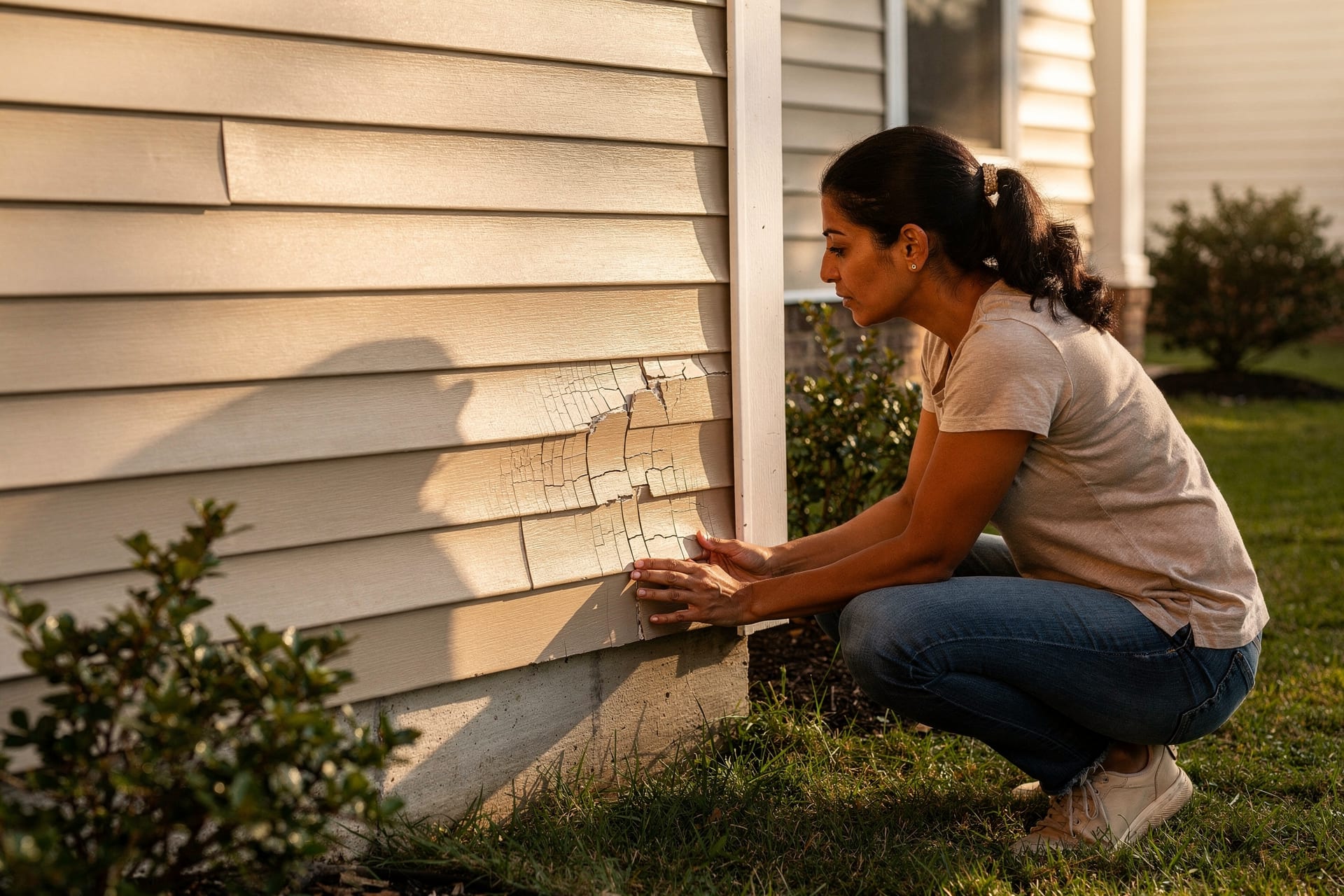
You usually find it on a Saturday. A crack low on the wall behind the grill, a patch gone wavy on the south side, or one elevation faded two shades past the rest of the house.
And the question that follows — repair or replace? — is the wrong first question. The right first question is: what kind of damage is this? The type, not the size, decides the money.
This is the decision page for the siding hub. The material’s honest limits live on the vinyl siding guide, and every dollar figure lives on what siding costs in NC. This page is about reading the damage.
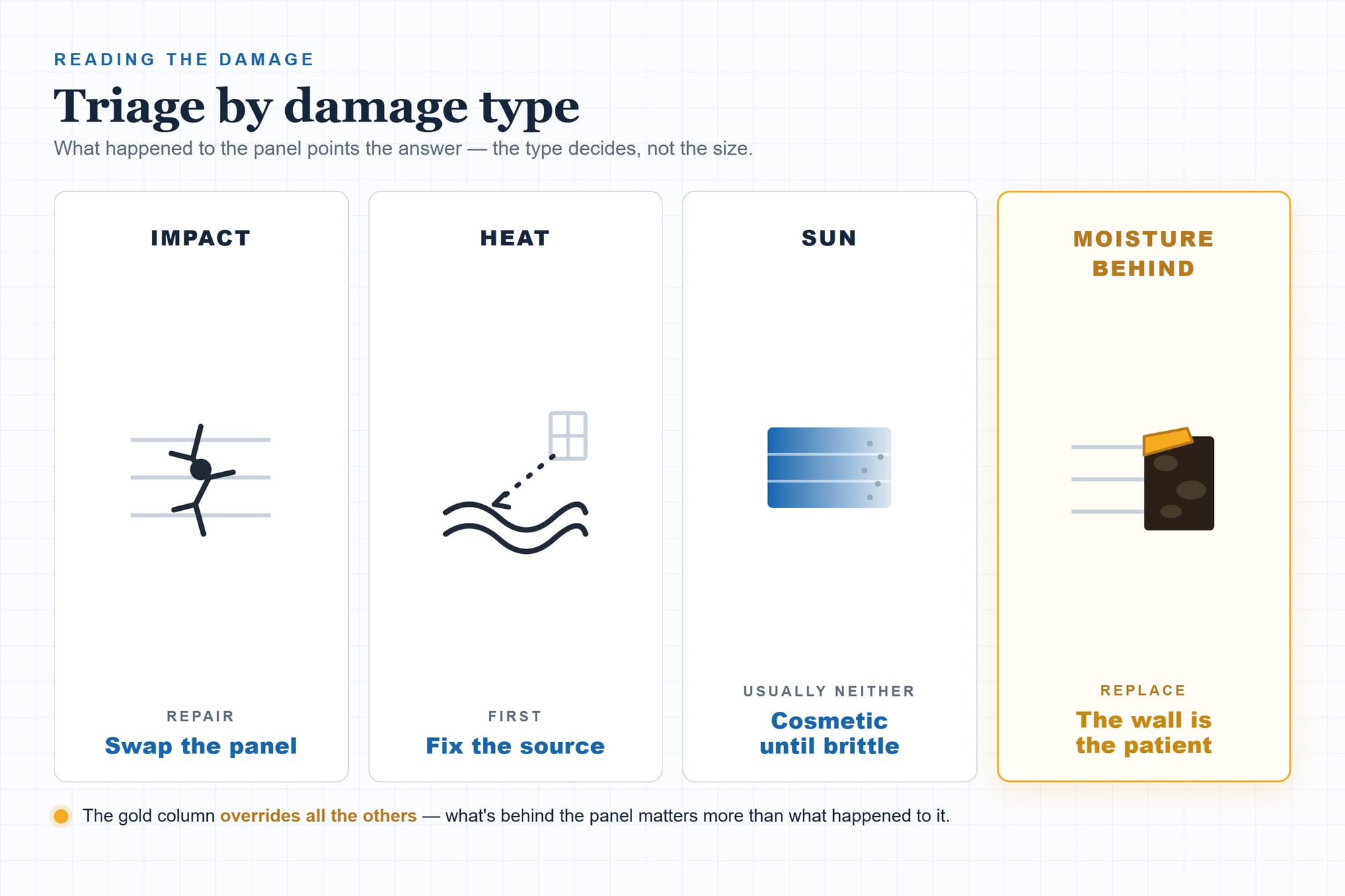
Is it better to repair or replace siding? Triage by damage type, not just size — the type decides the money.
- A cracked or holed panel with a match available is a repair. A panel swap is a modest job.
- Warped or melted panels mean a heat source — often concentrated reflection off high-performance glass nearby — that has to be addressed first, or the new panel fails the same way.
- Widespread fade is cosmetic, until panels also crack and loosen.
- Moisture behind the siding — soft sheathing, mold, wavy walls — is the true replace trigger. Then the wall, not the panel, is the patient.
And if a repair can’t match your weathered color, re-siding that one elevation corner to corner usually beats a patch that shouts.
Start with the damage type, not the size of the bill
Four kinds of trouble walk through this decision, and each one points a different direction: impact, heat, sun, and moisture.
Most advice sorts damage by extent — minor means repair, widespread means replace. That misses the forks that actually cost people money. Here’s the sort I’d run first:
| Damage you can see | Repair or replace? | Why |
|---|---|---|
| A crack, hole, or one broken panel (impact) | Repair — swap the panel | A mid-wall panel swap is a modest, learnable job. The real hurdle is finding a panel that matches your weathered wall. |
| A warped, rippled, or melted patch (heat) | Fix the heat source first | A new panel in the same reflection path fails the same way — and heat distortion is a standard exclusion in vinyl warranties. |
| Widespread fade or chalky powder (sun) | Usually neither — it's cosmetic | Faded panels still shed water. It becomes a replacement conversation when brittleness and cracking join the fade. |
| Soft, swollen, or moldy behind the panel (moisture) | The replace conversation | When the sheathing behind the siding is compromised, the wall is the patient — patching the skin hides the problem. |
A crack, hole, or one broken panel (impact)
- Repair or replace?
- Repair — swap the panel
- Why
- A mid-wall panel swap is a modest, learnable job. The real hurdle is finding a panel that matches your weathered wall.
A warped, rippled, or melted patch (heat)
- Repair or replace?
- Fix the heat source first
- Why
- A new panel in the same reflection path fails the same way — and heat distortion is a standard exclusion in vinyl warranties.
Widespread fade or chalky powder (sun)
- Repair or replace?
- Usually neither — it's cosmetic
- Why
- Faded panels still shed water. It becomes a replacement conversation when brittleness and cracking join the fade.
Soft, swollen, or moldy behind the panel (moisture)
- Repair or replace?
- The replace conversation
- Why
- When the sheathing behind the siding is compromised, the wall is the patient — patching the skin hides the problem.
A cracked or holed panel: almost always a repair
Impact damage — a mower stone, a foul ball, a hailstone, a January basketball — is the repair case, and it’s a smaller job than most people expect.
The method is standard: a zip tool unlocks the course above, the nails come out, the new panel clips in, and the nails go back loose — vinyl hangs on a float, never nailed tight. The whole thing is measured in an afternoon, not a week.
- 1Unlock the course aboveA zip tool hooks the bottom lip of the panel above and unhooks it along its length.
- 2Pull the nailsThe damaged panel’s nailing hem is now exposed. Out come the nails; out comes the panel.
- 3Clip the new panel inIt locks into the course below, same as the one you took out.
- 4Re-nail LOOSELeave a gap under the nail head. Vinyl hangs on a float and must slide as it expands — nailing tight is the classic mistake.
Two NC notes worth having. Cold makes vinyl brittle, so a winter impact cracks a panel that a summer one would bounce off — the season you assess in matters. And before you shop for a panel, check the attic and garage. Builders routinely leave spare siding with the house.
Here’s the market quirk nobody warns you about: small siding repairs are genuinely hard to hire out. A one-panel ticket doesn’t fill a crew’s day, so many outfits pass on it — one forum poster with a six-inch hole reported that nobody local would take the job.
That’s not anyone behaving badly. It’s arithmetic — and it’s why the panel swap is the most legitimate in siding, even for people who rate their own handiness modestly.
The dollars stay small — hundreds, not thousands, when a matching panel exists. The real question is that when. Hold that thought two sections.
Warped or melted panels: find the heat source before you buy a panel
A melted patch is a symptom. Swap the panel without fixing the source, and you’ve scheduled the same repair for next summer.
The usual suspects are a grill run too close to the wall — and, more often than you’d guess, concentrated reflection off high-performance low-E glass nearby, which can focus sunlight onto a wall like a slow magnifying lens. The full whodunit, grill exoneration included, lives on the vinyl page’s heat-distortion section; I won’t re-run the physics here.
What this page owes you is the triage consequence. The fix lives at the source:
- An exterior screen over the offending window. The forum-tested version mounts with Velcro tape so nobody drills the sash — the window’s warranty stays intact. Full mesh, diffuses the reflection, done.
- Landscaping or an awning that breaks the reflection path on that exposure.
- Perforated exterior film rated for the job — with one trap to know: tint or film applied to the glass itself commonly voids the glass manufacturer’s warranty. Fix the path, not the pane.
- Heat-resistant panels on that one wall, if the geometry can’t be changed.
One more twist from the same threads: it isn’t always the neighbor. Your own window can melt your own garage wall — the triage is the same, just a shorter walk.
And put this in your notes before any warranty call: heat distortion is a standard exclusion in vinyl fade-and-defect warranties — verified on the vinyl guide. The panel maker won’t pay for the sunbeam.
Faded or chalky siding: cosmetic, until it isn’t
Fade alone is not failure. A faded panel sheds water exactly as well as it did the day it went up. What you’ve lost is the look — and on vinyl, the look is the one thing you can’t cheaply refresh, because vinyl isn’t designed to be repainted.
There is a middle path. Vinyl-safe exterior paints exist specifically for this — Sherwin-Williams sells an entire VinylSafe palette for the job, with darker shades formulated to resist warping or buckling the panel underneath — and a paint-matched wall is a legitimate answer between live-with-it and re-side.
The honest escalation point: heavy chalking — that powder that comes off on your palm — signals advanced UV age. Advanced UV age means brittleness, and brittleness means the next January impact cracks instead of bouncing.
When fade, chalk, and cracking start arriving together, you’re not looking at a cosmetics problem anymore. You’re looking at a wall aging out — the same failing-in-multiple-ways-at-once pattern that flips the answer on windows.
Soft, swollen, or moldy behind the siding: the replace trigger
This is the fork that overrides everything above. When the wall behind the panel is compromised, the panel is no longer the patient.
Vinyl works as a rain screen — the house wrap behind it does the real waterproofing. Hung over compromised wrap or bad flashing, the panel survives while the wall underneath doesn’t. The warning signs read from both sides of the wall:
- Outside: soft spots you can press a thumb into, swollen or wavy runs, mold or algae lines that keep coming back.
- Inside: peeling paint or bubbling wallpaper on an exterior wall, a musty smell in one room, damp drywall low on the wall.
Here’s the empowering part. The same zip-tool skill from the panel swap doubles as a diagnostic. Pull one panel at the suspect spot — it’s cheap and completely reversible — and read the house wrap and sheathing directly. Dry, intact wrap and solid sheathing: exhale, and go back to panel-level thinking. Dark, soft, or swollen sheathing: stop patching.
Pull one panel. Read the wall. Then decide. Ten minutes of looking beats a year of wondering — and it means any replacement conversation you have starts with you already knowing what’s under there.
Pull one panel at the suspect spot — then read what’s behind it
Dry wrap · solid sheathing
The house wrap is intact, the sheathing is firm to a thumb, no dark staining.
Exhale. You’re back to panel-level thinking — this is a repair.
Dark · soft · swollen
Staining, a thumb that sinks in, swollen board, or wrap that’s torn or missing.
Stop patching. The wall is the patient, and this is the replace conversation.
The matching problem: why the new panel never quite matches
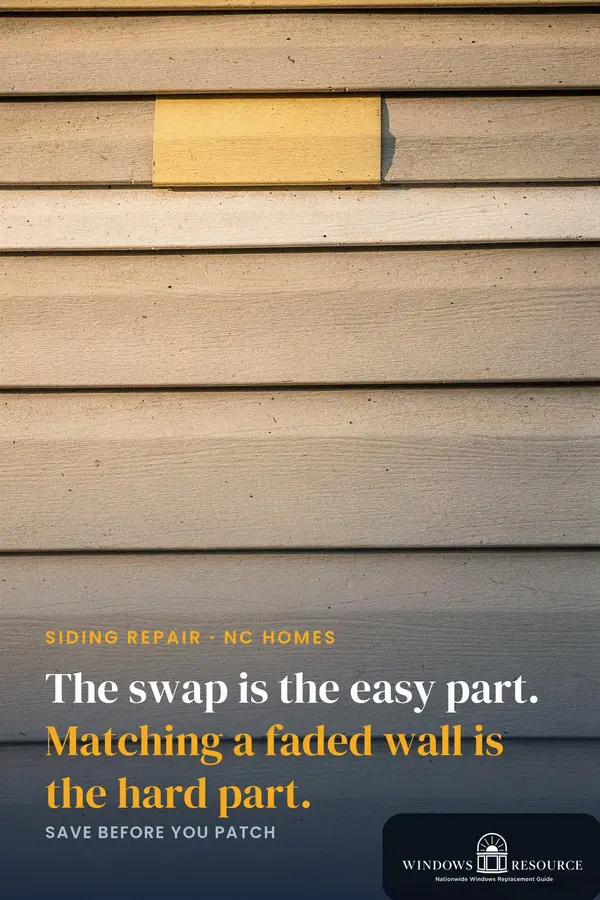
Two things stack against a perfect patch: color varies batch to batch even inside the same product name, and your wall has been fading in the sun since the day it went up. A brand-new panel in the “same” color reads shiny and wrong against 15 years of weather. One forum poster found the mismatch obvious after only five years.
Discontinued colors and profiles make it worse. So the working playbook, straight from people who’ve actually done it:
- Check the attic and garage first. Leftover panels from the original install match by definition — they’re from the same batch.
- The donor-panel harvest. One homeowner’s fix I genuinely admire: pull weathered panels from a hidden stretch of wall — low to the ground, behind the bushes, the north side — and use that aged siding in the visible spot. The shiny new panel goes where nobody looks. The color logic is airtight.
- Paint-match the patch. A painting contractor with decades in the trade endorsed the simple version: take a piece to the paint store and match it with a vinyl-safe flat exterior paint.
- Accept a visible patch on a low-visibility elevation. On the side wall behind the fence, a slight mismatch is a fact, not a problem.
A word on insurance, kept honest: sudden storm or hail damage is often claimable, and wear or fade generally is not. Policies and state rules differ, so read yours.
The matching gap is the part that stings. A policy may pay to patch the damaged wall without paying to make the patch match the house. Ask that question specifically, before the adjuster visit, not after.
And here’s where repair honestly tips over: if no donor panel exists and the patch would sit on the street face like a badge, re-siding that one wall — corner to corner — usually beats the mismatched patch. A color break at a corner reads intentional. A patch mid-wall reads like a patch, forever.
Partial re-side or the whole house?
Partial re-siding is legitimate — at elevation scale. Replace a whole wall corner to corner and the break lands where the eye expects one. The honest caveat: the old siding on the other three walls keeps aging on its own clock, so plan for the color gap to grow.
Whole-house wins when the damage stops being local:
- Multiple walls are failing at once — the aging-out pattern, not an incident.
- The color or profile is unmatchable and the mismatch would be everywhere you look.
- The wall behind needs opening anyway — once sheathing repairs are on the table, re-cladding the opened walls is the efficient move.
- You’re staying a long time. This is the fork the forums argue about most — and the argument has a clean answer, below.
For scale, without re-running numbers that live on the siding cost page: a panel swap is measured in hundreds, a one-elevation re-side in the low thousands, and a whole house typically in five figures. When the honest fix is the small one, the gap between those tiers is money that stays yours.
When a repair is honestly fine
More often than the replacement industry’s content would suggest. If your situation reads like this list, get the repair and keep your money:
Check these five
When a repair is honestly the right answer
Tick most of these and the small fix is the correct fix, not a missed upgrade.
One or two impact-damaged panels
And a donor panel or a credible match exists.
Damage confined to one low-visibility elevation
The fence side, not the street side. A slight mismatch back there is a fact, not a problem.
The siding is mid-life
Roughly under 10 to 15 years, and otherwise sound.
The wall behind reads dry
You pulled a panel and the wrap and sheathing checked out.
Ask"Can we pull one panel and look at the sheathing before we price anything?"
You're selling soon and the fix is cosmetic
A clean repair serves the sale as well as a re-side you'll never live with.
A repair measured in hundreds that actually holds is a win, not a missed upgrade. The trick is only ever the triage: type first, extent second, wall-behind third.
Bottom line
Read the damage before you price the answer. Impact damage is a panel swap. Heat damage is a source problem wearing a siding costume. Fade is cosmetic until brittleness joins it. And moisture behind the panel is the one true replace trigger — the only fork where the big number is honestly the right number.
If you’re staring at a wall and genuinely can’t tell which case is yours, that’s a fair thing to get a second opinion on — send a photo of the damage and I’ll tell you what it reads like, including “that’s a panel swap, don’t let it become a project.”
Sources, Verification & Fact-Checking verified July 2026
Every load-bearing fact on this page is sourced and verified against a primary authority.
Verified July 2026 via direct review of the cited authority — the links open the controlling source so you can check it yourself rather than take our word.
- Mid-wall vinyl panel replacement is a standard, learnable repair — zip tool to unlock the course above, remove nails, clip in the new panel, re-nail loose (never tight). Method per This Old House’s replacement guide (Tom Silva), which carries the same loose-nailing rule — “leave a small gap between the nail head and the siding to allow for movement” — consistent with the float-install rules verified on the vinyl siding guide. (view source — This Old House)
- Small siding repairs are hard to hire out, and spare panels are often left with the house. Homeowner-reported experience from a public forum thread: a poster with a six-inch hole found no local contractor, siding company, or handyman would take the job, and commenters advised checking the attic or garage for builder-left panels. Comment-sourced; quoted verbatim from the live thread. (view source — r/HomeImprovement)
- Reflected sunlight off high-performance low-E glass can distort vinyl siding; heat distortion is a standard exclusion in vinyl fade-and-defect warranties. Mechanism and warranty exclusion verified on the vinyl siding guide’s fact-check; restated here without new claims. The softening-temperature figures that circulate on forums are not repeated here because no primary source was verified for them.
- The forum-tested fix for reflection melt is at the source: a full exterior screen over the offending window, mounted with Velcro tape to avoid drilling the sash and voiding the window’s warranty; film applied to the glass itself commonly voids glass warranties. From the melted-siding thread’s top comments (the original post was removed by moderators; the comments remain live and are quoted verbatim). Comment-sourced. (view source — r/HomeImprovement)
- New vinyl rarely matches weathered vinyl: batch-to-batch color variation plus UV fade stack against a perfect patch; workarounds include harvesting weathered donor panels from hidden walls and paint-matching with vinyl-safe exterior paint. From an r/DIY thread on matching new siding to old, including a homeowner’s donor-panel method and a veteran painting contractor’s paint-match advice. Comment-sourced; quoted verbatim from the live thread. (view source — r/DIY)
- Vinyl-safe exterior paints are a legitimate refresh path for faded vinyl — Sherwin-Williams’ VinylSafe palette includes darker colors formulated to resist warping or buckling the siding. Product line and warping claim confirmed on the manufacturer’s current page. (view source — Sherwin-Williams VinylSafe)
- Decision-scale anchors — panel repair in the hundreds, one-elevation re-side in the low thousands, whole-house typically in five figures; one investor thread weighed a $5,000 repair-and-paint quote against a full replacement around $23,000 (2022 prices) on 30-year-old siding, and its top-voted answer — from an owner who’d made the same call — was full replacement on a long holding horizon. Scale anchors are directional; the real NC per-square-foot and whole-house bands are maintained on the siding cost page. Thread figures are homeowner-reported, dated 2022. (view source — r/realestateinvesting)
- Homeowners insurance often covers sudden storm or hail damage to siding but generally not wear, fade, or age; matching coverage varies by policy and state. Held as a hedged general statement — policy-dependent, no single controlling source; the reader’s own policy governs.