

Almost every siding conversation in North Carolina arrives at the same three words: “everyone says Hardie.” And “everyone says” is exactly the phrase that makes a homeowner who’s been sold before go quiet and wary.
So here’s my job on this page. Not to tell you Hardie is the best — you’ve heard that. My job is the part the sales sheet skips: which line is actually on your quote, whether the premium is real for your walls, and the catch that decides whether that 30-year warranty is worth the paper it’s printed on.
This is a brand review. If you want the material science — what fiber cement is, why the density holds up, and the install failure-modes that rot a wall — that lives on fiber cement siding in NC. If you want the straight head-to-head, vinyl versus fiber cement runs it in full. This one is about Hardie itself.
Is James Hardie siding worth it in NC? For a forever home in NC’s heat, humidity, and storm exposure, usually yes — spec the HZ10 line engineered for exactly that climate, and it earns its premium with a 30-year non-prorated board warranty and a 50-plus-year real-world life. The honest catch: it costs meaningfully more than vinyl — commonly around 1.5–2× at a comparable grade, with the bands overlapping at the premium-vinyl/entry-Hardie boundary — it’s heavy enough to need a Hardie-certified crew, and its longevity is conditional on that install being done to spec. Choose ColorPlus if you want the paint clock to run slow; choose primed only if a custom color matters more than the repaint interval.
Which Hardie is actually on your quote?
“Hardie” isn’t one product — it’s a system, and the line named on your quote changes both the look and the price. When a salesperson says “we’ll do Hardie,” the useful question back is which boards.
Here’s the lineup, in plain terms:
- HardiePlank Lap Siding is the flagship — classic horizontal lap, the field board that covers most of a house. “Hardie board” usually means this. It’s the default, and for most NC homes it’s the right default.
- HardiePanel Vertical Siding runs vertical, and paired with HardieTrim battens it becomes the board-and-batten look people want on farmhouse and modern elevations.
- HardieShingle mimics cedar shake and shingle — the cottage/gable accent. It’s typically the priciest style per square foot (each piece takes more cutting and fitting), so it tends to show up on accents rather than a whole house.
- Hardie Artisan is the premium heavy lap: thicker, with a deeper shadow line that reads even more like real wood.
They share the same colors and the same HZ10 climate engineering. The difference is the look and the labor — a shingle field costs more to hang than a plank field.
| Hardie line | The look | Where it fits an NC home | Relative cost |
|---|---|---|---|
| HardiePlank Lap | Classic horizontal lap | The whole-house default — most re-sides | Baseline |
| HardiePanel Vertical | Vertical panel; board-and-batten with trim | Farmhouse/modern looks, gables, accents | Near HardiePlank |
| HardieShingle | Cedar shake / shingle | Gable and cottage accents, rarely whole-house | Priciest style — runs above HardiePlank per sq ft |
| Hardie Artisan | Thick heavy lap, deep shadow line | A premium whole-house upgrade | Highest of the four |
HardiePlank Lap
- The look
- Classic horizontal lap
- Where it fits an NC home
- The whole-house default — most re-sides
- Relative cost
- Baseline
HardiePanel Vertical
- The look
- Vertical panel; board-and-batten with trim
- Where it fits an NC home
- Farmhouse/modern looks, gables, accents
- Relative cost
- Near HardiePlank
HardieShingle
- The look
- Cedar shake / shingle
- Where it fits an NC home
- Gable and cottage accents, rarely whole-house
- Relative cost
- Priciest style — runs above HardiePlank per sq ft
Hardie Artisan
- The look
- Thick heavy lap, deep shadow line
- Where it fits an NC home
- A premium whole-house upgrade
- Relative cost
- Highest of the four
HZ10 vs HZ5: the one NC-specific line to insist on
James Hardie builds climate-specific product, and North Carolina is HZ10 — the line engineered for hot, humid, salty, hurricane-prone weather. This is the single most useful fact on the page, and it’s the one no national review resolves for our state.
The HardieZone system tunes the board to eight climate variables — rain, hurricanes, UV, hail, snow, temperature swings, humidity, and terrain. It sorts into two families:
- HZ10 is the hot/humid line: built to resist cracking, swelling, and the “brutal, humid heat,” plus hurricane-force wind and coastal salt air. That’s NC.
- HZ5 is the cold line — freeze-thaw, snow, ice. It is not the NC spec, and if a quote lists HZ5 for a North Carolina address, that’s a flag to ask about.
Confirmed current for 2026: Hardie’s own system still places NC — coastal and Piedmont alike — in HZ10. One caveat worth honoring: the system runs on zip-level lookups, not a static county map, so a sliver of high-elevation western NC could read differently. Confirm your exact address on the zip tool at jameshardie.com/hardie-zone-system before you order.
Why HZ10 shrugs off our humidity, storms, and sun is the density story — and that’s covered in full on the fiber cement page, so I won’t re-run it here.
NC homeowner takeaway: if a quote says Hardie, make it say HZ10. That’s not upsell trim — it’s the line built for the exact weather your walls face here.
ColorPlus or primed: which paint clock do you want?
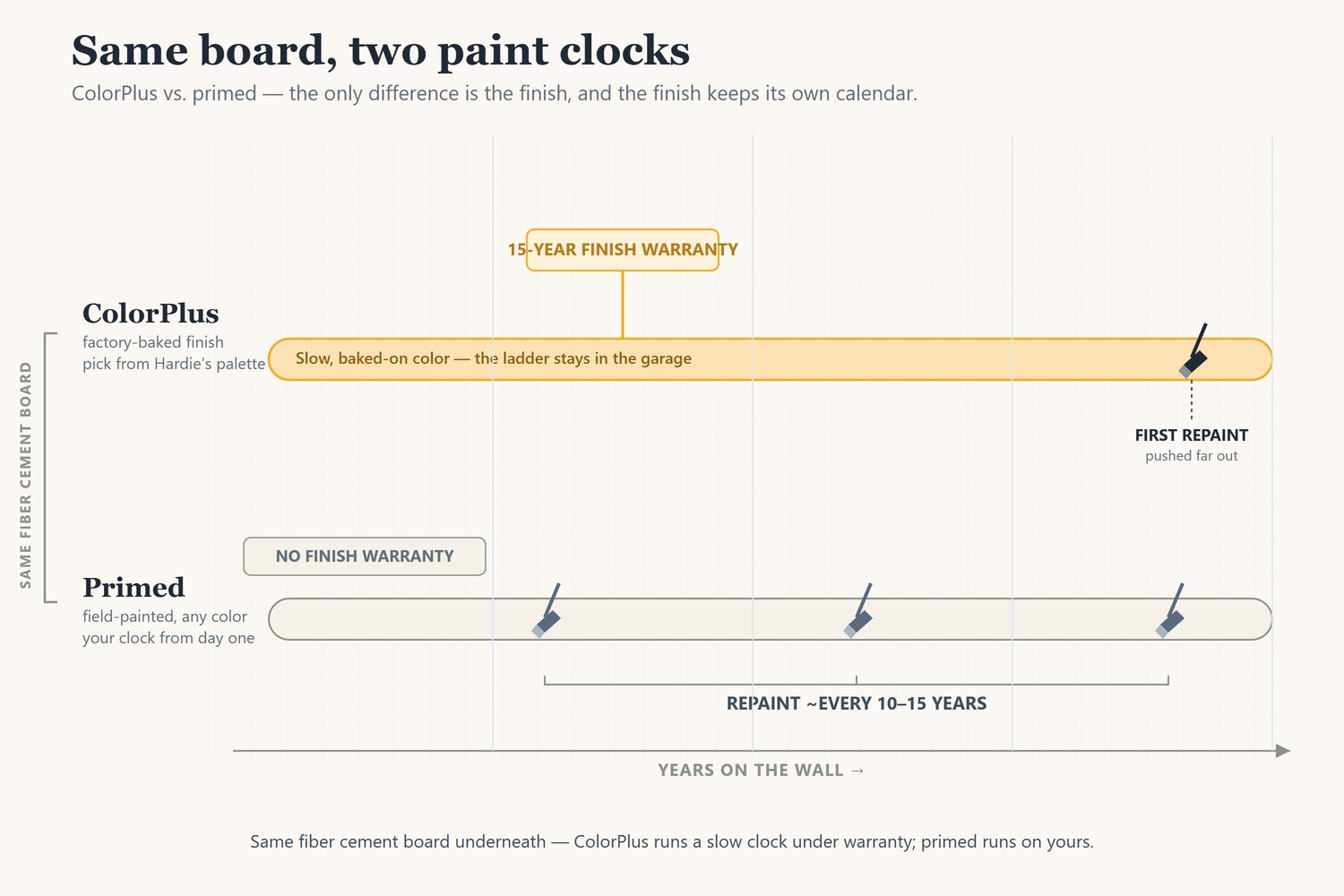
This is the buying decision most reviews bury in a footnote, and it’s really a question about when you’re back up a ladder. Both are the same board. The difference is the finish — and the finish is the part that runs on a clock.
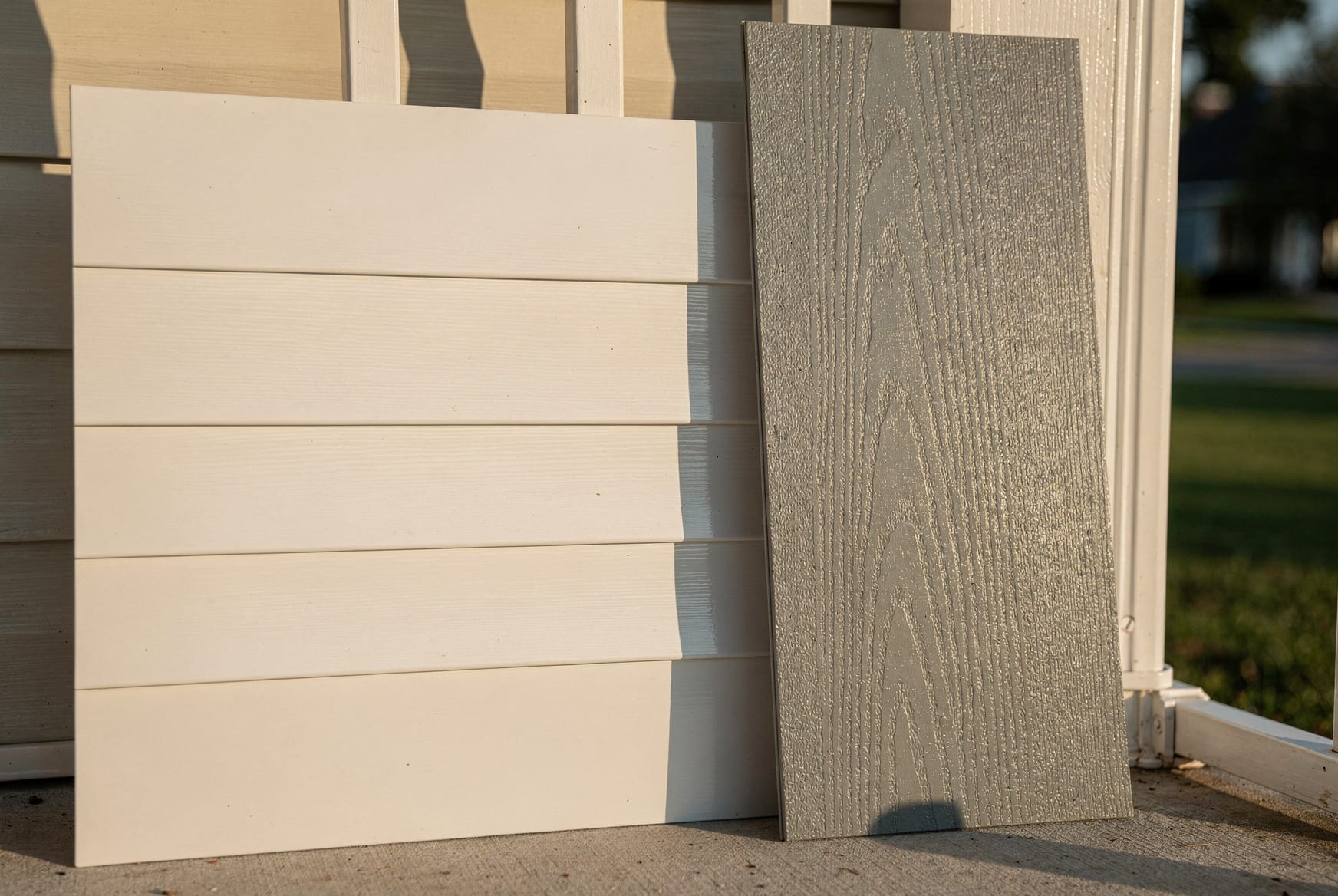
- ColorPlus is factory-applied, baked-on, multi-coat color. It carries a 15-year finish warranty against peeling, cracking, and chipping, and it holds color against NC’s hard UV far better than field paint. The trade: you pick from Hardie’s palette, and the paint clock runs slow.
- Primed board ships ready to field-paint any color you want — more flexibility, lower material cost. The trade: the paint is on your clock from day one, with a typical repaint interval around every 10–15 years (a reasonable-maintenance estimate, not a warranty figure — it moves with paint, exposure, and NC UV) and no factory finish warranty.
So it isn’t “which is better.” It’s which calendar do you want to own. If you’d rather the ladder stay in the garage, ColorPlus buys you that. If a custom color matters more than the repaint interval — a specific historic shade, an HOA-mandated color — primed earns its place.
What it actually costs
Fiber cement runs meaningfully more than vinyl installed — commonly around 1.5 to 2 times at a comparable grade, though the bands overlap where premium vinyl meets entry-level Hardie. That’s the honest premium behind “everyone says Hardie,” and the gap is mostly physics: the board is heavy enough to need specialized tools and a skilled crew, and that labor is real, not padding.
Real-world numbers vary wildly by size, region, and scope. On the forums, homeowner-reported installed quotes swung from mid-size projects up to around $85,000 on a large coastal job that excluded trim and caulking — proof that a single “per square foot” number never tells the whole story. Those aren’t NC quotes, and they’re not a promise for your house.
I won’t put an NC figure on it here, because the honest dollar picture — drivers, tear-off, trim scope, and how to read a padded quote — lives on what siding costs in NC. Price the job there, then bring the quote back to the warranty question below.
The warranty is real — and it’s conditional
Hardie’s warranty is genuinely strong, and it’s genuinely easy to void — both halves are true, and the second half is the one nobody tells you. This is the catch that decides whether the premium pays off.
Confirmed against James Hardie’s own published terms:
- The substrate — siding, trim, and soffit — carries a 30-year, non-prorated, transferable limited warranty. Non-prorated matters: the coverage doesn’t shrink year over year the way many “lifetime” siding warranties quietly do.
- The ColorPlus finish carries a separate 15-year limited warranty covering paint and labor against peeling, cracking, and chipping. Coverage is fullest in the early years and steps down over the term.
Here’s the load-bearing part: both require installation to James Hardie’s specifications. Over-driven nails, wrong ground clearances, pressure-washing above spec, painting over ColorPlus — any of those can void it. The forums say it more bluntly than any brochure: the warranty “must be done” a certain way “to qualify,” and, from an owner who’d clearly learned it the hard way, “don’t pierce it.”
So the warranty isn’t a reason to relax — it’s a reason to insist on a Hardie-certified crew and to keep the install to spec. The failure-modes that void it — clearances, weep gaps, kick-out flashing, fastening — are the same ones covered in detail on the fiber cement page.
Who Hardie is actually for
Fiber cement isn’t the “better” siding in the abstract — it’s the better siding for specific situations, and yours is probably clear once you name your horizon and your exposure.
Hardie earns its premium when:
- This is the forever home. A 50-plus-year board matches a stay-forever plan. A shorter horizon rarely gives the pricier board time to earn its gap over a good vinyl.
- Your walls face real weather. Coastal wind, long southern sun, storm exposure — HZ10 is built for exactly that, and it holds up where vinyl struggles.
- The wood look matters to you. Deep-embossed board, especially Artisan, reads like painted wood in a way a molded panel doesn’t.
- Resale is part of the math. Recent Cost vs. Value data puts fiber cement at the top of remodel tables — re-check the current edition before leaning on the number, since it shifts by year and region.
A good vinyl is the honest answer when the budget leads, you’re staying under about ten years, or your lot is sheltered. I’ll say that at your kitchen table rather than sell you up — a well-installed mid-grade vinyl is a genuinely good wall, and the full comparison is on vinyl versus fiber cement.
And whichever way you lean, it’s worth remembering that a re-side is the natural moment to handle the windows too — same wall, same scaffold, same month of disruption. If you’re pricing both, what replacement windows cost in NC is worth reading before you sign anything on the siding side.
Get a real read on your quote
A review tells you whether Hardie is a reasonable choice. It can’t tell you whether it’s your choice — that depends on your wall area, your exposure, your horizon, and whether the crew on the quote is certified to keep the warranty intact.
If you want a no-pressure second opinion on a Hardie quote you’ve already got — or an honest read on whether Hardie or a good vinyl fits your actual walls — have me walk the house with you. I’ll weigh your exposure and your horizon, and check the line, the finish, and the install scope.
And if vinyl is the honest answer, that’s the answer you’ll get.
Sources, Verification & Fact-Checking verified July 2026
Every load-bearing fact on this page is sourced and verified against a primary authority.
Verified July 2026 via direct review of the cited authority — the links open the controlling source so you can check it yourself rather than take our word.
- Product lines — HardiePlank Lap (flagship), HardiePanel Vertical (board-and-batten with HardieTrim), HardieShingle (shake/shingle look, the priciest style per square foot), and Hardie Artisan (thick premium lap); all share colors and HZ10 climate engineering. The four lines were confirmed live against James Hardie’s own product page (Plank Lap, Panel, Shake and Shingle, and Artisan). That HardieShingle is the priciest style is corroborated by a live-fetched cost guide (This Old House: HardiePlank ~$11–$12.50/sq ft installed vs HardieShingle ~$13.60+/sq ft) — it runs above HardiePlank per square foot, but the earlier “up to ~2×” multiple overstated it and was removed; get a per-line price on your own quote. (view source — James Hardie products, This Old House — Hardie board cost)
- HardieZone — NC = HZ10: James Hardie’s HardieZone system places North Carolina (coastal and Piedmont) in HZ10, engineered for hot, humid, salty, hurricane-prone climates; HZ5 is the cold-climate counterpart for freeze-thaw and snow. Confirmed current for 2026 against James Hardie’s own HardieZone page and matching both sibling siding pages. The system runs on zip-level lookups rather than a static county map, so a specific address (especially high-elevation western NC) should be confirmed on the zip tool. (view source — James Hardie, Hardie Zone System)
- Warranty — 30-year non-prorated, transferable substrate warranty on Hardie siding/trim/soffit; ColorPlus Technology finish carries a separate 15-year limited warranty covering paint and labor against peeling, cracking, and chipping; both require installation to James Hardie’s specifications and can be voided by deviations. Confirmed live against James Hardie’s own pages: the substrate terms and the ColorPlus 15-year paint-and-labor coverage are verbatim from the manufacturer, and James Hardie’s FAQ explicitly states that using a third-party paint voids the ColorPlus finish warranty and that a pressure washer can damage the siding surface — the two void conditions cited here. The exact year-by-year step-down of the ColorPlus coverage is not published on these pages; it is described in general terms (fullest early, declining over the term) rather than as a specific per-year percentage. (view source — James Hardie, Lifetime Value Siding Products, James Hardie FAQ)
- ColorPlus vs primed — ColorPlus is a factory-baked finish with a 15-year finish warranty and slow fade; primed board is field-painted any color, typically repainted roughly every 10–15 years with no factory finish warranty. The ColorPlus 15-year paint-and-labor warranty is confirmed live on James Hardie’s page; the 10–15-year repaint interval for field-painted primed board is a reasonable-maintenance estimate rather than a warranty figure — treat as approximate; it varies with paint, exposure, and NC UV (matches the sibling fiber-cement and vinyl-vs-fiber-cement pages). (view source — James Hardie, ColorPlus / finish warranty)
- Cost — fiber cement runs meaningfully more than vinyl installed, commonly around 1.5–2× at a comparable grade (with the bands overlapping where premium vinyl meets entry-level Hardie); homeowner-reported installed quotes ran up to about $85,000 on a large coastal job (excluding trim/caulking). The ~1.5–2× ratio is corrected from an earlier “2–3×” claim after a live-fetched cost guide (This Old House: vinyl ~$3–$12/sq ft vs HardiePlank ~$11–$12.50/sq ft installed) and a search of current guides put the typical spread nearer 1.5–2×, consistent with the sibling vinyl-vs-fiber-cement page’s overlapping bands. The earlier “$15,000” low anchor was not supported by the fetched homeowner threads (the lowest verified installed quotes ran mid-five-figures; a DIY materials-only job was ~$5,500) and was removed; the $85,000 coastal quote is verified. All are directional, not NC quotes — see the NC siding cost page for the full dollar breakdown. Homeowner price anecdotes from r/HomeImprovement (comment-sourced; parent posts later removed by mods, comments fetched live). (view source — r/HomeImprovement, Hardie quote thread, This Old House — Hardie board cost)
- Voice-of-customer themes — owners strongly favor Hardie when affordable (“Hardy board all day long if you can afford it”; “installed hardiboard 20 years ago… expect it to last longer than me”), with a near-universal caveat that the warranty/longevity is conditional on a certified install to spec (“must be done to qualify”; “don’t pierce it”), and the honest tradeoff that it’s “painted cement and can/will chip.” All quotes are comment-sourced from live-fetched r/HomeImprovement threads (the parent posts have since been removed by moderators; the comments themselves were read directly). (view source — r/HomeImprovement, vinyl vs Hardie thread and siding quotes thread)
- Durability basics — non-combustible A2 fire rating, withstands about 150 mph wind, weighs about 300 lb per 100 sq ft (vs about 60–70 for vinyl), commonly lasts 50+ years properly installed. Manufacturer and trade-source facts; the wind and lifespan figures are product- and install-dependent, so read the specific product listing. The material science behind these is covered in full on the NC fiber cement page rather than re-derived here. (view source — James Hardie)