

A homeowner on a building forum posted the window spec for their new house and asked if they should be worried. The build was in the million-plus range. The window line read: builder-series vinyl, single-hung.
The thread ran to hundreds of comments. Most of them were louder than they were useful.
The calmest reply is the one worth keeping: single-hung is about the least expensive operable window you can put in a wall — and that doesn’t make it a bad window, if it fits what you need.
That’s this whole page in one sentence. Here’s the rest: what a single-hung actually is, what it honestly gives up, and how to tell whether the one in your wall — or on your quote — was picked on purpose.
Are single-hung windows any good? Yes — with eyes open. A single-hung is the simplest window that still opens: one moving sash, the fewest moving parts of any operable style, and typically the lowest price. It seals fine when it’s installed well. What you give up is a top sash that never opens and never tilts in for cleaning — which costs you nothing on a ground-floor window and matters a lot on a second-story one. Good window. Wrong window to buy on autopilot.
What is a single-hung window?
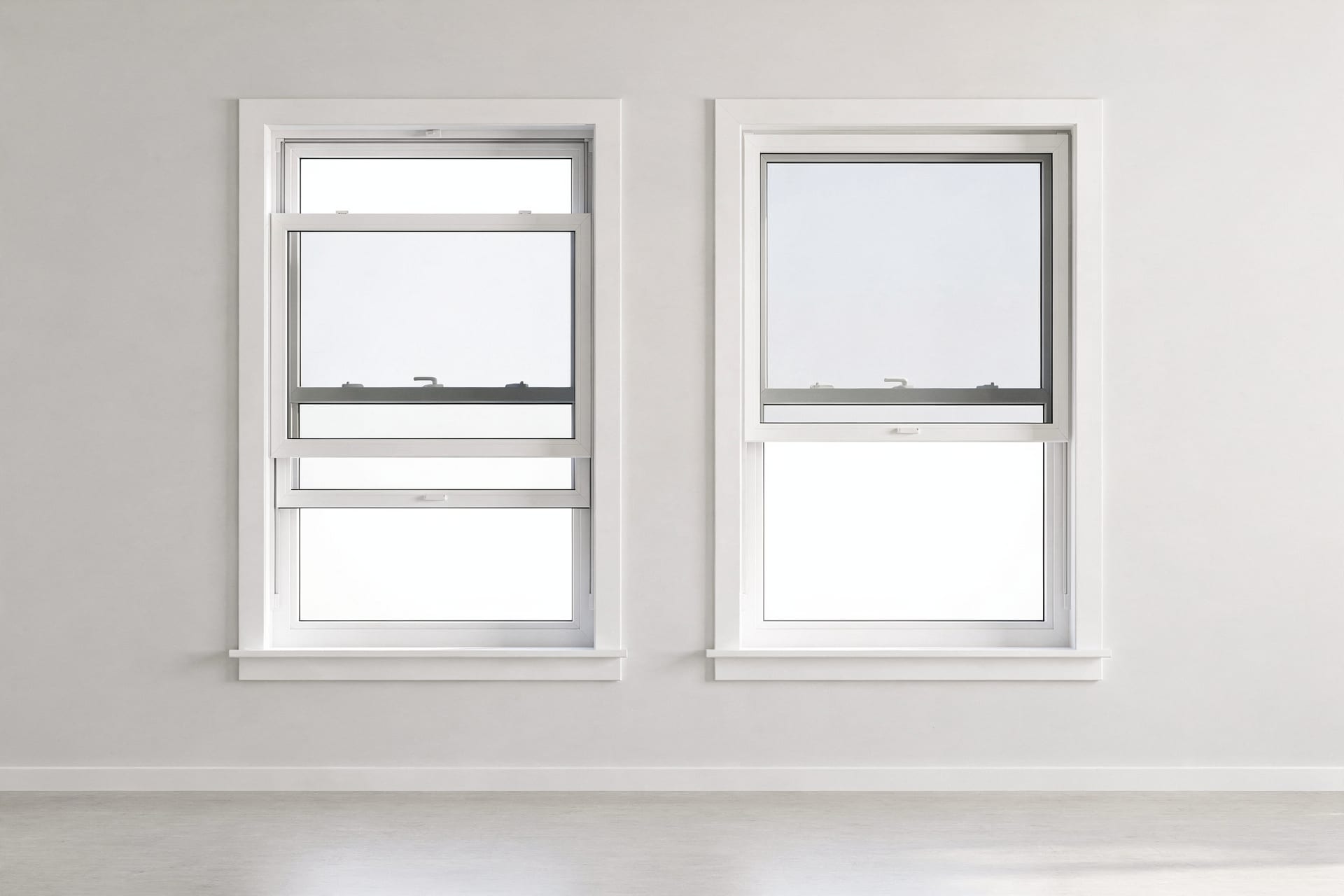
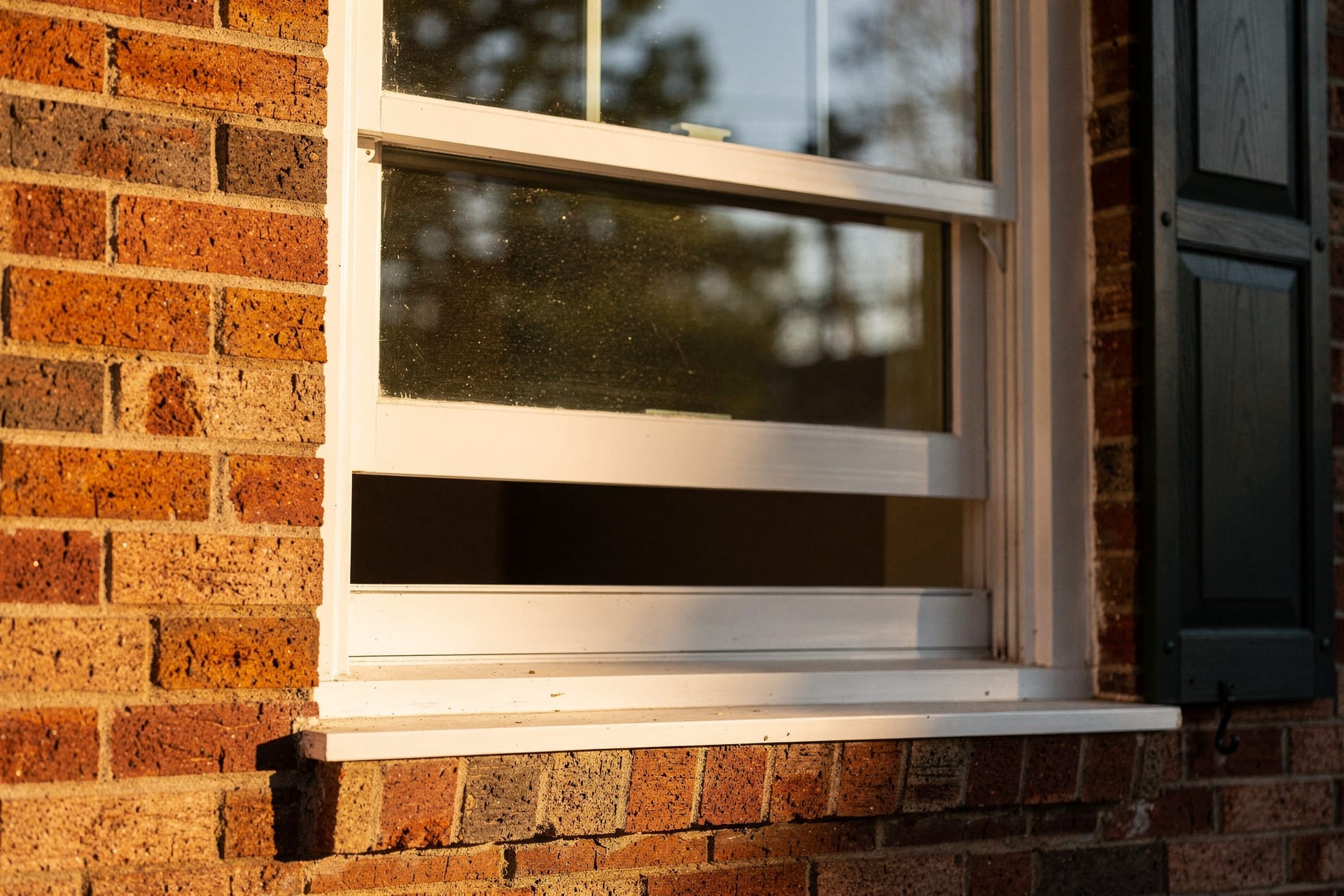
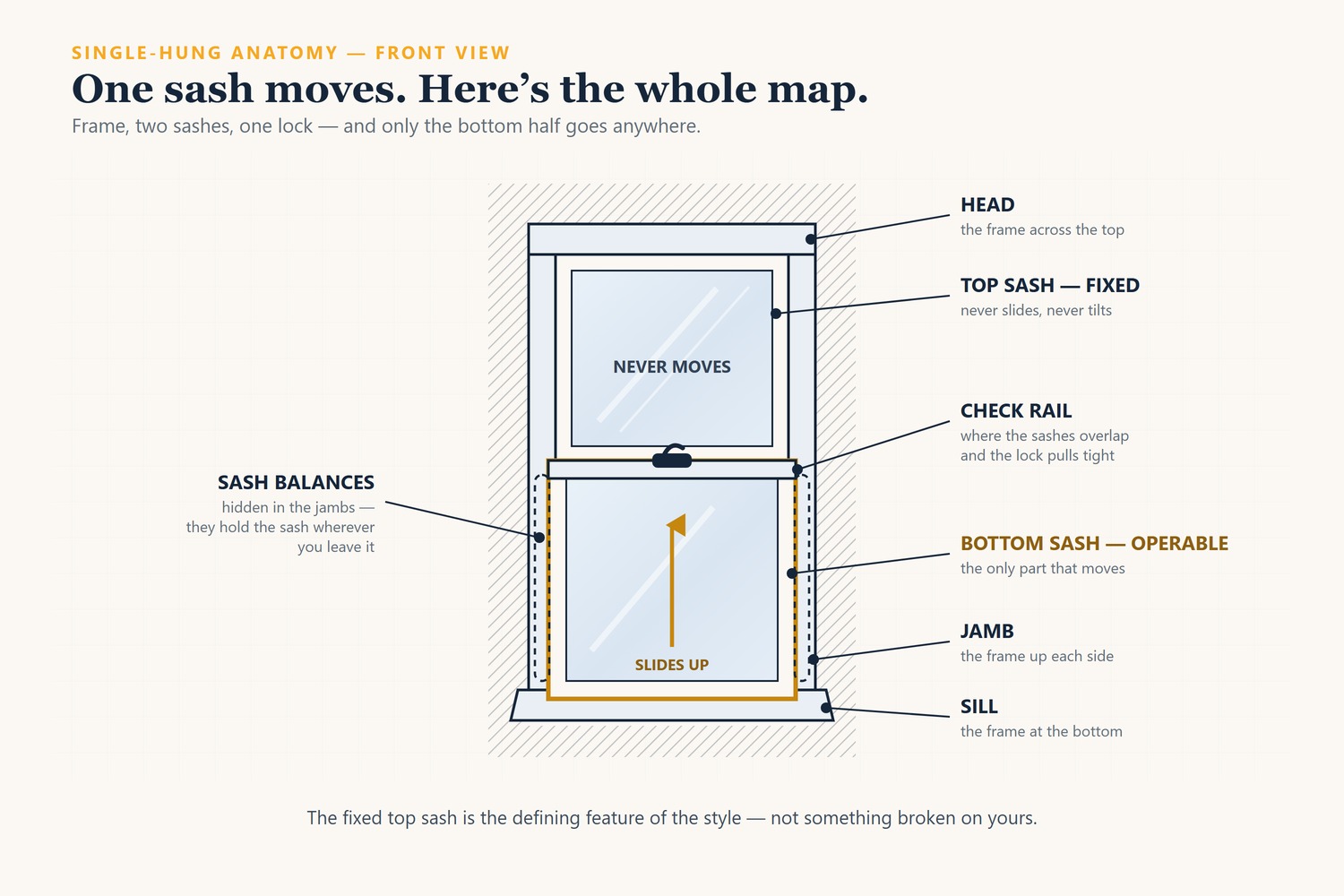
A single-hung window has two sashes, but only the bottom one moves. The top sash is fixed in place — it never slides, and it never tilts.
It belongs to the HUNG family — sashes that ride up and down in vertical tracks. That’s one of four ways a window can open: HUNG (slides up/down), SLIDE (glides left/right), SWING (cranks out on a hinge), and FIXED (sealed shut).
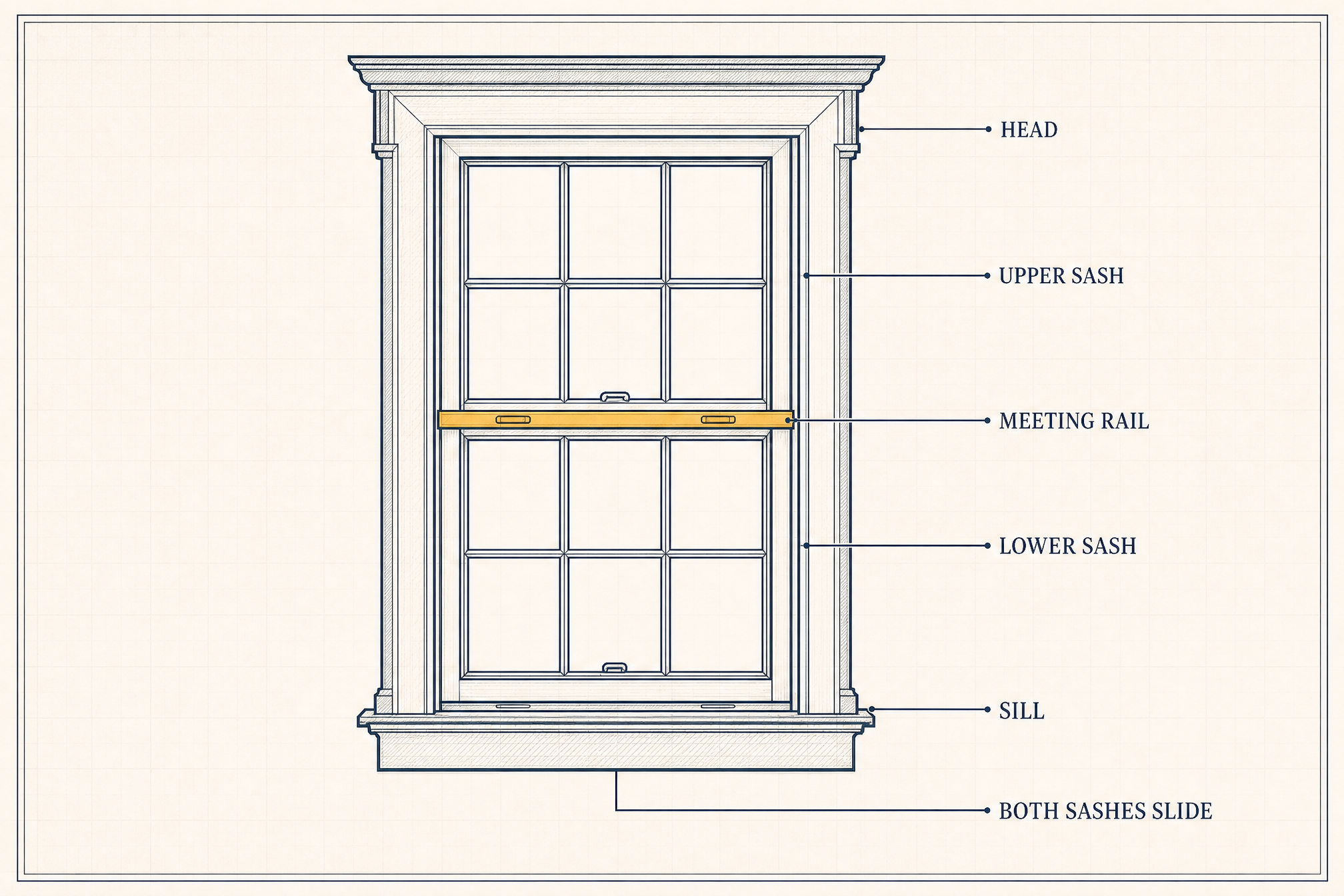
The anatomy is simple. The frame is the head across the top, a jamb up each side, and the sill at the bottom. The bottom sash rides in tracks and is held wherever you leave it by sash balances hidden in the jambs.
Where the two sashes overlap in the middle is the check rail — the spot the lock pulls tight against the weatherstripping.
The top sash is the simple half. No balances, no tilt latches, no track wear. It sits sealed against the frame and stays there for the life of the window.
How to tell what you own, in five seconds: unlock the window and push up gently on the top sash. If it moves, you own a double-hung. If it’s solid, check for tilt latches — the little thumb tabs on the top rail of each sash. Tabs on the bottom sash only, or none at all, means single-hung.
Can it open from the top? No — never. A single-hung has no top-down position. That’s the defining feature of the style, not something broken on yours.
One nuance worth knowing: on some single-hung lines the bottom sash still tilts inward for easy cleaning. The fixed top sash is the real limit — and we’ll get to exactly what that costs you.
What’s genuinely good about a single-hung?
The honest pros are real: it’s typically the lowest-priced operable style, it has the fewest moving parts of anything that still opens, and it usually takes the same glass packages as its double-hung siblings.
- The price, multiplied. The single-hung generally sits at the bottom of the operable price list, and on a whole-house job that difference repeats on every opening. Real NC dollars live on the window cost page — no figures asserted here.
- The fewest moving parts. One operable sash means one set of sash balances, one run of moving weatherstripping, and no top-sash tilt hardware. Over the years, that’s simply fewer parts that can fail.
- Same glass where it counts. The coating and the argon-filled doing the energy work are usually offered identically across a line’s single- and double-hung. The pane doesn’t know which sash it’s in.
One place to keep your guard up: “fewer moving parts” sometimes gets stretched into “seals tighter than a double-hung.” That’s a stretch.
Hung windows — single and double — sit in the same band for air leakage, and the seal quality plus the install decide the outcome, not the sash count. The number that settles it is the on the label.
What are the disadvantages of single-hung windows?
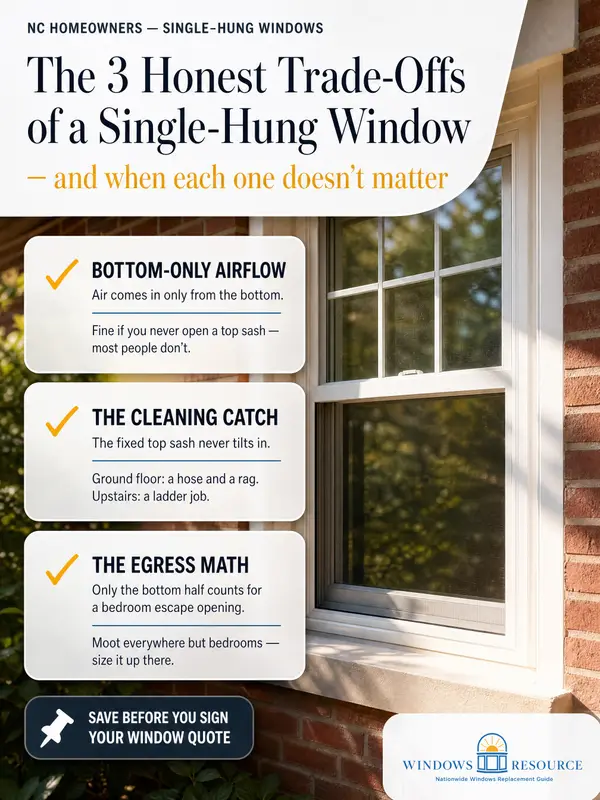
Three real ones: ventilation only from the bottom, a top sash you can’t clean from inside, and a harder path to a bedroom’s escape-opening size.
- Bottom-only ventilation. With no top opening, you lose the top-and-bottom convection airflow a double-hung can set up. If you never open a top sash anyway — most people don’t — you won’t miss it.
- The cleaning catch. The bottom sash tilts in on some lines, but the fixed top sash never does. On the ground floor its outside face is a hose and a rag. Upstairs it’s a ladder job, or it just doesn’t get cleaned. The fixed top sash bites hardest exactly where the price advantage is biggest — upstairs, at volume. Be honest with yourself about that trade before you order ten of them.
- The egress math. In a bedroom, only the sash that actually opens counts toward the escape-opening size — and on a single-hung, that’s roughly the bottom half of the unit. It takes a fairly large window to qualify. The sizing rules and North Carolina’s exact figures live on the egress page, and the NC permit page covers when a bedroom-window swap gets inspected.
If any of those three has you eyeing the upgrade, single-hung vs double-hung walks that decision room by room — it has its own page, and I won’t re-run it here.
Is “builder-grade” a verdict on the window?
No. Builder-grade describes a price tier and a purchasing decision — not a defect.
A volume builder buys windows the way anyone buys a hundred of anything: the least expensive unit that meets code and does the job. Single-hung wins that math, which is why whole subdivisions across North Carolina wear it.
The forum thread at the top of this page wasn’t really about the window, either. The complaint was the mismatch — a top-shelf house carrying the entry-shelf line item — and the fact that nobody had said so out loud before the approval form showed up.
The window would have done its job. The line item just deserved a conversation.
NC homeowner takeaway: the stigma is half right. On a high-end build, the window spec should match the house, and you’re allowed to ask why it doesn’t. But “single-hung” on a spec sheet is not evidence you’re being shorted — it’s evidence somebody did the volume math. Your job is to check that the math was done for your openings, not just the budget line.
Where does a single-hung fit an NC home?
Anywhere you can reach the outside glass, anywhere the opening count is high, and anywhere the top sash would never have been opened anyway.
| The opening | Single-hung fit | The check to run |
|---|---|---|
| Ground-floor windows you can reach | Strong — the fixed top sash costs you nothing here | Can you reach the outside glass with a hose and a rag? |
| Whole-house and rental jobs | Strong — the savings repeat on every opening | Count the openings; the difference multiplies |
| Patio- and walkway-facing walls | Fine — it slides vertically, so nothing swings out into the path | Any hung or sliding window shares this trait |
| Upstairs windows you'll actually clean | Weak — the top sash exterior is outside-access only | Be honest about who's climbing the ladder |
| Bedroom egress openings | Works, but only the bottom half counts | Size the unit against the egress rules before ordering |
Ground-floor windows you can reach
- Single-hung fit
- Strong — the fixed top sash costs you nothing here
- The check to run
- Can you reach the outside glass with a hose and a rag?
Whole-house and rental jobs
- Single-hung fit
- Strong — the savings repeat on every opening
- The check to run
- Count the openings; the difference multiplies
Patio- and walkway-facing walls
- Single-hung fit
- Fine — it slides vertically, so nothing swings out into the path
- The check to run
- Any hung or sliding window shares this trait
Upstairs windows you'll actually clean
- Single-hung fit
- Weak — the top sash exterior is outside-access only
- The check to run
- Be honest about who's climbing the ladder
Bedroom egress openings
- Single-hung fit
- Works, but only the bottom half counts
- The check to run
- Size the unit against the egress rules before ordering
For the whole lineup — casement, awning, slider, picture — see all the window styles. And whichever style wins, remember the pro truth that outranks it: the install matters more than the style name.
If what you’re staring at is an older house full of hung windows, the double-hung page covers the classic most NC homes already have.
Were you charged for doubles and given singles?
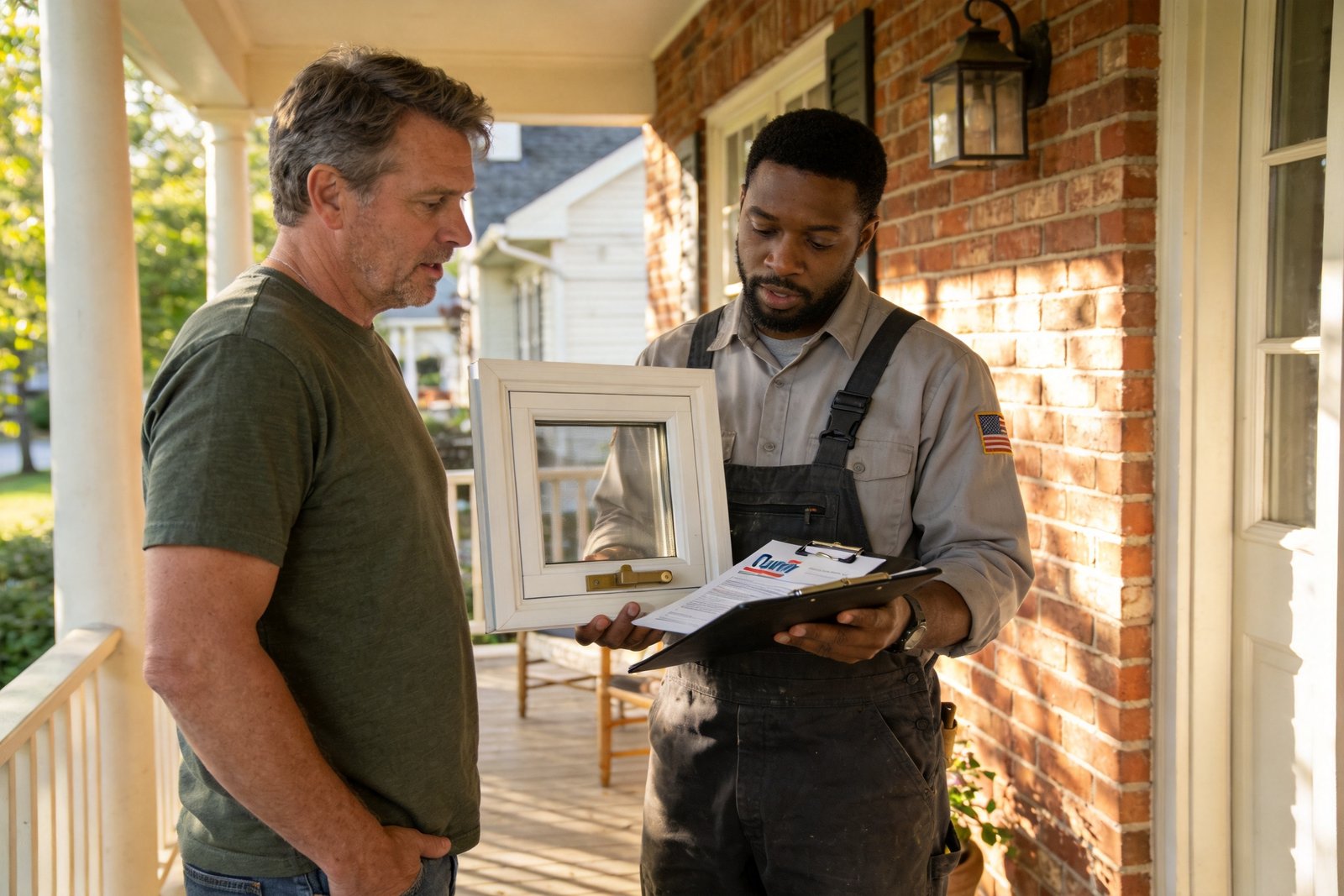
If the paperwork and the glass disagree, that’s a billing question — worth asking calmly, and in writing.
There’s usually a real price difference between the two styles. So a swapped spec isn’t a shrug, and this exact situation shows up in homeowner forums more often than you’d think.
Here’s that advice as a checklist you can run in ten minutes:
- Read the line item. Find the exact words on your contract or quote — “double-hung” or “DH” versus “single-hung” or “SH” — for each opening. Mixed orders are common and completely fine, as long as the mix was on purpose.
- Run the five-second test. At each window: push up gently on the top sash, and look for tilt latches on both sashes. Top sash solid, latches on the bottom only — that’s a single-hung.
- Count both ways. Windows on the paper versus windows in the walls, style by style.
- If they disagree, ask in writing. A spec-versus-invoice mismatch is a billing correction, not an accusation — most of the time it resolves in one email. While you have the quote out, here’s how to pressure-test the rest of it.
And if you’d rather have a second set of eyes on any of it — the quote, the mix of styles, whether single-hung belongs on your openings at all — that’s what a no-pressure consult is for.
Bring the paperwork. The top sash isn’t going anywhere!
Sources, Verification & Fact-Checking verified July 2026
Every load-bearing fact on this page is sourced and verified against a primary authority.
Verified July 2026 via direct review of the cited authority — the links open the controlling source so you can check it yourself rather than take our word.
- A single-hung window has one operable bottom sash and a fixed top sash; the top sash does not slide or tilt. This is the defining mechanic of the style, described from the hardware itself. Pella’s product page states the same definition — “a single movable sash that slides up from the bottom, while the top sash stays stationary” — and confirms the tilt-in bottom sash on select lines. (view source — Pella, Single-Hung Windows)
- Single-hung is typically the lowest-priced operable window style; the gap versus double-hung varies by brand, size, and glass package. Cost direction is stated qualitatively — no dollar figure is asserted on this page; real NC ranges live on the cost page. Manufacturers position single-hung as the cost-effective hung option (“cost-effective and versatile” is Milgard’s own line). (view source — Milgard, Single Hung Windows)
- Air-seal honesty: single- and double-hung sit in the same air-leakage band, and no sub-ranking between them is published; compression-seal swing styles (casement/awning) rate tighter than sliding-sash styles. A single-hung has one fewer operable sash — directionally fewer seams — but seal quality and installation dominate the outcome. No link is attached on purpose: the federal Energy Saver reference page for window operating types was removed in a site restructure (checked July 2026), and I don’t cite a page I can’t show you. The claim stays qualitative; the number that decides any specific window is the air-leakage rating on its NFRC label.
- Egress: only the operable portion of the window counts toward a bedroom’s emergency-escape opening, so a hung window needs a larger unit than a style that opens fully. The 2018 NC Residential Code (Section R310.2.1) sizes the opening by “net clear openable area” — the area you get by actually operating the window, which on a single-hung is the bottom sash only. This page intentionally states no NC dimensions — the amended North Carolina figures and the sizing math live on the egress page. (view source — 2018 NC Residential Code, Chapter 3, Section R310)
- The two homeowner stories are real, public forum threads, fetched July 2026; quotes are paraphrased. The million-plus build spec’d with builder-series vinyl single-hungs: (view source — r/Homebuilding, “My ‘luxury’ builder is asking for our approval…”). The charged-for-doubles check: (view source — r/Homebuilding, “Single v double hung windows: Do I throw a stink?”)
- Glass packages (Low-E coating, gas-filled IGU) are usually offered across both hung styles within a manufacturer’s line. Stated with “usually” — options vary by line. Spot-checked against one builder line: Pella’s 250 Series lists the same five InsulShield Low-E glass packages, with the same dual- or triple-pane options, on its single-hung and double-hung pages. (view source — Pella 250 Series Single-Hung · view source — Pella 250 Series Double-Hung)