

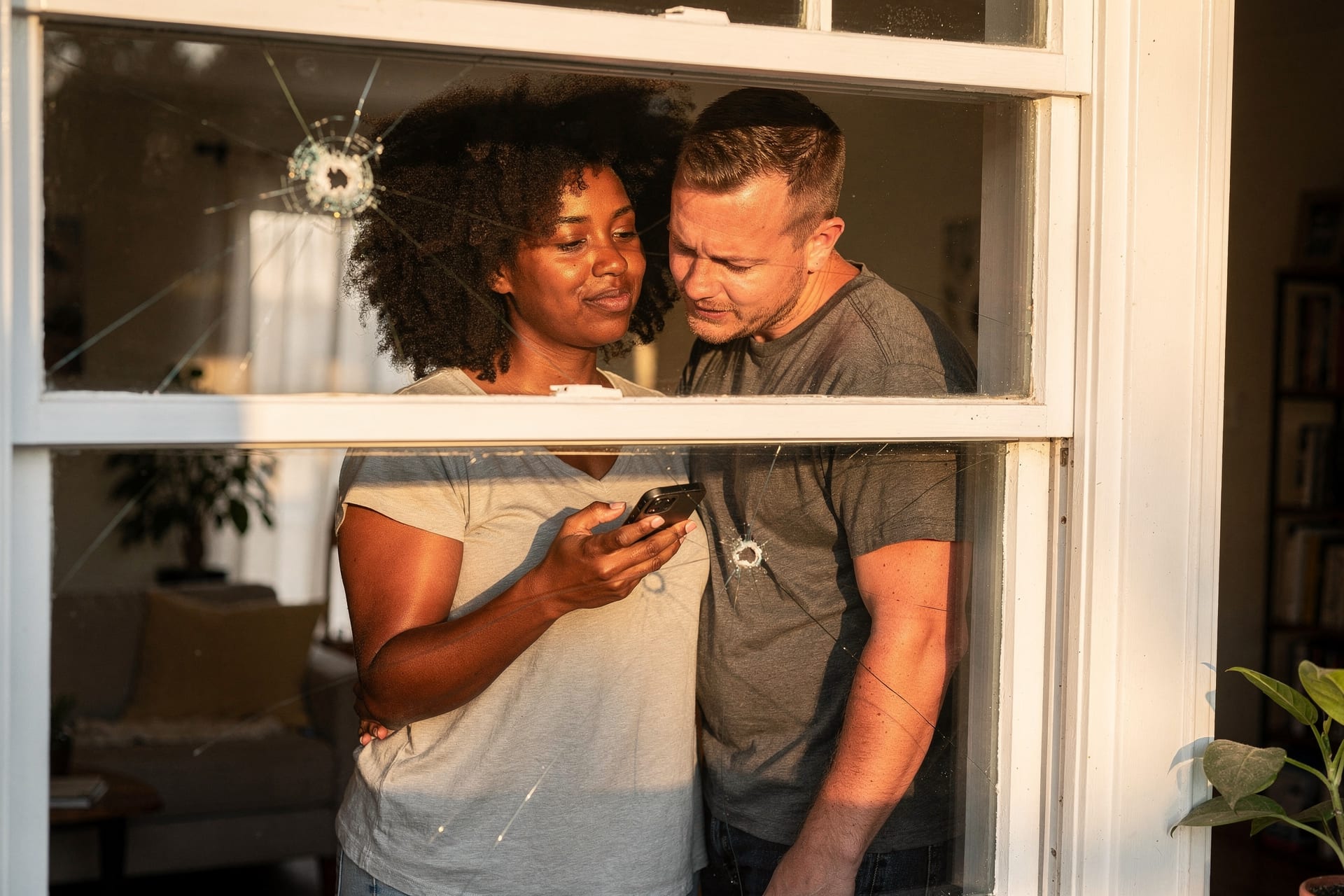
The rock came off the lawn mower and the window just… gave. A long crack, a small hole, and now you can watch it spread a little more each day.
So you called someone. And the number that came back was for a whole new window — four figures, maybe more — for what is, on the counter in front of you, a single sheet of broken glass.
Take a breath. That quote isn’t a scam, but it’s very likely the wrong quote for your problem. Here’s the most useful sentence I know in this whole category: a broken pane almost never means a new window. It usually means you called the wrong kind of company.
Do you have to replace the whole window for a broken pane? Almost never. If the frame and sash are sound, the glass is a replaceable part. On a single-pane sash you swap the piece of glass; on a double-pane you swap the whole sealed unit (the ). The whole window is the right call only when the frame failed too. And who you phone — a glass company or a window company — often decides the price.
Can you just replace the glass?
Yes — and the move that saves you the most money is calling a glass company, not a window-replacement company. They are two different businesses.
A glass company (a glazier) cuts, fabricates, and installs glass. A broken pane is their whole job. A window-replacement company sells and installs windows — the full unit, frame and all. So when you describe a broken pane to a window company, an honest one will still quote you a window, because a window is the product they sell.
That’s not a trick. It’s incentives. But it means the same broken pane can come back as a $4,800 window from one business and a few-hundred-dollar piece of glass from another — and the difference is which number you happened to dial first.
So the first, cheapest step is simply: for a broken pane, start with a glass shop. If the glass shop looks at it and says the frame is shot, then you’re in window territory — and now you know it’s real, because the company that would rather sell you glass told you so.
Single pane vs double pane: two different repairs
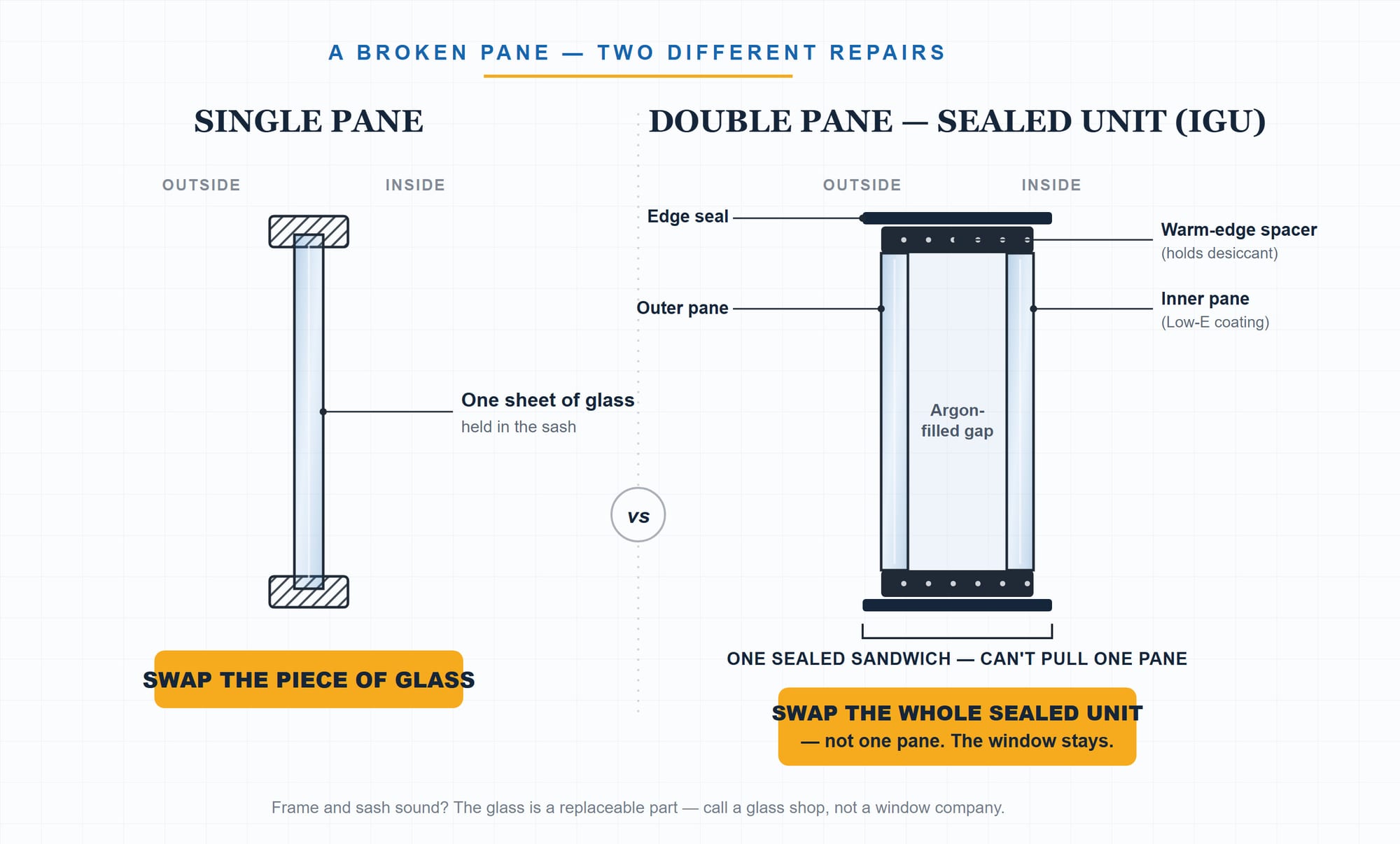
This is the fork everyone trips on. On a single-pane sash you replace the piece of glass. On a double-pane you can’t replace one pane — you swap the whole sealed unit.
A single-pane window is one sheet of glass in a sash. Break it, and a glazier cuts a new sheet to size and sets it in. Straightforward.
A double-pane window is not two loose sheets. It’s an — two panes bonded to a spacer around the edge, the gap sealed and usually filled with argon, closed by an edge seal. It’s built as one sealed sandwich.
So you cannot pull the one broken pane out and slot a new one in; the unit is a single sealed part. The fix on a double-pane is to swap the entire sealed unit into the same sash and frame. The window stays — only the glass package changes.
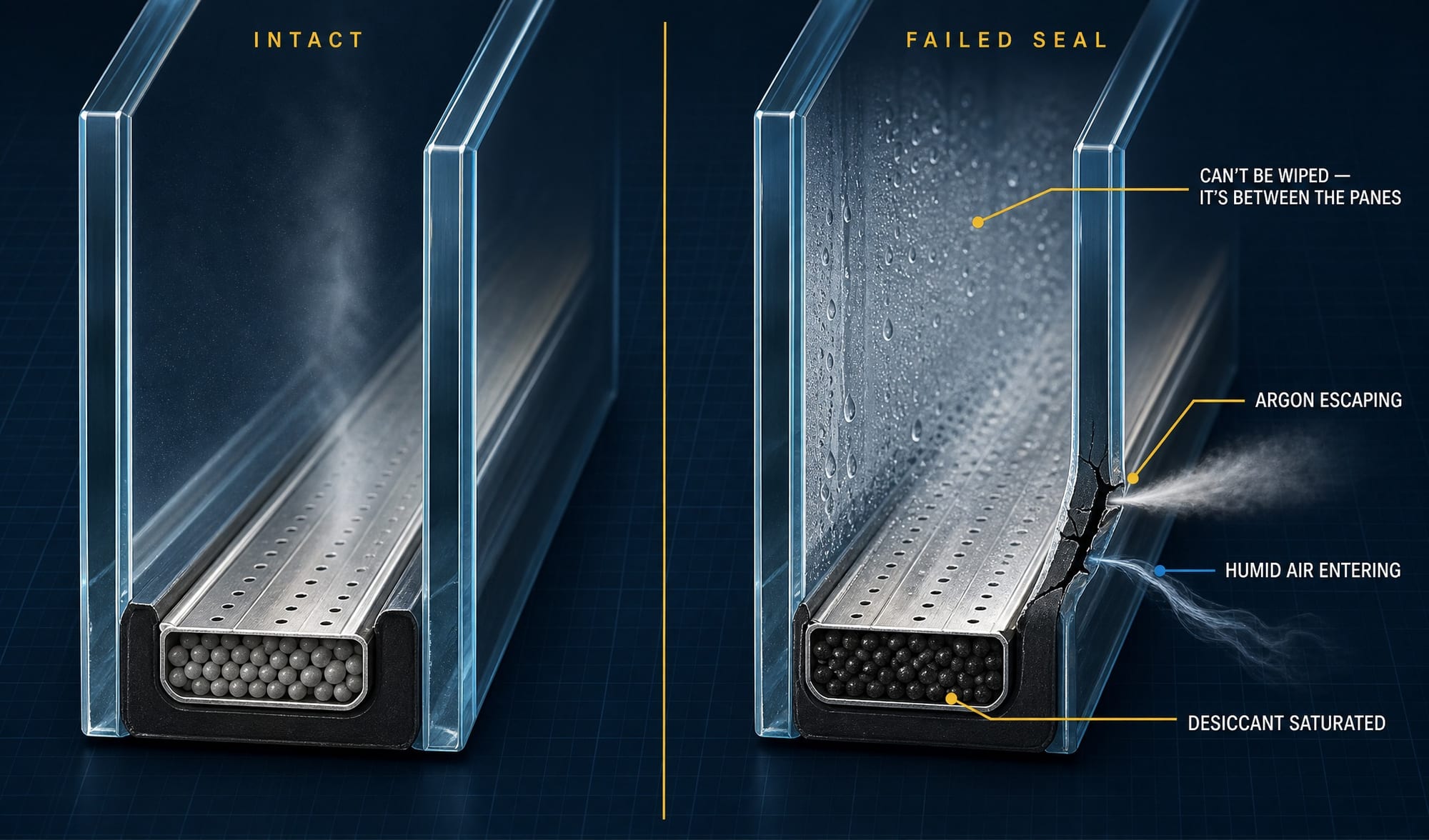
Here’s the plain version of why: the sealed unit is engineered as a thermos. Two walls, a sealed gap, a drying agent in the spacer. Breach it and it’s done as a unit.
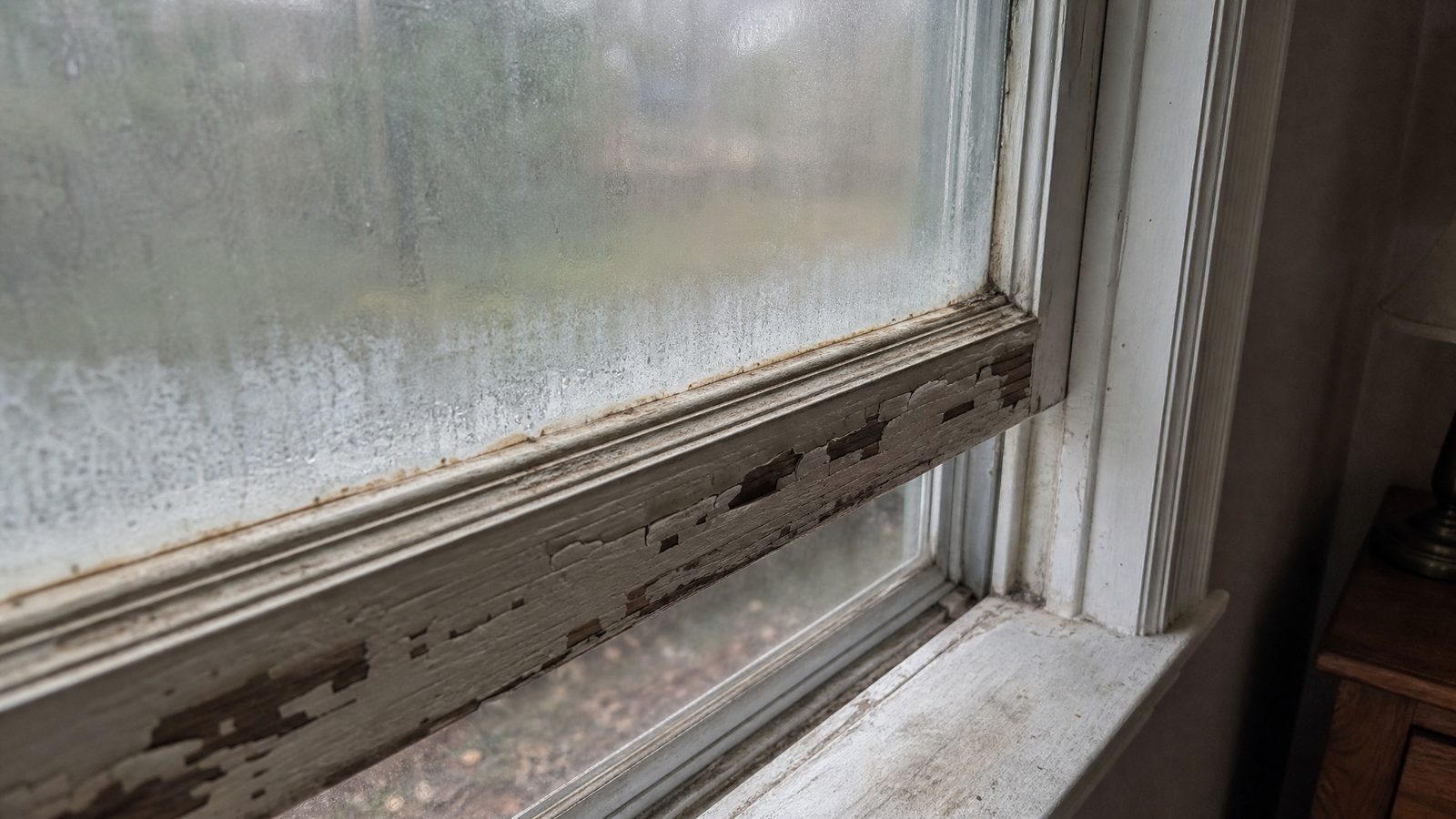
That’s also why a fogged double-pane gets fixed the same way — a failed seal and a cracked pane are two doors into the same answer: swap the glass, keep the window. (The fog story has its own page: why a window fogs between the panes.)
What does it actually cost?
When the frame is sound, replacing the glass is a fraction of a full window — often meaningfully less for the same opening. The honest catch: “the glass” spans a wide range, because a chip-repair, a single-pane sheet, and a sealed insulated unit are three different jobs.
Roughly, in national cost-guide bands (not an NC quote — get the itemized bid):
| The fix | Rough cost band | When it wins |
|---|---|---|
| Repair the glass (crack/chip resin) | about $100–$500 | Cosmetic crack or chip in a single-pane, no hole, glass otherwise sound — a small chip sits at the low end |
| Replace the glass only (single pane, or the sealed IGU on a double) | single pane about $150–$400; double-pane sealed unit about $350–$700 | Frame and sash are sound; the glass is what failed — the money-saving default |
| Replace the whole window | about $600–$1,500+ | The frame is rotted or racked, or it's a single-pane you were going to upgrade anyway |
Repair the glass (crack/chip resin)
- Rough cost band
- about $100–$500
- When it wins
- Cosmetic crack or chip in a single-pane, no hole, glass otherwise sound — a small chip sits at the low end
Replace the glass only (single pane, or the sealed IGU on a double)
- Rough cost band
- single pane about $150–$400; double-pane sealed unit about $350–$700
- When it wins
- Frame and sash are sound; the glass is what failed — the money-saving default
Replace the whole window
- Rough cost band
- about $600–$1,500+
- When it wins
- The frame is rotted or racked, or it's a single-pane you were going to upgrade anyway
The load-bearing point isn’t the exact dollar — it’s the ratio. When the frame checks out, the glass-only path runs well under a full replacement of the same opening.
Make it safe right now
Stabilize the pane, don’t stress it — and don’t call your insurer to “ask” before you get a glass quote. A crack or a hole in a large pane can let go, so a stopgap matters, but the wrong stopgap makes the real fix harder.
- Tape a spreading crack — lightly. Clear packing tape or a clear Gorilla-type tape laid flat across the crack, on both sides if you can reach them, slows it from running. Use light pressure — pressing hard can pop a stressed pane. A pass with a hair dryer helps the tape grab.
- Cover a hole with polycarbonate. A cut piece of polycarbonate (Lexan-type) sheet over a hole is a sturdier, impact-resistant stopgap than cardboard or a trash bag — it drills without shattering and keeps weather out until the glazier comes.
- Keep the shards. If the glass is safety glass, note it (more on that below) — it changes what the shop has to fabricate.
How to order the replacement glass or IGU
Measure the glass, spec what’s in it, and confirm the frame is sound first. A good glazier does this on-site, but knowing the steps keeps you from being sold a whole window you don’t need.
- Confirm the frame is sound. Press the sill and the corners. If the wood is soft or the sash is racked out of square, glass alone won’t fix it — that’s the whole-window conversation, below.
- Measure the glass, not the window. For a sealed unit the glazier needs the pane’s overall width and height, the total thickness (both panes plus the gap), and the spacer. For a single pane, width, height, and thickness.
- Spec what’s inside. On a double-pane, match the original package — coating, argon fill, warm-edge spacer — so the new unit performs like its neighbors. On any pane, ask whether code requires safety glass here.
- Know the tempered catch. Glass near a door, near the floor, in a bath, or a large low pane usually has to be tempered (safety) glass by code.
- Watch the size limit. Some shops can’t fabricate tempered above a certain size, so on a very large pane they may default to quoting a whole window even when glass-only should work. That’s a fabrication limit, not a verdict on your window — call another glass shop that can make the size.
On the North Carolina coast, add one more: in windborne-debris counties, a replacement pane in a protected opening may need to be laminated impact glass, not just tempered. That’s a separate code question from energy ratings — worth naming to the shop up front. (Details: coastal impact-glass requirements.)
When the whole window actually wins
When the failure isn’t just the glass. New glass in a dying frame is a part swap on a totaled car. Replace the window, not the pane, when:
- The frame is rotted. A soft sill or decaying jamb means water is winning. New glass won’t stop it.
- The frame is racked out of square. An opening that binds the sash puts edge stress on the next unit too — the new glass inherits the problem.
- It’s single-pane original glass you were going to upgrade anyway. If the pane broke on an old single-pane you’d been meaning to replace, this is your moment to go to an insulated unit.
- Failures are stacking up. One broken pane plus fog plus drafts plus a lock that won’t catch, across the house, shifts the math toward replacement.
That last call — how many problems tips you from “fix it” to “replace it” — is its own decision, and I walk the whole framework here: the signs that actually mean new windows. And if you’re weighing any repair-or-replace question, the repair-or-replace hub is the map.
The short version: a broken pane is a glass problem until a screwdriver in the sill proves it’s a frame problem. Prove that first, and you’ll usually spend a few hundred dollars where you were braced to spend thousands.
Your quiet hope walking in was that you don’t need a new window. For a broken pane, you usually don’t.
Send me a photo of the glass and the frame corner and I’ll tell you which fix it is — a glass-shop pane swap, a sealed-unit swap, or a genuine replacement — before you sign anything.
Sources, Verification & Fact-Checking verified July 2026
Every load-bearing fact on this page is sourced and verified against a primary authority.
Verified July 2026 via direct review of the cited authority — the links open the controlling source so you can check it yourself rather than take our word.
- A double-pane window is a sealed insulated glass unit (IGU) — two panes bonded to a spacer and edge seal — so a fogged or failed unit is replaced as a whole assembly, not one pane at a time. ENERGY STAR describes double-pane windows with failed seals as cloudy or moisture-filled between the panes, losing insulating power. (view source — ENERGY STAR, Is It Time to Replace Your Windows?)
- Window construction — two or more panes, a sealed gas-filled gap, a spacer, and an edge seal — per U.S. Department of Energy fenestration reference. (view source — U.S. Dept. of Energy, Building Science Education)
- Real-homeowner cost gap — a large broken pane quoted at $4,800 for full replacement was ultimately fixed by a glass company replacing just the pane with tempered glass for about $350 installed; the thread’s top-voted advice was to “call a glass replacement business not a window replacement company.” Attributed voice-of-customer, live-fetched. (view source — r/HomeImprovement thread)
- Glass repair and replacement cost bands (national cost-guide ranges, not NC quotes): crack/chip resin repair about $100–$500; single-pane glass replacement about $150–$400; double-pane sealed-unit (IGU) swap about $350–$700; whole-window replacement about $600–$1,500+. Live-fetched from national cost guides July 2026; every band confirms the glass-only paths run well under a whole-window replacement of the same opening. (view source — Modernize, Window Glass Replacement Costs; view source — This Old House, Window Glass Replacement Cost)
- Rule-of-thumb savings — a glass-only or sealed-unit swap runs roughly 50–70% less than a full window replacement of the same opening when the frame is sound. Directional estimate derived from the national bands above (e.g., a ~$350–$600 IGU swap against a ~$600–$1,500 whole window), not a fixed percentage; the fetched cost guides confirm glass-only is consistently cheaper but state no single savings figure.
- Safety-glazing requirement — glazing in hazardous locations (in and adjacent to doors, large panes near the floor, wet areas and baths, and along stairs) must be tempered or laminated safety glass under IRC R308.4, adopted in North Carolina’s 2018 Residential Code; coastal wind-borne-debris openings may additionally require laminated impact-rated glazing. Requirements vary by county, so confirm the rule for your specific location with your glazier or local building department before ordering. (view source — IRC R308.4 hazardous locations)