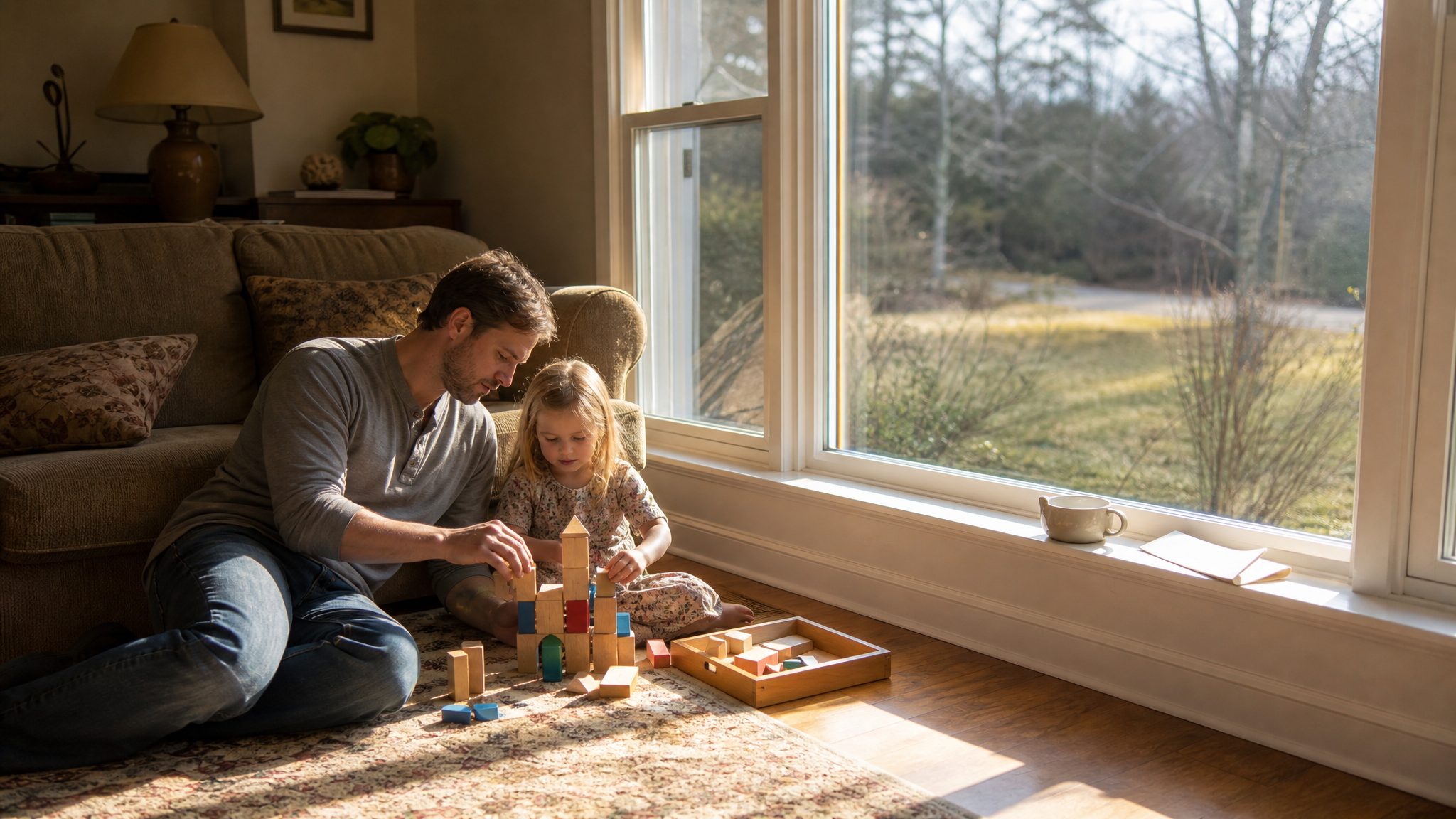

The one room where a window can embarrass you is the one room you most want daylight in. Bathrooms, street-facing front rooms, the sidelight next to your door.
So you ask for “privacy glass” or “frosted,” and you assume that settles it. Most of the time it does. But there’s a catch nobody mentions on the quote, and it shows up the first night you turn the light on.
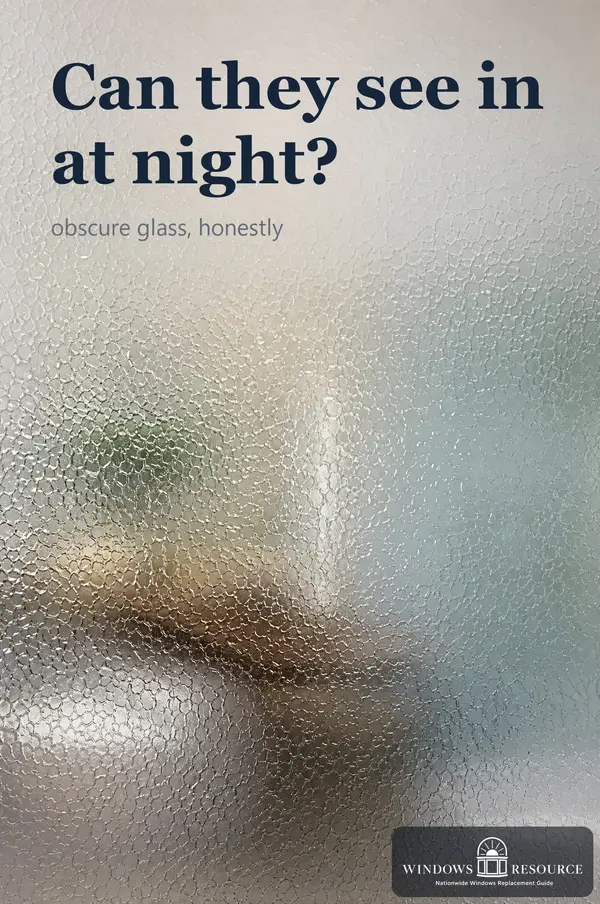
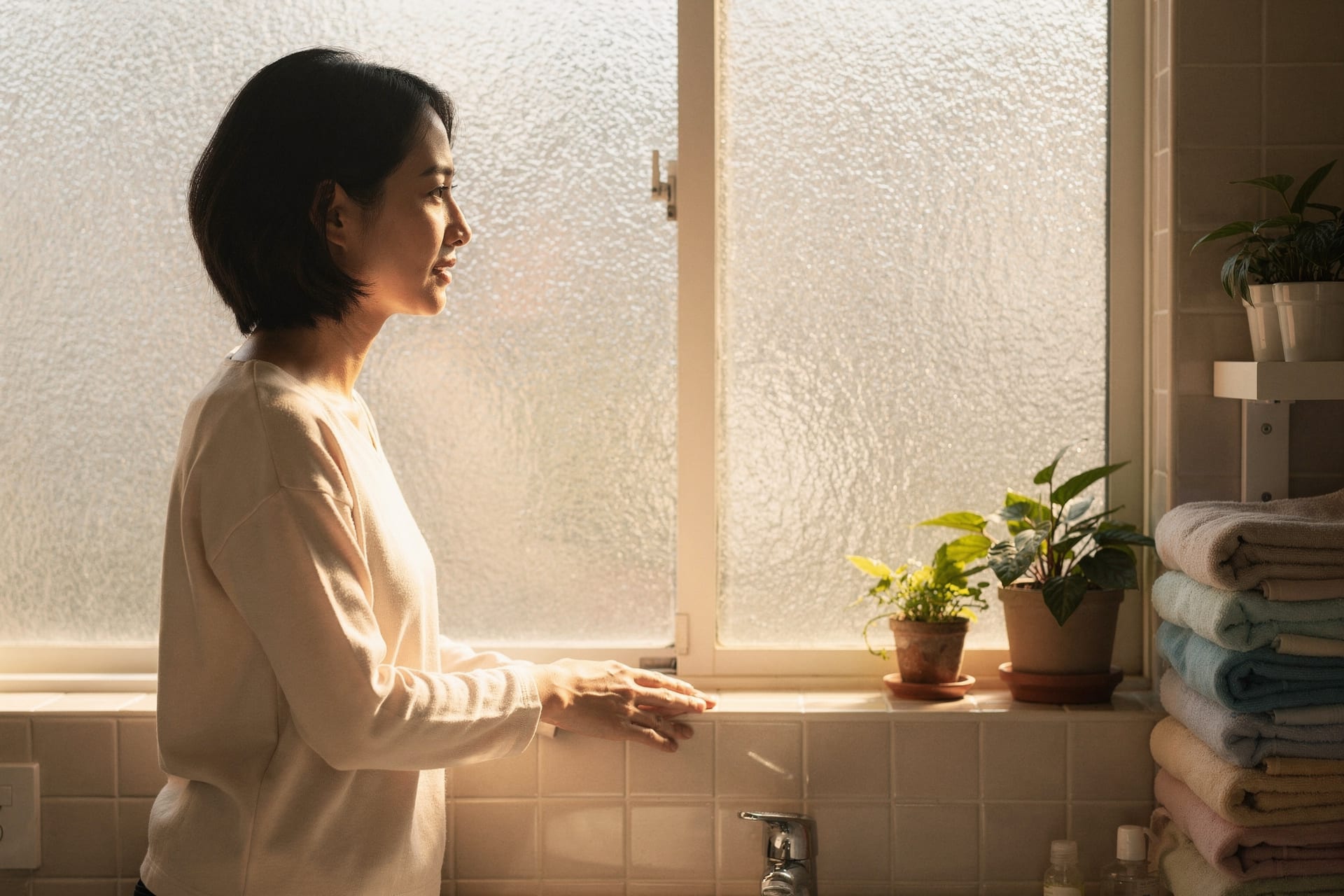
Can you see through obscure glass at night? In daylight, no — the outside is brighter than the room, so the texture scrambles the view and privacy comes free. After dark, with your light on and the outside black, the math flips and a silhouette can show through. How much depends on the pattern and how close someone stands. Heavy, busy textures hide you best; a light frost with a lamp behind it can give up a shape.
Can you actually see through it at night?
Privacy glass isn’t opaque — it’s a bet that it’s brighter outside than in, and after dark that bet reverses. Obscure glass works by scattering light so the eye can’t resolve a clear image through it. During the day the bright exterior floods the texture and the view beyond turns to mush. That’s real privacy, and it’s free.
At night the light sources swap. Now your lit room is the bright side and the street is the dark side. The same scattering that hid the outside by day now spreads your silhouette across the glass for anyone standing out there. You won’t be crisp. But a shape moving around a lit bathroom is often enough to feel seen.
Two things change how bad it is. First, the pattern: a deep, busy texture breaks up a silhouette far better than a light, even frost. Second, distance: the closer someone stands to the glass, the more defined you get — which is exactly backwards from how safe most people assume the far side is.
This isn’t me talking down a product I sell. It’s the honest physics, and the better manufacturers say it plainly.
ProVia’s own privacy-glass page warns that actual privacy “will vary depending on your distance from the glass and the amount of light in the room in comparison to the light outside your home.” That’s a spec sheet telling you the truth — the line worth asking about before you buy.
So which obscure glass is actually the most private?
As a rule: the heavier and busier the texture, the more it hides — and the word “obscure” on a quote tells you almost nothing about which pattern you’re getting. Manufacturers each carry their own catalog of textures, and they range from a light rippled “rain” to a deep, chaotic frost that barely lets a shape through.
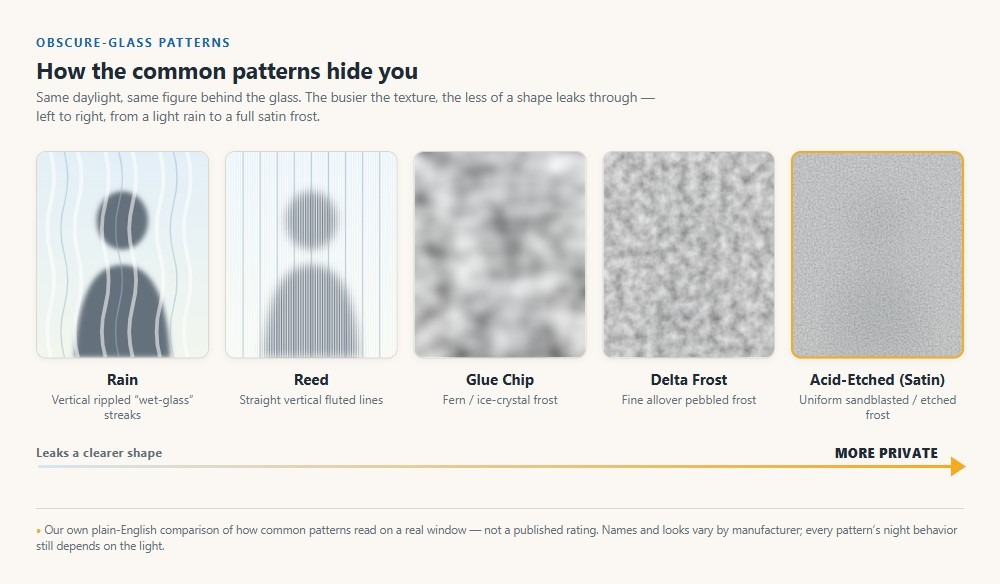
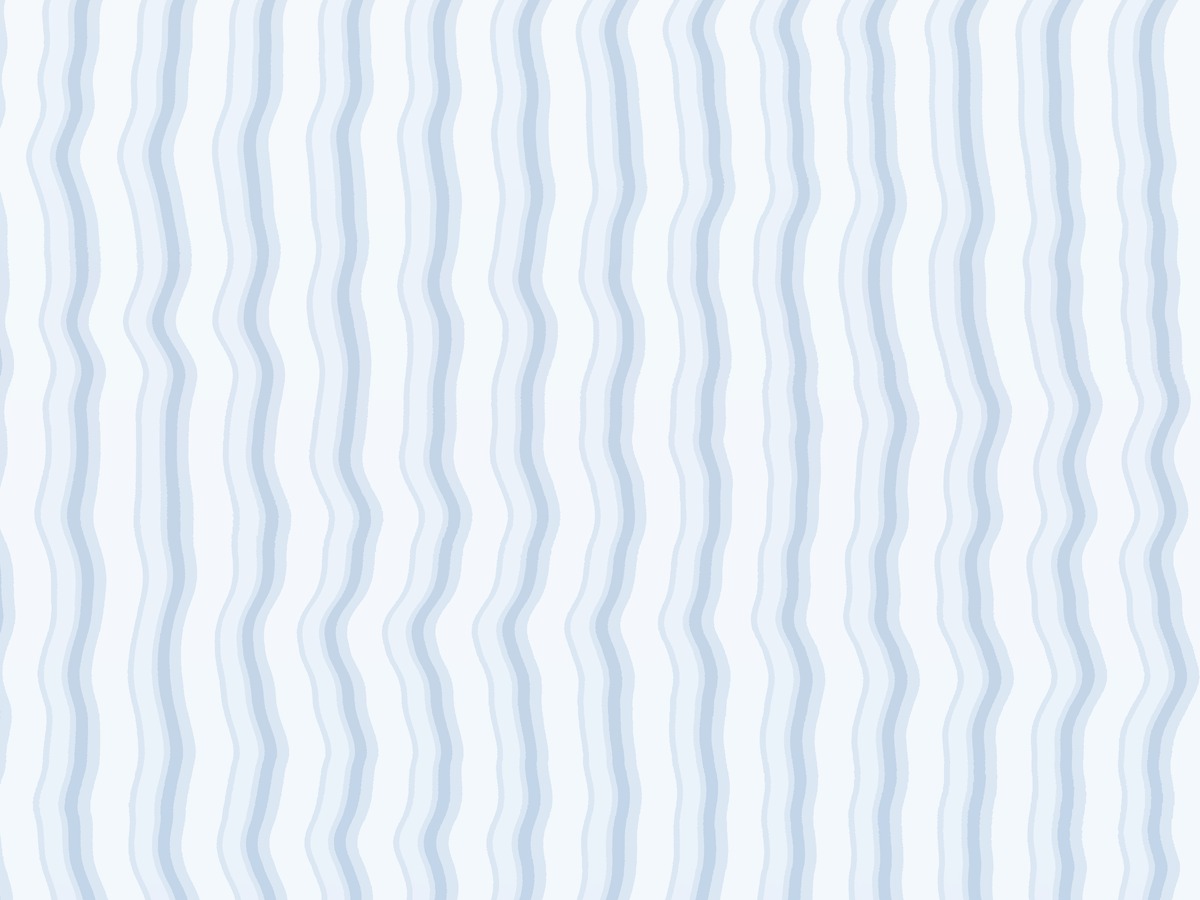
A few of the names you’ll actually see on quotes across the major lines: Rain (vertical, rippled, wet-glass look), Reed (straight vertical lines), Glue Chip (fern-and-ice-crystal pattern), Delta Frost (a fine, allover pebbled frost), and plain frosted / acid-etched glass, where one face is etched or sandblasted to an even satin.
ProVia alone lists seven textures (Chinchilla, Fluted, Frosted, Gluechip, Obscure Pebble, Taffeta, and Waterfall) at what it calls “varying levels of privacy.”
Here’s how those common patterns line up when what you care about is being hidden versus keeping the light and a soft view. The rank below is my own plain-English comparison of how these read on a real window, not a published standard — so treat it as a starting point, not a spec.


| Pattern | Example | What it looks like | Privacy (relative) | Light & soft view |
|---|---|---|---|---|
| Rain | 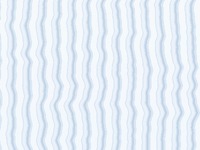 | Vertical rippled 'wet glass' streaks | Lower — leaks a clearer shape | High light, most residual view |
| Reed / ribbed |  | Straight vertical fluted lines | Low-to-medium — vertical shapes read through | High light, some view |
| Glue Chip | 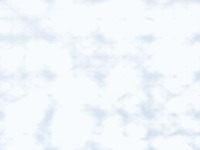 | Fern / ice-crystal frost pattern | Medium-to-high — busy texture hides well | High light, view broken up |
| Delta Frost | 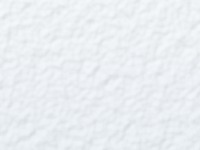 | Fine allover pebbled frost | High — even, hard to read through | High light, view mostly gone |
| Acid-etched (satin) / heavy frost |  | Uniform sandblasted or etched satin | Highest of the everyday patterns | High light, essentially no view |
Rain
- Example
-
- What it looks like
- Vertical rippled 'wet glass' streaks
- Privacy (relative)
- Lower — leaks a clearer shape
- Light & soft view
- High light, most residual view
Reed / ribbed
- Example
-
- What it looks like
- Straight vertical fluted lines
- Privacy (relative)
- Low-to-medium — vertical shapes read through
- Light & soft view
- High light, some view
Glue Chip
- Example
-
- What it looks like
- Fern / ice-crystal frost pattern
- Privacy (relative)
- Medium-to-high — busy texture hides well
- Light & soft view
- High light, view broken up
Delta Frost
- Example
-
- What it looks like
- Fine allover pebbled frost
- Privacy (relative)
- High — even, hard to read through
- Light & soft view
- High light, view mostly gone
Acid-etched (satin) / heavy frost
- Example
-
- What it looks like
- Uniform sandblasted or etched satin
- Privacy (relative)
- Highest of the everyday patterns
- Light & soft view
- High light, essentially no view
If you want a single number, the closest thing to a real standard is Pilkington’s five privacy levels for its Texture Glass range, graded from Level 1 (least obscuration) to Level 5 (greatest obscuration), where the busiest patterns sit at level 5.
There is no clean, industry-wide 1-to-10 privacy scale in the US market. So if a salesperson quotes you one, ask where the number comes from.
NC homeowner takeaway: you were right to want a name, not just “privacy glass.” Pick the pattern by how the room is used and lit — a light rain over a stairwell that’s dark at night is fine, but a lit bathroom that faces the sidewalk wants a heavy frost or a deep texture.
Match the texture to the worst-case moment, which is almost always after dark.
Frosted film vs factory obscure glass — and the warranty catch
A stick-on privacy film is cheap, reversible, and perfect for a rental — but on a modern double-pane it carries a real risk to the sealed unit that factory glass doesn’t. This is the decision most people are actually making, so let me lay it out straight.
Film wins on cost and flexibility. It’s a fraction of the price of reglazing, you can do it yourself in an afternoon, and you can peel it off when you move or change your mind.
For a renter, or a window you’re unsure about, that’s a genuinely smart first move — and yes, sometimes the honest answer is you don’t need to buy glass, a film will do.
But two cautions belong on the table before you commit.
Factory obscure glass has none of that baggage. The texture is manufactured into the glass and sealed into the unit, so there’s no film to peel, no lifespan clock, and nothing stressing the seal. It costs more up front, and if you’re only reglazing the sash it’s a bigger job than a roll of film.
And here’s the part that saves the most money: if your frame and sash are sound and you just want privacy on one existing double-pane, you often don’t need a whole new window at all.
You may be able to swap just the glass unit for an obscure one — the same repair-or-replace logic as a broken or fogged glass pane. Get that checked before anyone sells you full replacement for a privacy problem.
Where obscure glass earns its keep in an NC home
Baths, street-facing rooms, and entry sidelights are the real jobs — and a bedroom that doubles as an escape window is the one place to slow down. Obscure glass isn’t a whole-house idea. It’s a targeted fix for the specific windows where a sightline is the problem.
- Bathrooms. The classic. You want ventilation and daylight without a curtain, and a frosted or deep-texture pattern set high on the wall gives you all three. An awning window is the common partner here, because you can leave it cranked open through a shower and the rain still sheds off the outside.
- Street-facing front rooms. In a tight Triad neighborhood where the house sits close to the sidewalk, a lower obscure sash keeps the daylight and takes away the fishbowl feeling at eye level.
- Entry sidelights. The narrow glass beside a front door is a direct line into your hallway. Obscure glass there keeps the light and closes the sightline — the same move that carries over to entry doors and their glass.
One honest limit worth naming. Obscure glass doesn’t change how much a window opens, so it has no effect on egress. But don’t let a privacy upgrade tempt you into a fixed pane on a bedroom window that has to serve as an emergency escape.
In North Carolina that opening has to clear at least 4.0 square feet under the amended residential code — a lower figure than the national number, and one you protect first, privacy second.
Best part: none of this costs you comfort. Obscure glass is a surface texture, independent of the energy build-up, so it can still be a Low-E, argon-filled unit. You keep the coating that carries the summer heat load and just lose the sightline. The full set of glass decisions lives at the glass and energy hub.
If you’ve got a bathroom or a street-facing window that feels exposed, that’s a two-minute conversation. Tell me the room, which way it faces, and whether you’re thinking film or factory glass, and I’ll tell you which pattern actually holds after dark — a no-pressure second opinion, the physics included.
Sources, Verification & Fact-Checking verified July 2026
Every load-bearing fact on this page is sourced and verified against a primary authority.
Verified July 2026 via direct review of the cited authority — the links open the controlling source so you can check it yourself rather than take our word.
- Obscure (privacy) glass is textured, frosted, or patterned to block the view while still passing light, and it’s independent of the IGU’s energy build-up — it can still be a Low-E, argon-filled unit. The texture is a surface treatment on the pane, so it carries over to any standard insulated unit; a manufacturer’s privacy-glass page shows these options as ordinary sealed units. (view source — ProVia, privacy glass options)
- Night privacy depends on the light balance and viewing distance, not on the word “obscure.” ProVia’s privacy-glass page states that actual privacy “will vary depending on your distance from the glass and the amount of light in the room in comparison to the light outside your home” — a lit interior against a dark exterior is the case where a silhouette can show through. (view source — ProVia, privacy glass options)
- Manufacturers carry multiple named patterns at “varying levels of privacy”; heavier textures hide more. ProVia lists Chinchilla, Fluted, Frosted, Gluechip, Obscure Pebble, Taffeta, and Waterfall; other lines add Rain, Reed, Glue Chip, and Delta Frost, and Andersen’s patterned options (Cascade, Fern, Obscure, Reed, Satin Etch) were confirmed in a trade Q&A with the manufacturer’s product manager. (view source — ProVia patterns; view source — WDMA trade Q&A with Andersen/Pella/ProVia product managers)
- Frosted glass is produced by acid-etching or sandblasting one face of the glass to an even satin. (view source — Milgard, frosted windows)
- The pattern-by-pattern privacy ranking in the table above is our own plain-English comparison, not a published standard. The only widely cited numeric obscurity scale is Pilkington’s Texture Glass range, graded from Level 1 (least obscuration) to Level 5 (greatest obscuration), where the busiest patterns sit at level 5; there is no industry-wide US 1–10 privacy scale. (view source — Pilkington Texture Glass, five privacy levels)
- Aftermarket privacy film on a sealed double-pane can add heat retention that stresses the unit, and some manufacturers exclude it from the glass warranty; mirrored “one-way” films reverse to see-through at night when the interior is lit. Andersen’s A-Series limited warranty excludes damage related to “glass shading devices (e.g., glass tinting…)”; an industry source notes the added heat retention from film “can cause cracks, seal failure, or even glass breakage.” The night-reversal behavior is inherent to how reflective film works (it needs the exterior to be the brighter side). (view source — Andersen A-Series Limited Warranty (exclusions); view source — window-film industry, warranty & thermal stress)
- Obscure glass has no effect on egress; a bedroom escape window in North Carolina must clear at least 4.0 sq ft of net clear opening (2018 NC Residential Code R310.2.1, NC-amended — lower than the national 5.7 sq ft). The 2018 code is the cycle in effect statewide as of 2026 (the 2024 NC cycle remains delayed); confirm the code your local inspections office enforces before you rely on it.