

You’ve seen the look. Black windows on a light house — crisp, modern, a little bit magazine. Maybe on a new build down the street, maybe on a remodel that made you slow the car down. And now you’re pricing your own, and quietly wondering whether the thing you’re paying extra for is going to be the first thing that looks tired.
That’s the right thing to wonder. I hear the same worry in every black-window thread: it looks incredible on day one, and then what?
Here’s the honest version, and it’s better news than the regret stories suggest. Black is a safe, lasting choice for most NC homes. The regret you’re bracing for is real, but it’s narrow — and it’s almost always the same specific mistake.
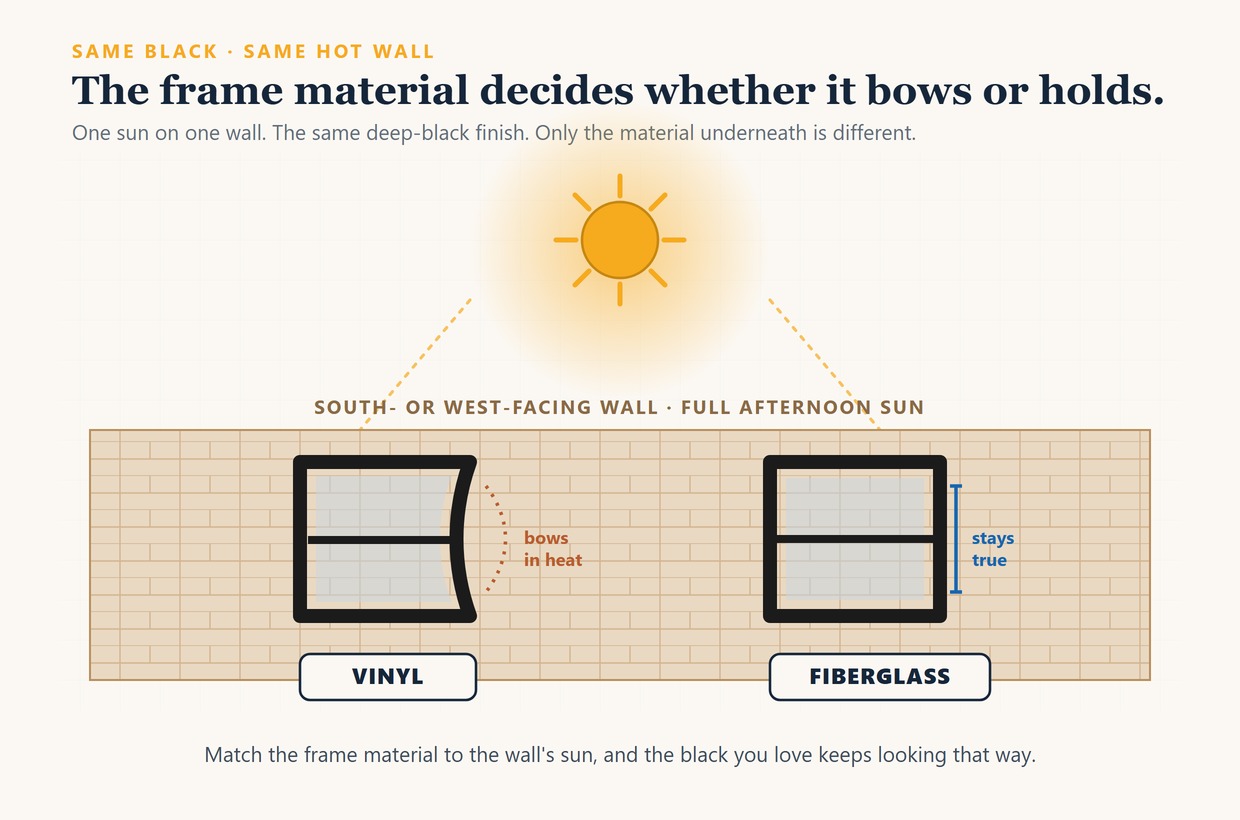
Are black windows a mistake in NC? No — for most homes black is a settled, lasting look, not a trend you’ll date. The one real regret is a material mismatch: a dark color on a vinyl frame on a full-sun south- or west-facing wall, where cheap vinyl can bow and the finish can chalk. Put deep black on fiberglass or aluminum for a hot wall and it holds for decades. Pick the frame material to match your exposure and the look you love keeps looking that way.
Are black windows still in style, or a trend I’ll regret?
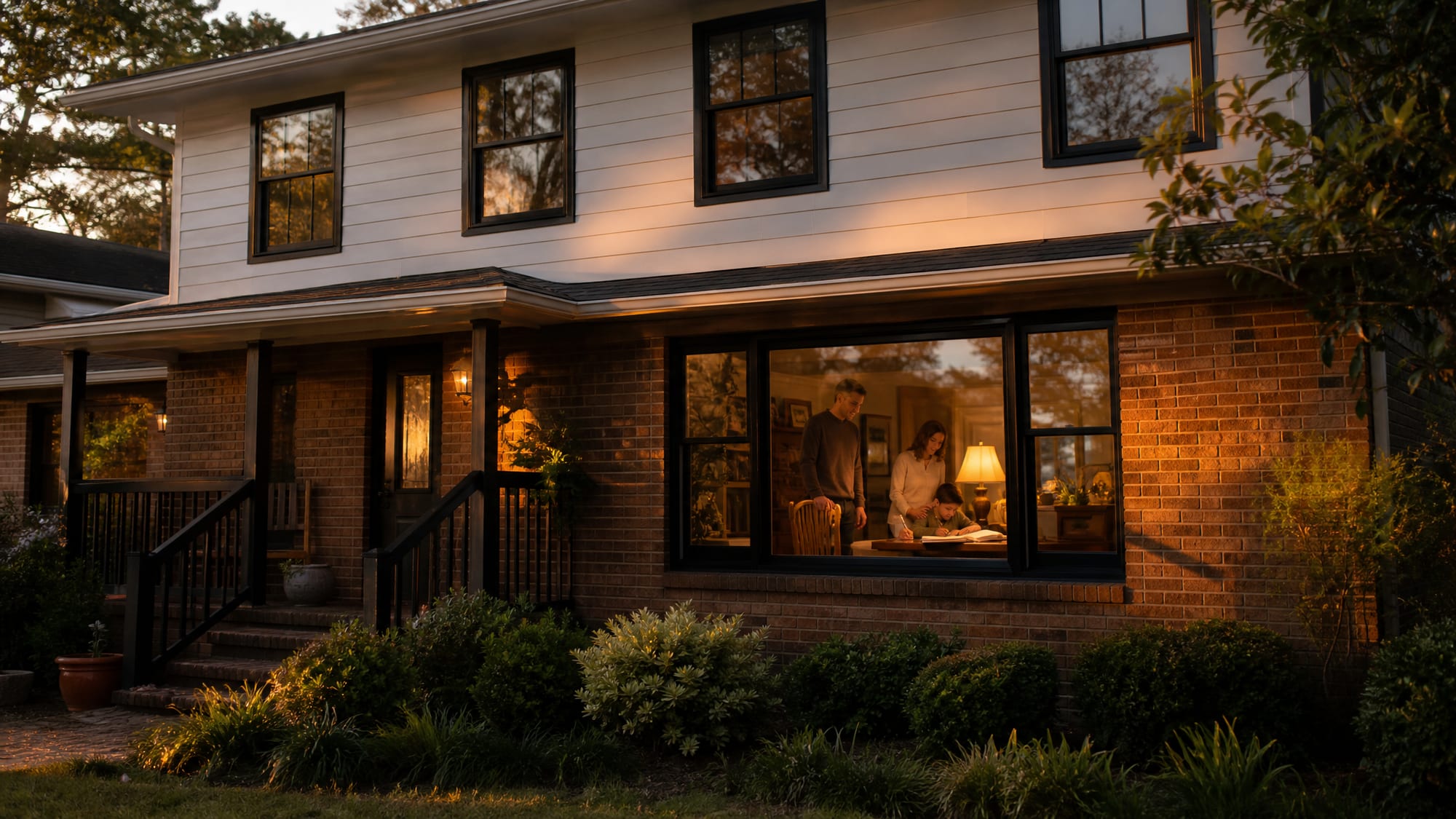
Black has crossed from trend to neutral — it’s more like “stainless appliances” than “avocado kitchen.” It’s been the default upgrade on modern-farmhouse, transitional, and contemporary elevations for years now, and it pairs across siding, brick, and stucco without fighting them.
Could the intensity of the black-everything moment cool off? Sure. But a black window frame is a neutral, and neutrals don’t date the way a bold color does. Nobody walks up to a house and thinks the black windows look “so five years ago.”
So the style fear — that you’ll regret the look itself — is the one I’d set down. The regret in the threads is almost never about the color. It’s about the finish not holding up. That’s a material question, and it’s the rest of this page.
Do black windows absorb more heat?
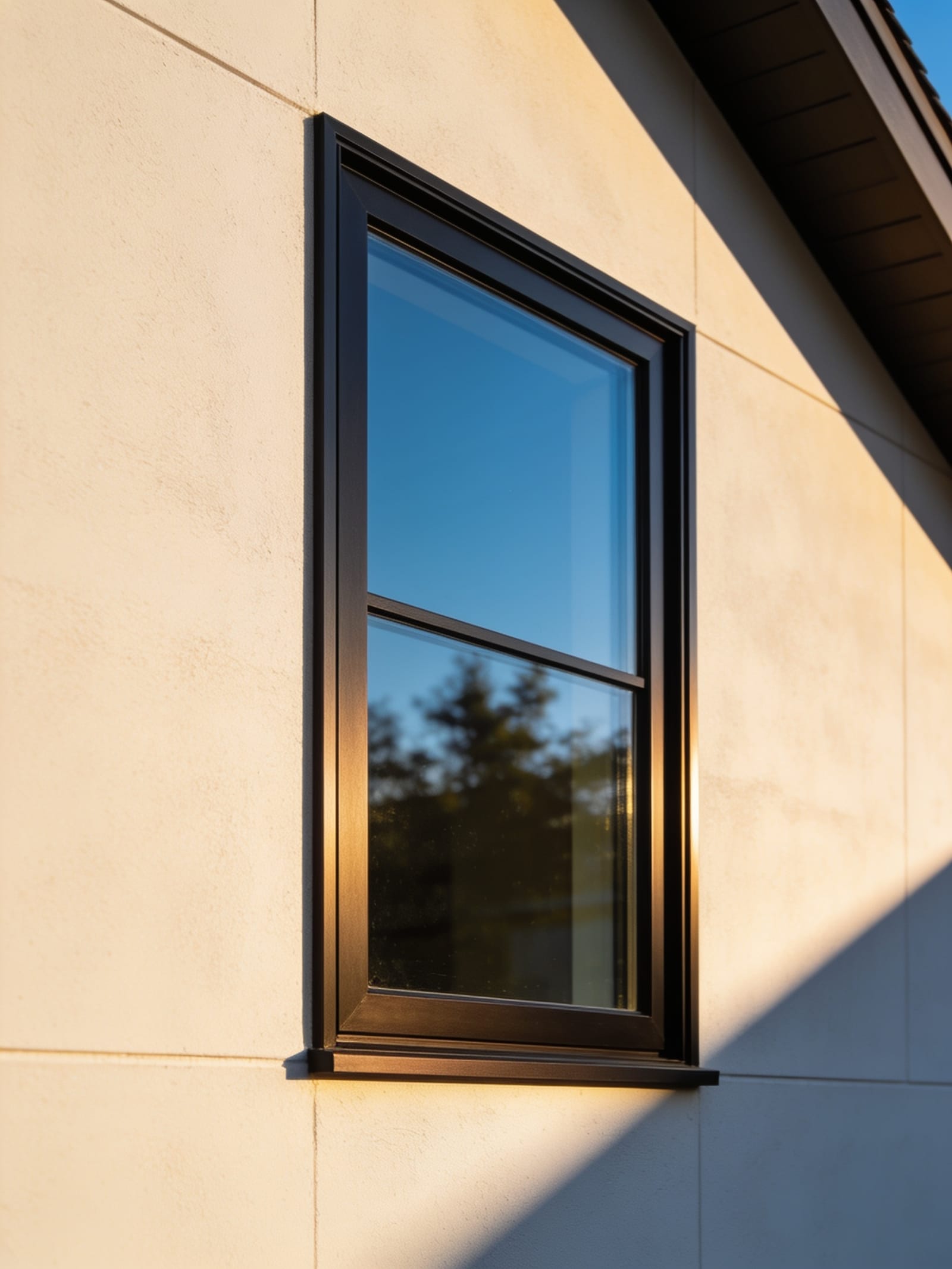
Yes — the frame gets hotter. But the frame is not what heats your room. A dark frame in direct sun can run tens of degrees hotter than a white one. Lay your hand on a black frame on an NC August afternoon and you’ll feel it.
Here’s the part that gets told backwards. What your room and your AC actually feel is driven by the glass — its coating and its — far more than by the color of the frame. The frame is a secondary player in the heat math.
That’s why the frame color doesn’t rewrite the label. The rates the whole unit — glass and frame together — so a black window with a good Low-E package can carry the same and SHGC as the white version of the exact same line.
The move here is simple: don’t assume black means a worse rating — check the NFRC label of the exact black line. If the numbers match the white version, the color isn’t costing you comfort. The U-factor and SHGC explainer walks through what the label is telling you.
Will a black frame warp? It depends entirely on the material
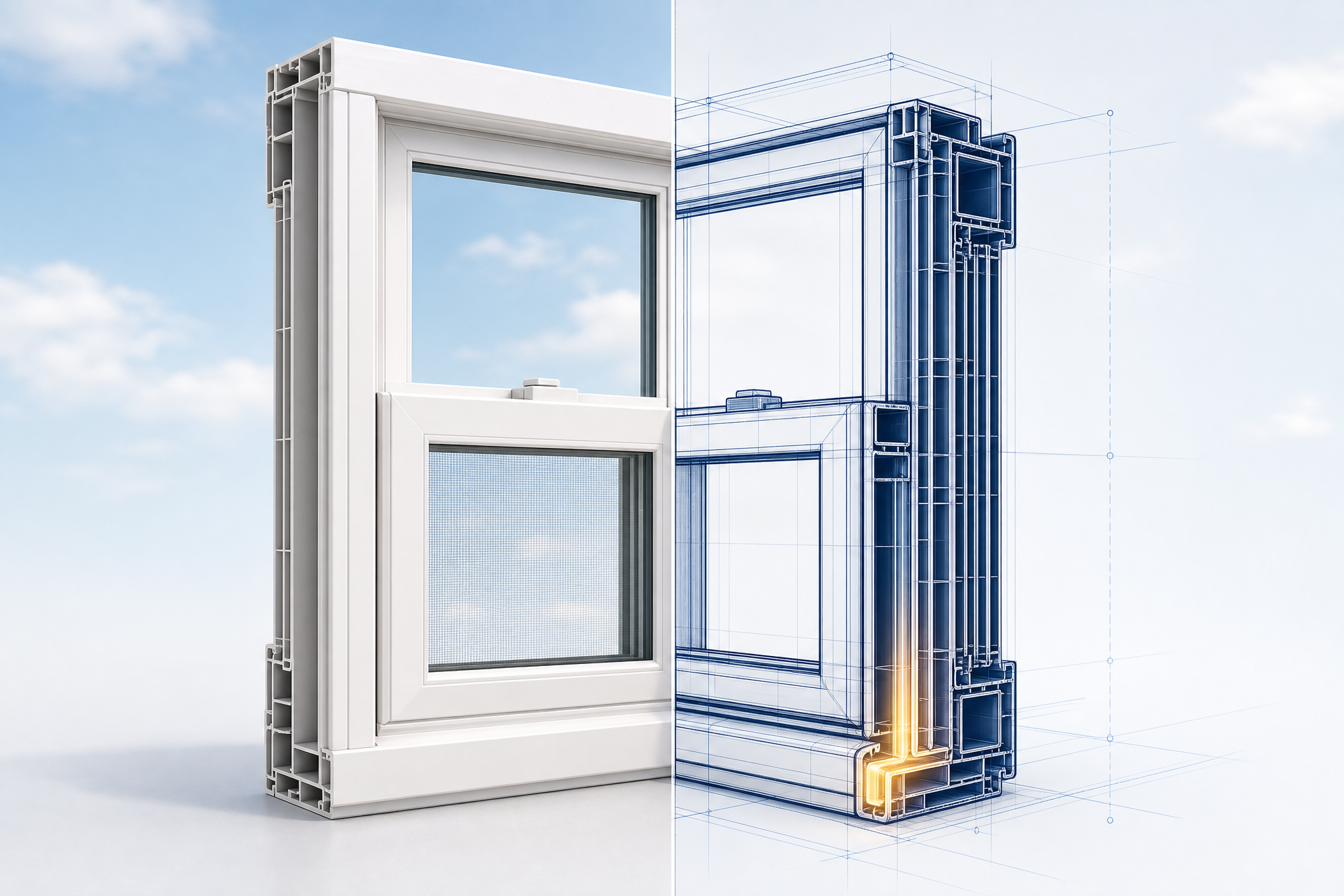
This is the whole ballgame, so let’s be specific: the warp risk is a frame-material question, not a color question. Dark colors absorb more heat and every frame material moves a little when it heats up. How much it moves — and whether it bows or holds — is set by what the frame is made of.
Ranked by how well each holds deep black on a hot NC wall:
- Fiberglass — holds it best. It’s the most dimensionally stable frame material, expanding at roughly the same rate as the glass it holds. It takes and keeps a deep, rich black without vinyl’s warp risk. On a full-sun wall, this is the clearest case to pay the fiberglass premium.
- Aluminum and aluminum-clad — takes black beautifully. Metal is stable and takes dark finishes well. Its real tradeoff isn’t warping — it’s insulation, since bare aluminum conducts heat and needs a thermal break to perform. Clad frames wrap a wood or composite core in an aluminum or fiberglass skin.
- Composite (including Fibrex-type materials) — stable, holds dark well. Composites move far less than vinyl and are marketed specifically for holding color in temperature extremes.
- Vinyl — the one to match to the wall. Vinyl is the frame material most prone to heat distortion, and dark-on-vinyl on a baking south or west wall is the worst case — worse on lower-grade lines. It’s not a blanket “black vinyl always warps,” but on a full-sun wall the risk has real teeth. Better vinyl lines use heat-resistant additives, UV stabilizers, and internal reinforcement to fight it.
| Frame material | Holds deep black on a hot wall? | The real tradeoff | Best for |
|---|---|---|---|
| Fiberglass | Best — expands about like the glass | Higher up-front cost | A full-sun S/W wall where you want deep black |
| Aluminum / clad | Very well — metal is stable | Insulation — needs a thermal break | Modern looks, big glass, black metal sightlines |
| Composite / Fibrex-type | Well — far less movement than vinyl | Mid-to-higher cost | Dark color with less warp worry than vinyl |
| Vinyl | Depends — the material most prone to distortion | Warp/bow risk on a hot wall, worse on cheap lines | Shaded or north walls, or a quality reinforced line |
Fiberglass
- Holds deep black on a hot wall?
- Best — expands about like the glass
- The real tradeoff
- Higher up-front cost
- Best for
- A full-sun S/W wall where you want deep black
Aluminum / clad
- Holds deep black on a hot wall?
- Very well — metal is stable
- The real tradeoff
- Insulation — needs a thermal break
- Best for
- Modern looks, big glass, black metal sightlines
Composite / Fibrex-type
- Holds deep black on a hot wall?
- Well — far less movement than vinyl
- The real tradeoff
- Mid-to-higher cost
- Best for
- Dark color with less warp worry than vinyl
Vinyl
- Holds deep black on a hot wall?
- Depends — the material most prone to distortion
- The real tradeoff
- Warp/bow risk on a hot wall, worse on cheap lines
- Best for
- Shaded or north walls, or a quality reinforced line
The reused facts here — that vinyl is the material most prone to heat distortion and fiberglass is the most dimensionally stable — come straight from the vinyl frame breakdown and the fiberglass frame breakdown, where they’re sourced to the same material data.
Will black fade — and what does the color warranty actually cover?
Darks fade and chalk sooner than lights if the finish is cheap — the finish system is the variable, not the color. A quality laminate wrap or a baked-on factory finish is engineered to hold a deep color. A budget finish on a hot wall is where you see the crisp black go dusty and flat.
So the fade question, like the warp question, routes back to what you’re buying — and this time the paperwork tells you a lot. Before you pay extra for black, read the color warranty, and read it for two things specifically.
Exterior color options beyond black, and going two-tone
Black isn’t the only dark, and you don’t have to carry the same color inside. If you love the drama but want a touch less contrast, the darks near black are worth a look, and the interior is a separate decision from the exterior.
Your realistic palette moves:
- Dark bronze and near-blacks. A bronze or dark-charcoal reads almost as crisp as true black against light siding but softens the contrast a hair — often the choice on warmer-toned brick.
- Matte vs. gloss. A matte or satin black looks more architectural and hides surface texture; a gloss reads sharper and shows more. It’s a real look decision, not a spec.
- Two-tone (black out, light in). Black or bronze on the exterior with a white or wood-look interior is common: the frame reads as clean trim from the street and disappears into the room inside. Confirm the exact pairing is offered on your line, and expect it can add cost over a single color.
- Black as a neutral pairing. Because black is a neutral, it sits comfortably against white or light-gray lap siding, warm red or brown brick, natural cedar, and stucco. It’s genuinely hard to pair badly.
One design note homeowners ask about: black frames don’t actually make a room dark. The frame is a thin border around the glass, and a black sightline can make the glass itself read bigger and the view crisper. The room’s light comes through the glass, not the frame.
Are black windows more expensive?
Often there’s no upcharge at all — and where there is one, it varies enough that you have to ask on your specific quote. Black is a standard, no-cost color across many fiberglass and standard lines. On others it’s a paid premium. There’s no single “black costs X% more” number that’s true everywhere.
Where a premium does show up, it’s usually a modest one on vinyl and a larger one on higher-end or custom lines. The point isn’t the exact figure — it’s that you shouldn’t assume there’s a premium, and you shouldn’t assume there isn’t.
The honest instruction is a question, not a number. Ask on your quote: is black an upcharge on this exact line, and how much per window?
Get it in writing, then compare that against the material decision above — because on a hot wall, paying up for a stable material is the spend that protects the look, not the color surcharge itself. The cost hub covers what actually moves a window price in NC.
What I’d tell an NC homeowner choosing black
Match the frame material to the sun the wall actually gets, and buy for how long you’re staying. That single rule prevents almost every black-window regret in the threads. Walk your own elevation before you sign:
- A south- or west-facing wall that bakes all afternoon — put deep black on fiberglass or aluminum, or a quality reinforced vinyl line at minimum. This is where the finish gets tested, so this is where the material matters most.
- A shaded or north-facing wall — black vinyl is usually fine here. The heat load that stresses the finish just isn’t there.
- Staying a long time — lean toward the more stable material even if it costs more up front. You’re the one who lives with year-ten black.
- Every wall — get the color warranty in writing, read the two exclusions above, and check that the black line’s NFRC label matches the white version’s numbers.
You’ve done the right homework by asking whether the look will last. It will — as long as the material fits the wall. That’s the difference between a choice you’re glad you made and one you’re explaining to the next owner.
If you’re staring at a black-window quote and not sure whether the line they specced will hold on your walls, that’s exactly the kind of thing worth a second set of eyes. Book a no-pressure second opinion — tell me which walls face the afternoon sun and what the quote says, and I’ll help you sort whether the material fits the look you want.
Sources, Verification & Fact-Checking verified July 2026
Every load-bearing fact on this page is sourced and verified against a primary authority.
Verified July 2026 via direct review of the cited authority — the links open the controlling source so you can check it yourself rather than take our word.
- Frame color is a secondary driver of indoor heat gain; the glass (Low-E coating + SHGC) drives it far more, and the NFRC rates the whole unit (frame + glass) together: a black window with a good glass package can carry the same U-factor/SHGC as the white version of the same line, so readers are directed to check the NFRC label of the exact black line. Whole-unit rating rule reused from the DOE fenestration data verified in windows/materials/vinyl; ENERGY STAR confirms products are independently tested and certified by NFRC. (view source — ENERGY STAR window criteria / NFRC certification basis)
- Vinyl is the frame material most prone to heat distortion; a dark color on a full-sun south/west wall is the worst case, worse on lower-grade lines, and mitigated by heat-resistant additives, UV stabilizers, and internal reinforcement: reused, already DOE-verified in windows/materials/vinyl. DOE fenestration data confirms vinyl has the highest thermal expansion of common frame materials; grounded search confirms dark vinyl absorbs more solar heat and can soften or distort on hot walls. (view source — DOE Fenestration: Types of Windows)
- Fiberglass is the most dimensionally stable frame material, expanding at roughly the rate of glass, and holds a deep dark color without vinyl’s warp risk: reused, already DOE-verified in windows/materials/fiberglass. DOE states verbatim that “fiberglass window frames are dimensionally stable.” The clearest case to pay the fiberglass premium is deep black on a full-sun wall. (view source — DOE Fenestration: Types of Windows)
- Dark/black frame surface temperature in direct sun: grounded search confirms the direction — a dark frame runs materially hotter than a white one, on the order of roughly 20–25°F warmer under the same summer sun, with higher single-point figures cited in secondary sources. No primary authority renders a fixed figure, so the page holds the hedge (“tens of degrees hotter”) and asserts no exact °F. (grounded-confirmed direction; figure hedged, confirm on your product/climate)
- Fade / color-warranty terms and exclusions: grounded search confirms the two carve-outs the page teaches are real and common — laminate finishes (e.g., Renolit Exofol) typically warrant color roughly 10–15 years and factory PVDF/Kynar finishes considerably longer (about 30–35 years), while warranties commonly exclude uniform/natural fading and non-uniform fading from unequal sun exposure. Per-brand and climate-dependent, so the page teaches the reader to read the two exclusions rather than asserting any brand’s years. (grounded-confirmed direction; verify exact years on the product’s live warranty document)
- Black cost premium over white: grounded search confirms the range — from no upcharge (black is a standard color on many fiberglass and standard lines) to roughly 10–35% on vinyl and higher-end lines, with some vinyl lines quoting a per-window adder. Ranges only and market-dependent, so the page hedges as a range and directs the reader to confirm the adder on the actual quote. (grounded-confirmed direction; confirm the figure on your quote)
- NC ENERGY STAR South-Central targets (most of NC — Piedmont, Sandhills, coast): U-factor 0.28 or less, SHGC 0.23 or less: the same targets apply to a black window as a white one, since the NFRC rates the whole unit. Confirmed live on the ENERGY STAR climate-zone finder for Guilford County, NC (South-Central). (view source — ENERGY STAR Climate Zone, Guilford County NC)