

You’ve got a sunroom quote on the counter and the same feeling you had the last time a stranger wanted five figures to work on your house. You’re not being paranoid. You’re being careful, and careful is exactly right here.
A sunroom is a big-ticket build — $15,000 to $85,000 in North Carolina — and it’s mostly roof-to-wall tie-ins and glass, which is to say it’s mostly the stuff that leaks when it’s done wrong. So the question isn’t “who’s cheapest.” It’s “who’s real, and how do I check without taking their word for it.”
I sell and measure these rooms for a living. Here’s the vetting I’d do on my own house.
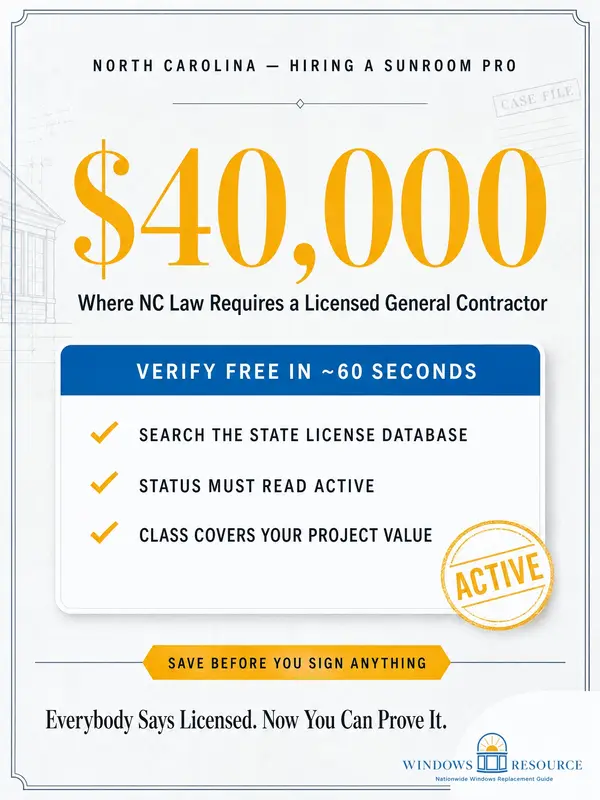
How do I hire a sunroom contractor in NC without getting burned? Verify three things you can actually check. One: if the job is $40,000 or more, NC law requires a licensed general contractor — confirm it free on the state’s NCLBGC lookup (status must read Active). Two: make them itemize the quote — foundation, glass, framing, permit, who pulls it. Three: find out who carries the warranty. Get all three and the burned-once stories mostly stop happening to you.
Is your project over $40,000? Then NC law requires a licensed contractor
In North Carolina, once the work costs $40,000 or more, the person building your sunroom must hold a general contractor license. That’s not a preference — it’s the law.
Most four-season rooms clear $40,000 easily, and plenty of three-season builds do too once you add foundation and glass. So “is your builder licensed for this?” isn’t a nicety on this job. It’s the first gate.
Here’s the part every “8 things to look for” article skips: NC general contractor licenses come in classes, and the class caps how big a single project the holder can legally take.
| License class | Max single project value | What it means for your sunroom |
|---|---|---|
| Limited | up to about $750,000 | Covers essentially any residential sunroom — the class most sunroom builders hold |
| Intermediate | up to about $1.5 million | More headroom than a sunroom needs; fine if they have it |
| Unlimited | any value | No dollar cap — common for larger general contractors |
Limited
- Max single project value
- up to about $750,000
- What it means for your sunroom
- Covers essentially any residential sunroom — the class most sunroom builders hold
Intermediate
- Max single project value
- up to about $1.5 million
- What it means for your sunroom
- More headroom than a sunroom needs; fine if they have it
Unlimited
- Max single project value
- any value
- What it means for your sunroom
- No dollar cap — common for larger general contractors
One more thing that trips people up: even under $40,000, the electrical, plumbing, and mechanical work each needs its own NC trade license, no matter the price. A general contractor license doesn’t cover a heat pump tie-in. The person running the wire for your new room’s outlets and lights has to be licensed for that specifically.
If you want the full NC picture on who has to be licensed and who pulls the permit, I laid it out on the NC permit and licensing page.
Verify the license yourself in 60 seconds — it’s free
North Carolina puts every general contractor license in a free public database. You do not have to trust a flyer or a truck decal — you can read the record yourself in about a minute.
Here’s exactly how:
- Go to the state lookup — portal.nclbgc.org/Public/Search. It’s the official public search.
- Search the company name or license number. The salesperson’s business card should have one; if it doesn’t, that’s your first answer.
- Read two fields. The status must say Active — not expired, not lapsed. And the classification has to be broad enough to cover your project’s dollar value.
If nothing comes up, that isn’t a glitch to shrug off. It means the company you’re about to hand a deposit to isn’t in the state’s licensed-contractor database. Call the board and ask before you go further — the NCLBGC has a public line at (919) 571-4183.
The “just sign as your own contractor” offer is a red flag, not a favor
If a builder offers to let you pull the permit as the owner and act as your own general contractor, stop. That’s not them saving you money — it’s the legal liability landing on you.
North Carolina has an owner-builder exemption: you’re allowed to superintend work on your own primary home without a contractor license. It exists for the homeowner genuinely doing their own project.
What it is not is a workaround for an unlicensed builder. When an unlicensed crew has you sign as the owner-builder, you become the responsible party. If the room leaks, if an inspection fails, if someone gets hurt, the exemption you signed can leave you holding it — not them.
There’s a catch that protects you here: NC law presumes the exemption was misused if the home isn’t occupied solely by you and your family for at least 12 months after completion. It’s written for the owner who genuinely lives in what they build — not a resale or rental dressed up as an owner-builder job.
What a fair itemized sunroom quote spells out
A real quote names the foundation, the glass package, the framing, the tie-in, and the permit — with who pulls it. Vagueness on any one of those is where a hidden cost, or a missing one, lives.
You’ve probably already heard the standard advice: get three itemized quotes. That’s right — with one upgrade. Make sure all three are itemized the same way, so you’re grading them line to line instead of squinting at three different bottom numbers.
Take this list to every appointment and ask them to break out each line:
- Foundation. Reused patio slab, new slab, or a frost-protected footing? This is the biggest swing in the whole quote.
- Glass package. Is it insulated glass, and what’s the and ? A “four-season” room with three-season glass is a room you’ll abandon in July.
- Framing. Thermally broken frames, or bare aluminum that pours cold straight through?
- HVAC tie-in. On the home system, a dedicated zone, or nothing but a space heater?
- Permit line. Is a permit included, who pulls it, and does a conversion need stamped plans? No permit line means a hidden cost or a skipped corner.
Ask them: “Can you itemize the foundation, the glass package with its U-factor and SHGC, the framing, the HVAC tie-in, and the permit — and tell me who pulls the permit?”
For what those numbers should actually land at, hold the quote against the real NC sunroom cost ranges. And for the deeper read on grading a bid, the sunroom quote red flags page walks the same three-quote method I use.
Deposits, draws, and the money moves that should stop you
A fair deal ties your money to progress. The horror stories almost always start with a large deposit paid up front, in a form you can’t claw back, before a shovel hits the ground.
The forums are full of this exact failure — and it’s the one homeowners fear most.
So watch the money mechanics as closely as the price:
- A deposit far bigger than the work. A modest deposit to schedule and order materials is normal. Half the job before the foundation is poured is not.
- Cash, wire, or Zelle only. These are the payment forms with the least recourse if the job stalls. A real builder takes a check or a card.
- The same-day discount. “$44,000 today, $35,000 if you sign tonight” is a pressure move, not a deal. A price that drops nine grand for a signature was never a real price to begin with.
Fair looks like a draw schedule: a deposit, then payments tied to real milestones — foundation in, framing up, glass set, final inspection passed. Your money should always be a step behind the work, not ahead of it.
And here’s the part that puts the job squarely on you: North Carolina has no law capping how big a residential deposit a contractor can ask for. Some states do — California caps a home-improvement down payment at 10% of the price or $1,000, whichever is less — but NC leaves it to the two of you.
That means your own draw discipline is the only guardrail. Nobody’s coming to enforce a fair split but you.
Who actually frames and flashes it — and carries the warranty?
The name on the quote should be the name on the warranty. Ask who physically frames, glazes, wires, and flashes the room — and whose company you call in year two when something goes wrong.
This is the border question, the one that separates a real builder from a salesperson who signs you up and hands the job to a rotating sub. Subcontracting isn’t automatically bad — good builders use trusted trade crews. The problem is the disappearing version: a salesperson’s company that collects, subs everything to whoever’s cheapest that month, and isn’t there when the flashing fails.
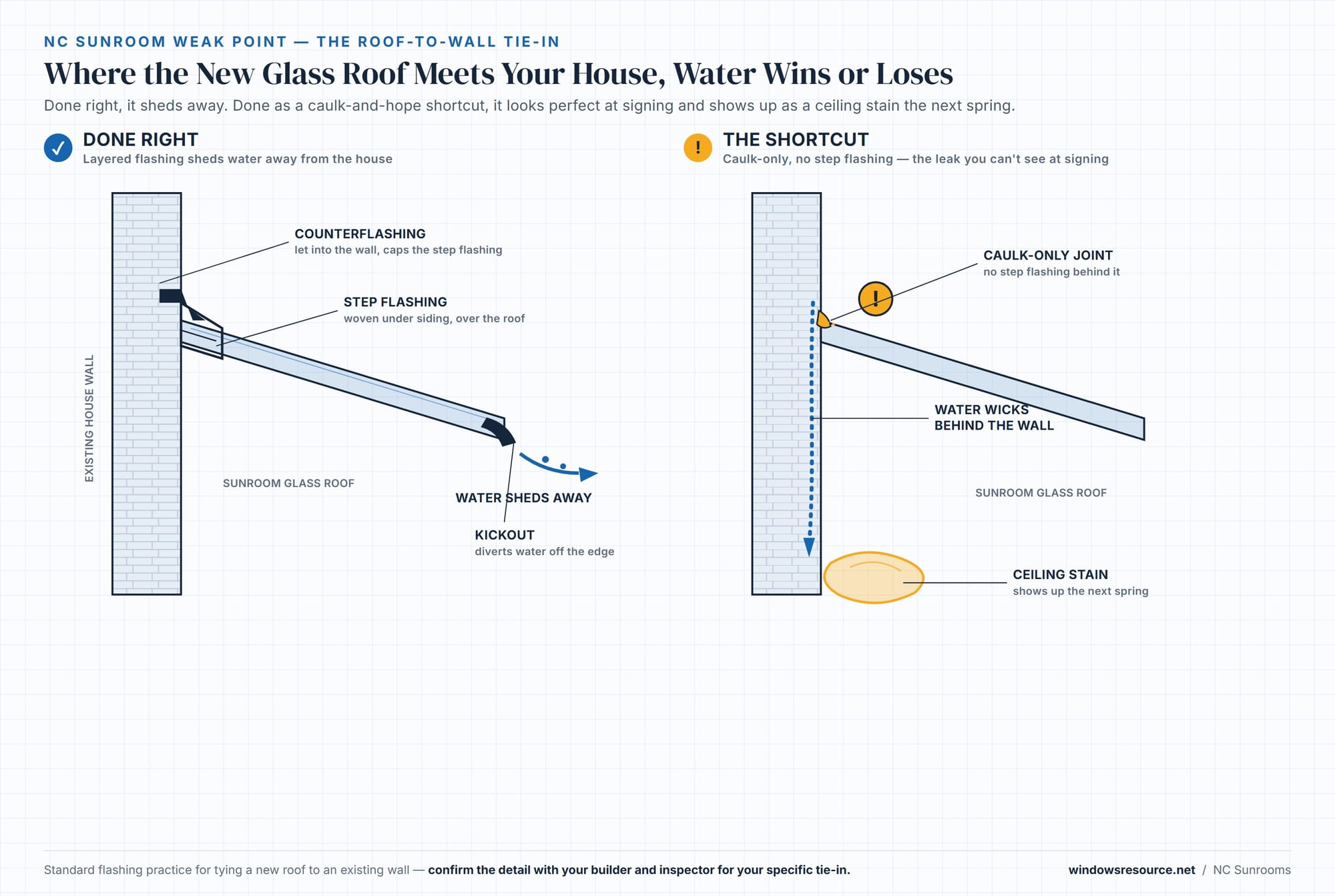
And it will be the flashing. A sunroom’s weak point is the roof-to-wall tie-in — where the new glass roof meets your existing house. Done right, water sheds away. Done as a caulk-and-hope shortcut, it looks perfect at signing and shows up as a ceiling stain the next spring.
This is exactly why a sunroom is really a window-and-door problem wearing a room’s clothes. A sunroom is mostly glass, and the glass decides whether the room roasts, leaks, or lasts — which is my actual wheelhouse.
So the questions I’d ask a sunroom builder are the same ones I’d ask any window installer: who’s doing the flashing, and what’s the warranty on the labor, not just the parts?
Two questions cut straight to it:
- “Is the crew that shows up your employees or a subcontractor — and either way, whose name is on the warranty?”
- “Is the warranty on the materials only, or on the labor and the install too?” A “lifetime” glass warranty means nothing if nobody covers the leak.
Local NC pro or national brand — what actually matters
Either can build you a great room. Reputation, licensing, and an honest itemized quote matter far more than the size of the logo on the truck. An instinct to go local isn’t wrong — it’s just not the whole test.
What a good local builder can offer that a national script can’t is the walkthrough where someone tells you the truth about your house — including when not to build. If a screened porch is honestly all you need, the right person says so.
That’s the whole reason this site exists, and it’s how I’d want to be hired. If you’re in the Triad — Greensboro, Winston-Salem, High Point — I’ll walk your space and check a quote in person, no pressure and no pitch. Anywhere else in North Carolina, you can still send a quote for a second read, or browse vetted NC sunroom builders in the directory.
The point was never to win the staredown with a salesperson. It’s to end up with the room your neighbors ask about — and the contractor’s number they ask you for.
If you want a second set of eyes before you sign, have me look at your quote. I’ll tell you if it’s fair, whether the builder checks out on the state lookup, and what to push back on — even when the honest answer is that you’re already in good hands.
Sources, Verification & Fact-Checking verified July 2026
Every load-bearing fact on this page is sourced and verified against a primary authority.
Verified July 2026 via direct review of the cited authority — the links open the controlling source so you can check it yourself rather than take our word.
- NC requires a licensed general contractor once a single project’s cost is $40,000 or more. NCGS 87-1 defines a general contractor as anyone who undertakes to build or superintend a project “where the cost of the undertaking is forty thousand dollars ($40,000) or more” — raised from $30,000, effective Oct 1, 2023. Most four-season sunrooms and many three-season builds clear this line. This is a distinct law from the $40,000 building-permit threshold under NCGS 160D-1110; the two share the dollar figure but govern different things — one is who may take the job, the other is whether a permit is required. (view source — NCGS 87-1, ncleg.gov · view source — NCGS 160D-1110, ncleg.gov)
- NC general contractor licenses are classed by single-project dollar value — Limited (up to $750,000), Intermediate (up to $1,500,000), Unlimited (no restriction on project value). Any of the three legally covers a residential sunroom; the class only caps the single-project value the holder may take. Figures are the current NCLBGC limitations. (view source — NCLBGC classifications & limitations)
- The NCLBGC public license lookup lets a homeowner verify a contractor free — status must read “Active” and the classification must cover the project value; board line (919) 571-4183. The tool searches by company name, license number, or qualifier and returns license status and classification. (view source — NCLBGC public license search)
- NC’s owner-exemption lets a homeowner build or alter a building on their own land, for their own occupancy, without a general contractor license — which is why an unlicensed builder having you sign as the owner-builder shifts responsibility onto you. NCGS 87-1(b)(2) presumes the exemption was misused if the building isn’t occupied solely by the owner and family for at least 12 months after completion. (view source — NCGS 87-1(b)(2), ncleg.gov)
- Electrical, plumbing, and mechanical work each require their own NC trade license regardless of project cost. A general contractor license does not cover the licensed trades. Electrical work is licensed by the NC State Board of Examiners of Electrical Contractors; plumbing, heating, and mechanical (HVAC) work by the NC State Board of Examiners of Plumbing, Heating & Fire Sprinkler Contractors.
- North Carolina sets no statutory cap on residential contractor deposits — unlike California, which caps a home-improvement down payment at 10% of the price or $1,000, whichever is less (CA Business & Professions Code §7159.5). In NC the homeowner’s own draw-schedule discipline is the guardrail. The deposit and payment red flags described on this page — a deposit far larger than the work performed, cash/wire/Zelle-only payment, and a large same-day “discount” for signing tonight — are recurring homeowner-reported failure patterns (e.g. a contractor holding a deposit “for nearly 16 months” with little work done), described as patterns, not a single sourced statistic.
- A sunroom’s most common leak point is the roof-to-wall tie-in; correct step flashing and counterflashing shed water away from the house, while a caulk-only shortcut looks fine at signing and fails later. This is standard flashing practice for attaching a new roof to an existing wall; confirm the detail with your builder and local inspector for your specific tie-in.