

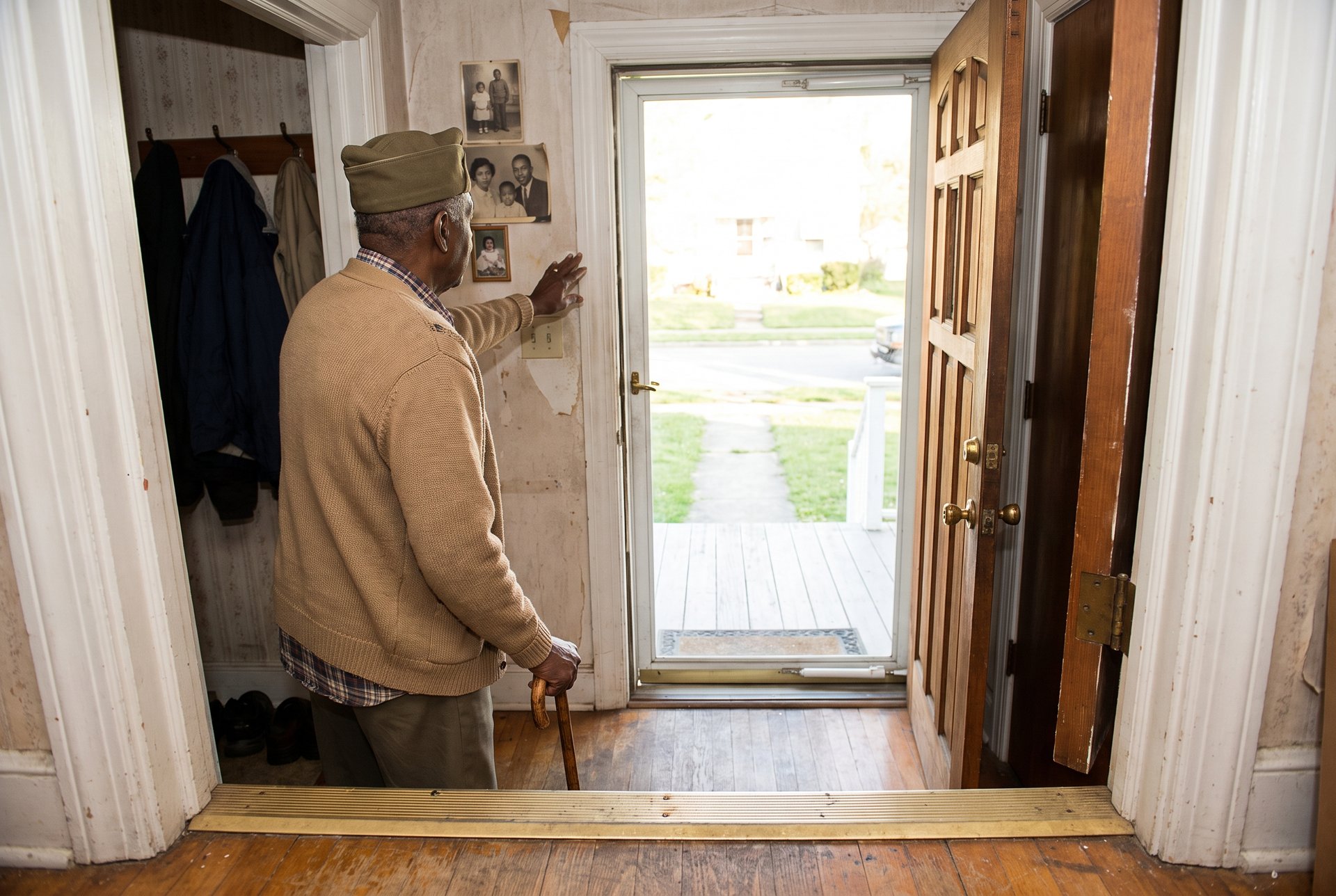
A retired official I know sent me a list of veterans’ home improvement programs after I asked him a simple question: is there money out there for vets who need work done on their houses?
There is. It’s real, it’s substantial, and most of it will not buy you windows.
That’s the sentence I’d want first if I were you, so I’m leading with it. Then I’ll show you where the money that can touch your windows actually lives — because that part almost nobody explains.
And if you’ve got the energy for exactly one thing today, make it this: call an accredited service officer and let them read your file. It’s free, they do this daily, and it’s the step that makes every other step shorter. Every VA-recognized organization, with phone numbers, is right on this page — or use VA’s own representative finder. The rest of this page will still be here tomorrow.
For every branch, every era
- Army
- Marine Corps
- Navy
- Air Force
- Space Force
- Coast Guard
Active, Guard, Reserve, and retired — eligibility runs on your record, not your era. These aren't official seals; the branches don't endorse anyone, us included.
The one distinction worth getting straight first
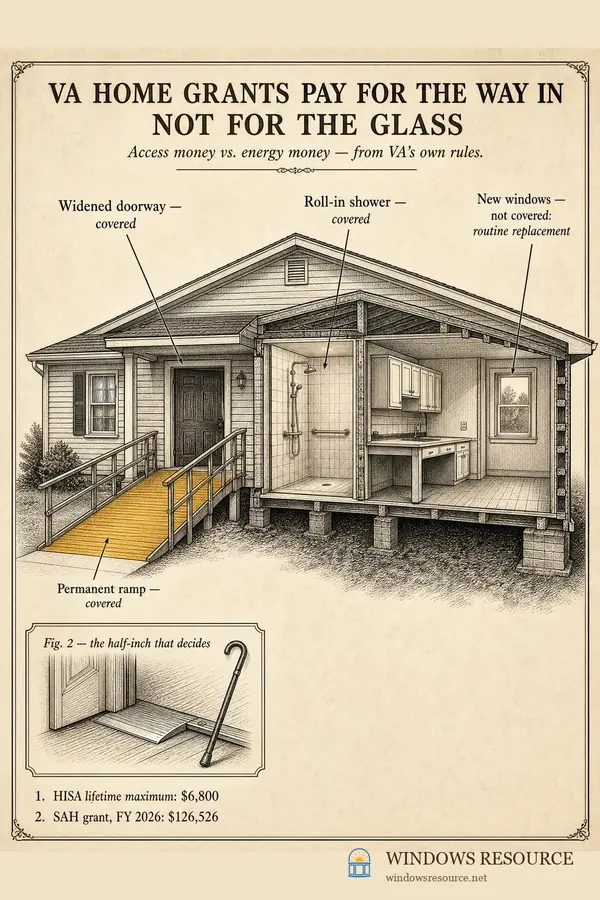
Home adaptation money from the Department of Veterans Affairs is access money. It answers one question: can you get into, out of, and around your own home safely, given a disability?
It is not efficiency money, and it is not maintenance money. It also isn’t chosen from a catalog.
, the grant most veterans reach first, runs on a VA physician’s prescription carrying a written medical justification tied to a diagnosis. The larger and grants run through the benefits side of VA instead, on a narrow list of qualifying service-connected disabilities.
Different doors, same principle — someone at VA decides, based on your condition.
So when a veteran hears “there’s VA money for home improvements” and pictures a quote for new windows, two very different things have been stacked on top of each other. Untangling them is the whole job of this page.
HISA: the smaller grant most veterans qualify for
HISA — Home Improvements and Structural Alterations — is the workhorse. It’s a lifetime benefit, administered through VA health care rather than the benefits side, and it comes in two tiers:
- Up to $6,800 to address a service-connected disability. Also available for a non-service-connected disability if you hold a service-connected rating of at least 50 percent. VA is explicit that no combining of disability percentages is allowed to reach that 50.
- Up to $2,000 for a disability outside those categories.
Those are lifetime totals, not annual allowances, and if you’ve used HISA before, what’s left is what’s left. Your local Prosthetic and Sensory Aids Service is who confirms your remaining balance — that’s a phone call worth making before you plan anything. Find your VA medical center here; ask the operator for Prosthetics.
What HISA pays for, and what it refuses
| HISA pays for this | HISA will not | |
|---|---|---|
| Getting in and out | Permanent ramping; improving entrance paths or driveways in the immediate area of the home | Portable ramps, porch lifts, stair glides |
| Bathroom | Roll-in showers and access to essential lavatory and sanitary facilities | Spa, hot tub, or Jacuzzi-type tubs |
| Kitchen | Lowering counters and sinks for accessibility | — |
| Systems | Plumbing or electrical work made necessary by installing home medical equipment | Home security systems |
| Maintenance | — | Routine repairs as part of regular home maintenance — VA names roof, furnace and air conditioner replacements specifically |
| Building new | — | New construction; exterior decking; walkways to exterior buildings |
Getting in and out
- HISA pays for this
- Permanent ramping; improving entrance paths or driveways in the immediate area of the home
- HISA will not
- Portable ramps, porch lifts, stair glides
Bathroom
- HISA pays for this
- Roll-in showers and access to essential lavatory and sanitary facilities
- HISA will not
- Spa, hot tub, or Jacuzzi-type tubs
Kitchen
- HISA pays for this
- Lowering counters and sinks for accessibility
- HISA will not
- —
Systems
- HISA pays for this
- Plumbing or electrical work made necessary by installing home medical equipment
- HISA will not
- Home security systems
Maintenance
- HISA pays for this
- —
- HISA will not
- Routine repairs as part of regular home maintenance — VA names roof, furnace and air conditioner replacements specifically
Building new
- HISA pays for this
- —
- HISA will not
- New construction; exterior decking; walkways to exterior buildings
Read that highlighted row carefully, because it’s the whole answer. HISA excludes routine maintenance replacement, and VA names roofs, furnaces and air conditioners as its examples. A window swap for comfort or efficiency sits in exactly that category.
Where it gets less absolute: HISA’s purpose list is about access. If a modification is genuinely part of medically necessary access to your home, that’s a conversation for your VA physician and your local Prosthetic and Sensory Aids Service. They decide — not a website, not a salesperson.
What I can tell you plainly is the thing that trips people up: windows as an energy upgrade are out.
The prescription conversation is the whole gate
Every HISA application runs through a prescription written or approved by a VA physician, and that prescription has to carry a medical justification — not just “patient needs a ramp,” but why the work is clinically appropriate for the diagnosis.
Which means a veteran who doesn’t know to raise it at an appointment never starts. So raise it, in these words:
Before anything else
What a complete HISA package contains
VA lists these as the application requirements. Missing any one of them stops the file.
A prescription from a VA physician
Written or approved by a VA doctor, naming your details, describing the project and the area of the home, and giving the diagnosis and medical justification.
Find your VA medical center to book the appointment →
Ask"My disability is making it unsafe for me to get in and out of my house. Can we talk about a HISA prescription — and can you write the medical justification for it?"
VA Form 10-0103
Veterans Application for Assistance in Acquiring Home Improvement and Structural Alterations. Ask for an advance payment on the application itself if you need one.
An itemized written estimate
Labor, materials, permits and inspections, broken out — not a single bottom-line number on a business card.
Ask"I need this itemized for a VA grant — labor, materials, permits, inspections, separately."
A color photograph of the unimproved area
The before shot. Take it before anyone touches anything.
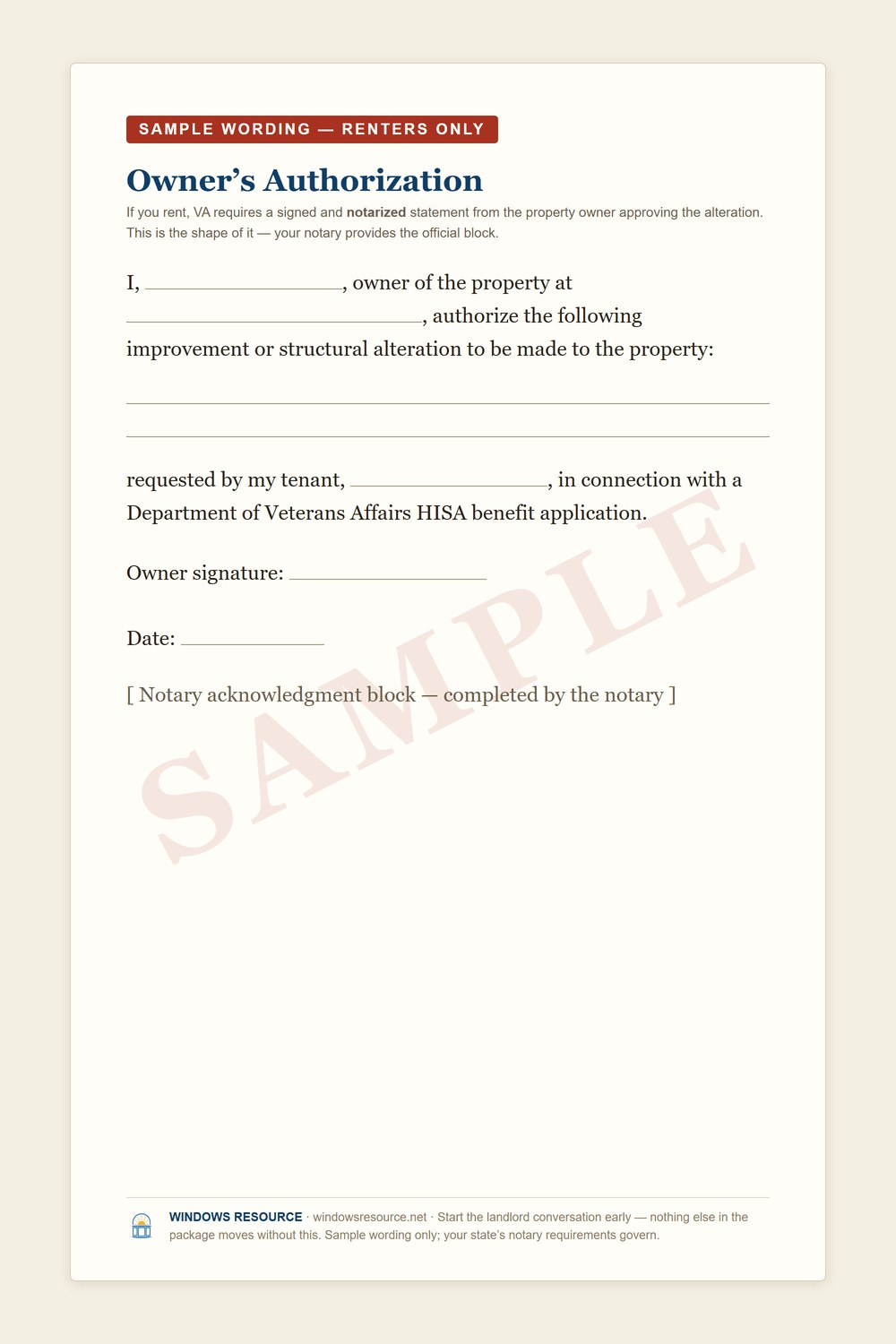
If you rent: a notarized owner's authorization
A signed and notarized statement from the property owner approving the alteration. Start this conversation early — nothing else moves without it.
What each piece looks like — tap to enlarge, download to keep
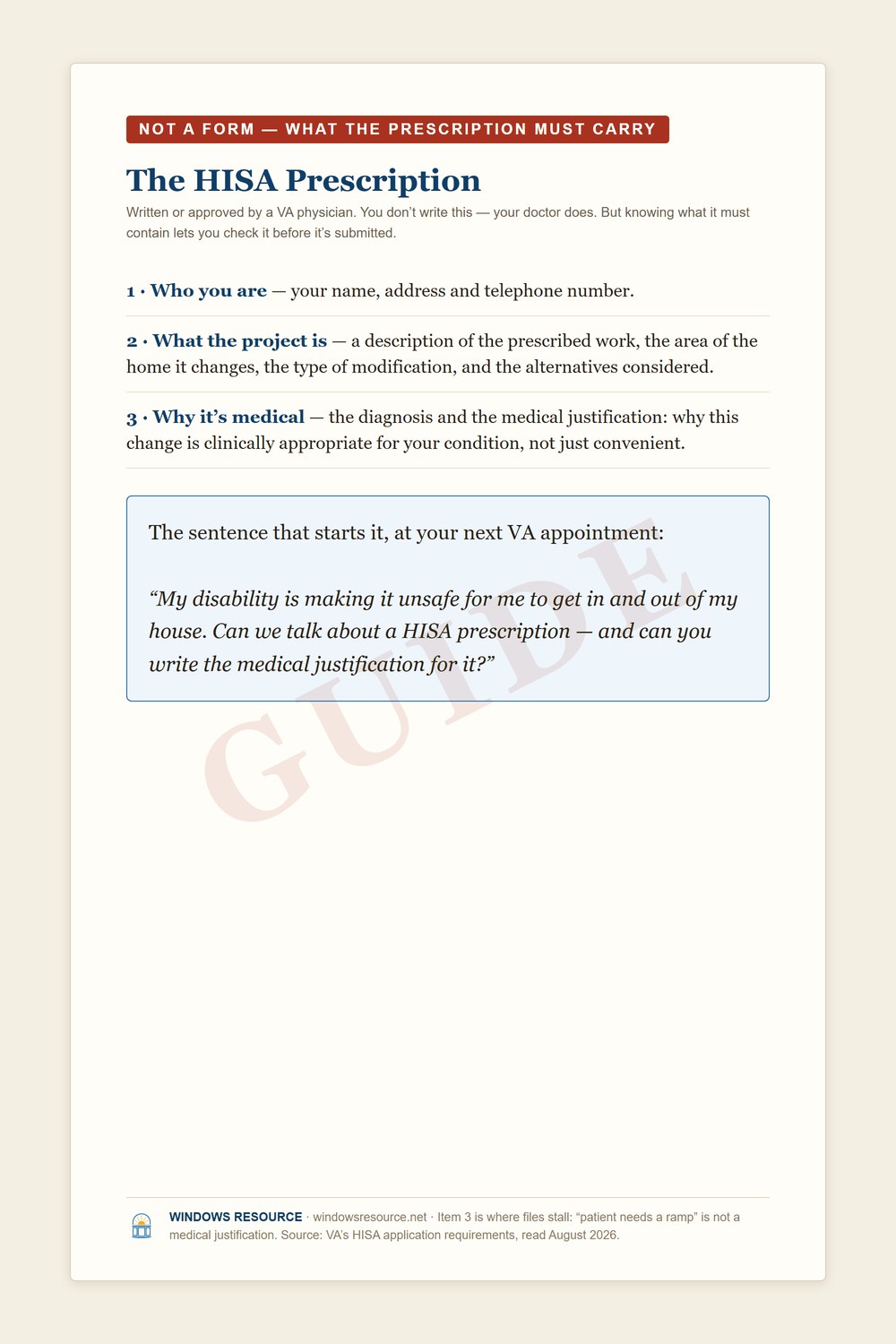
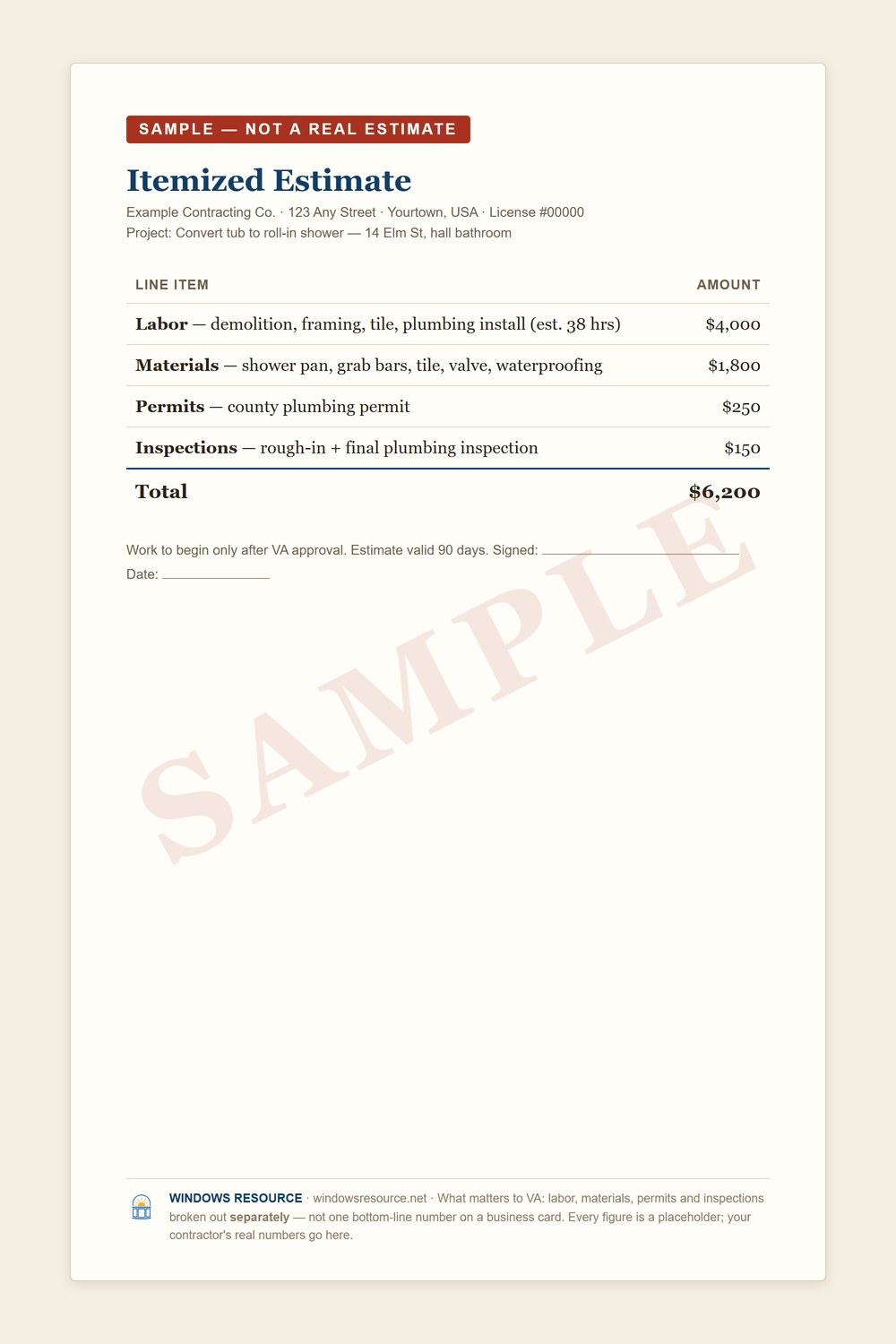
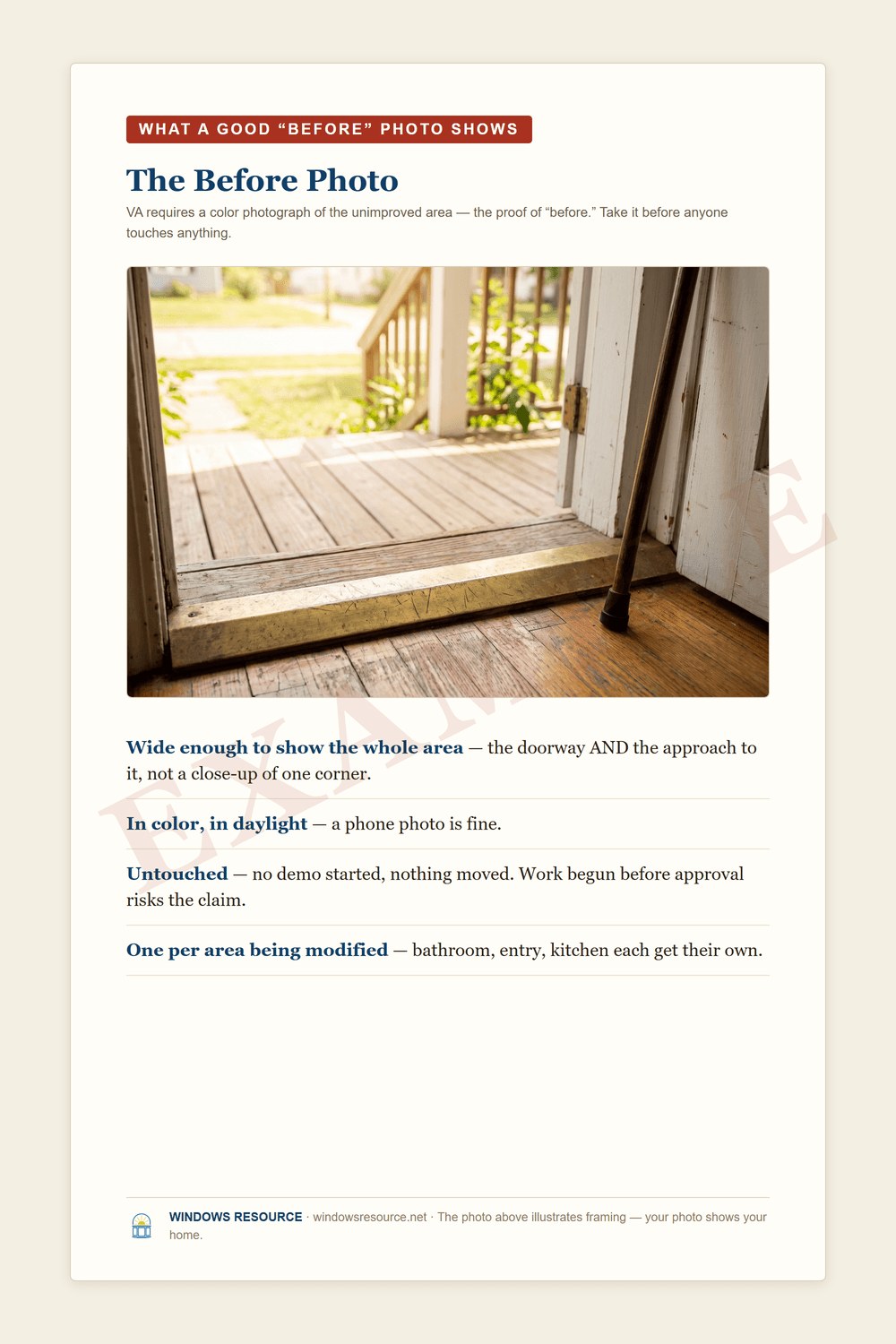
Item 2 needs no example — it’s the real thing: download VA Form 10-0103 (PDF) straight from VA — February 2025 revision, fillable. VA’s form page carries the current version if that link ever ages.
SAH, SHA and TRA: bigger money, narrower gate
These are the capital grants, run by the benefits side of the Department of Veterans Affairs rather than by its health care side, and they exist to buy, build, or substantially adapt a home. For fiscal year 2026:
| Grant | FY 2026 maximum | What it’s for |
|---|---|---|
| SAH — Specially Adapted Housing | $126,526 | Buy, build, or change a permanent home you own or will own |
| SHA — Special Home Adaptation | $25,350 | Same purposes, different qualifying disability list |
| — Temporary Residence Adaptation (SAH-qualified) | $50,961 | Adapting a family member’s home you’re living in temporarily |
| TRA — Temporary Residence Adaptation (SHA-qualified) | $9,100 | Same, for SHA-qualifying veterans |
Two things worth knowing that don’t get said often enough.
First, you can draw on an SAH or SHA grant up to six separate times over your lifetime — it isn’t one shot, and unused money stays available for later years.
Second, VA may raise the maximums annually with construction costs, and you may receive up to the current maximum for the last year you use the grant.
The gate is genuinely narrow, and it’s written in legal language.
SAH turns on qualifying conditions like these:
- the loss, or loss of use, of more than one limb
- blindness in both eyes at 20/200 or less
- certain severe burns
- the loss of use of a lower extremity after September 11, 2001 that leaves you unable to balance or walk unaided — a category Congress caps at 120 veterans per fiscal year
SHA turns on the loss or loss of use of both hands, certain severe burns, or certain respiratory injuries.
If you’re reading that list and thinking “I’m not sure whether my situation counts” — that’s the normal reaction, and it’s precisely what the next section is for. Don’t self-reject. Have someone who does this for a living read your file — and when you’re ready, the SAH/SHA application starts here on VA’s site.
The help with the paperwork is free
The Department of Veterans Affairs states it directly: the services an accredited Veterans Service Organization representative provides on your VA benefit claims are always free.
That distinction is worth holding onto, because not every kind of help is free. VA’s own page notes that accredited attorneys and claims agents may charge fees, while accredited representatives do not. Both are legitimate; they’re just different arrangements.
If you’re about to pay someone to prepare a VA benefits form, it’s worth knowing a no-cost path exists first.
The retired VA official who started this page off named seven of these from memory. Rather than reprint his shortlist, here is the whole roster — VA’s own.
The complete list
Every organization VA recognizes — all 85
This is VA's own roster of the organizations it recognizes to represent veterans on claims, read from its accreditation search in August 2026. Their service officers file this paperwork every day and, for a VA benefit claim, they don't charge for it. Tap a number to call.
Showing all 85
- African American PTSD Association Lakewood, WA253-589-0766
- Alabama Department of Veterans Affairs Montgomery, AL334-242-5077
- American Legion Washington, DC202-861-2700
- American Veterans Rockville, MD1-800-810-7148
- Arizona Department of Veterans Services Phoenix, AZ602-255-3373
- Arkansas Department of Veterans Affairs North Little Rock, AR501-683-2382
- Armed Forces Services Corporation Arlington, VA703-379-9311
- Blinded Veterans Association Washington, DC202-371-8880
- California Department of Veterans Affairs Sacramento, CA916-653-2573
- Catholic War Veterans of the USA Bellerose, NY703-549-3622
- Colorado Division of Veterans Affairs Lakewood, CO303-914-5832
- Commonwealth of the Northern Mariana Islands Division Saipan MP, XX670-664-2650
- Connecticut Department of Veterans Affairs Rocky Hill, CT860-616-3683
- Dale K. Graham Veterans Foundation Norman, OK405-550-8806
- Delaware Commission of Veterans Affairs Dover, DE302-739-2792
- Disabled American Veterans Washington, DC202-554-3501
- Fleet Reserve Association Alexandria, VA703-683 1400
- Florida Department of Veterans Affairs St. Petersburg, FL727-319-7440
- Georgia Department of Veterans Service Atlanta, GA404-656-2300
- (520) 562-5145
- Green Beret Foundation Southern Pines, NC844-287-7133
- Guam Office of Veterans Affairs Hagatna, GU671-642-4111
- Hawaii Office of Veterans Services Honolulu, HI808-433-0420
- IAM Veterans Benefits Support (IAM VBS) Upper Marlboro, MD
- Idaho Division of Veterans Services Boise, ID208-780-1380
- Illinois Department of Veterans Affairs Springfield, IL217-785-4114
- Indiana Department of Veterans Affairs Indianapolis, IN317-232-3910
- Iowa Department of Veterans Affairs Des Moines, IA515-362-7350
- Jewish War Veterans of the USA Washington, DC202-565-5122
- Kansas Office of Veterans Services Topeka, KS785-296-3976
- Kentucky Department of Veterans Affairs Louisville, KY502-595-4447
- Louisiana Department of Veterans Affairs Baton Rouge, LA225-219-5000
- Maine Veterans' Services Augusta, ME207-287-9933
- Marine Corps League Stafford, VA703-207-9588
- Maryland Department of Veterans Affairs Baltimore, MD410-260-3838
- 617-210-5765
- Michigan Veterans Affairs Agency Lansing, MI800-642-4838
- Minnesota Department of Veterans Affairs St. Paul, MN612-970-5662
- Mississippi Veterans Affairs Jackson, MS601-576-4872
- Missouri Veterans Commission Jefferson City, MO573-751-3779
- Montana Veterans Affairs (MVAD) Helena, MT406-324-3742
- National Association for Black Veterans, Inc. Clinton, MD855-225-0709
- National Association of County Veterans Service Officers Washington, DC
- National Law School Veterans Clinic Consortium Gulfport, FL
- 704-726-4860
- National Veterans Legal Services Program Arlington, VA202-265-8305
- Navajo Nation Veterans Administration Window Rock, AZ505-371-8467
- Navy Mutual Aid Association Arlington, VA1-800-628-6011
- Nebraska Department of Veterans Affairs Lincoln, NE402-742-1142
- (775) 668-1653
- New Hampshire Division of Veteran Services Manchester, NH603-624-9230 x-302
- New Jersey Department of Veterans Affairs Trenton, NJ609-530-7045
- New Mexico Department of Veterans Services Santa Fe, NM505-383-2417
- 518-474-6114
- 984-204-2980
- North Dakota Department Veterans Affairs Fargo, ND701-298-4694
- Office of Veterans Affairs American Samoa Government Washington, DC
- Ohio Department of Veterans Services Columbus, OH614 644 0898
- Oklahoma Department of Veterans Affairs Muskogee, OK918-781-7766
- Oregon Department of Veterans Affairs Salem, OR503-373-2388
- Paralyzed Veterans of America Washington, DC617-303-1395
- 717-861-8910
- Polish Legion of American Veterans Austin, TX512-560-6091
- Puerto Rico Veterans Advocate Office San Juan, PR787-758-5760
- 401-921-2119
- South Dakota Department of Veterans Affairs Sioux Falls, SD605-333-6869
- Swords to Plowshares San Francisco, CA415-252-4788
- Tennessee Department of Veterans Services Nashville, TN615-741-1863
- Texas Veterans Commission Austin, TX512-463-6564
- The Retired Enlisted Association Centennial, CO800-554-8732
- The South Carolina Department of Veterans Affairs Columbia, SC803-734-0200
- UDT-SEAL Association Virginia Beach, VA757-363-7490
- Utah Department of Veterans and Military Affairs Salt Lake City, UT801-326-2372
- Vermont Office of Veterans Affairs Montpelier, VT802-828-3379
- Veterans of Foreign Wars Washington, DC202-543-2239
- Veterans' Voice of America Silver Spring, MD
- Vets of Vietnam War Coalition Plains, PA · VA flags this one as not accepting new clients1-800-843-8626
- Vietnam Veterans of America Silver Spring, MD301-585-4000
- Virgin Islands Office of Veterans Affairs Christiansted, St. Croix, VI340-773-6663
- Virginia Department of Veterans Services Richmond, VA804-786-0286
- Washington Department of Veterans Affairs Olympia, WA1-800-562-2308
- West Virginia Dept of Veterans Assistance Charleston, WV304-558-3661
- Wisconsin Department of Veterans Affairs Madison, WI1-800-947-8387
- Wounded Warrior Project Jacksonville, FL888-997-2586
- Wyoming Veterans Commission Cheyenne, WY307-772-5234
Source: VA Office of General Counsel — accreditation search, read August 2026. Use that same tool to find an accredited representative near you, by name, city or state. 79 of these 85 link to a site we opened and checked in August 2026 (two of them — Massachusetts and Virginia — block automated checkers, so we confirmed the official address without being able to read the page). The remaining 6 show a phone number and no link, because their site wouldn't load for us and a link that fails a veteran is worse than none. Phone numbers are VA's, and they're the fastest way to a person either way. If an organization you expected isn't here, this is VA's list of recognized organizations as it stood on that date — search for an accredited representative in the same tool before assuming they can't help you.
So where is the money that can actually touch your windows?
Here’s the honest map, in the order I’d work it.
1. Your state’s Weatherization Assistance Program. This is the big one, and it’s the one nobody mentions to veterans because it isn’t a veterans program — it’s an income-based one. The Department of Energy funds it; every state administers its own, through local agencies that do the work at no cost to the household. Weatherization is explicitly about energy: air sealing, insulation, and yes, in some cases windows. Start at ‘s how-to-apply page, find your state administrator on the map, and ask what their program covers. Expect a waitlist and apply anyway.
2. Your state’s department of veterans affairs. Every state has one, and they’re separate from the federal VA — many run their own repair, tax relief, and hardship programs that never appear in a national article. The finder below names yours, and VA also maintains a directory of state offices.
3. Your county and your city. This is the layer that’s invisible from a search engine and obvious from a phone call. County veterans service offices, community action agencies, and local housing programs all fund home repair, and a county service officer usually knows every one of them by name.
4. Your state housing finance agency. These agencies quietly run repair programs, and the eligibility often turns on age, disability, or income rather than service. North Carolina’s is a good example of the shape: the NC Housing Finance Agency’s Urgent Repair Program finances emergency repairs for homeowners who are elderly or have special needs with incomes below 50% of the area median — delivered as an interest-free deferred loan forgiven at $5,000 a year, through local governments and nonprofits. Note what that program is and isn’t: it’s for conditions that threaten life or safety, and for accessibility modifications after an injury or illness. It doesn’t advertise itself as a veterans program, and plenty of veterans qualify for it anyway. Your state has something with a different name and a similar shape — go find its name.
5. If you’re rural: ‘s Section 504 repair program. Not a veterans program either — a rural one, and worth knowing about. USDA Rural Development offers repair loans up to $40,000 at a fixed 1% over 20 years, and for homeowners 62 or older who can’t repay a loan, grants up to $10,000 (lifetime) to remove health and safety hazards. Loans and grants can combine to $50,000. Two catches worth knowing up front: the property has to sit in a USDA-eligible rural area — their address checker answers that in a minute — and a grant must be repaid if you sell the home within three years.
6. The service organizations above. Post-level and chapter-level assistance for home repair is real, it’s local, and it’s usually a conversation rather than an application portal.
Find the three doors in your state
The state layer
Every link below was opened and read in August 2026. Where a state runs no home-repair program at its housing agency, it says so — that's a finding, not a gap.
Alabama
-
Your state's veterans department
Alabama Department of Veterans Affairs
Separate from the federal VA. State benefits, county service officers, and any state-run hardship or repair help start here.
-
Home repair money at the state housing agency
No statewide homeowner repair program at Alabama Housing Finance Authority (AHFA).
That makes your county and local nonprofits the live lane here — and the weatherization door below is still open. See what the agency does fund.
-
Weatherization — the lane that can touch windows
Alabama Department of Economic and Community Affairs (ADECA)
Income-based, free to the household, delivered by local providers. Expect a waitlist; apply anyway.
Alaska
-
Your state's veterans department
Alaska Office of Veterans Affairs (Dept. of Military and Veterans Affairs)
Separate from the federal VA. State benefits, county service officers, and any state-run hardship or repair help start here.
-
Home repair money at the state housing agency
Senior Access Program (SAP) · Alaska Housing Finance Corporation (AHFC)
Program does not name veterans; eligibility is age (55+) and income-based, delivered through AHFC-funded nonprofit providers.
-
Weatherization — the lane that can touch windows
Alaska Housing Finance Corporation (AHFC)
Income-based, free to the household, delivered by local providers. Expect a waitlist; apply anyway.
Arizona
-
Your state's veterans department
Arizona Department of Veterans' Services
Separate from the federal VA. State benefits, county service officers, and any state-run hardship or repair help start here.
-
Home repair money at the state housing agency
HOME Owner-Occupied Housing Rehabilitation (OOHR) · Arizona Department of Housing (ADOH)
Income-based, not veteran-specific; the page names no veteran set-aside — eligibility runs through local sub-grantee income rules.
-
Weatherization — the lane that can touch windows
Arizona Department of Housing (ADOH)
Income-based, free to the household, delivered by local providers. Expect a waitlist; apply anyway.
Arkansas
-
Your state's veterans department
Arkansas Department of Veterans Affairs
Separate from the federal VA. State benefits, county service officers, and any state-run hardship or repair help start here.
-
Home repair money at the state housing agency
No statewide homeowner repair program at Arkansas Development Finance Authority (ADFA).
That makes your county and local nonprofits the live lane here — and the weatherization door below is still open. See what the agency does fund.
-
Weatherization — the lane that can touch windows
Income-based, free to the household, delivered by local providers. Expect a waitlist; apply anyway.
California
-
Your state's veterans department
California Department of Veterans Affairs (CalVet)
Separate from the federal VA. State benefits, county service officers, and any state-run hardship or repair help start here. We couldn't read this page with our tools — the address is the agency's official one, but confirm it loads for you.
-
Home repair money at the state housing agency
CalHome Program · California Department of Housing and Community Development (HCD)
The program page does not name veterans; eligibility is income-based (low/very-low income), applied for via local agencies.
-
Weatherization — the lane that can touch windows
California Department of Community Services and Development (CSD)
Income-based, free to the household, delivered by local providers. Expect a waitlist; apply anyway.
Colorado
-
Your state's veterans department
Separate from the federal VA. State benefits, county service officers, and any state-run hardship or repair help start here.
-
Home repair money at the state housing agency
Single Family Owner-Occupied Rehabilitation (SFOO) Program · Colorado Department of Local Affairs — Division of Housing
Program does not name veterans; it is income-based (owner-occupied, AMI-limited) with health/safety, accessibility, and energy-efficiency criteria.
-
Weatherization — the lane that can touch windows
Income-based, free to the household, delivered by local providers. Expect a waitlist; apply anyway.
Connecticut
-
Your state's veterans department
Connecticut Department of Veterans Affairs
Separate from the federal VA. State benefits, county service officers, and any state-run hardship or repair help start here. We couldn't read this page with our tools — the address is the agency's official one, but confirm it loads for you.
-
Home repair money at the state housing agency
Small Cities Community Development Block Grant (CDBG) — town-administered homeowner rehabilitation · Connecticut Department of Housing (DOH)
Not veteran-specific — HUD low/moderate-income based; town programs are typically income/hazard-based, not veteran-named.
-
Weatherization — the lane that can touch windows
Connecticut Department of Energy & Environmental Protection (DEEP)
Income-based, free to the household, delivered by local providers. Expect a waitlist; apply anyway. We couldn't read this page with our tools — confirm it loads for you.
Delaware
-
Your state's veterans department
Delaware Office of Veterans Services / Delaware Commission of Veterans Affairs (DCVA)
Separate from the federal VA. State benefits, county service officers, and any state-run hardship or repair help start here.
-
Home repair money at the state housing agency
Statewide Emergency Repair Program (SERP) · Delaware State Housing Authority (DSHA)
SERP does not name veterans; eligibility is income- and health/safety-emergency-based for owner-occupants of 1+ year.
-
Weatherization — the lane that can touch windows
Delaware DNREC, Division of Climate, Coastal and Energy
Income-based, free to the household, delivered by local providers. Expect a waitlist; apply anyway.
Florida
-
Your state's veterans department
Florida Department of Veterans' Affairs (FDVA)
Separate from the federal VA. State benefits, county service officers, and any state-run hardship or repair help start here. We couldn't read this page with our tools — the address is the agency's official one, but confirm it loads for you.
-
Home repair money at the state housing agency
State Housing Initiatives Partnership (SHIP) · Florida Housing Finance Corporation
SHIP is income-based (typically <=80-120% AMI), not veteran-specific; local plans often prioritize elderly and persons with disabilities.
-
Weatherization — the lane that can touch windows
FloridaCommerce (Florida Department of Commerce)
Income-based, free to the household, delivered by local providers. Expect a waitlist; apply anyway.
Georgia
-
Your state's veterans department
Georgia Department of Veterans Service
Separate from the federal VA. State benefits, county service officers, and any state-run hardship or repair help start here.
-
Home repair money at the state housing agency
Community HOME Investment Program (CHIP) · Georgia Department of Community Affairs (DCA)
Page does not mention veterans; eligibility is income-based via local grantees, not veteran-specific.
-
Weatherization — the lane that can touch windows
Georgia Environmental Finance Authority (GEFA)
Income-based, free to the household, delivered by local providers. Expect a waitlist; apply anyway.
Hawaii
-
Your state's veterans department
Hawaii Office of Veterans' Services (State of Hawai'i Department of Defense)
Separate from the federal VA. State benefits, county service officers, and any state-run hardship or repair help start here.
-
Home repair money at the state housing agency
No statewide homeowner repair program at Hawai'i Housing Finance & Development Corporation (HHFDC).
That makes your county and local nonprofits the live lane here — and the weatherization door below is still open. See what the agency does fund.
-
Weatherization — the lane that can touch windows
Hawaii Department of Labor & Industrial Relations, Office of Community Services (OCS)
Income-based, free to the household, delivered by local providers. Expect a waitlist; apply anyway.
Idaho
-
Your state's veterans department
Idaho Division of Veterans Services
Separate from the federal VA. State benefits, county service officers, and any state-run hardship or repair help start here.
-
Home repair money at the state housing agency
No dedicated statewide consumer repair program page · Idaho Housing and Finance Association (IHFA)
Nothing veteran-specific; the closest offerings are income-based (HOME rehab via partners) or restricted to existing IHFA mortgage borrowers.
-
Weatherization — the lane that can touch windows
Idaho Department of Health and Welfare
Income-based, free to the household, delivered by local providers. Expect a waitlist; apply anyway.
Illinois
-
Your state's veterans department
Illinois Department of Veterans' Affairs
Separate from the federal VA. State benefits, county service officers, and any state-run hardship or repair help start here.
-
Home repair money at the state housing agency
Home Repair and Accessibility Program (HRAP) · Illinois Housing Development Authority (IHDA)
Programs are income-based (low/very-low-income homeowners), not veteran-specific; the page does not mention veterans.
-
Weatherization — the lane that can touch windows
Illinois Department of Commerce & Economic Opportunity (DCEO)
Income-based, free to the household, delivered by local providers. Expect a waitlist; apply anyway.
Indiana
-
Your state's veterans department
Indiana Department of Veterans Affairs (IDVA)
Separate from the federal VA. State benefits, county service officers, and any state-run hardship or repair help start here.
-
Home repair money at the state housing agency
Owner Occupied Rehabilitation Program (CDBG) · Indiana Office of Community and Rural Affairs (OCRA)
Page never mentions veterans; eligibility is income-based (CDBG low/moderate income), applied through local communities.
-
Weatherization — the lane that can touch windows
Indiana Housing and Community Development Authority (IHCDA)
Income-based, free to the household, delivered by local providers. Expect a waitlist; apply anyway.
Iowa
-
Your state's veterans department
Iowa Department of Veterans Affairs (IDVA)
Separate from the federal VA. State benefits, county service officers, and any state-run hardship or repair help start here.
-
Home repair money at the state housing agency
Housing Rehabilitation Fund (Roofing Replacement + Upper Story programs, CDBG) · Iowa Economic Development & Finance Authority (IEDA/IFA, opportunityiowa.gov)
No veteran mention on the page; eligibility is income-based (low-to-moderate income households) via community applicants, not veteran status.
-
Weatherization — the lane that can touch windows
Iowa Department of Health and Human Services
Income-based, free to the household, delivered by local providers. Expect a waitlist; apply anyway.
Kansas
-
Your state's veterans department
Kansas Office of Veterans Services (KOVS)
Separate from the federal VA. State benefits, county service officers, and any state-run hardship or repair help start here.
-
Home repair money at the state housing agency
Community Development Block Grant (CDBG) Housing Rehabilitation Program · Kansas Department of Commerce (with Kansas Housing Resources Corporation)
Income-based via local governments; does not name veterans.
-
Weatherization — the lane that can touch windows
Kansas Housing Resources Corporation (KHRC)
Income-based, free to the household, delivered by local providers. Expect a waitlist; apply anyway.
Kentucky
-
Your state's veterans department
Kentucky Department of Veterans Affairs (KDVA)
Separate from the federal VA. State benefits, county service officers, and any state-run hardship or repair help start here.
-
Home repair money at the state housing agency
Affordable Housing Trust Fund (AHTF) Home Repair · Kentucky Housing Corporation (KHC)
Program does not name veterans; eligibility is income-based (<=60% AMI), with accessibility adaptations added when a household member is disabled.
-
Weatherization — the lane that can touch windows
Kentucky Housing Corporation (KHC)
Income-based, free to the household, delivered by local providers. Expect a waitlist; apply anyway.
Louisiana
-
Your state's veterans department
Louisiana Department of Veterans Affairs
Separate from the federal VA. State benefits, county service officers, and any state-run hardship or repair help start here.
-
Home repair money at the state housing agency
Louisiana Blue Tarp Program · Louisiana Housing Corporation
Does not name veterans; eligibility is ownership + income-based, and parish-limited — no statewide general home-repair program was found.
-
Weatherization — the lane that can touch windows
Income-based, free to the household, delivered by local providers. Expect a waitlist; apply anyway.
Maine
-
Your state's veterans department
Maine Bureau of Veterans' Services
Separate from the federal VA. State benefits, county service officers, and any state-run hardship or repair help start here.
-
Home repair money at the state housing agency
Home Accessibility and Repair Program · MaineHousing (Maine State Housing Authority)
Page does not name veterans; eligibility is income- and ownership-based, with accessibility/disability repairs covered.
-
Weatherization — the lane that can touch windows
MaineHousing (Maine State Housing Authority)
Income-based, free to the household, delivered by local providers. Expect a waitlist; apply anyway.
Maryland
-
Your state's veterans department
Maryland Department of Veterans and Military Families (DVMF)
Separate from the federal VA. State benefits, county service officers, and any state-run hardship or repair help start here.
-
Home repair money at the state housing agency
Maryland Housing Rehabilitation Program (Special Loan Programs) · Maryland Department of Housing and Community Development (DHCD)
Income-based loan for health/safety and code repairs; page does not name veterans — eligibility is income and property condition, run through local administering agencies.
-
Weatherization — the lane that can touch windows
Maryland Department of Housing and Community Development (DHCD)
Income-based, free to the household, delivered by local providers. Expect a waitlist; apply anyway.
Massachusetts
-
Your state's veterans department
Massachusetts Executive Office of Veterans Services (EOVS)
Separate from the federal VA. State benefits, county service officers, and any state-run hardship or repair help start here. We couldn't read this page with our tools — the address is the agency's official one, but confirm it loads for you.
-
Home repair money at the state housing agency
Home Modification Loan Program (HMLP) · CEDAC (Community Economic Development Assistance Corp), for MA Rehabilitation Commission
Not veteran-specific: eligibility is disability/age-based (household member with disability or elder), with income limits — disabled veterans qualify on that basis.
-
Weatherization — the lane that can touch windows
Massachusetts Executive Office of Housing and Livable Communities (EOHLC)
Income-based, free to the household, delivered by local providers. Expect a waitlist; apply anyway. We couldn't read this page with our tools — confirm it loads for you.
Michigan
-
Your state's veterans department
Michigan Veterans Affairs Agency (MVAA)
Separate from the federal VA. State benefits, county service officers, and any state-run hardship or repair help start here.
-
Home repair money at the state housing agency
MI Neighborhood (MIN) — occupied rehabilitation funds · Michigan State Housing Development Authority (MSHDA)
Does not name veterans; eligibility is community/income-based via local grantees (page has zero veteran mentions).
-
Weatherization — the lane that can touch windows
Michigan Department of Health and Human Services (MDHHS)
Income-based, free to the household, delivered by local providers. Expect a waitlist; apply anyway.
Minnesota
-
Your state's veterans department
Minnesota Department of Veterans Affairs (MDVA)
Separate from the federal VA. State benefits, county service officers, and any state-run hardship or repair help start here.
-
Home repair money at the state housing agency
Rehabilitation Loan Program & Emergency and Accessibility Loan Program · Minnesota Housing (Minnesota Housing Finance Agency)
Income-based, not veteran-specific: RLP/ELP serve low-income homeowners with safety, habitability, accessibility, or emergency repair needs; disability drives ELP accessibility eligibility.
-
Weatherization — the lane that can touch windows
Minnesota Department of Commerce (Energy Division)
Income-based, free to the household, delivered by local providers. Expect a waitlist; apply anyway.
Mississippi
-
Your state's veterans department
Mississippi Veterans Affairs (Mississippi State Veterans Affairs Board)
Separate from the federal VA. State benefits, county service officers, and any state-run hardship or repair help start here.
-
Home repair money at the state housing agency
Homeowner Rehabilitation Program (HOME Investment Partnership) · Mississippi Home Corporation
Income-based (HOME low-income limits); the page does not name veterans as a category.
-
Weatherization — the lane that can touch windows
Mississippi Department of Human Services, Division of Community Services
Income-based, free to the household, delivered by local providers. Expect a waitlist; apply anyway.
Missouri
-
Your state's veterans department
Separate from the federal VA. State benefits, county service officers, and any state-run hardship or repair help start here.
-
Home repair money at the state housing agency
Home Repair Opportunity (HeRO) Program · Missouri Housing Development Commission (MHDC)
Page does not name veterans; eligibility is income-based (low/moderate-income owner-occupants), with focus on non-metro and disaster areas.
-
Weatherization — the lane that can touch windows
Missouri Department of Natural Resources — Division of Energy
Income-based, free to the household, delivered by local providers. Expect a waitlist; apply anyway.
Montana
-
Your state's veterans department
Montana Veteran Affairs Division (Dept. of Military Affairs)
Separate from the federal VA. State benefits, county service officers, and any state-run hardship or repair help start here.
-
Home repair money at the state housing agency
No statewide homeowner repair program at Montana Housing (MT Dept. of Commerce).
That makes your county and local nonprofits the live lane here — and the weatherization door below is still open. See what the agency does fund.
-
Weatherization — the lane that can touch windows
Montana DPHHS — Human & Community Services Division
Income-based, free to the household, delivered by local providers. Expect a waitlist; apply anyway.
Nebraska
-
Your state's veterans department
Nebraska Department of Veterans' Affairs
Separate from the federal VA. State benefits, county service officers, and any state-run hardship or repair help start here.
-
Home repair money at the state housing agency
Nebraska Affordable Housing Trust Fund (NAHTF) owner-occupied rehabilitation · Nebraska Department of Economic Development (Housing Division)
Income-based (low/moderate income), not veteran-specific; veterans qualify through the same income limits via local grantees.
-
Weatherization — the lane that can touch windows
Nebraska Department of Water, Energy, and Environment (DWEE)
Income-based, free to the household, delivered by local providers. Expect a waitlist; apply anyway.
Nevada
-
Your state's veterans department
Nevada Department of Veterans Services
Separate from the federal VA. State benefits, county service officers, and any state-run hardship or repair help start here.
-
Home repair money at the state housing agency
Homeowner Rehabilitation (HOME Investment Partnerships Program) · Nevada Housing Division (Dept. of Business & Industry)
Program does not name veterans; eligibility is income- and owner-occupancy-based under federal HOME rules.
-
Weatherization — the lane that can touch windows
Nevada Housing Division (Dept. of Business & Industry)
Income-based, free to the household, delivered by local providers. Expect a waitlist; apply anyway.
New Hampshire
-
Your state's veterans department
New Hampshire Department of Military Affairs and Veterans Services (Division of Veterans Services)
Separate from the federal VA. State benefits, county service officers, and any state-run hardship or repair help start here.
-
Home repair money at the state housing agency
Emergency Home Repair Loan · New Hampshire Housing (NH Housing Finance Authority)
Does not name veterans; eligibility is borrower-status and emergency-based, not veteran/age/disability-based.
-
Weatherization — the lane that can touch windows
New Hampshire Department of Energy
Income-based, free to the household, delivered by local providers. Expect a waitlist; apply anyway.
New Jersey
-
Your state's veterans department
New Jersey Department of Veterans Affairs
Separate from the federal VA. State benefits, county service officers, and any state-run hardship or repair help start here.
-
Home repair money at the state housing agency
Small Cities CDBG (housing rehabilitation via local governments) · NJ Department of Community Affairs (DCA)
Not veteran-specific — local CDBG rehab programs are income-based (low/moderate income), not tied to veteran status.
-
Weatherization — the lane that can touch windows
NJ Department of Community Affairs, Division of Housing and Community Resources
Income-based, free to the household, delivered by local providers. Expect a waitlist; apply anyway.
New Mexico
-
Your state's veterans department
New Mexico Department of Veterans Services (DVS)
Separate from the federal VA. State benefits, county service officers, and any state-run hardship or repair help start here.
-
Home repair money at the state housing agency
HOME Rehabilitation Program (plus Home Improvement Program in unserved counties) · Housing New Mexico | MFA (New Mexico Mortgage Finance Authority)
MFA also runs a dedicated Veterans Home Rehabilitation and Modification Program (named in site nav); the base HOME Rehab program itself is income-based, not veteran-specific.
-
Weatherization — the lane that can touch windows
Housing New Mexico | MFA — NM Energy$mart Weatherization Assistance Program
Income-based, free to the household, delivered by local providers. Expect a waitlist; apply anyway.
New York
-
Your state's veterans department
New York State Department of Veterans' Services
Separate from the federal VA. State benefits, county service officers, and any state-run hardship or repair help start here.
-
Home repair money at the state housing agency
Access to Home for Heroes · New York State Homes and Community Renewal (HCR)
Explicitly veteran-specific: eligibility is veterans with disabilities, low/moderate income. HCR also runs RESTORE (age 60+ emergency repairs, hcr.ny.gov/restore-program, also verified).
-
Weatherization — the lane that can touch windows
New York State Homes and Community Renewal (HCR)
Income-based, free to the household, delivered by local providers. Expect a waitlist; apply anyway.
North Carolina
-
Your state's veterans department
North Carolina Department of Military and Veterans Affairs
Separate from the federal VA. State benefits, county service officers, and any state-run hardship or repair help start here.
-
Home repair money at the state housing agency
Urgent Repair Program · North Carolina Housing Finance Agency
Does not name veterans; eligibility is income- and special-needs-based (elderly/disabled), so disabled veterans typically qualify on those grounds.
-
Weatherization — the lane that can touch windows
NC Department of Environmental Quality — State Energy Office
Income-based, free to the household, delivered by local providers. Expect a waitlist; apply anyway.
North Dakota
-
Your state's veterans department
North Dakota Department of Veterans Affairs
Separate from the federal VA. State benefits, county service officers, and any state-run hardship or repair help start here.
-
Home repair money at the state housing agency
Rehab Accessibility Program (RAP); also Helping HAND and HOME Owner-Occupied Rehabilitation · North Dakota Housing Finance Agency (NDHFA)
No veteran-specific eligibility; RAP is income- and disability-based (lower-income North Dakotans with physical disabilities), others are income-based at 80% AMI.
-
Weatherization — the lane that can touch windows
North Dakota Department of Commerce, Division of Community Services
Income-based, free to the household, delivered by local providers. Expect a waitlist; apply anyway.
Ohio
-
Your state's veterans department
Ohio Department of Veterans Services
Separate from the federal VA. State benefits, county service officers, and any state-run hardship or repair help start here.
-
Home repair money at the state housing agency
Housing Assistance Grant Program · Ohio Department of Development
Income-based (at/below ~50% AMI), not veteran-specific; the page does not name veterans.
-
Weatherization — the lane that can touch windows
Ohio Department of Job & Family Services
Income-based, free to the household, delivered by local providers. Expect a waitlist; apply anyway.
Oklahoma
-
Your state's veterans department
Oklahoma Department of Veterans Affairs
Separate from the federal VA. State benefits, county service officers, and any state-run hardship or repair help start here.
-
Home repair money at the state housing agency
HOME Investment Partnerships Program · Oklahoma Housing Finance Agency (OHFA)
Income-based (at/below 80% AMI via local subrecipients); the program does not name veterans.
-
Weatherization — the lane that can touch windows
Oklahoma Department of Commerce
Income-based, free to the household, delivered by local providers. Expect a waitlist; apply anyway.
Oregon
-
Your state's veterans department
Oregon Department of Veterans' Affairs (ODVA)
Separate from the federal VA. State benefits, county service officers, and any state-run hardship or repair help start here.
-
Home repair money at the state housing agency
Restore Health and Safety (RHS) Program · Oregon Housing and Community Services (OHCS)
Explicitly veterans-only — the page states 'These funds are available for veterans only', a rare state repair program built for veterans.
-
Weatherization — the lane that can touch windows
Oregon Housing and Community Services (OHCS)
Income-based, free to the household, delivered by local providers. Expect a waitlist; apply anyway.
Pennsylvania
-
Your state's veterans department
Pennsylvania Department of Military and Veterans Affairs (DMVA)
Separate from the federal VA. State benefits, county service officers, and any state-run hardship or repair help start here.
-
Home repair money at the state housing agency
Whole-Home Repairs Program · PA Department of Community & Economic Development (DCED)
Not veteran-specific: income-based (page discusses income limits) with habitability and disability-accessibility criteria; veterans qualify on those terms.
-
Weatherization — the lane that can touch windows
PA Department of Community & Economic Development (DCED)
Income-based, free to the household, delivered by local providers. Expect a waitlist; apply anyway.
Rhode Island
-
Your state's veterans department
Rhode Island Office of Veterans Services (RIVETS)
Separate from the federal VA. State benefits, county service officers, and any state-run hardship or repair help start here.
-
Home repair money at the state housing agency
Community Lending Programs (LeadSafe Homes, Septic/Sewer, Access Independence II) · RIHousing
Programs are income/hazard/disability-based; the page does not name veterans.
-
Weatherization — the lane that can touch windows
RI Department of Human Services
Income-based, free to the household, delivered by local providers. Expect a waitlist; apply anyway.
South Carolina
-
Your state's veterans department
South Carolina Department of Veterans' Affairs (SCDVA)
Separate from the federal VA. State benefits, county service officers, and any state-run hardship or repair help start here.
-
Home repair money at the state housing agency
Housing Preservation Initiative (SC Housing Trust Fund) · SC State Housing Finance and Development Authority (SC Housing)
Income-based (low to very low income); the page names no veteran set-aside — disability accessibility modifications are covered.
-
Weatherization — the lane that can touch windows
SC Office of Economic Opportunity (OEO)
Income-based, free to the household, delivered by local providers. Expect a waitlist; apply anyway.
South Dakota
-
Your state's veterans department
South Dakota Department of Veterans Affairs
Separate from the federal VA. State benefits, county service officers, and any state-run hardship or repair help start here.
-
Home repair money at the state housing agency
Home Improvement & Rehab Programs (CHIP loan; HOME/HOF Homeowner Rehabilitation) · South Dakota Housing Development Authority (SD Housing)
Programs are income/owner-occupancy based, not veteran-specific; page does not mention veterans.
-
Weatherization — the lane that can touch windows
South Dakota Department of Social Services
Income-based, free to the household, delivered by local providers. Expect a waitlist; apply anyway.
Tennessee
-
Your state's veterans department
Tennessee Department of Veterans Services
Separate from the federal VA. State benefits, county service officers, and any state-run hardship or repair help start here.
-
Home repair money at the state housing agency
Emergency Repair Program (ERP) · Tennessee Housing Development Agency (THDA)
ERP is age/disability/income-based, not veteran-specific; THDA's companion Tennessee Repair Loan Program explicitly names veterans as a target group.
-
Weatherization — the lane that can touch windows
Tennessee Housing Development Agency (THDA)
Income-based, free to the household, delivered by local providers. Expect a waitlist; apply anyway.
Texas
-
Your state's veterans department
Separate from the federal VA. State benefits, county service officers, and any state-run hardship or repair help start here.
-
Home repair money at the state housing agency
Homeowner Reconstruction Assistance (HRA) via Help for Texans · Texas Department of Housing and Community Affairs (TDHCA)
Income-based, not veteran-specific; open to low-income homeowners including veterans through local provider organizations.
-
Weatherization — the lane that can touch windows
Texas Department of Housing and Community Affairs (TDHCA)
Income-based, free to the household, delivered by local providers. Expect a waitlist; apply anyway.
Utah
-
Your state's veterans department
Utah Department of Veterans and Military Affairs
Separate from the federal VA. State benefits, county service officers, and any state-run hardship or repair help start here.
-
Home repair money at the state housing agency
Olene Walker Housing Loan Fund — Single Family Rehabilitation & Reconstruction Program (SFRRP) · Utah Division of Housing and Community Development (Dept. of Workforce Services, jobs.utah.gov)
Program does not name veterans; eligibility is income-based (low-income/≤80% AMI) with a rural-community focus — veterans qualify on income like anyone else.
-
Weatherization — the lane that can touch windows
Utah Division of Housing and Community Development (Housing Stability, jobs.utah.gov)
Income-based, free to the household, delivered by local providers. Expect a waitlist; apply anyway.
Vermont
-
Your state's veterans department
Vermont Office of Veterans Affairs
Separate from the federal VA. State benefits, county service officers, and any state-run hardship or repair help start here.
-
Home repair money at the state housing agency
Manufactured Home Improvement and Repair Program (MHIR) · Vermont Department of Housing and Community Development (ACCD/DHCD)
Income-based, not veteran-specific; page does not mention veterans. Limited to manufactured/mobile homes.
-
Weatherization — the lane that can touch windows
Vermont Department for Children and Families, Office of Economic Opportunity
Income-based, free to the household, delivered by local providers. Expect a waitlist; apply anyway.
Virginia
-
Your state's veterans department
Virginia Department of Veterans Services (DVS)
Separate from the federal VA. State benefits, county service officers, and any state-run hardship or repair help start here. We couldn't read this page with our tools — the address is the agency's official one, but confirm it loads for you.
-
Home repair money at the state housing agency
Essential Home and Accessibility Repair Program (EHARP) · Virginia Department of Housing and Community Development (DHCD)
EHARP is income/disability-based and does not name veterans; separately, Virginia Housing's Granting Freedom grant (virginiahousing.com/accessibility-grants, verified) funds home mods specifically for service-disabled veterans.
-
Weatherization — the lane that can touch windows
Virginia Department of Housing and Community Development (DHCD)
Income-based, free to the household, delivered by local providers. Expect a waitlist; apply anyway.
Washington
-
Your state's veterans department
Washington State Department of Veterans Affairs (WDVA)
Separate from the federal VA. State benefits, county service officers, and any state-run hardship or repair help start here.
-
Home repair money at the state housing agency
Home Rehabilitation Grant Program (HRGP) · Washington State Department of Commerce
Names veterans explicitly: priority to seniors, disabled residents, families with children under five, and veterans.
-
Weatherization — the lane that can touch windows
Washington State Department of Commerce
Income-based, free to the household, delivered by local providers. Expect a waitlist; apply anyway.
West Virginia
-
Your state's veterans department
West Virginia Department of Veterans Assistance
Separate from the federal VA. State benefits, county service officers, and any state-run hardship or repair help start here.
-
Home repair money at the state housing agency
No statewide homeowner repair program at West Virginia Housing Development Fund (WVHDF).
That makes your county and local nonprofits the live lane here — and the weatherization door below is still open. See what the agency does fund.
-
Weatherization — the lane that can touch windows
Income-based, free to the household, delivered by local providers. Expect a waitlist; apply anyway.
Wisconsin
-
Your state's veterans department
Wisconsin Department of Veterans Affairs (WDVA)
Separate from the federal VA. State benefits, county service officers, and any state-run hardship or repair help start here.
-
Home repair money at the state housing agency
Home Improvement Loan Program (HILP) and More Like Home™ Repair and Renew Loan · Wisconsin Housing and Economic Development Authority (WHEDA)
Neither program names veterans; eligibility is income/credit/home-age based, open to any qualifying Wisconsin homeowner.
-
Weatherization — the lane that can touch windows
Wisconsin Department of Administration, Division of Energy, Housing and Community Resources (DEHCR)
Income-based, free to the household, delivered by local providers. Expect a waitlist; apply anyway.
Wyoming
-
Your state's veterans department
Wyoming Veterans Commission (Wyoming Military Department)
Separate from the federal VA. State benefits, county service officers, and any state-run hardship or repair help start here.
-
Home repair money at the state housing agency
Spruce Up · Wyoming Community Development Authority (WCDA)
Not veteran-specific — eligibility is first-time-homebuyer and income/purchase-price limits, not veteran status.
-
Weatherization — the lane that can touch windows
Wyoming Department of Family Services (DFS)
Income-based, free to the household, delivered by local providers. Expect a waitlist; apply anyway.
Fifty states checked in August 2026. Programs change and pages move — if a link has gone stale, the agency name is the durable part of the answer.
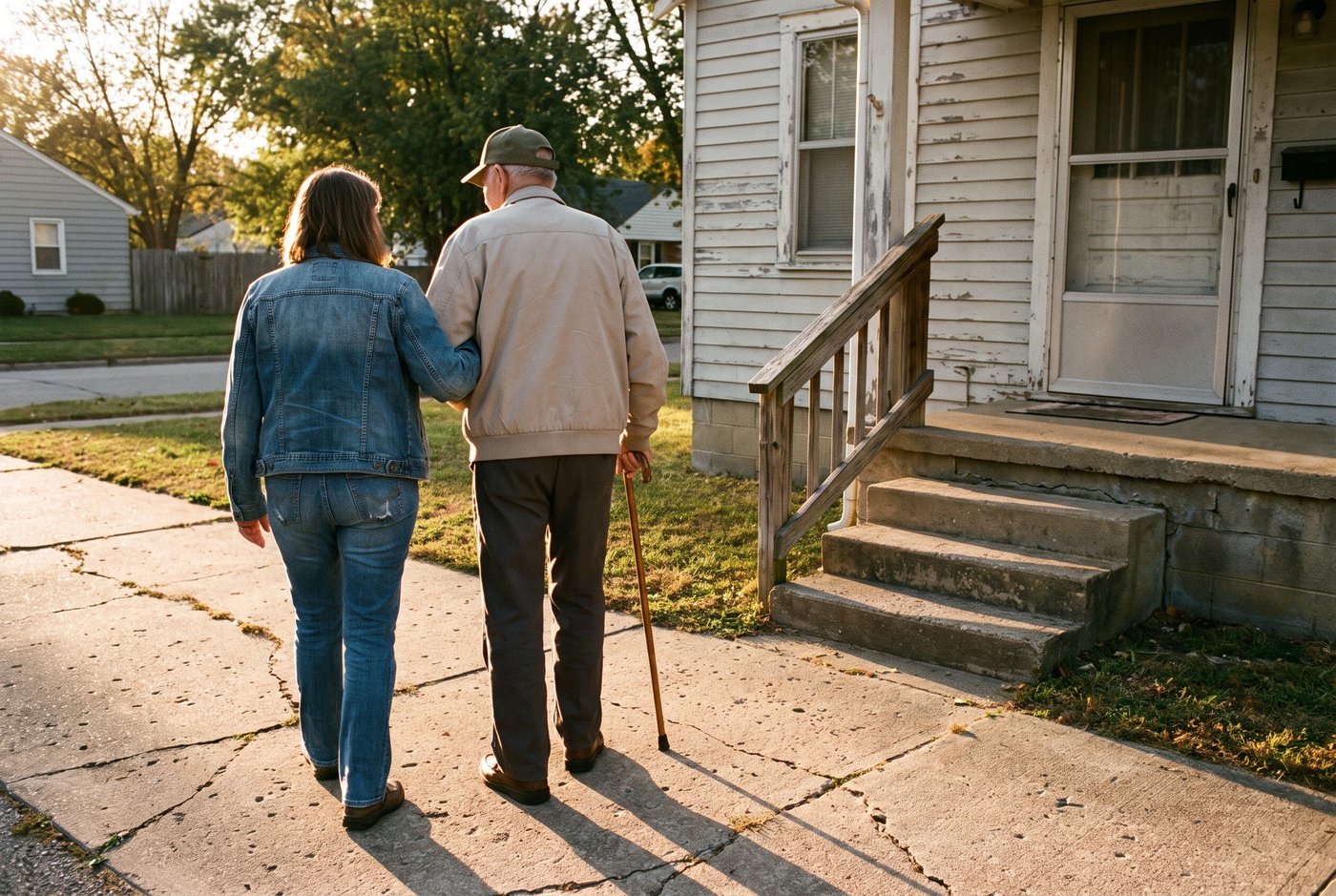
If you’re the one doing this research for someone else
A lot of people reading this are not the veteran. You’re the spouse, or the adult kid at the kitchen table at eleven at night, trying to work out whether Dad’s house can be made to work for him.
Two things will save you the most time. Call a VSO service officer before you fill out anything — free, they’ve seen your exact situation before, and the full directory with phone numbers is above. And raise the access problem at the next VA medical appointment in plain language, because the physician’s prescription is the gate everything else waits behind.
The paperwork is genuinely slow. It also genuinely works, and the people who get through it are usually the ones who started with a phone call instead of a form.
Three more things come up constantly when veterans compare notes on these grants. All three belong in your first phone call.
A denial isn’t the end. Veterans report denials overturned on Higher-Level Review. Ask about your review options before you give up — VA’s Higher-Level Review page explains how.
Ask PSAS what VA provides directly before you spend grant money. Some equipment comes through other VA channels — part of why HISA’s own list excludes portable ramps and stair glides. Let your Prosthetic and Sensory Aids Service tell you what’s theirs to supply.
Get more than one itemized estimate. Veterans on the benefits forums warn that quotes offered against grant money don’t always match quotes offered without it. A second number is the cheapest protection there is.
Sources, Verification & Fact-Checking verified August 2026
Every load-bearing fact on this page is sourced and verified against a primary authority.
Verified August 2026 via direct review of the cited authority — the links open the controlling source so you can check it yourself rather than take our word.
- HISA benefit amounts, purposes, exclusions and application requirements — U.S. Department of Veterans Affairs, Prosthetic & Sensory Aids Service, Home Improvements/Structural Alterations (HISA). Page last updated February 12, 2025; read August 6, 2026.
- SAH, SHA and TRA FY 2026 maximums, eligibility categories and the six-use rule — U.S. Department of Veterans Affairs, Disability housing grants for Veterans. Page last updated November 18, 2025; read August 6, 2026.
- Accredited VSO representative services are free — U.S. Department of Veterans Affairs, Get help from a VA accredited representative or VSO. Read August 6, 2026.
- Weatherization is state-administered; apply through your state administrator — U.S. Department of Energy, How to Apply for Weatherization Assistance. Read August 6, 2026.
- State veterans affairs office directory — U.S. Department of Veterans Affairs, state veterans affairs offices. Read August 6, 2026.
- USDA Section 504 repair loan and grant terms — USDA Rural Development, Single Family Housing Repair Loans & Grants. Read August 7, 2026 via the Internet Archive’s July 7, 2026 snapshot — USDA’s site refuses automated readers, so the figures were taken from the archived copy of USDA’s own page and should be confirmed on the live page before you rely on them.
- North Carolina Urgent Repair Program terms — North Carolina Housing Finance Agency, Urgent Repair Program. Read August 6, 2026.
Every figure on this page was read directly from the agency that sets it, in August 2026. Benefit amounts change by fiscal year — confirm current figures before you rely on them.
Corrected during research. The figure that reached me for the SAH grant was “up to $109,986+” — a real number from an earlier fiscal year, and low. VA’s own page gives $126,526 for FY 2026. Grant maximums move annually with construction costs, which is exactly why a figure quoted from a third-party page is worth re-reading at the source.
Deliberately not stated. Whether VA has ever approved window work under HISA as part of a medically necessary access project. I could not source an answer, so this page doesn’t imply one in either direction — it states what VA’s own exclusion list says, and routes that question to the people who decide it.