


If you’re shopping for windows in North Carolina and someone dangled a tax credit to sweeten the number, stop for one second before it changes your math.
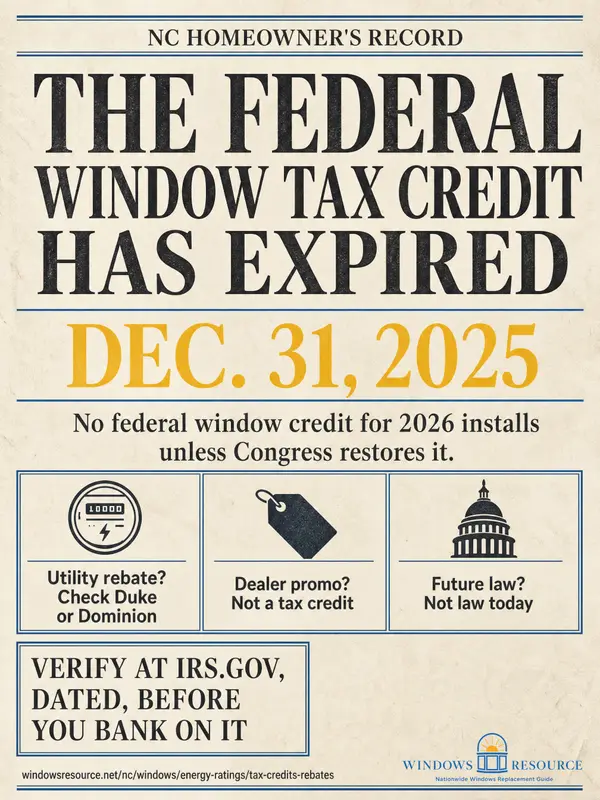
The most useful thing I can tell you is also the least fun: the federal tax credit for windows expired at the end of 2025. A lot of pages and pitches haven’t caught up. Some still advertise it like it’s live.
So this page does the boring, honest version. What’s actually gone. What might still apply. And how to check any of it before you bank a single dollar on it.
Is there a federal window tax credit in 2026? As of July 2026, no. The 25C Energy Efficient Home Improvement Credit for windows expired December 31, 2025 and isn’t available for 2026 installs unless Congress restores it. Utility rebates and promotions may still exist — but every one of them has to be verified against the current program, dated, before you count on it.
The federal window tax credit expired — say it plainly
The 25C Energy Efficient Home Improvement Credit covered qualifying windows through December 31, 2025, and then it stopped. For windows installed in 2026, there is no federal window tax credit to claim right now.
I’m leading with that because it’s the one thing the internet is slowest to update. Search “window tax credit” today and you’ll still find pages promising a federal credit as if nothing changed. Brochures printed last year still name it — and a brochure has no idea what year it is. It’s an easy thing to repeat and a costly thing to believe.
Here’s the honest read: if a quote’s value depends on a federal window credit in 2026, that value isn’t there. The windows might still be worth buying. The credit just isn’t part of the deal anymore.
If Congress restores or replaces it, that changes — tax law moves, and this page gets re-checked every publish cycle. But I won’t tell you a credit is live when, as of July 2026, it isn’t.
What the credit was (and why it might still matter for one year)
If your windows were placed in service on or before December 31, 2025, the old credit may still apply to that tax year — claimed on your 2025 return, not going forward. That’s a filing question, and it’s the one live corner of an otherwise closed door.
Here’s the shape of it, hedged, because the exact figures belong to the IRS and not to me:
- It applied to windows meeting the higher ENERGY STAR Most Efficient bar — not just plain ENERGY STAR certified.
- It was worth a percentage of the cost, up to an annual dollar cap for windows, inside a larger annual cap for home-improvement credits. I’m deliberately not printing the exact numbers here as a current figure, because the amounts, caps, and eligibility are the kind of detail that shifts — pull them from the IRS Form 5695 instructions for the tax year you’re filing.
- It was nonrefundable and for a principal residence — a credit against tax owed, not a check in the mail.
If that’s you — 2025 install, qualifying windows — talk to whoever does your taxes and have them confirm the current numbers. If your install is a 2026 job, this paragraph is history, not a plan.
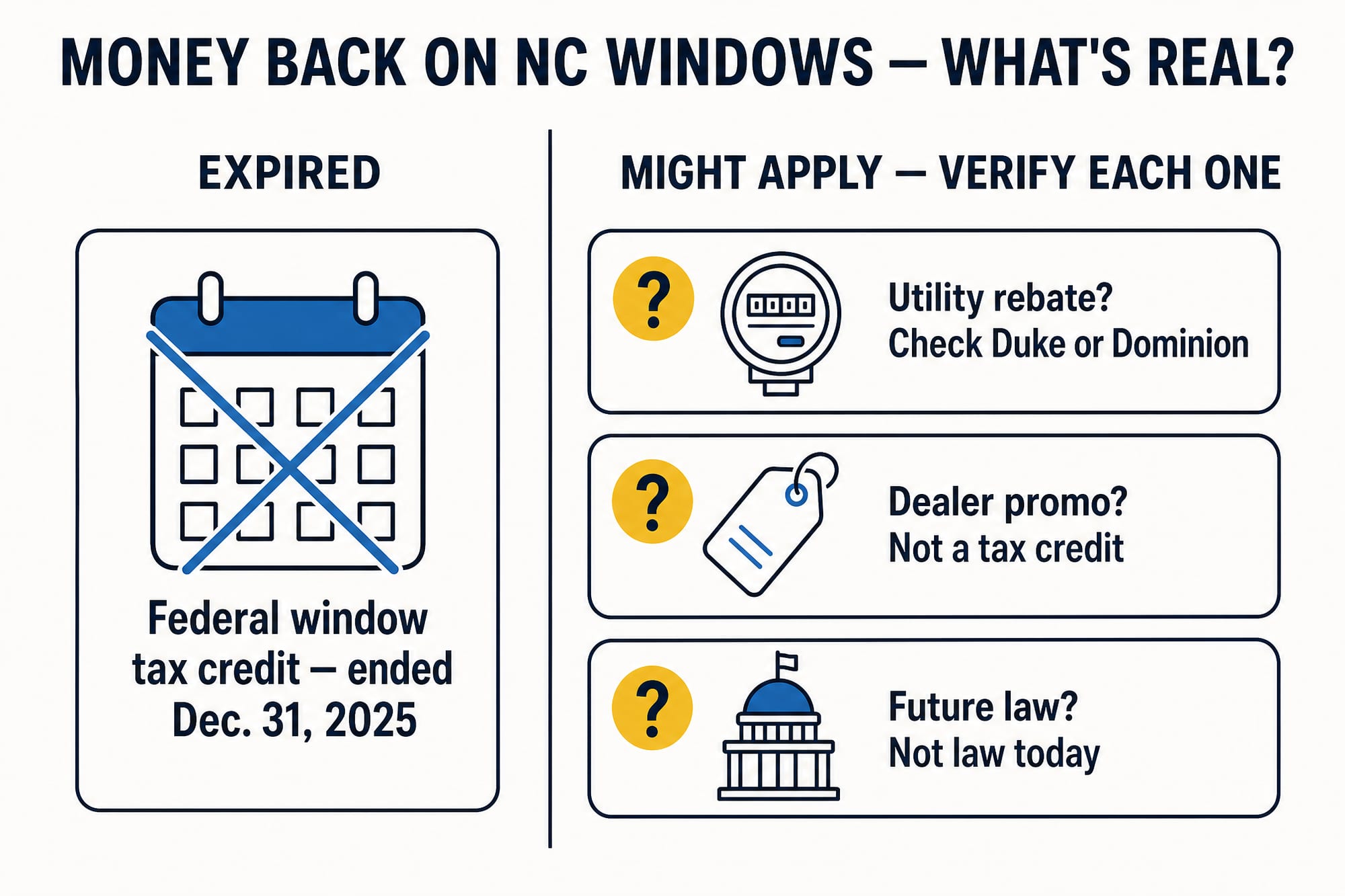
What might still put money back — all of it “check the current program”
With the federal credit gone for 2026, the honest list of what could still help is short, local, and unconfirmed until you check it. None of these is a sure thing, and I’d rather tell you that than sell you a rebate that isn’t there.
- Utility rebates. Most of North Carolina is served by Duke Energy or Dominion Energy. These programs are real and they change often — and as of August 2026, Duke’s Smart $aver program has a live window rebate worth up to $3,250, with eligibility rules strict enough to deserve their own page: the Duke window rebate, and who actually qualifies. The rule stands either way: pull up the current program and read the eligibility before you factor a rebate into any quote.
- Manufacturer or dealer promotions. Seasonal “buy-more-save-more” or financing promos are common. They’re a discount from a company, not a government credit — read them as marketing, confirm the terms, and don’t confuse them with a tax benefit.
- State-administered energy rebate programs. Federally funded home-energy rebate programs are being rolled out through the states, and eligibility (and whether windows even qualify) depends on how North Carolina runs its program and on your household. I can’t confirm a live NC window rebate as of July 2026 — so treat this as “worth a phone call,” not a line in your budget.
- Future federal legislation. If a new or restored credit passes, the ENERGY STAR requirement will almost certainly come back with it — which is one more reason to buy to a good NFRC spec regardless. But “might pass” is not “is law,” and this page treats it that way.
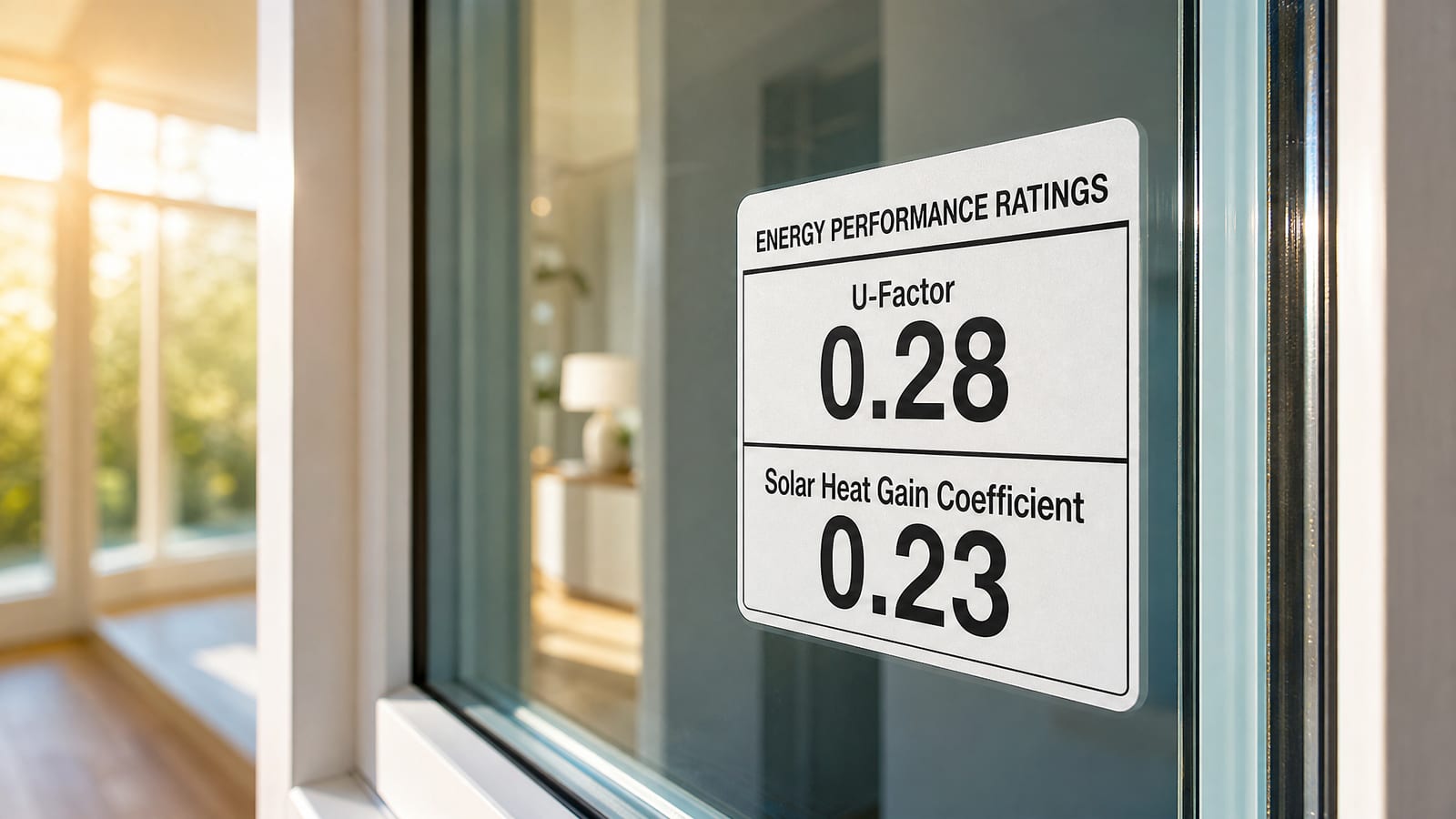
The one requirement that survives every version of this: whenever a credit or rebate does exist, it almost always requires an ENERGY STAR–qualified window, and the richer tiers require the stricter ENERGY STAR Most Efficient numbers. So buying to spec keeps whatever door might open, open — here’s the exact NC spec to ask for.
How to check any of this without getting burned
Three moves, and you never have to take a credit on faith.
- For anything federal, go to the source. Open IRS.gov and search “Energy Efficient Home Improvement Credit” for the current tax year. If it doesn’t list windows for the year you’re installing, it doesn’t exist for you — no matter what the banner says.
- For utility rebates, name the program. Go to your actual utility (Duke Energy or Dominion Energy for most NC homes) and find the current residential rebate list. If a salesperson cites a rebate, pull the program up together and read the eligibility. “There’s a rebate” is a claim; a program page with your window on it is a fact.
- For any credit or rebate, get it in writing and dated. A real program has terms you can print. If nobody can show you the current terms with a date on them, treat the money as not there and decide on the windows alone.
This is the same instinct you already have about quotes — get it itemized, in writing, and don’t sign to a number you can’t verify. Money-back promises deserve exactly the same treatment.
So how should the money-back question change your decision?
It shouldn’t drive it — and after 2025, it especially can’t. With no federal window credit on the table for 2026, the case for new windows comes back to what it always should have been: comfort, the rooms that stop roasting or freezing, and a window that meets the right NC spec.
A credit or rebate, if you can genuinely confirm one, is a bonus on top of a decision you’d make anyway. It is not the reason.
If you’re weighing whether the whole project pencils out, the honest math lives here — is replacing your windows actually worth it — and if it’s the up-front cost that’s the real obstacle, financing options tend to matter far more than any credit ever did. What the job actually costs in NC is its own page: replacement window costs.
The point of this page isn’t to talk you out of money that’s really there. It’s to make sure that when someone says “you’ll get it back on your taxes,” you know how to check — and that you don’t buy a window for a credit that expired on a December 31st.
Sources, Verification & Fact-Checking verified July 2026
Every load-bearing fact on this page is sourced and verified against a primary authority.
Verified July 2026 via direct review of the cited authority — the links open the controlling source so you can check it yourself rather than take our word.
- The federal 25C Energy Efficient Home Improvement Credit for windows expired December 31, 2025. The One Big Beautiful Bill Act (signed July 2025) terminated the credit for property placed in service after that date, so there is no federal window tax credit for 2026 installs unless Congress restores it. Tax law changes — re-confirm the current status each year at IRS.gov. (IRS — Energy Efficient Home Improvement Credit)
- Windows placed in service on or before December 31, 2025 may still be claimed on the 2025 return using Form 5695. The credit’s prior terms: windows had to meet ENERGY STAR Most Efficient; it was worth 30% of cost, capped at $600 per year for windows within a $1,200 per year aggregate limit for most improvements; nonrefundable; principal residence only. Confirm the exact figures for your filing year in the IRS Form 5695 instructions or with a tax professional. (IRS — About Form 5695)
- Any federal window credit requires ENERGY STAR qualification, with the richer tiers requiring ENERGY STAR Most Efficient window criteria. Confirm the current criteria before buying to a credit-eligible spec. (ENERGY STAR — key window criteria)
- Utility rebates for windows in NC vary by utility and change often. Duke Energy has offered a residential rebate for qualifying window replacements; Dominion Energy’s NC residential programs currently emphasize weatherization, HVAC, thermostats, and appliances rather than full window replacement. Check your specific utility’s current program, dated, before counting on any rebate. (Duke Energy — rebates & offers)
- State-administered federal home-energy rebate programs exist, but whether replacement windows qualify depends on how North Carolina runs its program and on the household. No live NC residential window rebate is confirmed here as of July 2026 — treat it as worth a phone call, not a budget line.
- No credit amounts, percentages, or rebate figures are asserted as current on this page by design. Every money-back figure is deferred to the current, dated program (IRS or your utility) rather than stated here, because these numbers change.