


Your dealer quote says “Andersen 400 Series.” A friend swears she got Andersens for way less. Now you’re wondering whether the 400 on your paper is a real step up from the 200 — or a nicer badge you’re paying a whole house of windows for.
Here’s the part the spec blogs bury: 200, 400, and A-Series aren’t a good-better-best quality cliff. They’re a ladder of options. Moving up buys you more wood species, more colors, more styles, and the top glass packages — not a fundamentally tougher window.
The Andersen 200 and 400 are both wood-interior windows with a low-maintenance vinyl exterior. The 400 is the flagship with the deepest catalog; the 200 is the value line with the popular sizes and fewer choices; the A-Series is the premium architectural tier above both.
This page decodes what actually changes up the ladder — and keeps every spec attributed to Andersen’s own site, so nothing reads as gospel it hasn’t earned.
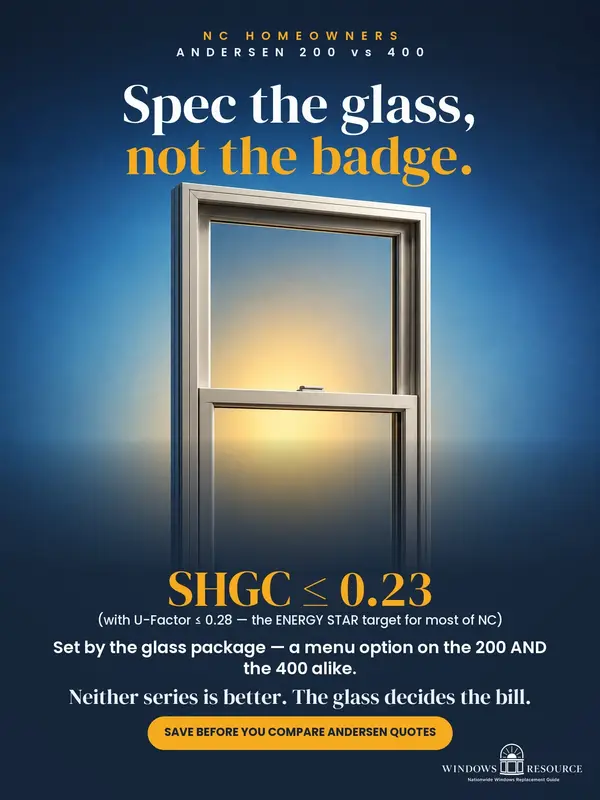
Andersen 200 vs 400 — which do I need? Neither is a better window — they answer different questions. The 400 buys options (more species, colors, styles, and its top glass); the 200 covers the popular configurations for less. For an NC home, the number that moves your power bill is the glass package — ≤ 0.23 — and that’s a menu option on both. So the honest move is to spec the glass first, then pick the lowest series that carries the look and options you actually want.
Andersen 200 vs 400 vs A-Series: the quick decoder
Same wood-interior idea all the way up; what changes is how many choices you get and what the exterior is made of. Here’s the whole ladder in one block, per Andersen’s own product pages:
| Factor | 200 Series | 400 Series | A-Series |
|---|---|---|---|
| Interior | Wood (pine) | Wood (more species) | Wood (widest species range) |
| Exterior cladding | Vinyl (Perma-Shield) | Vinyl (Perma-Shield) | Fibrex + fiberglass composite |
| Exterior colors | Few (e.g. white, sandtone) | More (whites, darks, canvas) | Widest catalog |
| Styles & sizes | Popular sizes, core styles | Deepest traditional catalog | Architectural / custom shapes |
| Glass packages | Low-E options (NC-capable) | Top High-Performance Low-E options | Full high-performance range |
| Where it sits | The value wood line | The flagship default | The premium ceiling |
| Who it's for | Popular sizes, fewer choices, lower price | Wants specific species/color/style | Custom or architectural work |
Interior
- 200 Series
- Wood (pine)
- 400 Series
- Wood (more species)
- A-Series
- Wood (widest species range)
Exterior cladding
- 200 Series
- Vinyl (Perma-Shield)
- 400 Series
- Vinyl (Perma-Shield)
- A-Series
- Fibrex + fiberglass composite
Exterior colors
- 200 Series
- Few (e.g. white, sandtone)
- 400 Series
- More (whites, darks, canvas)
- A-Series
- Widest catalog
Styles & sizes
- 200 Series
- Popular sizes, core styles
- 400 Series
- Deepest traditional catalog
- A-Series
- Architectural / custom shapes
Glass packages
- 200 Series
- Low-E options (NC-capable)
- 400 Series
- Top High-Performance Low-E options
- A-Series
- Full high-performance range
Where it sits
- 200 Series
- The value wood line
- 400 Series
- The flagship default
- A-Series
- The premium ceiling
Who it's for
- 200 Series
- Popular sizes, fewer choices, lower price
- 400 Series
- Wants specific species/color/style
- A-Series
- Custom or architectural work
The practical takeaway: up the ladder you buy more options and more wood, not a tougher window. The series line on a quote tells you which set of choices you’re paying for. It does not, by itself, tell you whether the window clears NC’s energy numbers — that’s the glass, and we’ll get there.
So what actually changes from 200 to 400?
Four things step up — interior wood choices, exterior colors, the style-and-size catalog, and the top glass package. The frame idea doesn’t. Both are wood inside with a Perma-Shield vinyl exterior; both are real Andersen windows. Here’s where the money goes when you move up:
- Interior wood species. The 200 is pine (unfinished for staining, or factory-painted white). The 400 keeps pine as standard but opens up oak and maple on select styles like the Woodwright — which matters if you’re staining to match trim rather than painting.
- Exterior colors. The 200 gives you a short list (White and Sandtone). The 400 carries seven — adding darks like Black and Dark Bronze, plus Canvas, Terratone, and Forest Green — useful on a house where white would look wrong.
- Styles, shapes, and sizes. The 400 carries the deepest traditional catalog — including its Woodwright double-hung and specialty shapes the 200 simply doesn’t offer.
- Glass packages. Both offer Andersen’s Low-E4 and SmartSun coatings; the 400 carries the fuller high-performance range (triple-pane, Sun, PassiveSun). Important caveat below: because SmartSun and are options on both, a good glass package on a 200 can still clear NC’s numbers.
Notice what doesn’t change: it’s the same wood-plus-vinyl construction family. You’re not crossing from a plastic window to a wood one when you go 200 → 400. You’re crossing from “the popular options” to “most of the options.”
Is the 400 worth ~20–30% more than the 200?
Worth it if you need what it adds — a specific species, a dark exterior, a style the 200 lacks, or the top glass. Not worth it if you just need a solid double-hung in white that the 200 already covers. The trap is deciding this one window at a time.
National cost aggregators put the 400 roughly 20–30% above the 200 per window — directional context, not a quote, and it drifts. On a single opening that feels like rounding error. Across a whole house it’s the actual decision.
The whole-house math is the part the one-window spec blogs skip. Say the step is a few hundred dollars a window. On two feature windows where you want a stained interior and a dark exterior, paying up for the 400 is easy to justify. On fourteen plain white double-hungs, that same step is four figures for options you won’t look at twice.
So the honest sequence is: decide which openings actually need what the 400 adds, and let the rest ride on the 200 if the size and style are covered. You’re allowed to mix — a dealer can quote some rooms one way and some another. Here’s how each Andersen series prices out installed in NC, where the whole-house number lives.
Is the 200 Series any good, or is it “builders-grade”?
It’s a genuine wood-interior window, not a throwaway — and the “builders-grade” label says more about the argument than the window. This is the beat where the forums split, so let me report both sides fairly and then give you the tell.
Some owners describe the 200 as builders-grade next to the 400 — fewer options, a single-hung that “feels lighter” in the hand. That’s reported sentiment, and it’s real to the people saying it.
Set against it: plenty of owners have had 200-era Andersens sitting in their walls for decades, still clear, still sealed, still operating.
Both can be true at once, because the difference between the lines is choices, not a quality cliff.
NC homeowner takeaway on the “builders-grade” label: it’s not wrong that the 200 has fewer options — that part’s real. What it gets wrong is treating fewer options as lower quality.
Spec a good Low-E package on a 200, in the size and style it offers, installed right, and you have a legitimate NC window. Don’t let the label decide for you what the glass and the install actually decide.
Where does the A-Series fit — and when is it worth the jump?
The A-Series is the premium, architectural ceiling — a bigger jump from the 400 than the 400 was from the 200, and it’s a different exterior material. This is the rung the dealer 200-vs-400 posts drop, and it’s the one people mislabel most.
Two things set the A-Series apart from the 400:
- The exterior is composite, not vinyl. Where the 200 and 400 wear a Perma-Shield vinyl exterior, the A-Series wears a Fibrex-and-fiberglass composite — Andersen’s stiffer material, which lets it hold darker colors and narrower frames. (The aluminum-exterior Andersen is the E-Series — a common mix-up worth getting right on a quote.)
- The catalog is architectural. The widest range of wood species, colors, shapes, and custom sizing — built for design-driven or historically-matched projects, and priced accordingly.
Roughly, the A-Series runs well above the 400 — a bigger step than 200-to-400, per national aggregators (directional, not a quote). It earns that money on a custom or architectural job where the 400’s catalog can’t produce the shape or match the look.
For a straightforward replacement in standard openings, the 400 usually does everything the A-Series would, for less. Where Fibrex composite comes from — and how it compares to vinyl — is covered in the full Andersen review.
Which Andersen series is right for an NC home?
For an NC power bill, chase the glass, not the series number — and the glass you want is a menu option on all three. This is the expert reframe the whole ladder debate misses.
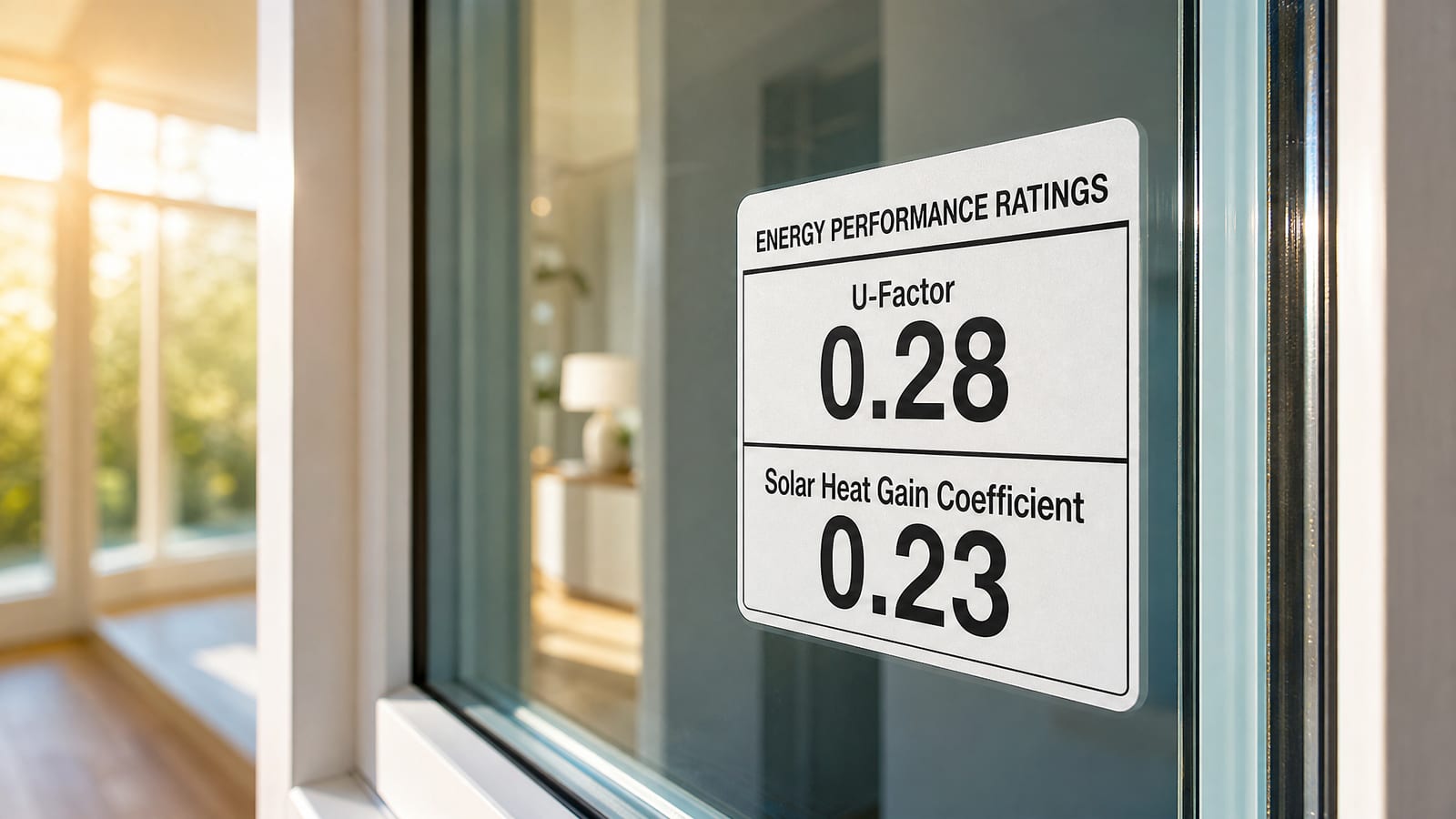
Most of North Carolina sits in ENERGY STAR’s South-Central climate zone, where the targets are roughly ≤ 0.28 and SHGC ≤ 0.23. In our climate the SHGC — how much summer heat the glass lets in — is the headline number, and it’s set by the glass package, not the frame series.
Here’s why that reframes the decision. A 400 with a base glass package can miss the NC target that a 200 with a good Low-E package hits.
The series number on the quote doesn’t tell you whether the window clears NC — the SHGC on the label does. So the buying order that actually protects your bill is: pick the glass package that clears NC first, then choose the lowest series that carries the look and options you want.
That’s not a knock on the 400 — it’s the flagship for good reasons. It’s just that “which series” and “will it cut my summer heat” are two different questions, and only one of them shows up on the NFRC label. Here’s how to read that label, series by series, so you’re comparing the number that matters instead of the badge.
One NC footnote: the federal 25C window tax credit expired at the end of 2025, so don’t let any quote lean on it as a current incentive.
How to decode which Andersen is actually on your quote
Before you compare two Andersen numbers, confirm you’re comparing the same kind of purchase — because “Andersen” can mean three different things on a quote. Run the series line through these three questions:
- Is a series named — 200, 400, A, or E? If the quote just says “Andersen,” ask which series. That one word changes the options, the exterior material, and the price band. A quote that won’t name the series isn’t a quote you can compare yet.
- Is the glass package spelled out, with an SHGC? The series without the glass package is half an answer. Get the Low-E package named and the SHGC number on paper — that’s what clears NC, and it’s comparable across any brand.
- Is this a dealer window, or an in-home full-service sale? If someone sat in your living room and quoted a turnkey “Andersen” project, you may be looking at Renewal by Andersen — a separate full-service division, a different purchase entirely. Here’s how the dealer series differ from the full-service arm.
Get those three on paper for each quote and the comparison stops being a mystery. You’re no longer guessing whether 200-vs-400 explains a price gap — you can see the series, the glass, and the channel, and the gap explains itself.
So — which Andersen is right for you?
My take, labeled as opinion: pick the glass that clears NC first, then the lowest series that carries the look and options you actually want. By scenario:
- Standard openings, white or a stock color, popular sizes → the 200 with a good Low-E package is the value pick, and it can hit the same NC numbers as a 400. (opinion)
- You want a stained wood species, a dark exterior, or a style/shape the 200 lacks → the 400 earns its step here — that’s exactly what the extra ~20–30% buys. Consider it opening-by-opening, not house-wide. (opinion)
- A custom, architectural, or historically-matched project → the A-Series is the tier built for it — and remember the exterior is composite, not vinyl, and the aluminum one is the E-Series.
- You want one company to handle the whole project → that may not be the dealer channel at all — it’s the full-service model, reviewed on the Renewal-by-Andersen comparison. And for the wider question of whether the right glass beats the right series number, see how the brands actually stack up.
Whichever rung you land on, the two moves that protect you are the same ones that protect you with any window: get the series and the glass package (with SHGC) named in writing, and vet the installer like they’re the product — because a great series with a rushed install performs like neither the label nor the price.
And if you’ve got an Andersen quote and want a straight read on which series it really is and whether the glass clears NC, that’s exactly what a no-pressure second opinion is for. Bring the paper. Same fair standard every brand gets here.
Sources, Verification & Fact-Checking verified July 2026
Every load-bearing fact on this page is sourced and verified against a primary authority.
Verified July 2026 via direct review of the cited authority — the links open the controlling source so you can check it yourself rather than take our word.
- 200 and 400 Series are both wood-interior windows with a Perma-Shield vinyl exterior; the 400 is the flagship with a deeper catalog (more species, colors, styles) and the fuller glass range; the 200 is the value line with pine interiors, two exterior colors, and the popular sizes/styles: confirmed on Andersen’s own 400 Series product page (only Andersen’s own site used; dealer restatements not relied on).
- The 400 Series exterior cladding is Perma-Shield vinyl, NOT Fibrex composite: confirmed on Andersen’s own 400 Series page (“Perma-Shield® cladding… a proprietary, high-grade vinyl”), and matches the sibling Andersen review. Andersen’s public compare-tool auto-summary mislabeled this as composite; the individual series page is the authority.
- The A-Series exterior is a Fibrex/fiberglass composite; the extruded-aluminum-exterior Andersen is the E-Series (not the A-Series): confirmed against Andersen’s A-Series and E-Series product descriptions (July 2026). The compare-tool summary mislabeled these.
- Glass packages: both 200 and 400 offer Andersen’s Low-E4 and SmartSun coatings; the 400 carries the fuller high-performance range (triple-pane, Sun, PassiveSun); both can be specced to hit NC’s SHGC target: confirmed against Andersen’s glass and series pages (July 2026). Because SmartSun and Low-E are options on both series, the SHGC number — not the series badge — is what clears NC.
- Warranty is the same limited structure for 200 and 400: 20-year glass, 10-year non-glass components, 5-year wood-exterior components, transferable to the next owner (Owner-to-Owner): confirmed against Andersen’s limited-warranty terms (July 2026), consistent across sources; the series-specific warranty PDF is the canonical source at each 6-month re-check.
- Price step (roughly 20–30% from 200 to 400 per window; A-Series well above the 400): directional aggregate from 2026 national cost guides, never presented as a quote. No precise per-window dollar figure printed, by design — real NC numbers live on the cost page and every quote should be compared line-to-line on a live bid.
- NC ENERGY STAR targets (most of NC = South-Central: U ≤ 0.28, SHGC ≤ 0.23; mountains = North-Central: U ≤ 0.25, SHGC ≤ 0.40; all-NC-safe spec = U ≤ 0.25 and SHGC ≤ 0.23), with SHGC as the NC headline number set by the glass package, not the series: verified county-by-county against the live ENERGY STAR finder (2026-07-06); re-confirm each ENERGY STAR criteria cycle. (view source — ENERGY STAR criteria; view source — NFRC label)
- Federal 25C window tax credit expired 12/31/2025: stated so no quote leans on it as a current incentive; confirmed against current IRS guidance (Form 5695; windows placed in service on/before 12/31/2025 only).
- Owner sentiment (some call the 200 “builders-grade”; others report decades of trouble-free 200-era Andersens): reported homeowner sentiment from window forums, attributed and reported not editorialized, never stated as company fact. No disparagement — the subject is the confusion between series/glass/install, never Andersen and never a salesperson.
- Renewal by Andersen is a separate full-service division, a different purchase from a dealer-channel series: reused from the verified sibling Andersen review and RbA-vs-Andersen comparison (both companies’ own sites, July 2026).