

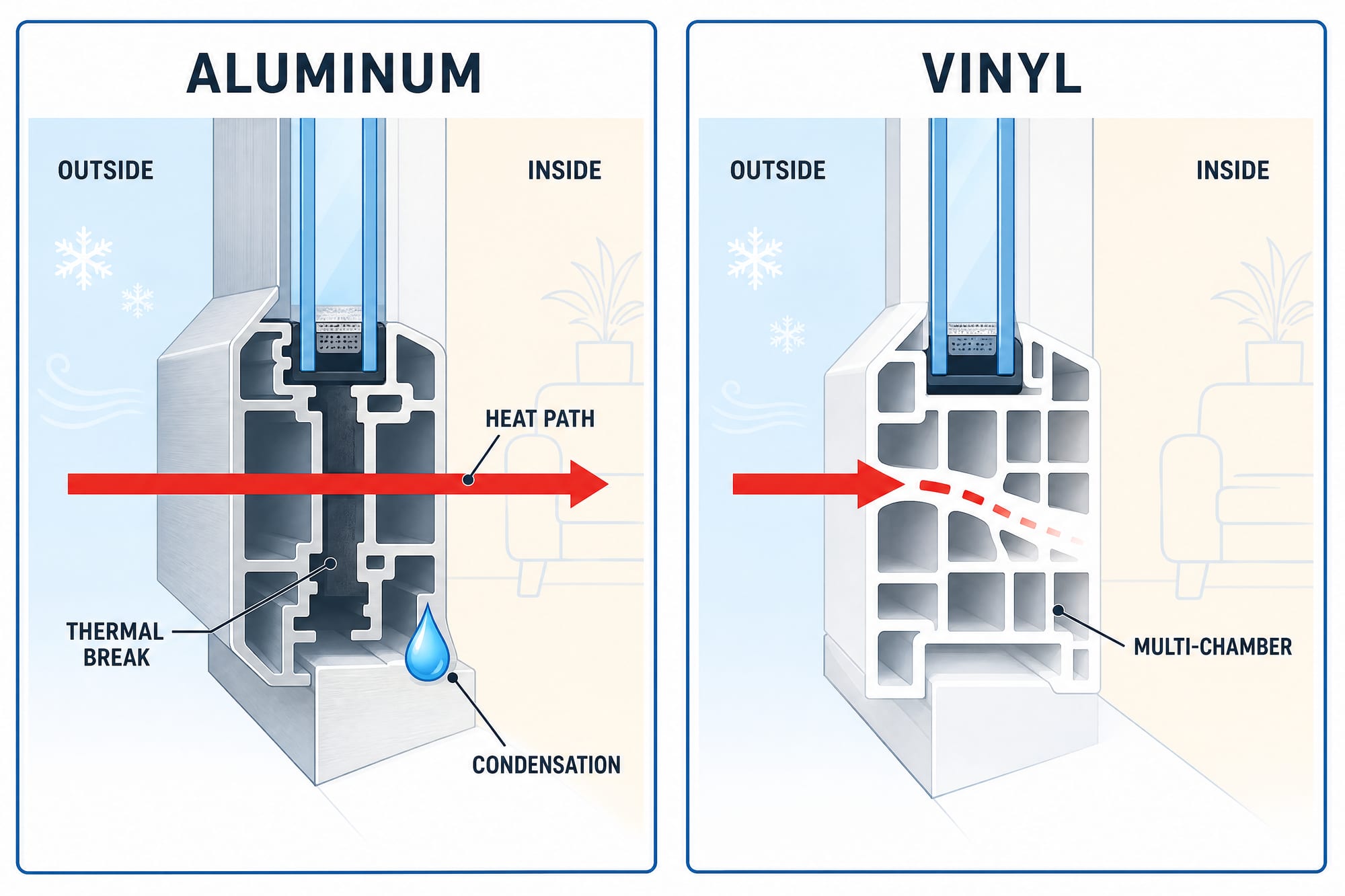
You’ve got two window quotes with opposite personalities. One is aluminum — thin, strong, modern-looking, the frame that disappears and leaves you mostly glass. The other is vinyl — cheaper, chunkier, and the one everyone keeps calling the smart pick.
You’re trying to work out whether the modern look costs you something you can’t see, and whether “smart pick” is just another way of saying you’re settling. Here’s how I’d decide between them if it were my own house.
The short version: this isn’t a good-versus-bad question. It’s a strength-versus-comfort question — and once you name it that way, your own house usually answers it for you.
Aluminum vs vinyl: the quick verdict
Pick the frame that fits what your wall actually needs, not the one that photographs best. Here’s the decision in one block:
- Pick vinyl if: comfort, energy, and value come first, and you want a frame that won’t sweat on a cold NC morning. That’s most homes.
- Pick aluminum if: you need to span a large opening cleanly, you want the slimmest possible modern sightlines, or you’re buying a coastal impact product that’s engineered in aluminum — and you’re buying its strength on purpose, not for insulation.
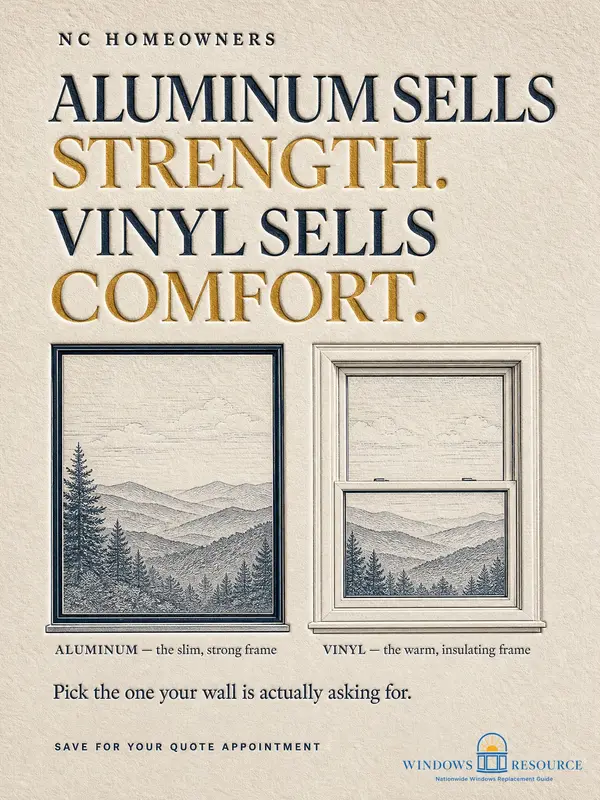
Both are legitimate frames. The difference is what each is for. Aluminum sells strength and slim lines; vinyl sells insulation and value — and in NC’s humidity, comfort is what most homes are shopping for.
| Factor | Aluminum | Vinyl (PVC) |
|---|---|---|
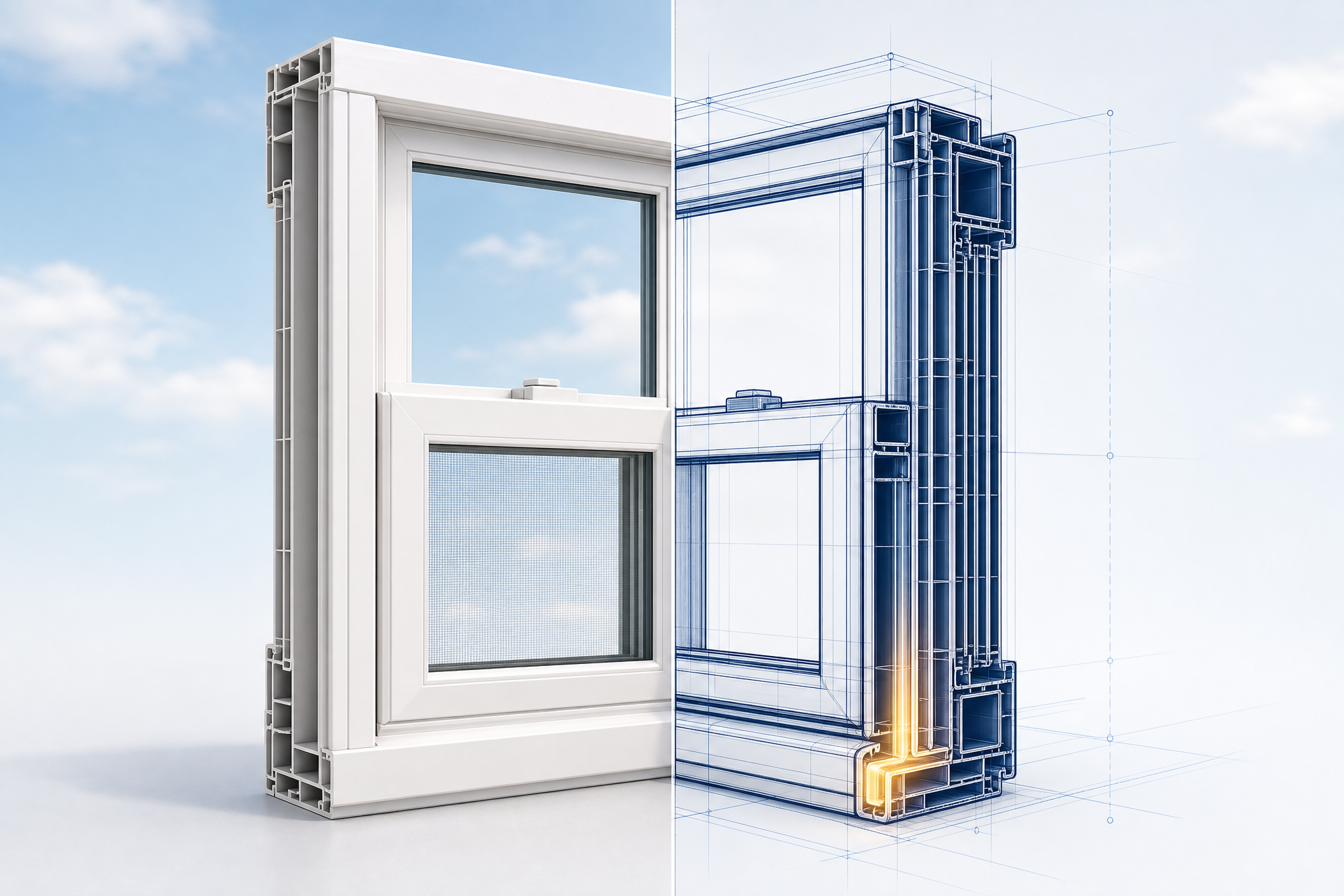
| Insulation | Worst of the group — a strong heat conductor; needs a thermal break just to be acceptable | Genuinely good — multi-chamber frame, often foam-fillable |
| Strength & sightlines | Strongest; slimmest profiles; spans large openings cleanly | Less rigid; standard sightlines; needs bulk to span wide |
| NC humidity | Bare frame condensates ('sweats') on cold, damp mornings | Warmer interior face — doesn't reach the dew point the same way |
| Thermal movement | Dimensionally stable when thermally broken | Most movement of the common frames; dark colors can warp in full sun |
| Coast / salt air | Can corrode without a good coating — but often the frame for impact products | Resists moisture, rot, and corrosion |
| Installed cost | Bare is cheap; a proper thermally broken unit is a premium | The value pick for most NC homes |
| Best for | Big spans, slim modern look, coastal impact | Comfort-first replacements — the NC default |
Insulation
- Aluminum
- Worst of the group — a strong heat conductor; needs a thermal break just to be acceptable
- Vinyl (PVC)
- Genuinely good — multi-chamber frame, often foam-fillable
Strength & sightlines
- Aluminum
- Strongest; slimmest profiles; spans large openings cleanly
- Vinyl (PVC)
- Less rigid; standard sightlines; needs bulk to span wide
NC humidity
- Aluminum
- Bare frame condensates ('sweats') on cold, damp mornings
- Vinyl (PVC)
- Warmer interior face — doesn't reach the dew point the same way
Thermal movement
- Aluminum
- Dimensionally stable when thermally broken
- Vinyl (PVC)
- Most movement of the common frames; dark colors can warp in full sun
Coast / salt air
- Aluminum
- Can corrode without a good coating — but often the frame for impact products
- Vinyl (PVC)
- Resists moisture, rot, and corrosion
Installed cost
- Aluminum
- Bare is cheap; a proper thermally broken unit is a premium
- Vinyl (PVC)
- The value pick for most NC homes
Best for
- Aluminum
- Big spans, slim modern look, coastal impact
- Vinyl (PVC)
- Comfort-first replacements — the NC default
Which insulates better?
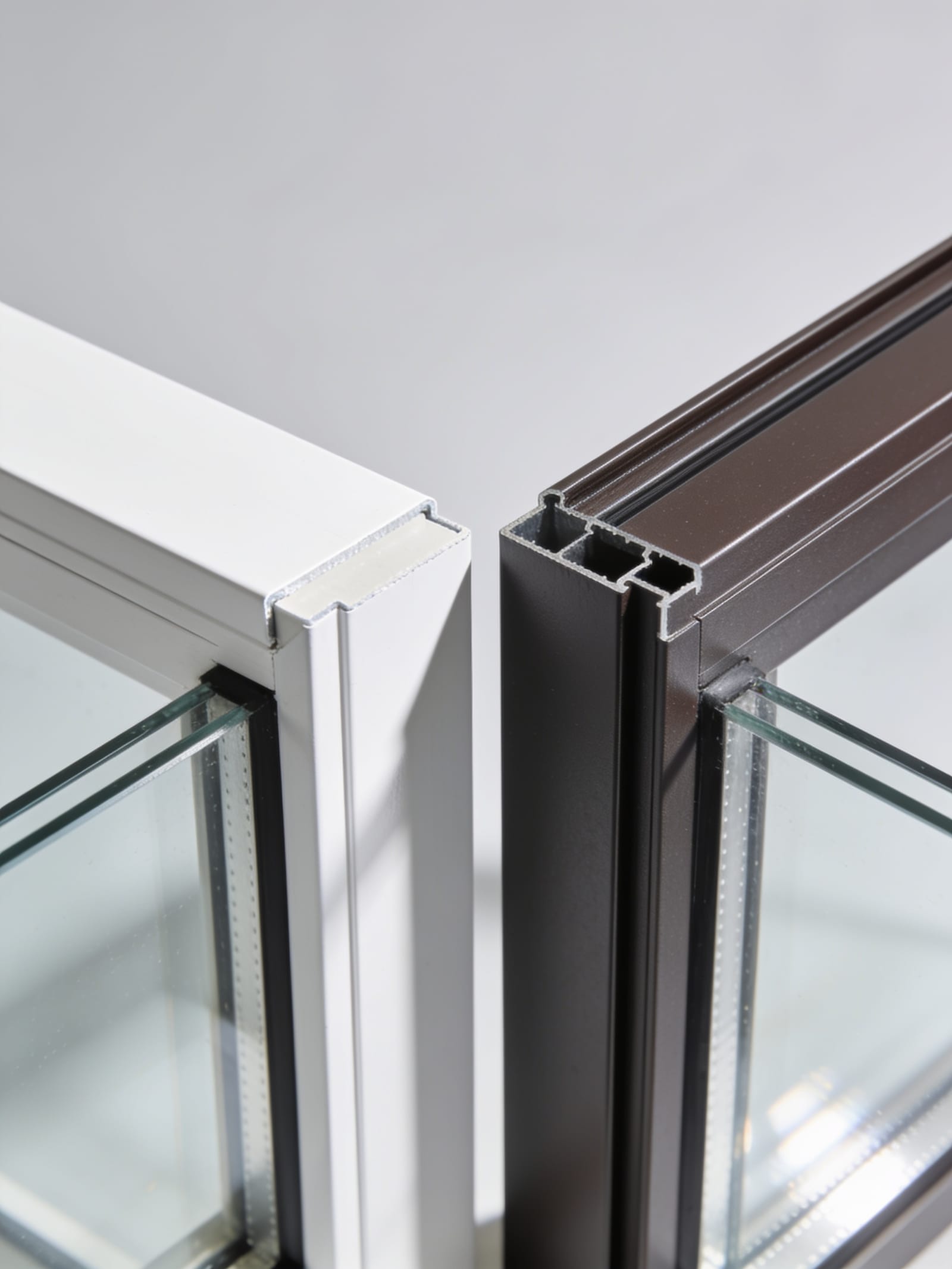
Vinyl — and this is the one spec where it isn’t a debate. Aluminum conducts heat on the order of a thousand times faster than vinyl, so a bare aluminum frame acts like a thermal bridge, pulling outdoor temperature straight through to the inside.
That’s the whole story of aluminum’s biggest weakness. Every frame material has a thermal conductivity — how fast it moves heat. Vinyl () is a good insulator. Aluminum is in a completely different league, conducting heat hundreds to a thousand times faster.
The fix on aluminum is a thermal break: an insulating polyamide or polyurethane strip set inside the frame to separate the outdoor metal from the indoor metal, so heat can’t run straight through. Any aluminum window worth considering for a home has one.
But here’s the honest limit — a thermal break narrows the gap; it never closes it.
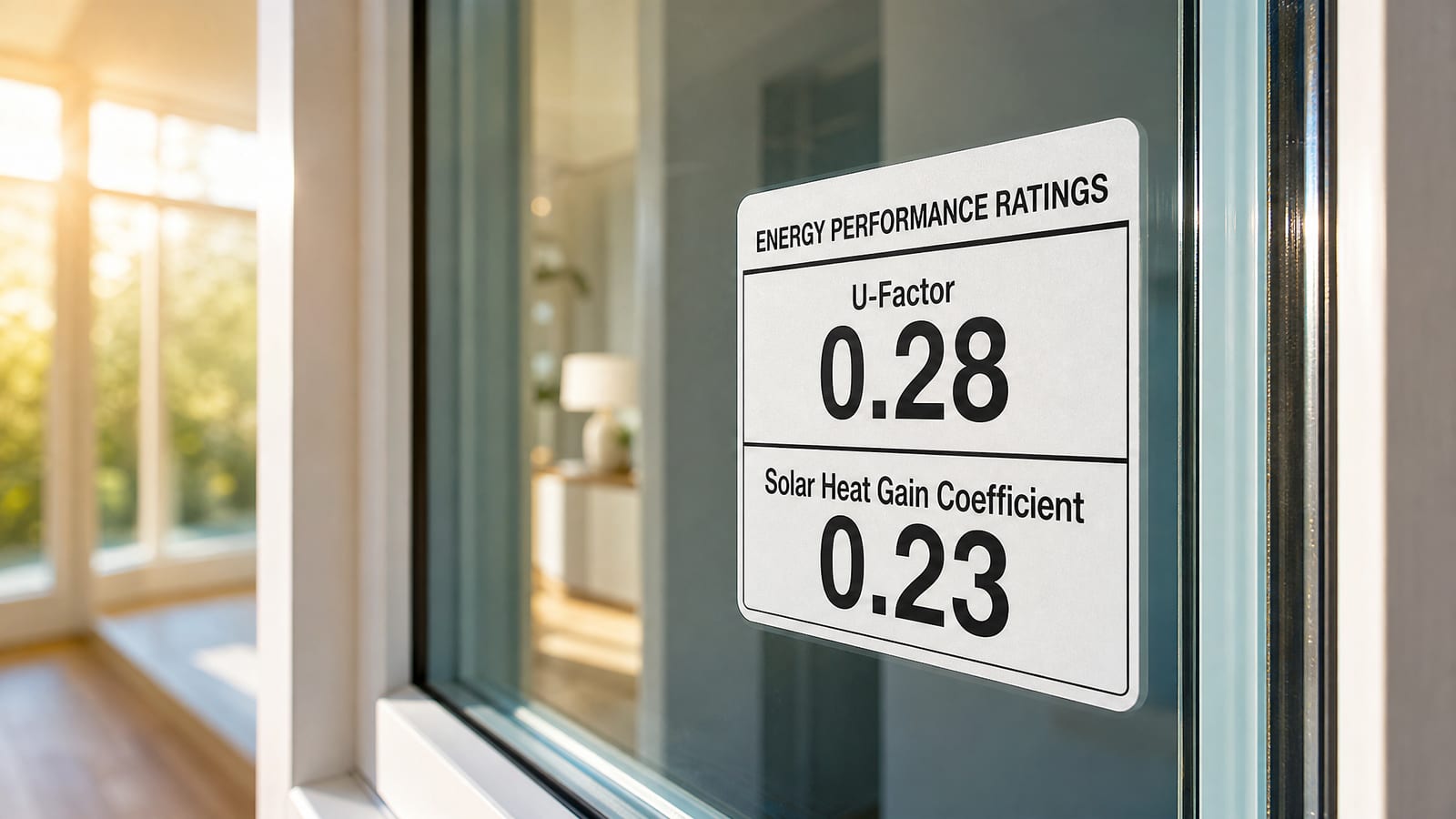
As a directional guide, a thermally broken aluminum unit tends to land near a of 0.30–0.45, where comparable vinyl runs roughly 0.25–0.35. The break makes aluminum livable indoors. It doesn’t make it a good insulator.
So if comfort and energy are what you’re buying, vinyl wins this round on the merits, in NC’s climate especially.
Where aluminum wins: strength and slim lines
Aluminum is the strongest frame there is, and it holds the slimmest sightlines — that’s what you’re actually paying for. This is the flip side of the insulation story, and it’s a real advantage.
- Big or structural spans. Aluminum is rigid enough to frame a wide picture wall or a tall opening with a thin profile, where vinyl would flex and need a bulkier frame to do the same job.
- The modern slim look. If you want minimal frame and maximum glass — narrow sightlines on a contemporary elevation — aluminum does it better than any other material.
- Coastal impact products. Some wind-borne-debris and impact-rated windows for North Carolina’s coastal counties are engineered in aluminum for its strength. If you’re on the coast buying to an impact spec, aluminum may simply be what the product is built from.
In every one of these you’re buying strength and looks, and you accept the insulation trade going in. That’s a clear-eyed choice, not a mistake — the same way choosing a casement for a tight egress wall is about matching the tool to the job.
The NC catch: humidity and the coast
In a hot, humid state, a bare aluminum frame’s real problem isn’t the energy bill — it’s the water on your sill. This is the failure most people don’t see coming, and it’s where vinyl quietly wins the everyday.
When the interior face of a bare aluminum frame drops below the indoor dew point, moisture condenses on it — the “window sweating” that leaves a puddle on the sill on cold, damp mornings. Over time that feeds mold and mildew and can damage the frame and the wall around it.
NC’s humidity makes the dew point easy to reach, so it shows up here more than in a dry climate. Vinyl’s warmer interior face sidesteps the problem by nature; a thermal break on aluminum eases it but doesn’t erase it.
There’s a second, coast-specific catch: salt air. Near the water, aluminum can corrode without a good protective coating, so finish quality matters more on the coast. (The irony is real — the same coast is where aluminum’s strength makes it the frame of choice for impact products. Buy the coating spec as carefully as the impact rating.)
And there’s a twist worth naming, because most pitches skip it: on thermal movement, aluminum is actually the steadier frame. Vinyl has the most thermal movement of the common frame materials — day after day of expansion and contraction is what can stress its seals over the years, and dark vinyl on a full-sun wall can warp.
Thermally broken aluminum barely moves. So the honest scorecard splits: aluminum wins dimensional stability, vinyl wins insulation and comfort.
For most NC homes, comfort is the one that decides it — but if you want the frame that stays tightest to the glass over decades, that’s the same question the vinyl-vs-fiberglass comparison turns on.
Which is right for your house?
Match the frame to the job, and the aluminum-versus-vinyl argument mostly settles itself. For a standard, comfort-focused replacement in Greensboro or Charlotte, vinyl’s mix of good insulation, no sweating, and lower cost is hard to beat — which is exactly why it took over the residential value tier.
For a big modern span, the slimmest sightlines, or a coastal impact product, aluminum can be precisely the right tool, as long as the frame is thermally broken and you’re buying it on purpose.
I’m keeping the dollars relative here on purpose — real NC numbers belong on the cost page, not a national average dropped into a sentence. What’s worth knowing is the shape of it: a bare aluminum frame is cheap, a proper thermally broken one is a premium, and quality vinyl sits in the value sweet spot for most homes.
NC homeowner takeaway: the online shorthand that “aluminum is always a bad idea” is too blunt, and so is “vinyl is cheap junk.” Neither holds. Aluminum is specialized — buy it for strength, slim lines, and big spans, and only after you know what it costs you in comfort.
Vinyl is the value insulator that fits most NC homes, with two honest limits (it moves the most, and dark colors can warp in full sun) that don’t undo the case for it. Match the frame to the job and both reputations sort themselves out.
And the pro truth that outranks the whole material debate: a premium frame installed badly loses to a mid-grade frame installed right. Whichever frame you choose, the install decides more than the badge does.
Want both shown against your actual openings and your walls — the slim look, the insulation trade, and whether the coast or the sun changes the answer? Get a no-pressure second opinion — book a consult on your quote, no pitch. And if you want the deeper detail on each frame, here’s aluminum’s strengths and thermal limits and why vinyl dominates NC replacement.
Sources, Verification & Fact-Checking verified July 2026
Every load-bearing fact on this page is sourced and verified against a primary authority.
Verified July 2026 via direct review of the cited authority — the links open the controlling source so you can check it yourself rather than take our word.
- Aluminum is the worst insulator of the common frame materials, conducting heat on the order of a thousand times faster than vinyl. Published thermal-conductivity ranges put aluminum at roughly 130–237 W/mK versus roughly 0.15–0.25 W/mK for vinyl (PVC), an order-of-magnitude difference of about a thousandfold. The “~1,000×” figure is a directional order-of-magnitude derived from those ranges, not a single certified spec. (view source — U.S. Dept. of Energy, Building Science Education)
- A bare aluminum frame acts as a thermal bridge; a thermal break (an insulating polyamide/polyurethane barrier inside the frame) is required to make it acceptable, and even then it trails vinyl. The U.S. Department of Energy describes metal (aluminum) frames as conducting heat rapidly and notes a thermal break is needed to reduce heat flow; thermally broken aluminum still does not match vinyl’s thermal performance. As a directional guide, a thermally broken aluminum unit typically falls near a of 0.30–0.45 versus roughly 0.25–0.35 for comparable vinyl — typical whole-unit ranges, not a single certified spec; read any specific product’s rating off its label. (view source — U.S. Dept. of Energy, Building Science Education)
- In a humid climate, the cold interior face of a bare aluminum frame drops below the indoor dew point and condensation (“window sweating”) forms, which can feed mold and damage the frame and wall; vinyl’s warmer interior face avoids this. This follows from the thermal-bridge behavior above and standard building-science on condensation; NC’s humidity makes the dew point easier to reach. Held as directional building-science consensus. (view source — U.S. Dept. of Energy, Building Science Education)
- Aluminum is the strongest common frame material and holds the slimmest sightlines and largest spans, but can corrode in coastal/salt air without a good protective coating; vinyl is less rigid but resists moisture, rot, and corrosion and has the most thermal movement of the common frames. Aluminum’s strength/sightline advantage and vinyl’s high thermal movement are industry consensus rather than a single certified figure — held as directional; verify a specific product’s coastal rating against the manufacturer’s spec sheet. (view source — U.S. Dept. of Energy, Building Science Education)
- Some North Carolina coastal windows are engineered in aluminum to meet wind-borne-debris / impact requirements. The NC Residential Code’s high-wind provisions define a wind-borne-debris region along the coast (design wind speeds of roughly 130 mph and up) that requires impact-resistant glazing or approved shutters; impact products for these zones are frequently built in aluminum for its strength. Verify a specific address and product against the current NC code and the manufacturer’s listing. (view source — 2018 NC Residential Code, high-wind provisions)
- Frame material matters less than a correct install (plumb, level, square, flashed, insulated). The U.S. Department of Energy states windows are only as good as their installation — improper installation lets in water and air, invites condensation damage, and can void the warranty. (view source — U.S. Dept. of Energy, Correct Window Installation Methods)