

Your front door needs replacing, you’re pricing it out, and the two materials keep splitting apart on the quote: steel is the lower number, fiberglass costs more, and the salesman has a favorite. And you’re trying to work out whether fiberglass is worth the jump or whether steel is just fine.
Here’s the honest version from someone who sells and measures these: the slab material matters, but less than the pitch makes it sound — and the right answer depends on your wall, not the brochure.
Fiberglass or steel — the quick call? For most NC replacements, fiberglass is the balanced pick: it doesn’t dent, rust, swell, or rot, and it takes our heat and humidity with near-zero upkeep. Steel is the stronger slab against a raw kick and the lower entry price — honest value on a covered entry with a tight budget. But whichever you choose, the lock, the weatherseal, and a plumb-level-square install decide whether the door lasts. National ranges — verify locally.
Cost figures here are broad national bands, not an NC quote. Last reviewed July 2026.
Fiberglass vs steel: the quick verdict
Two good materials, two different trade-offs — and no single “best” for every doorway. Match the material to your wall, your budget, and how much upkeep you’re willing to do (with these two, that’s close to none either way).
Fiberglass is the durability-to-maintenance winner in our climate. Steel is strong and cheap to start. Here’s the head-to-head:
| Factor | Fiberglass | Steel |
|---|---|---|
| Dents | Resists dents; flexes and recovers | Dents don't pop back — a ding is permanent |
| Rust | Doesn't rust — no metal to corrode | Can rust once the paint or coating is breached |
| Security (raw slab) | Solid, well ahead of wood; can flex under torque with a plain deadbolt | Strongest slab against a raw kick |
| Insulation (R-value)* | ~R-5 to R-8 (premium ~R-10) | ~R-5 to R-6 (foam core) |
| Lifespan | 15–30 yrs typical; 50+ best-case | ~30 yrs (40–50 with upkeep) |
| Typically, installed | ~$2,200–$8,000+ | ~$1,200–$3,800 |
| Best for | Exposed walls, NC humidity, low-worry, resale | Covered entries, tight budgets, raw slab strength |
Dents
- Fiberglass
- Resists dents; flexes and recovers
- Steel
- Dents don't pop back — a ding is permanent
Rust
- Fiberglass
- Doesn't rust — no metal to corrode
- Steel
- Can rust once the paint or coating is breached
Security (raw slab)
- Fiberglass
- Solid, well ahead of wood; can flex under torque with a plain deadbolt
- Steel
- Strongest slab against a raw kick
Insulation (R-value)*
- Fiberglass
- ~R-5 to R-8 (premium ~R-10)
- Steel
- ~R-5 to R-6 (foam core)
Lifespan
- Fiberglass
- 15–30 yrs typical; 50+ best-case
- Steel
- ~30 yrs (40–50 with upkeep)
Typically, installed
- Fiberglass
- ~$2,200–$8,000+
- Steel
- ~$1,200–$3,800
Best for
- Fiberglass
- Exposed walls, NC humidity, low-worry, resale
- Steel
- Covered entries, tight budgets, raw slab strength
Read the quote down to a single installed number — old door pulled and hauled off included — before you compare materials across bids.
The dent-and-rust question — steel’s real weak spot
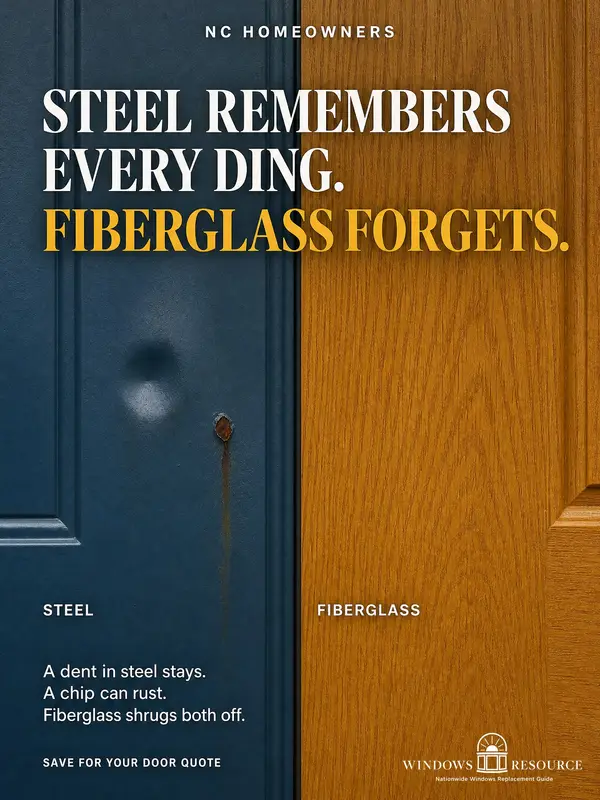
Steel’s Achilles heel is simple: a dent doesn’t pop back, and breached coating can rust — and fiberglass shrugs off both. This is the difference you’ll actually see on the door years from now, so it’s worth being honest about.
Steel is a skin over a foam core. It’s strong against a straight push, but a concentrated hit — a bike pedal, a mover’s dolly, a hailstone, a kid with a hockey stick — leaves a dent that stays.
There’s no popping it back out like a car panel. And once the paint or coating is scratched or dinged through, the exposed steel underneath can rust, especially on a wall that takes weather.
Fiberglass doesn’t dent the same way and has no metal to corrode. It flexes and recovers, and you wash it with mild soap and water. On an exposed entry, a garage-side door that takes traffic, or a coastal wall, that resilience is the whole case for paying up.
Which handles NC heat and humidity better?
Fiberglass, clearly — because it doesn’t absorb moisture, so it can’t swell, warp, or rot the way our climate pushes a door to. This is where the material choice actually earns its keep in North Carolina.
Steel doesn’t swell with humidity either — that’s a wood problem, not a steel one — so both fiberglass and steel beat a solid wood slab in an NC summer. But steel brings the dent-and-rust exposure back into the picture on a weathered wall, while fiberglass has neither failure mode.
Many fiberglass models also meet or exceed ENERGY STAR, with skins that mimic wood grain and stain convincingly, or come smooth for paint.
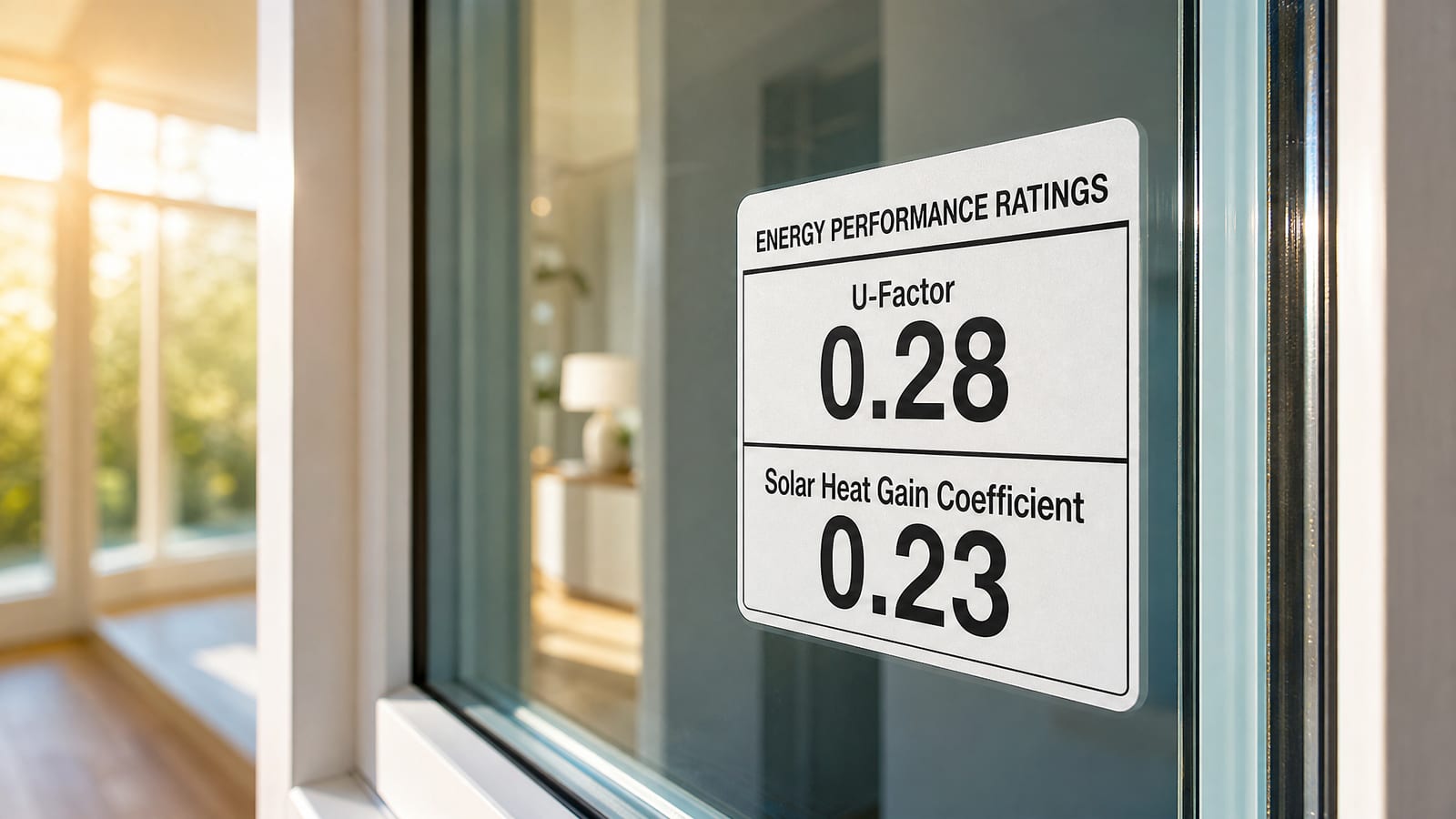
Both materials carry the same label your windows do, and for a mostly-solid door the number that matters is the .
Most of an entry door is opaque, so barely applies unless the door has a lot of glass.
For NC — most of the state sits in ENERGY STAR’s South-Central zone — an opaque door needs a U-factor at or below the figure below to qualify, and both fiberglass and steel can hit it.
One more heat note, whichever material you pick: a dark door on a south- or west-facing NC wall runs hot in direct sun all afternoon. Fiberglass takes that heat best, but a very dark color soaks up more of it on any material.
If you love a dark color on a sun-facing wall, an overhang, a storm door’s shade, or a lighter finish keeps the surface cooler. A covered north-facing entry is far more forgiving — steel or fiberglass both do fine out of the weather.
Which is actually more secure?
Steel is the stronger slab, but the lock, the jamb, and the strike decide security — not the skin. That’s the part the pitch usually skips while it sells you a heavy slab.
Steel is generally the strongest material against a raw kick, and fiberglass is solid and well ahead of wood. But most kicked-in doors don’t fail at the slab. They fail at the strike, where a short screw pulls out of thin jamb wood, or at an out-of-square jamb where the latch never fully seats.
What actually hardens a door, in either material:
- A multi-point lock that pulls the door tight at several points along the edge, not just at one deadbolt.
- A reinforced strike plate with 3-inch screws driven into the framing behind the jamb — not the half-inch screws that ship in the box.
- A sound, square jamb so the latch seats fully every time.
If a quote sells you a steel slab for “security” but says nothing about the strike or the screws, that’s the question to put back to them. A steel door on a short-screwed strike is still easy to kick.
Which costs less — and is cheaper worth it?
Steel is the lower entry price, and on the right wall that’s honest value, not a compromise. The materials overlap in the middle, but the floor is lower for steel.
Broadly, a basic steel prehung runs the least; upgraded steel and fiberglass land in the middle; and a premium fiberglass door with decorative glass, sidelights, and a transom sits at the top. Those are national bands, not an NC quote — labor and any hidden sill rot move the real number, so verify locally.
Here’s the honest read on when cheaper is the right call:
- Covered entry, tight budget, low traffic → basic steel is genuinely fine. It’s weather-tight, strong, and the lowest number. Don’t let anyone shame you off it.
- Exposed wall, driveway or garage side, coastal, or you just want to install it and forget it → fiberglass earns the premium. The dent-and-rust resistance and near-zero upkeep are what you’re paying for, and over a 20-to-30-year life they usually pay you back.
NC homeowner takeaway: the “fiberglass is best” pitch is mostly right for our climate — it’s the durability-to-maintenance champ here. But “best” isn’t “best at everything.” If your entry’s covered and your budget’s tight, steel is honest value. If it’s exposed and you want it low-worry, fiberglass is worth the jump.
So which should you buy?
The pro truth that outranks the material debate: a great door installed badly loses to a mid door installed right. The slab gets the marketing; the lock, the weatherseal, and a square set decide whether it drafts, sticks, or rots.
So make the call on your wall:
- Covered entry, budget-minded, want raw slab strength → steel. Strongest slab, lowest entry price, and out of the weather it may never show its weak spots.
- Exposed wall, NC humidity and sun, want near-zero upkeep and strong resale → fiberglass. It doesn’t dent, rust, swell, or rot, and it takes our climate without asking for anything.
Either way, get the lock package and the install named on the quote — a multi-point lock, a reinforced strike with 3-inch screws, and the whole unit set plumb, level, and square. For the fuller picture, including wood as a third option and the sill-pan detail that quietly rots an entry, here’s the complete NC entry-door buying guide.
Got a quote and you’re not sure the material matches your wall? That’s exactly what a no-pressure second opinion is for — have me look at it. I’ll check the exposure, name the lock package you actually need, and let you decide.
Sources, Verification & Fact-Checking verified July 2026
Every load-bearing fact on this page is sourced and verified against a primary authority.
Verified July 2026 via direct review of the cited authority — the links open the controlling source so you can check it yourself rather than take our word.
- Steel vs fiberglass entry-door trade-offs: dents, rust, insulation, durability, maintenance, weak spots. Steel foam-core ~R-5 to R-6, the strongest slab against forced entry but dents don’t pop back and exposed metal can rust once the coating is breached — best in a covered entry. Fiberglass ~R-5 to R-8 (premium ~R-10), resists dents, rot, swell, and warp and doesn’t absorb moisture — the durability-to-maintenance winner in a humid climate; it can flex under torque with a plain deadbolt. R-values are typical ranges that vary by product and thickness — treat as typical, not a spec sheet, and read the NFRC label on the specific door for its certified numbers. (view source — ENERGY STAR, Residential Windows, Doors & Skylights)
- Entry-door security depends more on the lock, jamb, and strike than the slab material. A multi-point lock, a reinforced strike plate, and 3-inch screws driven into the framing do more against forced entry than the door skin; steel is the strongest slab, but a short-screwed strike still fails. This is a construction fact, not a rated spec.
- Doors carry the same NFRC label as windows; U-factor is the number that matters most because most of an entry door is opaque, so SHGC is “No Rating” for a fully opaque door. (view source — NFRC)
- ENERGY STAR v7.0 door criteria (effective Oct 23, 2023): an opaque door needs U-factor at or below 0.17 in all zones; a mostly-glass (over half-lite) door in NC’s South-Central zone needs U-factor at or below 0.28 and SHGC at or below 0.23. North Carolina spans IECC zones 3A/4A/5A and falls in the South-Central zone for ENERGY STAR purposes; both fiberglass and steel can meet the opaque criterion. (view source — energystar.gov)
- Installed cost direction (steel the lower entry price, fiberglass higher): basic steel prehung ~$1,200–$2,200; upgraded steel/fiberglass ~$2,200–$3,800; premium fiberglass with glass, sidelights, and a transom ~$3,800–$8,000+. Broad national estimates aggregated from 2025–2026 contractor cost guides, not NC quotes — NC labor and coastal/impact upgrades will move them; verify locally before treating any figure as your price.
- A dark door on a south- or west-facing NC wall runs hot in direct sun; wood swells with humidity while steel and fiberglass do not, and fiberglass takes heat and moisture best of the mainstream materials. Exposure and color drive surface heat; an overhang, a storm door’s shade, or a lighter finish reduces it. The steel-door dent story is a recurring forum pattern, told as illustration, not attributed to any one named thread.