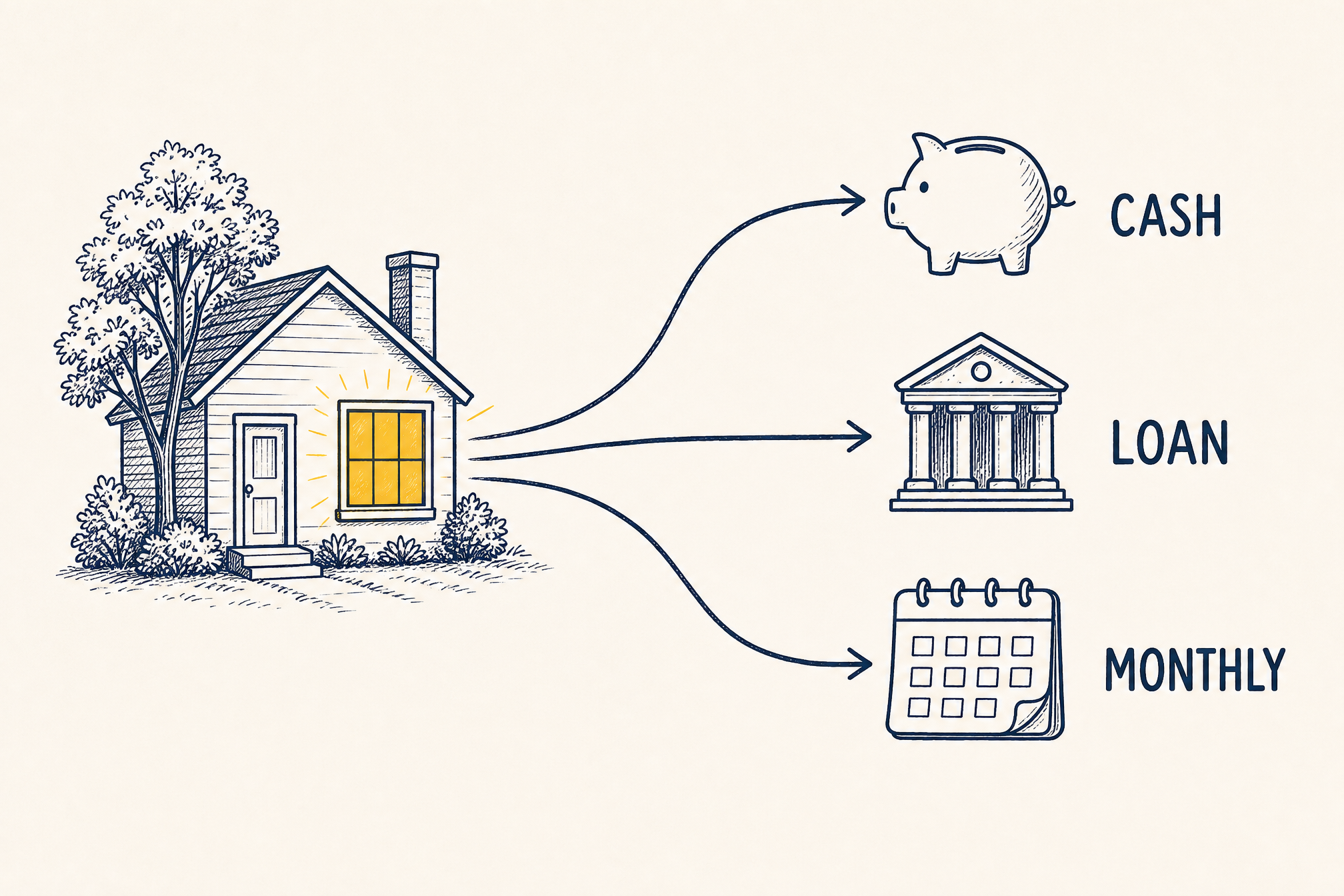



The salesperson ran the application at your kitchen table, the tablet thought about it, and the answer came back no. Then somebody said “you’d want to be around a 700 for this,” and you were left holding a quote you still need and a number you don’t have.
Here is the part most people never get told: the decline is not the end of the process. It is the start of a document you are legally owed — and that document is the only reliable to-do list in this whole situation.
First: the letter is the assignment

When a lender turns down a credit application, it cannot simply say no and move on.
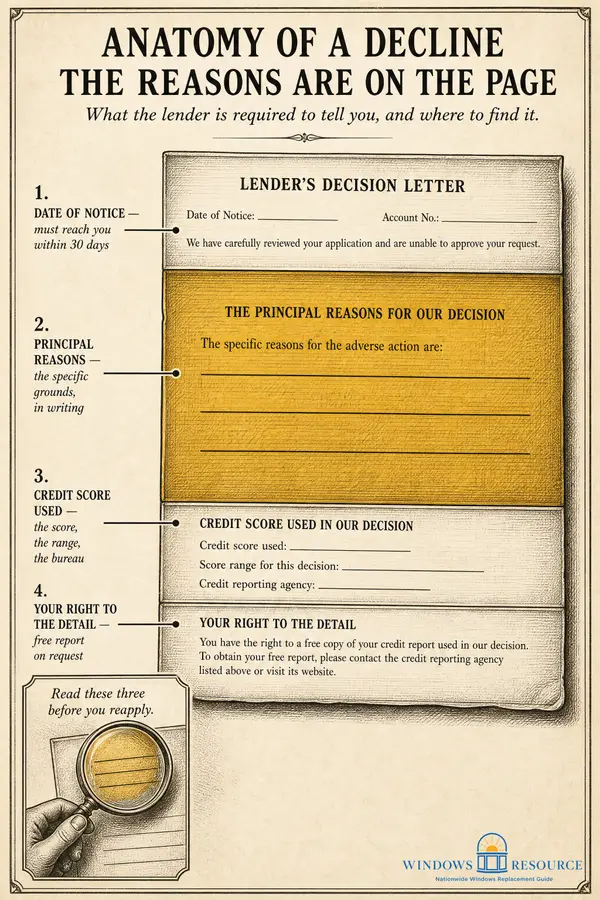
Under the Equal Credit Opportunity Act, the creditor has to notify you in writing, within 30 days. That notice must carry either a statement of the specific reasons it took adverse action, or instructions for getting them.
That is not a courtesy. It is 12 CFR 1002.9, and it exists precisely so a declined applicant knows what to fix.
Read those reasons before you do anything else, because they routinely say something other than “your score is too low.”
I have seen them point at the length of credit history. At how much of the available credit is already used. At income relative to the payment. At a loan amount that was simply too big for the program the application went into.
Notice of Action Taken
from the LENDER — the finance company, not the window company
Date of notice
Must reach you within 30 days of your application.
Principal reason(s) for the decision
This is the assignment. Note that none of these three says “your score is too low” — and the third one is not about you at all.
Credit score used, and the bureau it came from
If a score drove the decision, the notice tells you the score, the range, and who supplied it.
Why everyone keeps saying 700
Because it is a convenient shorthand, not because it is a rule.
There is no federal or industry line at 700. Base FICO scores run 300 to 850, and every lender picks its own cutoffs, its own pricing tiers, and its own overlays on top of whatever a program technically allows.
The same 600 that gets declined by one lender gets approved by another — at a higher rate, or for a smaller amount, or with a co-signer.
What is true is that the cost of borrowing moves with the score, and it moves in steps rather than smoothly. That is why the person across the table talks in round numbers.
So the useful question is not “how do I get to 700.” It is “what did this lender object to, and is it something I can move, or something I should route around?”
The five things a FICO score is actually made of
Every point comes from one of five buckets, and they are not weighted equally. This is the map for deciding what to attack first.
| What it measures | Share of a FICO score | How fast it moves | What that means for you this month |
|---|---|---|---|
| Payment history — did you pay past accounts on time | 35% | Slow | Nothing you do today rewrites the past. What you can do is guarantee no NEW late marks: autopay the minimums on everything, today. |
| Amounts owed — how much of your available credit you are using | 30% | Fast — often one to two cycles | This is the lever. Paying a card down changes what gets reported on the next statement date, and it is the biggest number you control this month. |
| Length of credit history | 15% | Slow, and it only grows | Do not close your oldest card to tidy up. Age is an asset; closing it throws the asset away. |
| New credit — recent applications and new accounts | 10% | Recovers on its own | Stop applying while you sort this out. Several applications in a short window reads as risk. |
| Credit mix — cards, installment loans, retail accounts | 10% | Slow | Not worth opening anything just to diversify. This is the smallest bucket and the least worth chasing. |
Payment history — did you pay past accounts on time
- Share of a FICO score
- 35%
- How fast it moves
- Slow
- What that means for you this month
- Nothing you do today rewrites the past. What you can do is guarantee no NEW late marks: autopay the minimums on everything, today.
Amounts owed — how much of your available credit you are using
- Share of a FICO score
- 30%
- How fast it moves
- Fast — often one to two cycles
- What that means for you this month
- This is the lever. Paying a card down changes what gets reported on the next statement date, and it is the biggest number you control this month.
Length of credit history
- Share of a FICO score
- 15%
- How fast it moves
- Slow, and it only grows
- What that means for you this month
- Do not close your oldest card to tidy up. Age is an asset; closing it throws the asset away.
New credit — recent applications and new accounts
- Share of a FICO score
- 10%
- How fast it moves
- Recovers on its own
- What that means for you this month
- Stop applying while you sort this out. Several applications in a short window reads as risk.
Credit mix — cards, installment loans, retail accounts
- Share of a FICO score
- 10%
- How fast it moves
- Slow
- What that means for you this month
- Not worth opening anything just to diversify. This is the smallest bucket and the least worth chasing.
Notice what that table is telling you. Utilization is 30% of the score and it is the one you can change before the next statement closes. Almost everything else is time.
Why the payment you made didn’t move the score yet
1 · You pay it down
Balance drops the moment the payment posts. Nothing has been reported to anyone.
2 · Statement date
This is the snapshot. Whatever the balance is today is the number your card sends the bureaus.
3 · It reports
Usually a few days later. Now the bureaus hold the new, lower number.
4 · The score recalculates
Next time it is pulled. This is the month people give up in — nothing was broken, it just hadn’t reported yet.
Practical version: pay it down before the statement date, not after — same money, a cycle earlier.
What to actually do, in order
Start here
The first thirty days after a decline
In this order. The first three cost nothing, and two of them are yours by law.
Get the adverse action notice in writing
From the LENDER, not the contractor. It must carry the specific reasons, or tell you how to request them.
Ask"Who was the lender, and can you send me the adverse action notice?"
Pull all three credit reports
Free every week from the federally authorized site. Checking your own reports does not affect your scores.
Dispute anything that is wrong
Errors are common and fixable. Dispute with the credit reporting company AND the business that supplied the information.
Attack utilization, not "the score"
Pay down the cards sitting closest to their limits first. The change reports on the next statement date, not the day you pay.
Freeze new applications
Every fresh application while you are repairing is a step backwards in the newest-credit bucket.
Re-price the job, not just the loan
A smaller approved amount and a phased job beats a perfect plan you cannot fund. Worst windows first.
Free download
The Declined Recovery Plan worksheet
Two printable pages: what the lender actually said, what your three credit reports say, which windows to phase first, and the routes that do not need a 700. Fill it in once and it becomes the file you take back to a lender.
Download The Worksheet (PDF, 2 Pages)The paths that fund the job while you climb
This is the part that gets skipped. You do not have to choose between “700” and “nothing.” These are the routes that exist at a middling score, with the honest catch on each.
| Path | What it is | Why it can work at a lower score | The honest catch |
|---|---|---|---|
| FHA Title I property improvement loan | A home-improvement loan from a private lender, insured by the federal government | The federal insurance is what lets a lender say yes where its own money alone would say no | Capped by regulation at $25,000 for a single-family home ($17,500 for a qualifying manufactured home). The lender still underwrites you, and not every lender offers it — you have to ask for it by name. |
| Phase the work | Do the failing windows now, the rest later | A $4,000 approval is a far easier ask than a $16,000 one, at any score | You will pay more per window on a small job, and you will have two install days instead of one. Get the phased plan priced in writing so phase two is not a surprise. |
| A creditworthy co-signer | Someone else's credit stands behind the loan | The lender is underwriting them as much as you | It is their debt if you miss. Do not ask unless you are certain, and say so out loud when you ask. |
| Secured borrowing | A loan or card backed by your own savings or a deposit | The collateral, not the score, is doing the convincing | It ties up cash you already have. Useful for rebuilding, rarely enough to fund a whole job on its own. |
| Contractor payment plans | Paying the company in stages rather than borrowing | It is not a credit product, so it is not a credit decision | Get every stage and date in the contract. A plan you agreed to verbally is not a plan. |
| Assistance programs | Public repair and weatherization help, income-qualified | They are not credit at all — eligibility is income and need, not score | Almost all of them fund health, safety and energy work rather than a remodel. See the section below for who genuinely qualifies. |
FHA Title I property improvement loan
- What it is
- A home-improvement loan from a private lender, insured by the federal government
- Why it can work at a lower score
- The federal insurance is what lets a lender say yes where its own money alone would say no
- The honest catch
- Capped by regulation at $25,000 for a single-family home ($17,500 for a qualifying manufactured home). The lender still underwrites you, and not every lender offers it — you have to ask for it by name.
Phase the work
- What it is
- Do the failing windows now, the rest later
- Why it can work at a lower score
- A $4,000 approval is a far easier ask than a $16,000 one, at any score
- The honest catch
- You will pay more per window on a small job, and you will have two install days instead of one. Get the phased plan priced in writing so phase two is not a surprise.
A creditworthy co-signer
- What it is
- Someone else's credit stands behind the loan
- Why it can work at a lower score
- The lender is underwriting them as much as you
- The honest catch
- It is their debt if you miss. Do not ask unless you are certain, and say so out loud when you ask.
Secured borrowing
- What it is
- A loan or card backed by your own savings or a deposit
- Why it can work at a lower score
- The collateral, not the score, is doing the convincing
- The honest catch
- It ties up cash you already have. Useful for rebuilding, rarely enough to fund a whole job on its own.
Contractor payment plans
- What it is
- Paying the company in stages rather than borrowing
- Why it can work at a lower score
- It is not a credit product, so it is not a credit decision
- The honest catch
- Get every stage and date in the contract. A plan you agreed to verbally is not a plan.
Assistance programs
- What it is
- Public repair and weatherization help, income-qualified
- Why it can work at a lower score
- They are not credit at all — eligibility is income and need, not score
- The honest catch
- Almost all of them fund health, safety and energy work rather than a remodel. See the section below for who genuinely qualifies.

The move that works without touching your credit at all
Whole house, all at once
the application that got declined
The three windows that are actually failing
phase one
A lender that says no to the long bar will often say yes to the short one, at the same score, on the same day. Get both phases priced in writing now, so phase two is a plan rather than a surprise.
About those assistance programs, honestly
I want to be precise here, because this is where hopeful articles go vague and waste people’s time.
Most public repair money is for health and safety, not for a remodel.
North Carolina’s Urgent Repair Program is the shape of it: emergency repairs for homeowners who are elderly or have special needs, with income below 50% of the area median. Failing septic. Dangerous heating. Rotten floors. Accessibility work.
If your windows are genuinely a safety problem, that is a real conversation. If they are drafty and dated, it is not that program.
Where windows do often fit is weatherization. The federal Weatherization Assistance Program is administered state by state — you apply through your state’s weatherization administrator, not to Washington.
It is income-qualified, and an energy audit chooses the work. Sometimes that includes window and glazing work. Sometimes it concludes your money is better spent on air sealing and insulation first.

What a rebuilt score is worth here
Two things change when the score climbs, and it is worth being clear which is which.

The approval line moves. More lenders and more programs will consider you at all. That is the binary one.
The price moves. Lenders price in tiers, so crossing into a better tier changes the rate on the same loan. This is where the real money is.
It is also where I will not print a number. Rates move constantly and vary by lender, term and amount — run your own on FICO’s loan savings calculator with a real figure, rather than trusting anyone’s example. Including mine.
Soft check or hard check — and why it decides your next move
Every time your credit gets looked at, it is one of two things, and the difference is the whole reason the last section says once, deliberately.
| Soft check (soft pull) | Hard check (hard inquiry) | |
|---|---|---|
| What triggers it | Checking your own credit, a prescreened offer, many prequalification tools, an existing lender reviewing your account | A real application for credit — the moment you say yes to being underwritten |
| Effect on your score | None | For most people, less than five points for one additional inquiry |
| Who can see it | Only you, on your own report | Any lender who pulls your report |
| How long it lingers | Not a factor | On the report up to two years; affects FICO scores for one |
What triggers it
- Soft check (soft pull)
- Checking your own credit, a prescreened offer, many prequalification tools, an existing lender reviewing your account
- Hard check (hard inquiry)
- A real application for credit — the moment you say yes to being underwritten
Effect on your score
- Soft check (soft pull)
- None
- Hard check (hard inquiry)
- For most people, less than five points for one additional inquiry
Who can see it
- Soft check (soft pull)
- Only you, on your own report
- Hard check (hard inquiry)
- Any lender who pulls your report
How long it lingers
- Soft check (soft pull)
- Not a factor
- Hard check (hard inquiry)
- On the report up to two years; affects FICO scores for one
So the answer to “is there anything to be done with a soft check” is yes, and it is the most useful move available to you right now: shop with soft pulls before anyone pulls hard.
Most lenders will tell you whether their prequalification is a soft pull if you ask plainly. That turns “apply and hope” into “find out who is likely to say yes, then apply once.”
The rate-shopping rule, and why it may not cover you
You will read that multiple applications inside a short window count as one inquiry. That is real — FICO groups hard inquiries made in a 14-to-45-day window, and ignores inquiries from the 30 days before scoring.
Here is the part that is usually left out: that grouping is documented for mortgage, auto and student loans. Home-improvement financing is very often a personal loan or a retail card, and you should not assume those get the same treatment.
Which is exactly why the soft-pull question above matters more here than it would if you were buying a car.
The one that actually costs you money: applying again blind
If you take nothing else from this page, take this. Reapplying into the same problem produces the same answer, and each attempt adds a fresh application to the newest-credit bucket.
Read the reasons. Fix the fixable ones. Dispute the wrong ones. Then reapply once, deliberately, with a number sized to what you can actually get approved for.
Sources, Verification & Fact-Checking verified August 2026 — each source read directly at the primary; where two secondary sources disagreed on the FHA Title I cap, the regulation decided it.
Every load-bearing claim on this page is tied to a primary source: the regulation itself where one governs, and the score publisher where the subject is scoring.
Verified August 2026 — each source read directly at the primary; where two secondary sources disagreed on the FHA Title I cap, the regulation decided it. via direct review of the cited authority — the links open the controlling source so you can check it yourself rather than take our word.
- A declined applicant must be notified in writing within 30 days, and the notice must carry a statement of the specific reasons for the decision or tell the applicant how to obtain them. (view source — 12 CFR 1002.9, Regulation B (Equal Credit Opportunity Act))
- A single-family property improvement loan under FHA Title I is capped at $25,000; a manufactured home that qualifies as real property is capped at $17,500. Two secondary sources disagreed on this figure ($25,000 vs $35,000) — the regulation settled it, and the regulation is what is printed here. (view source — 24 CFR 201.10, Loan amounts)
- FICO score composition — payment history 35%, amounts owed 30%, length of credit history 15%, new credit 10%, credit mix 10%. (view source — myFICO, What’s in your credit score)
- Base FICO scores run 300 to 850. (view source — myFICO, FICO Score versions)
- Most negative information can be reported for seven years; bankruptcies for up to ten. No service can shorten that clock for accurate information. (view source — CFPB, How long does negative information stay on my credit report?)
- Credit reports are free every week from the federally authorized source, and checking your own does not affect your scores. (view source — AnnualCreditReport.com)
- A dispute should go to both the credit reporting company and the business that supplied the information. (view source — CFPB, How do I dispute an error on my credit report?)
- North Carolina’s Urgent Repair Program serves homeowners who are elderly or have special needs with incomes below 50% of the area median, for repairs that threaten life or safety — delivered as an interest-free deferred loan forgiven at $5,000 a year. It is emergency repair money, not remodel money, and the page says so. (view source — NC Housing Finance Agency, Urgent Repair Program)
- The Weatherization Assistance Program is administered at state and local level; applicants start with their state weatherization administrator, not with the federal government. (view source — U.S. Department of Energy, How to Apply for Weatherization Assistance)
- Soft inquiries — including your own requests for your reports — do not affect your credit scores, and are visible only to you on your own report. (view source — CFPB, What is a credit inquiry?)
- For most people one additional hard inquiry takes less than five points off a FICO Score; hard inquiries stay on the report up to two years but affect FICO Scores for one year. FICO groups multiple hard inquiries made in a 14-to-45-day window as a single inquiry, and ignores inquiries from the 30 days before scoring — a rule FICO documents for MORTGAGE, AUTO and STUDENT loans. The page deliberately does NOT extend that grouping to home-improvement financing, which commonly runs as a personal loan or a retail card; telling a reader they can shop freely for 14 days would be comfortable and unsupported. (view source — myFICO, Do Credit Inquiries Lower Your FICO Score?)
- Debt-to-income ratio is all monthly debt payments divided by gross monthly income, and lenders use it to measure ability to repay. (view source — CFPB, What is a debt-to-income ratio?)
- No interest rate, APR or “points gained” figure appears on this page. Rates move constantly and vary by lender, term and amount, and score-improvement timelines depend entirely on what is holding a given file down. Rather than invent a number, the page sends readers to run their own on FICO’s calculator. (view source — myFICO Loan Savings Calculator)