
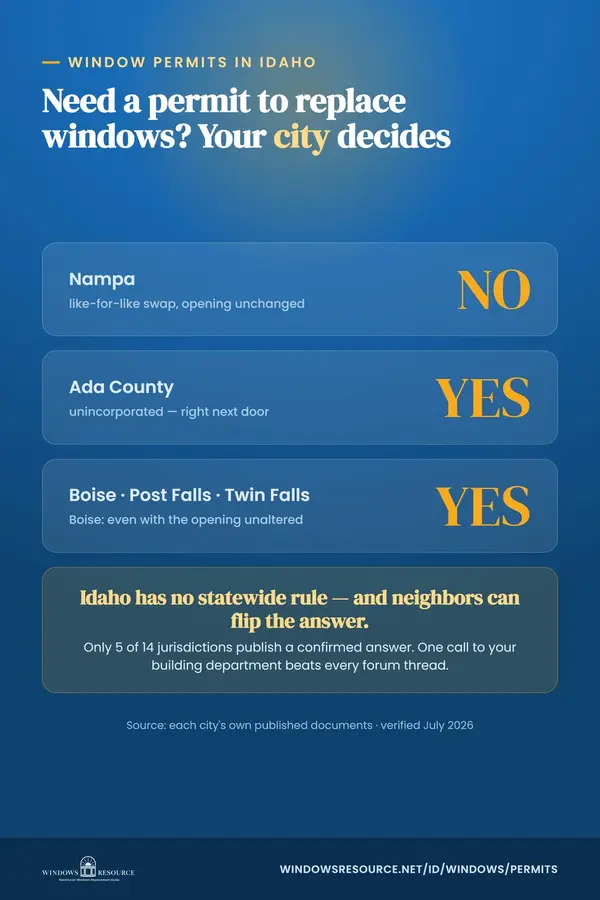


Here’s the short version, because if you’ve already been through the forum threads — each one swearing a different answer — you just want a yes or no: Idaho has no statewide rule on window-replacement permits. Your city decides. Boise, unincorporated Ada County, Post Falls, and Twin Falls require a permit. Nampa doesn’t, as long as the opening stays the same size. Idaho Falls is genuinely unclear — even its own documents point two directions. And eight of the fourteen jurisdictions I checked don’t publish an answer at all.
That last part isn’t a gap in this article. It’s the finding.
I went looking for the real answer in fourteen Idaho cities and counties, document by document — policy PDFs, fee schedules, adopted code text, FAQ pages. What came back is a map nobody’s quote-checking for you: five confirmed answers, one conflict, and eight honest blanks. Let’s walk it.
Why there’s no statewide answer
Idaho’s building rules — IDAPA 24.39.30, the state’s adopted version of the 2018 residential code — set a baseline list of work that’s exempt from permits. The state made exactly two changes to that list.
Shallow prefabricated swimming pools. And flag poles.
Windows didn’t make the cut. Neither did much of anything else — which means the baseline national list applies, and that list doesn’t exempt window replacement either. There’s also no dollar-threshold exemption anywhere in the rule, so “small jobs don’t need permits” isn’t an Idaho thing.
The practical effect: the state stepped back, and each local building department sets the real answer. That’s not sloppiness on Idaho’s part. It’s just where the decision lives. And it means the only trustworthy permit answer is the one from your jurisdiction — which brings us to the two neighbors that prove it.
The two neighbors that prove you can’t guess
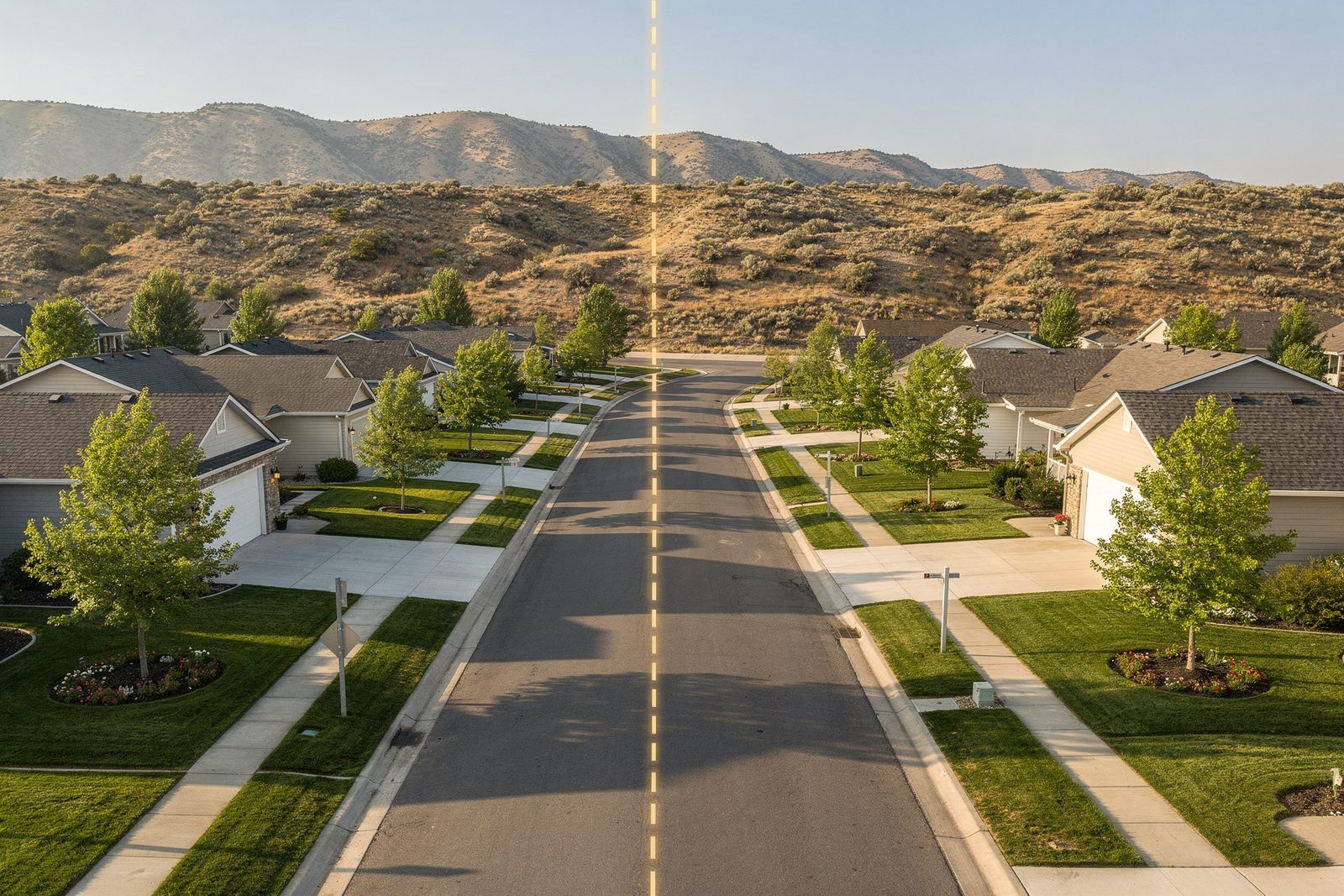
In the Treasure Valley, Nampa and unincorporated Ada County sit side by side. Same metro, same climate, same houses going up and getting re-windowed.
Nampa: no permit for a like-for-like swap. The city’s own Residential FAQ requires a permit for window or door replacement only “where the openings are reduced or enlarged.” Keep the opening the same, and you’re outside the trigger.
Unincorporated Ada County: permit required. The county publishes an 18-item list of work exempt from permits, and windows aren’t on it. Roofing is. Siding is. Windows, conspicuously, are not — and the county went further and deleted the code’s general “repairs” exemption entirely.
The catch-all item for miscellaneous work is gated with “provided no changes are made to the building envelope,” and your windows are the building envelope.
This is why “my neighbor didn’t need one” and “my last house didn’t need one” are worthless data points in Idaho. The line between required and not required can be a jurisdictional boundary you can’t see from the street.
The five confirmed answers — and the one conflict
Here’s every jurisdiction where a published document actually settles the question, plus the one where the documents disagree. Everything in this table comes from the jurisdiction’s own materials, checked in July 2026.
| Jurisdiction | Permit? | The fine print | Where that answer comes from |
|---|---|---|---|
| Boise | YES | Even with the opening unaltered | City window-replacement policy, signed by the Building Official |
| Ada County (unincorporated) | YES | Windows aren't on the 18-item exempt-work list | County exempt-work list — repairs exemption deleted |
| Nampa | NO | Unless the opening is reduced or enlarged | City Residential FAQ |
| Post Falls | YES | $100 flat-fee permit line for residential window replacement | City fee schedule (rev. 10-1-2025) |
| Twin Falls | YES | "Most alterations, including… new windows" | City permit-requirements page |
| Idaho Falls | UNCLEAR | The documents conflict (see below) | City adopted code vs. common belief |
Boise
- Permit?
- YES
- The fine print
- Even with the opening unaltered
- Where that answer comes from
- City window-replacement policy, signed by the Building Official
Ada County (unincorporated)
- Permit?
- YES
- The fine print
- Windows aren't on the 18-item exempt-work list
- Where that answer comes from
- County exempt-work list — repairs exemption deleted
Nampa
- Permit?
- NO
- The fine print
- Unless the opening is reduced or enlarged
- Where that answer comes from
- City Residential FAQ
Post Falls
- Permit?
- YES
- The fine print
- $100 flat-fee permit line for residential window replacement
- Where that answer comes from
- City fee schedule (rev. 10-1-2025)
Twin Falls
- Permit?
- YES
- The fine print
- "Most alterations, including… new windows"
- Where that answer comes from
- City permit-requirements page
Idaho Falls
- Permit?
- UNCLEAR
- The fine print
- The documents conflict (see below)
- Where that answer comes from
- City adopted code vs. common belief
Two notes on that table, in the spirit of showing my work.
Post Falls publishes the answer as a fee line rather than a narrative: “Replacing Windows, Residential — $100.00 Flat Fee.” A dedicated fee for a window-replacement permit is strong evidence the permit exists and applies. If you want the exact trigger conditions, the department can give them to you in one call.
Idaho Falls is the honest asterisk. The city’s adopted building code amends the exempt-work list only for pools and flag poles — the same two edits the state made — which implies windows do need a permit. But the city publishes no plain-language statement, and you’ll find plenty of confident claims online that Idaho Falls is exempt.
When a city’s own code and the common wisdom point opposite directions, I’m not going to pick a side for you. Call the Idaho Falls building department and get it in writing.
Boise: yes, even when nothing about the opening changes
Boise deserves its own section, because its policy is unusually specific — a two-page document, revised May 2025, signed by the city’s Building Official.
The core of it, verbatim: “A building permit is required for the replacement of window assemblies in existing residential buildings.” And the scope line makes the reach explicit — it covers replacements “where the rough openings are not being altered.” So the common assumption that an insert replacement inside the existing frame flies under the permit line doesn’t hold in Boise. The policy was written precisely for that job.
One boundary worth knowing: the policy is window-only. The words “door” and “siding” appear nowhere in it. Boise does have a permit type whose scope checkboxes cover roofing, siding, and windows, so siding work isn’t a free-for-all — but if your project includes doors or siding, ask the department directly rather than stretching the window policy to cover them.
What a Boise inspection actually checks: the egress ladder
Here’s the part of Boise’s policy nobody quotes, and it’s the most useful thing in it. The permit exists mostly to check life-safety items — and the biggest one is egress: the window someone climbs out of in a fire.
The national code numbers apply in Idaho unchanged, because Idaho adopts the IRC’s escape-opening section without amendment. A bedroom or basement escape window needs 5.7 square feet of net clear opening (5.0 square feet for grade-floor and below-grade openings), at least 24 inches of clear height and 20 inches of clear width, with the sill no more than 44 inches above the floor.
Those numbers come with a companion rule that has to travel with them, because it changes the answer for almost everyone reading this: IRC R310.2.5, the replacement-window exemption.
A replacement window doesn’t have to meet those size minimums if it’s the manufacturer’s largest standard size that fits the existing frame or rough opening, it’s the same operating style as the old window (or one that opens larger), and the job isn’t part of a change of occupancy. That’s the code acknowledging that you can’t conjure a bigger opening out of an existing wall.
Boise’s policy turns both rules into a three-step ladder for replacements:
- If the existing window meets egress, the new one must too. A compliant opening can’t be downgraded.
- If the existing window falls short, but the rough opening is big enough to host a style that complies — the policy’s own example is swapping a single-hung for a casement in the same opening — then the complying style is what goes in.
- If the opening simply can’t get there, a same-type replacement is allowed, “as long as they do not make the situation any worse than what existed before.”
That’s a fair ladder. It never demands the impossible, and it never lets a bedroom window quietly get worse. The policy adds one more check while the crew is there: new windows in hazardous locations — near doors, near floors, around tubs — must meet safety-glazing requirements.
The ladder's step 2, drawn
Same opening, roughly double the clear opening
The policy's own worked example: a single-hung swapped for a casement in the same opening. Nothing about the hole in the wall changes — only how much of it the window can free.
Single-hung
Frees roughly half the frameOnly the bottom sash slides up. The top half of the frame stays glass.
Casement
Frees roughly the full frameThe whole sash swings clear on side hinges, like a door.
You can't conjure a bigger opening out of an existing wall — but a different style can free more of the one you have.
The eight cities that don’t publish an answer
For these jurisdictions, I looked and the answer is not published anywhere I could verify. That’s not a criticism of anyone’s website — permit scope is genuinely hard to publish and keep current. But it means any confident yes/no you’ve read about these places is somebody’s guess, and you now know what a guess is worth in a state where Nampa and Ada County disagree across a boundary line.
- Meridian — building pages describe the application portal and checklists, but no permit-required or exempt list is published.
- Caldwell — the forms page wouldn’t load when checked; no permit-scope document retrieved.
- Coeur d’Alene — the building FAQ page is gone; department pages describe function only.
- Kootenai County (unincorporated) — the county lists what the Building Division permits (re-roofing, decks, garages, dwellings, pole barns, tall fences) and windows aren’t named either way.
- Pocatello — publishes adopted codes and design criteria, but no permit-scope list.
- Lewiston — the permit list is generic (“altered, constructed, converted…”) and never names windows.
- Rexburg — the building page didn’t return permit-scope content.
- Ketchum — the planning-and-building section was unreachable when checked.
The move for all eight is the same: one phone call to the building department before work starts.
Two minutes, and you’re standing on rock instead of a forum post.
Two “exemptions” you may have read — and what they actually govern
If you’ve researched this already, you’ve probably run into two passages that get passed around as proof Idaho exempts window replacement. Both are real text. Neither says what it’s quoted as saying, and this article exists partly so you don’t have to chase them down yourself.
The triggers that need a permit everywhere
Whatever your city says about a straight swap, some things push a window project into permit territory in every Idaho jurisdiction I checked, because they show up in every permit-required list that exists:
- Enlarging, reducing, or cutting a new opening. Nampa’s trigger is literally “where the openings are reduced or enlarged”; Boise’s brochure flags widening or reducing existing openings. Once a header moves, you’re doing structural work.
- Converting a window to a door, or a door to a window. Same opening-alteration logic, plus a change to the structural load path.
- Creating a new egress window — the classic case is finishing a basement into a bedroom. That’s a new opening plus new habitable space, and it’s permit territory everywhere.
- Any electrical, plumbing, or structural work bundled into the job. Those carry their own trade permits regardless of what the window itself needs.
One more thing: no permit still doesn’t mean no code
This trips people up in the no-permit cities, so let me say it plainly: a permit exemption is not a code exemption.
Replacement windows in Idaho have to meet the state’s adopted energy code whether or not anyone inspects the job — a maximum U-factor of 0.32 in Climate Zone 5 and 0.30 in Zone 6. Boise’s window policy states it outright: when existing windows are replaced, the new windows shall meet the U-value in the current adopted energy code. So a Nampa homeowner skipping the permit line, entirely legally, is still buying windows the code has opinions about.
The full story on those numbers — including why the code minimum is a low bar in a state with real winters — is in the Idaho window energy code guide. And if the reason you’re replacing at all is fog between the panes or water on the glass, read the condensation guide first — that fix isn’t always new windows.
The permit answer in Idaho isn’t complicated. It’s just local. Five jurisdictions have told us theirs in writing. For the rest, the building department’s phone number beats every forum thread ever written.
Sources, Verification & Fact-Checking verified July 2026
Every load-bearing fact on this page is sourced and verified against a primary authority.
Verified July 2026 via direct review of the cited authority — the links open the controlling source so you can check it yourself rather than take our word.
- Idaho’s building rules contain no statewide dollar-threshold permit exemption, and the state’s only amendments to the code’s exempt-work list are shallow prefabricated swimming pools and flag poles. The baseline exempt-work list therefore does not exempt window replacement, leaving the answer to each local jurisdiction. (view source — IDAPA 24.39.30, Rules of Building Safety)
- Boise requires a building permit for replacement of window assemblies in existing residential buildings, explicitly including jobs where the rough openings are not altered — and the policy covers windows only. The same policy contains the three-step egress ladder, the safety-glazing requirement, and the requirement that replacement windows meet the adopted energy code’s U-value. (view source — City of Boise Residential Window Replacement Policy, rev. 5-1-25)
- Unincorporated Ada County requires a permit for window replacement: windows are absent from the county’s 18-item exempt-work list (roofing and siding are exempt; windows are not), and the county deletes the code’s general repairs exemption. (view source — Ada County Code §7-2-5)
- Nampa does not require a permit for like-for-like window replacement — its Residential FAQ requires a permit for window or door replacement only “where the openings are reduced or enlarged.” (view source — City of Nampa Residential FAQ)
- Post Falls’ fee schedule carries a dedicated permit line: “Replacing Windows, Residential — $100.00 Flat Fee.” (view source — City of Post Falls Fee Schedule, rev. 10-1-2025)
- Twin Falls requires permits for “most alterations, including new roofs, new windows, etc.” and applies the adopted code’s exempt-work section for everything else. (view source — City of Twin Falls Permit Requirements)
- Idaho Falls’ adopted building code amends the exempt-work list only for swimming pools and flag poles — implying windows are not exempt — but the city publishes no plain-language statement, so the answer is presented here as unresolved. (view source — Idaho Falls Title 7, Building Regulations)
- Idaho adopts IRC R310 (emergency escape and rescue openings) without amendment, so the national numbers apply: 5.7 sq ft net clear opening (5.0 sq ft at grade floor), 24 in minimum height, 20 in minimum width, 44 in maximum sill height. (view source — IDAPA 24.39.30 (R310 absent from the amendment list) · view source — 2018 IRC R310.2.1)
- 2018 IRC R310.2.5 exempts replacement windows from the egress size minimums and sill-height maximum when the unit is the manufacturer’s largest standard size fitting the existing frame or rough opening, is the same operating style or one with equal or greater opening area, and is not part of a change of occupancy. (view source — 2018 IRC R310.2.5, reproduced in a municipal building-department handout)
- The “minor alteration” list in Idaho’s building rules governs annual permits issued to state agencies, not homeowner permit exemptions; the “exterior surfaces… windows and doors” exemption language sits under the smoke-alarm and carbon-monoxide-alarm sections (IRC R314.2.2/R315.2.2) and does not address permits. (view source — IDAPA 24.39.30)
- In Boise’s historic districts, a Certificate of Appropriateness is required before applying for a building permit, and vinyl windows are not permitted. (view source — City of Boise, Historic District Windows · view source — City of Boise, Guide to Residential Construction)
- Replacement windows must meet Idaho’s adopted energy code regardless of permit status — maximum fenestration U-factor 0.32 in Climate Zone 5 and 0.30 in Zone 6. (view source — City of Boise prescriptive energy-code compliance · view source — IDAPA 24.39.30, amended Table R402.1.2)