

Boise did something almost no city does: it wrote down exactly what it expects when you replace your windows, in a two-page policy signed by the Building Official, in language a homeowner can actually read. That’s a rare compliment for a building-department PDF, and I mean it.
Here’s the short version, then the whole local picture.
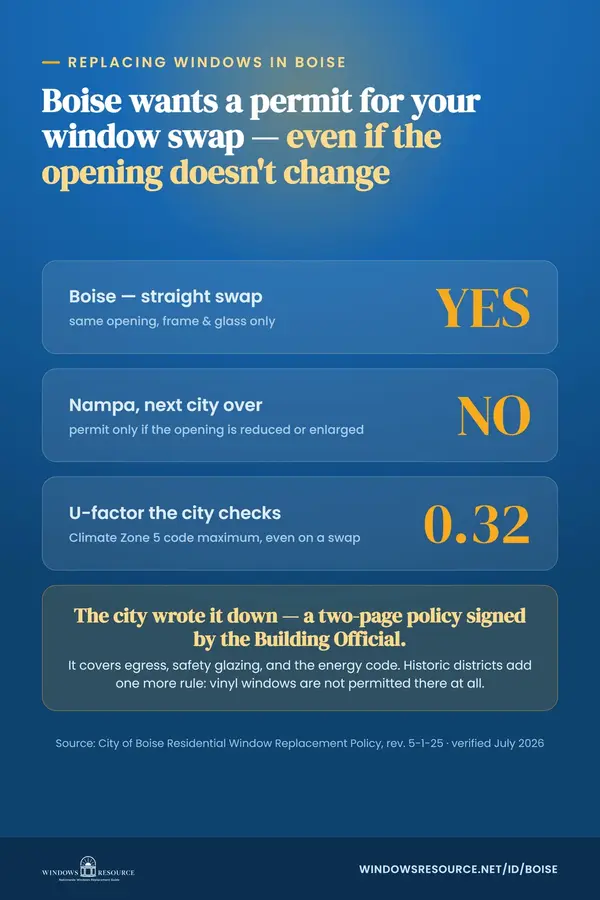
TL;DR: Boise requires a permit for window replacement even when the opening isn’t being altered. The same policy contains a three-step egress rule that can turn your single-hung into a casement. If you live in the North End or another historic district, vinyl windows are not permitted — the city’s words, not mine — and approval comes before the permit. Boise sits in Climate Zone 5B, so the code floor is a U-factor of 0.32. There is no Idaho Power window rebate; the honest local answer is a state loan program. And some of the windows quoted in Boise are manufactured about twenty miles away in Nampa.
Do I need a permit to replace windows in Boise? Yes — even in an unaltered opening
Most cities make you dig for this answer. Boise publishes it as a standalone policy — the Residential Window Replacement Policy, revised 5-1-25 and signed by Building Official Jason Blais. The operative line:
“A building permit is required for the replacement of window assemblies in existing residential buildings.”
And the scope line makes clear this covers the case people assume is exempt — replacing frame and glass “where the rough openings are not being altered.” A straight swap, same hole in the wall, still needs the permit, and the city inspects the work.
Two things worth knowing about that policy’s edges:
- It’s window-only. The words “door” and “siding” appear nowhere in it. Boise does have a permit type that covers roofing, siding, and windows as scopes of work, but the written policy itself makes no claim about like-for-like door or siding replacement. If your project includes those, ask the city directly rather than reading the window rule across.
- Your neighbor’s city plays by different rules. Nampa — the next city over — requires a window permit only “where the openings are reduced or enlarged.” Same valley, opposite answer for the straight swap. Unincorporated Ada County, meanwhile, requires the permit like Boise does. Permit policy in Idaho is genuinely city-by-city, so never infer yours from a neighbor’s.
Same valley, opposite answers — here’s the contrast at a glance:
| Jurisdiction | Permit for a straight swap? | The source’s own words |
|---|---|---|
| Boise | Yes | required even “where the rough openings are not being altered” |
| Nampa | No | permit only “where the openings are reduced or enlarged” |
| Ada County (unincorporated) | Yes | window replacement is not on the county’s list of permit-exempt work |
The permit isn’t the city getting in your way. Look at what the inspection actually checks — escape openings, safety glazing, the energy code — and it reads more like a second set of eyes on the three things a bad install gets wrong.
The three-step egress rule — Boise wrote down what a careful installer already does
This is the part of the policy nobody quotes, and it’s the best thing in it. It concerns emergency escape and rescue openings — bedroom and basement windows — so let me lay the groundwork first, straight and complete.
Idaho adopts the national 2018 IRC egress numbers unamended: a bedroom window must give 5.7 square feet of net clear opening (5.0 square feet for grade-floor or below-grade openings), at least 24 inches of clear height and 20 inches of clear width, with the sill no more than 44 inches above the floor.
The same code also carries a provision most homeowners never hear about: IRC R310.2.5, Replacement windows. A like-for-like replacement is exempt from those size minimums when it’s the manufacturer’s largest standard size that fits the existing frame or rough opening, keeps the same operating style (or one that opens equal-or-larger), and isn’t part of a change of occupancy.
Those two rules travel together — quoting the 5.7 number at a replacement buyer without the exemption is incomplete, and quoting the exemption without the numbers is worse.
Boise’s policy takes that national framework and turns it into a ladder. Three steps, in the city’s own logic:
- If your existing window meets escape requirements, its replacement must too. No quietly trading a compliant opening for a smaller one.
- If it doesn’t meet them, but the rough opening is big enough for a style that would — the policy’s own example is swapping a single-hung for a casement in the same rough opening — then the complying style shall be installed. A casement opens its full frame; a single-hung opens half. Same hole, roughly double the escape opening.
- If the opening genuinely can’t get there, a new window of the same type is allowed — “as long as they do not make the situation any worse than what existed before.”
The egress ladder — step 2
Why the same hole can pass with a casement
Both windows below sit in the same rough opening. The only change is the operating style — the policy's own example.
Single-hung
Opens roughly half the frameOnly the bottom sash slides up. The top half of the frame stays glass.
Casement
Opens its full frameThe whole sash swings clear on side hinges, like a door.
A casement opens its full frame; a single-hung opens half. Same hole, roughly double the escape opening.
The policy adds one more line worth carrying: windows in hazardous locations — think tub and shower surrounds, or glass close to doors — must meet safety glazing requirements when replaced. Tempered glass where a fall would otherwise meet a pane.
Notice what step 2 means in practice. The city didn’t just adopt the code’s replacement exemption and stop; it spelled out the case where the exemption doesn’t let you coast — where the opening could hold a compliant window, so it must. That is exactly the judgment call a conscientious installer makes at the measuring stage, now written down where everyone can see it.
If your quote is for bedroom or basement windows and nobody has mentioned egress yet, ask. It’s one question, and in Boise the answer is inspectable.
Live in the North End? Read this before you fall in love with a quote
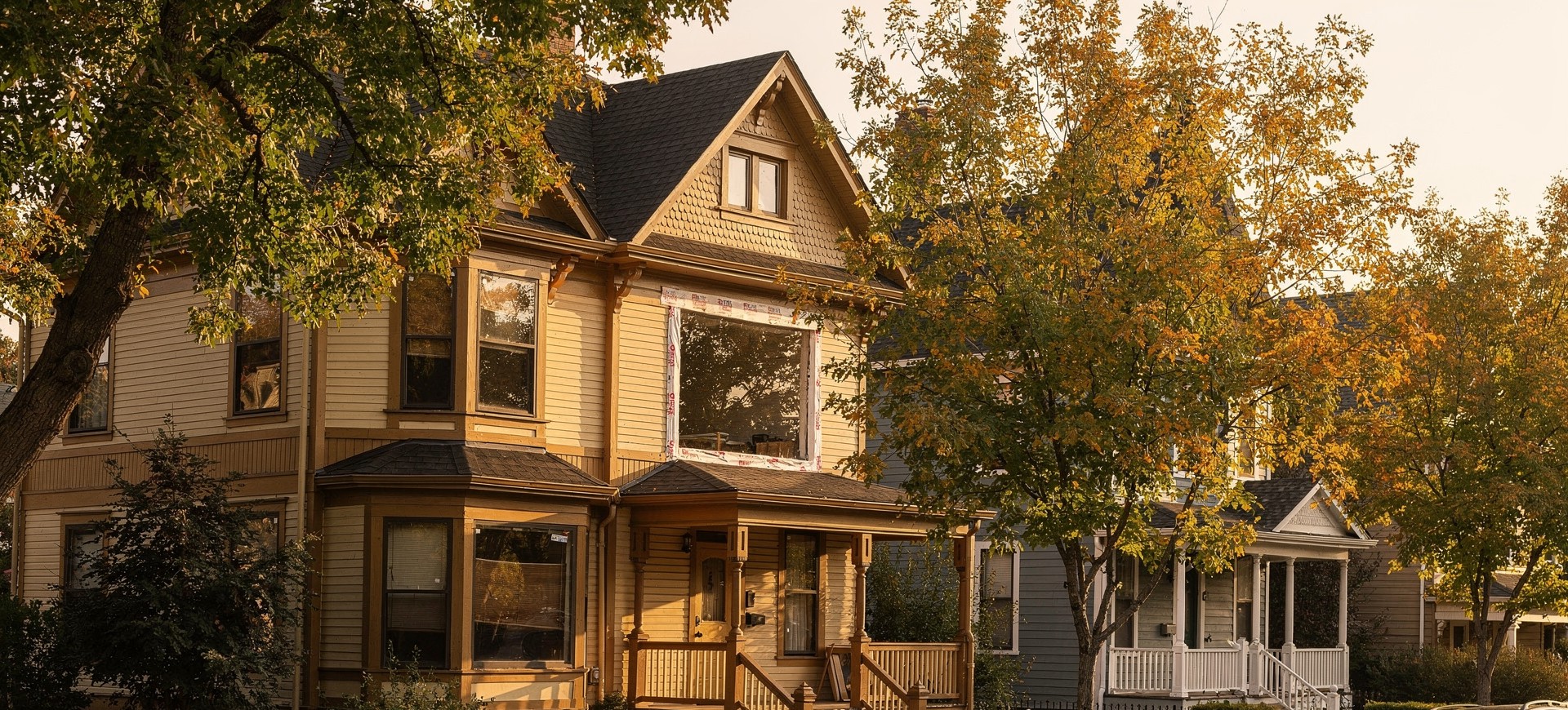
Boise’s historic districts — the North End, Warm Springs, Harrison Boulevard, Hyde Park, and several others — carry their own layer of rules, and the window rule is the strictest one:
“Vinyl windows are not permitted within Boise’s Historic Districts.”
That’s the city’s page, verbatim. Not discouraged — not permitted. The approved materials are wood, metal-clad wood, or fiberglass, and when an existing vinyl window in a historic district is replaced, an approved material must go in. This changes the math of every quote before the salesperson rings the doorbell: the least expensive material class on the market is simply not on the menu for these blocks.
One distinction worth keeping straight, because flattening it causes real confusion: for siding in the districts, the language is softer — vinyl and metal siding are “not recommended” and “closely scrutinized,” not banned. Windows are the hard rule; siding is a strong preference. Treat them differently, because the city does.
The energy code still applies — and Boise’s floor is a low one
Boise sits in Climate Zone 5B, where Idaho’s amended energy code caps fenestration U-factor at 0.32. The window policy closes the loop explicitly: replacement windows “shall meet the required U-value” of the current adopted energy code — permit, inspection, and all, even in a straight swap.
Two things about that number, told honestly. First, it’s a maximum — lower is better, and the code says nothing about how much better. Second, Idaho amended its Zone 5 requirement looser than the national 2018 IECC baseline of 0.30. So “meets code” in Boise means clearing a bar the state deliberately set below the national one. It’s a true statement — it’s just not a performance claim.
The full story — both zones, the missing limit, why the code minimum is the least the law allows — is in the Idaho window energy code guide. The short version for a Boise quote: treat 0.32 as the starting line, ask for the numbers on the exact glass package being quoted, and if February drafts or condensation on the glass are what started this project, know that the code minimum was never designed to fix either.
Rebates in Boise: the honest answer
Here’s the part where I’d love to hand you a rebate. I can’t, and neither can anyone else — so let’s be precise about what exists.
Idaho Power has no residential window rebate. Not a small one, not a hidden one. Its residential rebates page lists heating-and-cooling programs, an A/C credit, and a shade-tree project — no window, patio-door, or glass measure for regular residential customers. The per-square-foot Idaho Power window rebate that circulates on national aggregator sites does not appear on any Idaho Power page. The federal 25C tax credit is gone too — expired for property placed in service after 2025.
What actually exists in the Treasure Valley:
- The state OEMR Energy Loan Program. Idaho’s Office of Energy and Mineral Resources runs a low-interest loan for efficiency work, and window and door replacement explicitly qualifies — at 3% over 3 years, 5% over 5 years, or 7% over 7 years, for up to $40,000. The conditions: you hold the deed on a single-family home, you pass a credit check, and the windows meet ENERGY STAR Northern criteria — which is the zone for every ZIP code in Idaho. It’s first-come, first-served until funding runs out or the end of 2026, whichever comes first.
- Income-qualified weatherization. For households under Idaho Power’s income limits, its weatherization program can deliver up to $6,000 in value at no cost — new windows and doors are on the measure list — for electrically heated homes, applied for through the regional Community Action Partnership agency.
A loan is not a rebate, and I won’t dress it up as one. But an honest 3% note against windows that meet the Northern-zone criteria beats a rebate that doesn’t exist, and it’s the answer I’d want someone to give me straight.
What can you actually buy in Boise? More local than you’d think
Most window shopping advice is written as if every brand is equally available everywhere. Boise’s market has real texture, and it’s worth knowing before the quotes arrive.
The genuinely local story: the Earthwise Group’s Idaho member, Western Window — a division of Hoff Companies, an Idaho family company — manufactures vinyl windows and doors in Nampa, about twenty miles down the road. Its warranty service territory is literally defined by road connection to the plant’s street address on Madison Avenue. This isn’t a marketing region; it’s a factory.
Milgard has a real Boise bench too: its own site lists dealer profiles for View Point, Wood Windows, Roadrunner Glass, and Builders FirstSource in Boise. If a Milgard line is on your shortlist, the Milgard review covers the current series and — more usefully — what the warranty documents actually say versus what the brochure implies.
That read-the-document habit applies to the local option just as much. Earthwise’s national marketing says “transferable Limited Lifetime warranty”; Western Window’s actual warranty PDF transfers once and then caps at ten years from manufacture, with labor covered for two years and capped at $100. None of that is a knock on anyone — it’s the standard gap between a warranty’s headline and its terms, and the fix is the same everywhere: get the governing document for the exact product on your quote, and read it before you sign.
The Boise checklist
Everything above, compressed into what I’d actually do with a quote on the counter:
- Confirm the permit is in the plan. Boise requires it even for a straight swap. Ask who pulls it — you or the installer — and get that answer in writing.
- Bedroom or basement windows? Ask the egress question. Does the replacement keep or improve the escape opening, and if the current window falls short, is the rough opening big enough for a style that complies? The city will check; better that your installer checked first.
- Historic district? Certificate of Appropriateness first, and no vinyl. Budget for wood, metal-clad wood, or fiberglass — and genuinely consider the city’s repair-first suggestion for original sash before replacing anything.
- Get the NFRC numbers. U-factor at or below 0.32 is merely legal in Zone 5. Ask what the exact glass package tests at, not the brand’s best number.
- Skip the rebate hunt; check the loan. OEMR’s program is the real Treasure Valley option, and ENERGY STAR Northern windows are the qualifying ticket.
- Ask what’s actually available. A Nampa-built window and a national line may both be quoted on your kitchen table. Neither is automatically right — but knowing the market means nobody can tell you your options are narrower than they are.
Boise took the trouble to write its expectations down. Reading them before you sign is the cheapest upgrade in this whole project.
Sources, Verification & Fact-Checking verified July 2026
Every load-bearing fact on this page is sourced and verified against a primary authority.
Verified July 2026 via direct review of the cited authority — the links open the controlling source so you can check it yourself rather than take our word.
- Boise requires a building permit to replace window assemblies in existing homes, explicitly including replacements where the rough openings are not altered — and the policy addresses windows only. Residential Window Replacement Policy, rev. 5-1-25, signed by the Building Official. (view source — City of Boise Residential Window Replacement Policy)
- Boise’s three-step egress rule for replacement windows — compliant stays compliant; a sufficient rough opening requires a complying style (e.g. single-hung to casement); an insufficient opening allows same-type “no worse than before” — plus the safety-glazing and energy-code U-value requirements. (view source — City of Boise Residential Window Replacement Policy)
- Idaho adopts IRC R310 unamended, so the national 2018 IRC egress numbers apply: 5.7 sq ft net clear opening (5.0 for grade-floor/below-grade), 24 in minimum height, 20 in minimum width, 44 in maximum sill height. (view source — IDAPA 24.39.30, Rules of Building Safety · view source — 2018 IRC R310.2.1)
- 2018 IRC R310.2.5 exempts replacement windows from the R310.2.1/R310.2.2 size minimums when the unit is the manufacturer’s largest standard size that fits the existing frame or rough opening, keeps the same or a larger-opening operating style, and is not part of a change of occupancy. (view source — 2018 IRC R310.2.5, reproduced in a municipal code handout)
- Nampa requires a window-replacement permit only “where the openings are reduced or enlarged.” (view source — City of Nampa Residential FAQ)
- Unincorporated Ada County requires a permit for window replacement — windows do not appear on the county’s 18-item list of work exempt from permit. (view source — Ada County Code §7-2-5)
- “Vinyl windows are not permitted within Boise’s Historic Districts”; approved materials are wood, metal-clad wood, or fiberglass, and replaced vinyl must be exchanged for an approved material. (view source — City of Boise, Historic District Windows)
- In Boise’s historic districts, a Certificate of Appropriateness is required for window replacement and must be obtained before applying for a building permit or starting work. (view source — City of Boise, Certificate of Appropriateness · view source — City of Boise, Guide to Residential Construction)
- The city’s residential historic design guidelines prefer enhancing the energy efficiency of original windows over replacing them, and treat vinyl/metal siding as “not recommended” rather than prohibited. (view source — Design Guidelines for Residential Historic Districts, 2014)
- Boise is in Climate Zone 5, where Idaho’s amended code sets a maximum fenestration U-factor of 0.32; the city’s prescriptive compliance page carries the same values. (view source — IDAPA 24.39.30 · view source — City of Boise, Prescriptive Residential Energy Code Compliance)
- Idaho Power has no residential window rebate — its residential rebates page lists no window, patio-door, or glass measure for non-income-qualified customers. (view source — Idaho Power, Rebates and Offers)
- The Idaho OEMR State Energy Loan Program offers 3%/3-year, 5%/5-year, and 7%/7-year loans up to $40,000; window and door replacements qualify when they meet ENERGY STAR Northern requirements. (view source — Idaho OEMR Loan Program)
- Idaho Power’s income-qualified weatherization program provides up to $6,000 in value at no cost, with new windows and doors on the measure list, for electrically heated homes. (view source — Idaho Power, Weatherization Programs)
- The federal 25C Energy Efficient Home Improvement Credit applies only to property placed in service before December 31, 2025. (view source — IRS, Energy Efficient Home Improvement Credit)
- The Earthwise Group’s Idaho member, Western Window (a Hoff Companies division), manufactures vinyl windows and doors in Nampa, Idaho, and defines its service territory by road connection to 1815 Madison Ave, Nampa. (view source — Earthwise Windows of Boise, Idaho · view source — Western Window Service Territory)
- Western Window’s dealer locator returned ten Earthwise dealers within 3.7 miles of downtown Boise (retrieved July 2026), and Western Window’s warranty PDF transfers once, then limits coverage to 10 years from manufacture, with labor covered within 2 years and capped at $100. (view source — Western Window dealer locator · view source — Western Window Limited Lifetime Warranty)
- Milgard’s own sitemap lists Boise dealer profiles for View Point Inc., Wood Windows Inc., Roadrunner Glass Co., and Builders FirstSource. Count method: URLs in Milgard’s published sitemap, July 2026 — not a company-published dealer tally. (view source — Milgard sitemap)