
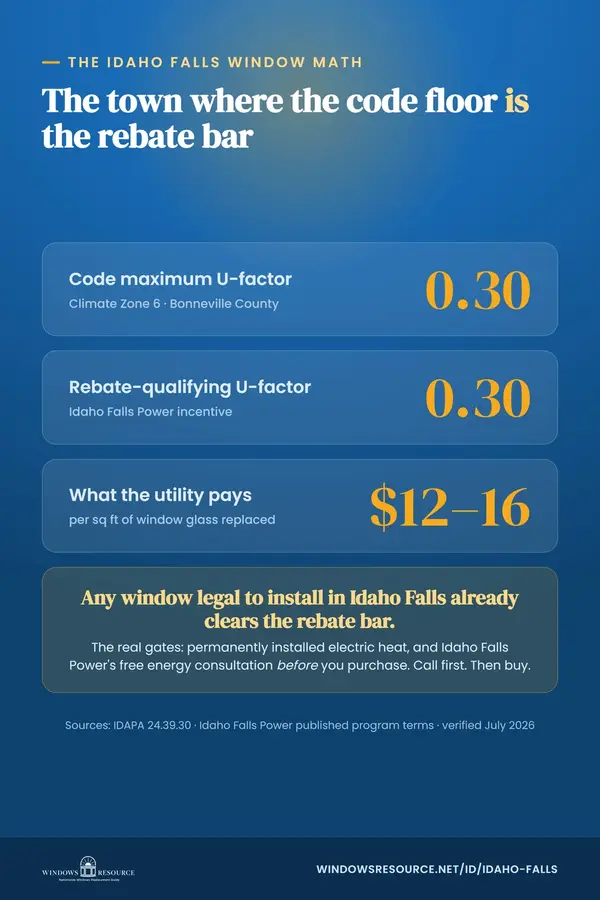

Idaho Falls is one of the few places in Idaho where real window money exists. The city’s own utility pays $12 to $16 per square foot of glass replaced — and the qualifying U-factor happens to be the exact number the state energy code already requires here.
But every dollar of it runs through a sequence your quote will never mention. Call the utility first. Verify the permit — because the published sources genuinely conflict on that one. Then buy.
Here’s the whole sequence, in order, with the fine print stated plainly.
What does Idaho Falls Power actually pay for new windows?
Idaho Falls runs its own municipal utility, and Idaho Falls Power’s efficiency program covers replacement windows directly. The published terms:
- $12.00 to $16.00 per square foot of window glass replaced. The higher tier applies when you’re replacing single-pane windows or aluminum-frame double-pane — which describes a lot of the older housing stock here.
- The home must have permanently installed electric heat. That’s the gate. If your furnace is gas, this program is not for you (more on your options below).
- The new windows must have a U-factor of 0.30 or lower. That’s the number off the label for the exact glass package on your quote — not the brand’s best number from a different line.
- A free energy consultation with IFP Energy Services is required before purchase or installation. Before. Not after. This is the clause that quietly disqualifies people.
There’s a second path most people never hear about: a 0%-interest loan in place of the rebate — up to 60 months, up to 100% of the eligible measure cost, with a $25 administration fee. The loan requires 12 months of City of Idaho Falls utility payment history with no late payments.
That’s an unusually generous municipal program. It just has an order of operations.
The Idaho Falls sequence
Five steps — the order is the whole game
Same steps either way. Only this order keeps the rebate alive — the two gold steps happen before a dollar moves.
Contact Idaho Falls Power
Two minutes on the phone before you sign anything.
Free energy consultation
IFP Energy Services checks your house against its own program — required before purchase or installation.
Purchase
U-factor 0.30 or lower, off the NFRC label for the exact glass package on your quote.
Install
Apply
The $12–$16 per square foot rebate — or the 0% loan in its place.
Why the code minimum and the rebate threshold are the same number here
Idaho Falls sits in Bonneville County, which is IECC Climate Zone 6B. Under Idaho’s amended energy code, Zone 6 windows must come in at a U-factor of 0.30 or lower — that’s the legal maximum for any window installed here, rebate or no rebate.
Now look back at the rebate requirement: U-factor ≤ 0.30.
Same number. Idaho Falls is the rare town where the code minimum and the rebate threshold shake hands. Any window that’s legal to install here already clears the utility’s bar — which means the incentive question in Idaho Falls is never “can I find a qualifying window.” It’s “is my heat electric, and did I call first.”
Two things worth knowing beyond the headline number:
- The code sets no requirement at all — the solar-heat-gain column in Idaho’s table reads “NR,” not required. In a heating-dominated climate like eastern Idaho’s, solar gain through south-facing glass is free winter heat, so a low-SHGC package chosen out of habit can be the wrong default. Nobody decides this for you; decide it on purpose.
- Idaho is a two-zone state — 5B and 6B, nothing else. If a chart puts any part of Idaho in Zone 7, it’s wrong. The full state picture, including why the code minimum is a floor and not a standard, is on the Idaho energy-code page.
And if you want to aim higher than the floor: ENERGY STAR’s Northern-zone criteria — which cover every ZIP code in Idaho — ask for U ≤ 0.22 with SHGC ≥ 0.17. That’s a meaningfully better window than 0.30, and it’s also the spec that unlocks the state loan program described below.
Do I need a permit to replace windows in Idaho Falls?
Here’s where I have to tell you something most pages won’t: the primary sources conflict, and I’m not going to guess for you.
What the documents show. Idaho Falls’ adopted building code — Title 7 of the city code — takes the 2018 International Residential Code and amends its “work exempt from permit” list only for swimming pools and flag poles. Window replacement is not on the exempt list. Read strictly, that implies a like-for-like window swap needs a permit.
What’s missing. The city publishes no plain-language statement saying “window replacement requires a permit” or “it doesn’t.” And advice circulating locally — including material we ourselves had to correct — asserts the opposite of what the code text implies. Part of the confusion traces to a widely misread code passage about exterior work that’s actually a smoke-alarm exception, not a permit exemption.
So: call the Idaho Falls building department and ask directly — “do I need a permit to replace windows in an existing opening, same size, no structural change?” Write down the answer and who gave it. It’s a two-minute call, and it beats every secondhand answer including this page’s reading of the code text.
Two things I can say without hedging:
- Don’t infer the answer from a neighboring city. Idaho has no statewide permit rule for this — the answer is set city by city, and neighboring jurisdictions genuinely differ. In the Treasure Valley, Boise requires a permit for a like-for-like swap while Nampa doesn’t. Eastern Idaho will have its own texture.
- The energy code applies whether or not a permit does. A permit exemption is never a code exemption — the 0.30 U-factor requirement rides along regardless.
One more routing note: if your home is in one of Idaho Falls’ older historic areas, ask the city whether any historic review applies to window changes while you’re on the phone. I couldn’t verify a published process for Idaho Falls, so that’s a question, not a warning.
What if my heat isn’t electric — or I’m outside the city?
The Idaho Falls Power program is the headline, but it’s gated on electric heat and city utility service. Here’s the honest map of everything else:
| Program | What it pays | The gate |
|---|---|---|
| Idaho Falls Power — windows incentive | $12–$16 / sq ft of glass replaced, or a 0% loan up to 60 months | City utility customer, permanently installed electric heat, U ≤ 0.30, consultation before purchase |
| Rocky Mountain Power — wattsmart (eastern Idaho) | $40 / window (electrically heated home) or $15 / window (electrically cooled or dual-fuel heat pump) | RMP rate schedule 1 or 36, U-factor ≤ 0.22, professional install, apply within 90 days |
| Idaho OEMR State Energy Loan | Loan up to $40,000 — 3% / 3 yr, 5% / 5 yr, or 7% / 7 yr | Statewide; windows must meet ENERGY STAR Northern; deed + credit check; first-come through Dec 31, 2026 |
| Federal 25C tax credit | Nothing — expired for property placed in service after 2025 | — |
Idaho Falls Power — windows incentive
- What it pays
- $12–$16 / sq ft of glass replaced, or a 0% loan up to 60 months
- The gate
- City utility customer, permanently installed electric heat, U ≤ 0.30, consultation before purchase
Rocky Mountain Power — wattsmart (eastern Idaho)
- What it pays
- $40 / window (electrically heated home) or $15 / window (electrically cooled or dual-fuel heat pump)
- The gate
- RMP rate schedule 1 or 36, U-factor ≤ 0.22, professional install, apply within 90 days
Idaho OEMR State Energy Loan
- What it pays
- Loan up to $40,000 — 3% / 3 yr, 5% / 5 yr, or 7% / 7 yr
- The gate
- Statewide; windows must meet ENERGY STAR Northern; deed + credit check; first-come through Dec 31, 2026
Federal 25C tax credit
- What it pays
- Nothing — expired for property placed in service after 2025
- The gate
- —
A few notes that don’t fit in a table:
- If your electric bill says Rocky Mountain Power instead of Idaho Falls Power, the wattsmart program is your lane — note its bar is tighter (U ≤ 0.22, which is ENERGY STAR Northern territory) and the dollar amount is smaller. RMP’s own page says all rebates are subject to change with 45 days’ notice.
- The state loan program (OEMR) works anywhere in Idaho regardless of your utility or heat fuel. It’s a loan, not a rebate — but 3% money for a project that qualifies is a real tool, and window and door replacements explicitly qualify when they meet ENERGY STAR Northern.
- The federal window tax credit is gone. The 25C credit ended for property placed in service after 2025, and no successor exists. If a sales sheet still mentions it, the sheet is out of date.
Gas-heated home, on city power, inside Idaho Falls? Then the truthful answer is that the big per-square-foot rebate isn’t available to you — the OEMR loan is the main lever, and the windows themselves still owe the same 0.30 code number.
What about basement bedroom windows?
Eastern Idaho houses have basements, basements have bedrooms, and bedroom windows are where window replacement touches life safety. This part stays simple and complete.
Idaho adopts the national escape-opening rule — IRC R310 — without amendment. The numbers: 5.7 square feet of net clear opening (5.0 square feet at grade floor), a minimum 24 inches of clear height, 20 inches of clear width, and a sill no more than 44 inches above the floor. Window wells, where needed, must give at least 9 square feet with 36 inches of projection and width.
But the same code carries R310.2.5, a specific exemption for replacement windows — and Idaho doesn’t amend that either. A replacement window may go in below those numbers if all three conditions hold:
- It’s the manufacturer’s largest standard size that fits the existing frame or rough opening.
- It’s the same operating style as the old window, or a style with equal or greater opening area.
- It’s not part of a change of occupancy.
The exemption is real and it’s generous — but it’s not a license to shrink an escape route. Swap a casement for a double-hung in the same opening and you can lose condition 2, because a double-hung only opens half its frame. And if you’re creating a bedroom — finishing a basement, say — the full numbers apply with no exemption at all.
Condition 2, drawn
Why swapping a casement for a double-hung can lose condition 2
Both windows below sit in the same rough opening. The only change is the operating style — exactly what condition 2 measures.
Double-hung
Opens roughly half its frameOnly the bottom sash slides up. The top half of the frame stays glass.
Casement
Opens its full frameThe whole sash swings clear on side hinges, like a door.
A casement opens its full frame; a double-hung opens half. Same hole — which is why the swap direction matters.
If a quote touches a bedroom window, ask the installer to confirm, in writing, which side of R310.2.5 your replacement lands on. A good one will know exactly what you mean.
Can I buy an Idaho-made window in Idaho Falls?
Yes — and this is a genuine local option, not a marketing line.
The Earthwise Group’s Idaho member, Western Window, manufactures vinyl windows and patio doors in Nampa — a division of Hoff Companies, an Idaho family company. Western Window sells through dealers rather than direct, and its own dealer locator returns ten dealers within about 26 miles of Idaho Falls, including CK’s Window & Door, Valley Glass, and several building-supply houses toward Rexburg.
The national brands have a real bench here too. Milgard’s own dealer listings include CK’s Window, Doors & Trim in Idaho Falls — yes, the same CK’s, carrying both lines, which tells you something about how window retail actually works out here. If you’re weighing Milgard, the full Milgard review covers the lines and the warranty documents in detail.
One read-the-document note that applies to every brand, local or national. Earthwise’s marketing describes a transferable limited lifetime warranty. Western Window’s actual warranty PDF is more specific: the lifetime tier belongs to the original owner-occupant, the warranty transfers once and then runs 10 years from the manufacture date, the insulated glass unit is covered for 20 years, and labor is covered only within 2 years, capped at $100.
None of that is unusual in this industry — Milgard’s and Cascade’s documents have their own versions of the same shape. The point isn’t that any of these companies is doing something wrong. The point is that the warranty that counts is the PDF attached to your order, so ask your dealer which document applies and read that one.
And whichever brand you land on: in every quote I’ve read, the install line matters at least as much as the logo. A well-flashed, well-shimmed mid-tier window with a clean sill pan beats a premium unit foamed into a crooked opening.
The Idaho Falls order of operations
Put the whole thing in sequence:
- Check your heat and your utility bill. Electric heat + Idaho Falls Power = the $12–$16/sq ft program. RMP = wattsmart. Gas heat = the OEMR loan is your main lever.
- Call Idaho Falls Power before you sign anything. The free consultation must come before purchase. This is the single most expensive step to skip.
- Call the building department and ask the permit question directly. The published sources conflict; a two-minute call settles it for your address. Ask about historic review at the same time if your home is in an older district.
- Spec to the label, not the brochure. U-factor ≤ 0.30 is the legal floor and the rebate bar; U ≤ 0.22 with SHGC ≥ 0.17 is the ENERGY STAR Northern spec that also unlocks the state loan. Get the NFRC numbers for the exact glass package on your quote.
- If a bedroom window is involved, get the egress answer in writing.
Notice what the entire protection layer of this project costs: two phone calls. One to Idaho Falls Power before you sign, one to the building department before you start — a couple of minutes each. Every expensive mistake on this page dies inside one of those calls.
If cold glass is what started all this — fog between panes you can’t wipe off, or a sheet of cold pouring off the window in January — it’s worth reading the condensation guide first. Sometimes the fix is cheaper than a window.
Sources, Verification & Fact-Checking verified July 2026
Every load-bearing fact on this page is sourced and verified against a primary authority.
Verified July 2026 via direct review of the cited authority — the links open the controlling source so you can check it yourself rather than take our word.
- Idaho Falls Power pays $12.00–$16.00 per square foot of window glass replaced (higher tier for replacing single-pane or aluminum-frame double-pane), requires permanently installed electric heat, requires replacement windows at U-factor ≤ 0.30, and requires a free energy consultation by IFP Energy Services before purchase or installation. A 0%-interest loan is available in lieu of the rebate — up to 60 months, up to 100% of eligible cost, $25 administration fee, requiring 12 months of on-time City of Idaho Falls utility payment history. (view source — Idaho Falls Power, Insulation & Windows)
- Bonneville County (Idaho Falls) is IECC Climate Zone 6B, and Idaho is a two-zone state (5B and 6B) with no county assigned to any colder zone. (view source — DOE/PNNL, Guide to Determining Climate Regions by County)
- Idaho’s amended energy code sets a maximum fenestration U-factor of 0.30 in Climate Zone 6, with SHGC listed as “NR” (not required). (view source — IDAPA 24.39.30, Rules of Building Safety)
- Idaho Falls’ adopted building code (Title 7, adopting the 2018 IRC) amends the work-exempt-from-permit list only for swimming pools and flag poles; window replacement is not exempted, and the city publishes no plain-language permit statement for window replacement — sources conflict, so readers are directed to the building department. (view source — City of Idaho Falls, Title 7 Building Regulations)
- Idaho adopts IRC R310 unamended: escape openings require 5.7 sq ft net clear opening (5.0 sq ft at grade floor), 24 in minimum height, 20 in minimum width, and a maximum 44 in sill height — and IRC R310.2.5 exempts qualifying replacement windows from the size and sill requirements under three conditions. (view source — IDAPA 24.39.30 (IRC amendment list; R310 absent) · view source — 2018 IRC R310.2.1 · view source — 2018 IRC R310.2.5 text (municipal handout))
- Rocky Mountain Power’s wattsmart Idaho program pays $40 per window for electrically heated homes ($15 for electrically cooled or dual-fuel heat pump homes), requires U-factor ≤ 0.22, rate schedule 1 or 36, professional installation, and application within 90 days; rebates subject to change with 45 days’ notice. (view source — Rocky Mountain Power wattsmart Homes, Idaho windows)
- Idaho’s OEMR State Energy Loan Program offers loans up to $40,000 at 3%/3 yr, 5%/5 yr, or 7%/7 yr statewide; window and door replacements qualify when they meet ENERGY STAR Northern requirements; first-come, first-served until the funding limit or December 31, 2026. (view source — Idaho OEMR State Energy Loan Program)
- The federal Section 25C Energy Efficient Home Improvement Credit is not available for property placed in service after 2025. (view source — IRS, Energy Efficient Home Improvement Credit)
- Every Idaho ZIP code is in the ENERGY STAR “Northern” climate zone, where the v7.0 window criteria are U-factor ≤ 0.22 with SHGC ≥ 0.17. (view source — ENERGY STAR V7 climate-zone assignments by ZIP and county · view source — ENERGY STAR V7.0 final specification)
- The Earthwise Group’s Idaho member, Western Window (a division of Hoff Companies), manufactures vinyl windows and patio doors in Nampa, Idaho, and its dealer locator lists ten dealers within about 26 miles of Idaho Falls, including CK’s Window & Door. (view source — Earthwise Windows of Boise, Idaho · view source — Western Window Service Territory)
- CK’s Window, Doors & Trim in Idaho Falls appears in Milgard’s own dealer listings. (view source — Milgard dealer profile, CK’s Window, Doors & Trim)
- Western Window’s warranty document provides lifetime frame/sash coverage for the original owner-occupant, one transfer then 10 years from manufacture date, 20-year insulated-glass coverage, and labor within 2 years capped at $100. (view source — Western Window Limited Lifetime Warranty)